
b12138
The update introduces optimized Metal kernel usage for matrix multiplication with K values between 32 and 64, and adds a new kernel for BF16 x BF16 matrix multiplication, improving performance on Apple Silicon devices.
Search headlines, summaries and articles to connect the dots.
The update introduces optimized Metal kernel usage for matrix multiplication with K values between 32 and 64, and adds a new kernel for BF16 x BF16 matrix multiplication, improving performance on Apple Silicon devices.
Meta Platforms Inc. has acquired artificial intelligence coding startup Conductor in a deal first reported today by Axios. Conductor confirmed it’s joining Meta in a post on its website. Terms were not disclosed. Conductor’s software lets a developer run several coding agents at once, each in an isolated copy of the codebase, and then review […] The post Meta acquires AI coding startup Conductor, whose app runs several coding agents at once appeared first on SiliconANGLE.
As artificial intelligence and accelerated computing continue to push the boundaries of what's possible, the latest NVIDIA CUDA release arrives to unlock...
arXiv:2611.04007v1 Announce Type: new Abstract: Prestress governs the stability, stiffness, and dynamic behavior of tensegrity structures, but it is not directly observable from sparse structural measurements, and it may decrease during service life. Under strong excitation, the cables may slacken and the dynamics become nonsmooth. Existing identification methods are limited to the taut regime, and physics-informed networks for tensegrities solve only the forward problem of predicting the response from known member parameters. This study formulates the inverse problem. Neural networks are trained on the equation-of-motion residual in constrained Cartesian coordinates, where the mass matrix is constant and the force densities enter linearly. The force densities, damping, and axial stiffness are trainable parameters, and the tension-only cable law is kept. A Fisher-information analysis shows, before inversion, which member parameters a record can determine. The method is tested on simulated planar tensegrity frames with up to five modules and a three-dimensional prism, and on measured records of a biomimetic leg and a full-scale tensegrity simplex. On the one-module frame, the identifiable force densities are recovered within 1.5% from noisy accelerations at half the free coordinates, on records with and without taut-slack transitions. Records with transitions determine members that taut records leave undetermined. On the five-module frame, a 16-cable two-span bridge, the median force-density error rises moderately, to 4.2%. On measured records, an identified spring stiffness is within 0.1% of its independently measured value on average, and the identified simplex prestress at 13 levels agrees with its cable force transducers to 2.9% root-mean-square.
Article URL: https://github.com/ndrean/ZeBridge Comments URL: https://news.ycombinator.com/item?id=50376801 Points: 1 # Comments: 0
arXiv:2611.03916v1 Announce Type: new Abstract: Koopman representations describe nonlinear dynamics through linear evolution in a transformed space, offering an attractive framework for their linear simplicity and generality. Yet these advantages do not necessarily translate into improved performance in deep latent data assimilation (LDA). We systematically compare seven representative methods and structural baselines across five systems spanning approximately periodic to strongly chaotic dynamics and a broad range of state dimensions. We evaluate forecast and assimilation accuracy, physical state recovery, latent-trajectory behavior, and dynamical consistency, and assess Gaussian error assumptions, objective convexity, and uniqueness of analysis solutions. Our results reveal a trade-off between representational flexibility and optimization tractability. Linear evolution of the latent state can stabilize short-term forecasts but restrict expressiveness in strongly chaotic and high-dimensional systems, without consistently improving assimilation accuracy. Parameterized linear operators offer greater flexibility, yet their joint optimization with the encoder--decoder remains nonconvex. Methods with closed-form analysis updates generally perform better and exhibit greater robustness in our experiments, although matrix inversion remains a computational bottleneck. These findings show that the practical benefits of Koopman structure depend on both sufficient observational information and the choice of assimilation procedure.
arXiv:2611.04090v1 Announce Type: new Abstract: Practitioners who compare systems with an LLM judge and have no human labels often check a conclusion by repeating it with a judge from another provider. We test how far that check can be trusted. In a preregistered study (with a disclosed post-registration reduction of the judge set), five judge models from three providers re-judged 4,000 Chatbot Arena battles (nine systems, 33 system pairs) that carry human votes, each in both response orders. Agreement with the human vote was low at the verdict level (median Cohen's kappa = 0.22), and system rankings did not survive a change of judge: Kendall's tau with the human ranking ranged from 0.17 to 0.89 (median 0.67), so the preregistered hypothesis that rankings remain stable was not supported. Conclusions replicated by two low-cost judges from different providers matched the human conclusion more often than single-judge conclusions (+0.10 precision), but the gain came from filtering out one poorly aligned judge, and replication involving that judge left a conclusion for only 35% of comparisons. Judges that agreed with humans reached a stable conclusion with no more verdicts than human votes required; the others failed to converge on 26-70% of system pairs at the sample sizes tested (up to 100 verdicts per pair). Disagreements with the human vote co-occurred across judges far more often than independence predicts, although a single human vote per battle cannot separate shared judge bias from voter noise.
vLLM supports Kimi K3.1 Pro on day 0: sparse attention on a KDA hybrid, a packed KV cache with FP8 or NVFP4 latents and MXFP4 index keys, token-sharded prefill, decode context parallelism, and fused low-latency decode.
FlashMap is a speculative decoding drafter from Polymathic AI, Princeton and USC ISI researchers. It drafts 16 tokens jointly in one pass and reaches up to 6.14x lossless speedup on Qwen3-8B. The post Polymathic AI and Princeton Researchers Release FlashMap, a Flow Map Drafter for 6.14x Faster LLM Decoding appeared first on MarkTechPost.

Google DeepMind released Genie 4 as a research preview. The real-time world model adds native audio, live dialogue and text steering, with Gemini 3.8 Flash planning events inside the simulation loop. The post Meet Google DeepMind’s Genie 4: Real-Time World Model With Native Audio appeared first on MarkTechPost.

arXiv:2502.02727v4 Announce Type: replace-cross Abstract: Client-drift compensation methods mitigate the impact of data heterogeneity in federated learning (FL). While drift correction is well studied for stochastic gradient descent (SGD)-based FL, its interaction with adaptive client optimizers remains less understood. Adaptive optimizers such as Adam build each update from running averages of past gradients, so correcting only the final update direction leaves those averages, and the drift they contain, unchanged. We propose Federated Adaptive Gradient Correction ({\tt FA-GC}), which corrects each gradient before it enters these running averages, and compare it with Federated Adaptive Naive Tracking ({\tt FA-NT}), which adds the correction to the final direction. We show that, in an idea
NVIDIA Nemotron 3.5 Transcribe and Granary v2: Intelligent Multilingual Transcription You Can Prompt and Adapt
arXiv:2610.34914v1 Announce Type: new Abstract: High-performance General Matrix Multiplication (GEMM) implementations rely on breaking down GEMM into carefully selected tiles to achieve peak performance. We present Waypoint, a new analytical model to automatically identify the optimal tile size for a given hardware and input matrix shape. Waypoint estimates the achievable performance for a given tile choice by capturing all the architectural effects including interactions with memory hierarchy, instruction-level parallelism, and multi-threading. Using the estimates as a proxy, we search through the space of possible tile sizes to identify the one that maximizes performance. Additionally, Waypoint helps hardware designers estimate realistic performance on experimental hardware optimizations
arXiv:2610.32104v1 Announce Type: new Abstract: Several formal theories have been developed to characterize the capabilities and limitations of the transformer architecture, each employing different abstractions that capture different features of the architecture. Due to the differences in their underlying assumptions and conceptual frameworks, these theories can disagree in their predictions about what tasks transformers find easy or hard. We map out seven theories of transformer capability (Star-free, $\mathsf{AC}^0$, $\mathsf{TC}^0$, C-RASP, MPC, BAPO, and Sensitivity) and translate their results into a common matrix of predictions across a suite of tasks covering different computational structures. We provide new theoretical results to complete this matrix. We then evaluate theoretical
Alexander Embiricos, the OpenAI executive responsible for dots, never wants to have a meeting with someone else's AI agent.

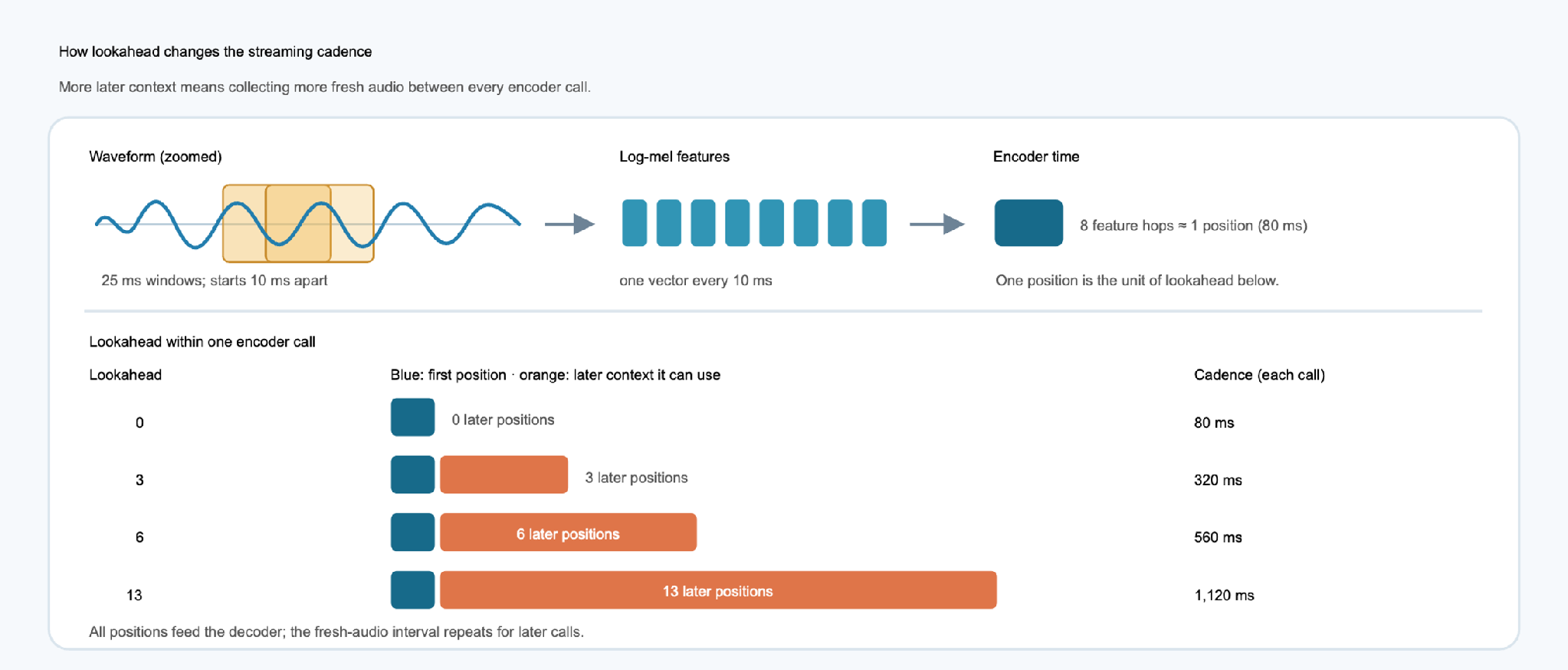
When you’re speaking to a device, you expect text to appear as you talk. That makes streaming automatic speech recognition (ASR) a different challenge from batch transcription, where the model... The post Optimizing Streaming Speech Recognition on Arm® Edge Devices with ExecuTorch appeared first on PyTorch.

Today we are taking a look at ASRock's high-end Radeon AI inference card for workstations, the Creator Radeon AI Pro R9700. With 32GB of RAM and a $1700 price tag, the card is a highly affordable way to fill out a workstation for local AI inference The post ASRock Creator Radeon AI Pro R9700 Review: Workstation Inference, AMD Style appeared first on ServeTheHome.
metal : stop overflow from happening in large matrix output offsets (#30072) * Metal : stop overflow from happening in large matrix output offsets Assisted-by: Codex * metal : widen batch offsets and MUL_MAT_ID token indices Assisted-by: Codex --------- Co-authored-by: feni6 <270037094+feni6@users.noreply.github.com> **Website:** - **Attestations:** - **macOS/iOS:** - [macOS Apple Silicon (arm64)](https://github.com/ggml-org/llama.cpp/releases/download/b11895/llama-b11895-bin-macos-arm64.tar.gz) - macOS Apple Silicon (arm64, KleidiAI enabled) [DISABLED](https://github.com/ggml-org/llama.cpp/pull/23780) - [macOS Intel (x64)](https://github.com/ggml-org/llama.cpp/releases/download/b11895/llama-b11895-bin-macos-x64.tar.gz) - [iOS XCFramework](https://github.com/ggml-org/llama.cpp/releases/dow
llama-quant : fix 4D tensor quantization using ggml_nrows() and name-based expert detection (#30820) * llama-quant : fix quantizing 4D tensors nrows_total was ne[1]*ne[2], so for a 4D tensor only the first ne[2] slices were quantized and the rest of the rows were dropped. Use ggml_nrows(tensor) to count all rows, including ne[3]. Fixes #29916 * llama-quant : detect expert tensors by name and fix imatrix size for 4D tensors The MXFP4_MOE path used ne[2] > 1 to detect MoE expert tensors. This is wrong for non-expert tensors with 3 or more dims, e.g. MLA projections (BailingMoE3) and 4D conv kernels. Use the tensor name instead: all tensors used by GGML_OP_MUL_MAT_ID are named *_exps or *_chexps. This also removes the BailingMoE3 special case. The imatrix holds one vector of ne[0] values per
Python 3.15.0 added to actions/python-versions Bit of a niche link, but I've been waiting for this for a couple of days - I even told ChatGPT to check for it: Clone https://github.com/actions/python-versions and git pull once an hour until they add the stable 3.15 - then tell me about it Now that this has landed, you can add "3.15" to a GitHub Actions testing matrix to run tests against the new Python 3.15.0 release. Tags: github, python, github-actions, chatgpt