Skip to content
AI NEWS JOURNAL
AI, IN PERSPECTIVE

Search AI news

Search headlines, summaries and articles to connect the dots.

Newest first

BlockLock: Reproducible LLM Inference with Fixed Batch Geometry

arXiv:2611.06977v1 Announce Type: new Abstract: Reproducible LLM inference requires that a request produces the same output regardless of the other requests in the batch. Existing solutions pay for this in different ways: batch-invariant kernels constrain every operator, and isolating prefill with fixed-shape decode ({our CoRun-style baseline}) gives up shared prefill compute and pads decode. We present BlockLock, which keeps shared batched prefill and pins only the numerical path of the protected request: it fixes the geometry that the request sees, with {two modes: BlockLock-Rows uses fixed-width rows and retains batched decode of all requests; BlockLock-Pack uses terminal-anchored packing with an isolated dummy segment, then extracts the protected request's KV state for target-only decode. Under a stated per-deployment contract, both modes preserve the target's output bitwise when its companions change.} Across five {dense} models (Qwen3-8B/14B, Llama-3.1-8B-Instruct, and Gemma-3-4B/12B-IT) and three single-GPU deployments (NVIDIA A6000, A100, and H100), we evaluate our approach on both tinyBenchmarks and BFCL{; we also include initial tensor-parallel experiments on two NVIDIA A6000 GPUs. Both modes preserve target sequences and Top20-logit bits in the reported tests.} At equal delivered work, {BlockLock-Rows} reduces latency by 53.5--55.0\% and improves throughput by 115.2--122.2\% relative to vLLM Batch-Invariant; compared with batch-invariant kernels, it needs no custom kernel implementations and constrains only the protected requests.

NUMA-Torch: Compiler-Driven NUMA-Aware LLM Prefill on Multi-Socket CPUs

arXiv:2611.07105v1 Announce Type: new Abstract: For sufficiently large transformer-based Large Language Models (LLMs), whose parameters cannot be retained in on-chip caches, prefill throughput on multi-socket CPUs is often limited by sustainable DRAM bandwidth rather than peak floating-point throughput. In the standard PyTorch compilation (i.e., TorchInductor) path, model weights are allocated without considering the Non-Uniform Memory Access (NUMA) topology: specifically, the affinity between memory banks and compute cores is disregarded. This causes a substantial fraction of weight accesses to traverse the inter-socket interconnect, severely degrading the effective memory bandwidth available to each socket. We address this bottleneck through a compiler-level solution that makes TorchInductor NUMA-aware. Treating each NUMA socket as an independent tensor-parallel partition, we introduce NUMA-aware Tensor Parallelism (NUMA-TP). This approach transparently shards weights across sockets and schedules compute kernels such that thread pools and memory allocations remain strictly local to their respective sockets using CPU affinity. We evaluate the approach on GPT-2 (117M, 345M, 762M) and BERT (Small, Large), which exercise standard multi-head attention and MLP, as well as Gemma 3 270M, which combines Multi-Query Attention with a GeGLU-gated MLP. By strictly enforcing data locality, our approach successfully mitigates cross-socket traffic, achieving prefill speedups of up to 2.63x on a dual-socket Haswell platform, up to 1.87x on a dual-socket Cascade Lake platform, and up to 2.27x on a four-socket Haswell-EX platform.

llama.cpp · b12065

kv-cache : never return 0 kv_rows for sequences without cells (#31570) A cache that shares the cells of another one (f.ex. the gemma4 assistant) can build a graph before its sequences have any cells, f.ex. at the server warmup. get_n_kv_rows() then returned 0, which means that kv_rows are not used, so the graph fell back to the dense KQ mask and the scheduler re-planned for it. Later graphs with larger masks then aborted with GGML_SCHED_DEBUG_REALLOC=1. **Website:** - **Attestations:** - **macOS/iOS:** - [macOS Apple Silicon (arm64)](https://github.com/ggml-org/llama.cpp/releases/download/b12065/llama-b12065-bin-macos-arm64.tar.gz) - macOS Apple Silicon (arm64, KleidiAI enabled) [DISABLED](https://github.com/ggml-org/llama.cpp/pull/23780) - [macOS Intel (x64)](https://github.com/ggml-org/l

Opera launches the WebAI standard, enabling AI models to run natively in the browser

Opera has introduced a new web standard called WebAI, designed to allow users to run AI models directly in their browsers without relying on cloud services. This standard is compatible with multiple models; Opera demonstrated it using Google’s open-source Gemma model and also supports Apple’s on-device foundation models. By not being tied to any specific model and targeting open-weight AI systems, WebAI represents a continuation of Opera’s earlier efforts to enable large language models to run locally within the browser. Currently, WebAI is available as a preview feature in Opera One, Opera’s flagship browser, though users must manually enable it.

Opera推出WebAI标准,支持浏览器本地运行AI模型
Timeline and related coverage

Perturbation-Based Data Selection for Medical Question Answering

arXiv:2610.33440v1 Announce Type: new Abstract: Selecting a compact training subset is an important step in adapting medical language models from existing question-answering banks. We investigate perturbation-based data selection using two signals derived from Gaussian perturbations of the final-block representation: prediction-change frequency and non-flipping margin contraction. After a shared entropy prefilter, Representation-Sensitivity Prioritization (RSP) combines the signals using automatic root-mean-square scaling, while RSP-Drop ranks candidates by contraction alone. Both selectors use only questions and answer options during selection. We evaluate them with MedGemma-4B on five medical QA datasets at retained-set budgets of 64, 128, and 256 examples. At the primary budget of 128,

Timeline and related coverage

v0.43.0

## What's Changed * model_prefetch: syncrhonize all graph cleanups by @rattus128 in https://github.com/Comfy-Org/ComfyUI/pull/17178 * Add rope scaling support to MOSS-image by @kijai in https://github.com/Comfy-Org/ComfyUI/pull/17172 * [Partner Nodes] Renew partner-node sign-in tokens in API nodes by @dante01yoon in https://github.com/Comfy-Org/ComfyUI/pull/16943 * [Partner Nodes] feat(HeyGen): add HeyGen Voice instant clone and text-to-speech by @bigcat88 in https://github.com/Comfy-Org/ComfyUI/pull/17043 * [Partner Nodes] feat(ClarityAI): add Crystal Video Upscaler node by @bigcat88 in https://github.com/Comfy-Org/ComfyUI/pull/17192 * [Partner Nodes] feat(BFL): add 2K/4K resolutions to FLUX 3 Video nodes by @bigcat88 in https://github.com/Comfy-Org/ComfyUI/pull/17200 * Support MOSS-image

Timeline and related coverage

Release: v5.21.0

# Release v5.21.0 ## New Model additions ### MiniCPM-OCR MiniCPM-OCR is a document-understanding model from OpenBMB's MiniCPM-V family. It keeps the MiniCPM-V 4.6 architecture, which pairs a SigLIP vision encoder and a window-attention merger with a Qwen3.5 language model. It is specialized for reading text-dense images such as scanned pages, screenshots, receipts and tables. **Links:** [Documentation](https://huggingface.co/docs/transformers/main/en/model_doc/minicpm_ocr) | [Paper](https://huggingface.co/papers/2509.18154) * Feat test (#49920) by @guarin in [#49920](https://github.com/huggingface/transformers/pull/49920) ### Flint Flint is Recursive's mixture-of-experts language model. Compared to a standard SwiGLU MoE transformer such as Qwen3-MoE, it uses hybrid attention (sliding-windo

Timeline and related coverage

SAGE Benchmark and GAR Framework Released: Advancing Multimodal Semantic Alignment Evaluation

On October 26, 2026, arXiv published the paper arXiv:2610.31838v1, introducing Sense-Aligned Grounding Evaluation (SAGE)—a unified 10-candidate image-selection benchmark—along with the training‑agnostic Gloss-Augmented Reasoning (GAR) framework, designed for cross‑noun, verb, and entity‑centered multimodal grounding evaluation.

新闻源配图 · arXiv cs.CL

Why it matters:This study is the first to unify three types of tasks—VWSD, VerSe, and WikiDiverse—under a term-centric grounded evaluation protocol, introducing a mechanism for identifying hard negative samples and context‑exchange diagnostics. Empirical results demonstrate that the synergistic effect of definition enhancement and constraint‑guided reasoning can significantly improve the Hits@1 metric (from 65.90 to 71.22), thereby providing a more fine-grained, interpretable new evaluation paradigm for multimodal semantic alignment.

Timeline and related coverage

How Much Do You Trust A Dog? Quantifying Hint-Following in Reasoning Language Models

arXiv:2610.32055v1 Announce Type: new Abstract: Large language models (LLMs) often exhibit sycophancy, altering their answers to align with user suggestions even on objective factual and reasoning tasks. Yet the quantitative form of this influence--- and whether it is calibrated to source reliability--- remains poorly understood. In this work, we investigate this behavior through hint-induced answer shifts on MMLU questions, evaluating prompts of the form ``[Source] thinks the answer is (X)''. We systematically vary the source to which the hint is attributed (a professor, a friend, or a dog) across three open-source model families, Qwen, Gemma, and SmolLM. We show that the change induced by the hint follows a predictable structure well-characterized by an exponential tilt: the hint induces

Timeline and related coverage

b11888

common, grammar: add recursive depth limit, make it a requirement (#31153) * common, grammar: add recursive depth limit, make it a requirement * catch more recursive functions * common : tidy up peg parser changes * grammar : reject candidates in a loop, without a depth limit The depth limit in llama_grammar_reject_candidates_for_stack counted the code points of a vocab token, so any token of 256 chars or more was always rejected under a grammar, such as the 512-space token of GLM-4.7-Flash or the long space tokens of Laguna-S-2.1. The rejection now walks the code points with its own stack of levels instead of recursing: there is no limit and no stack risk, whatever the length of a token from the GGUF, and the masks match master. * grammar : track rejected candidates as indices into the in

Timeline and related coverage

Research reveals the local geometric structure of semantic meaning in large language models

A paper published on October 24, 2026, on arXiv (ID 2610.30715v1) characterizes the local geometric properties of semantic meaning in embedding space across four decoder-only large language models—Gemma 4, Llama 3.2, Qwen 2.5, and Pythia—using cross-lingual probes and fine-grained probes.

Meaning Contracts: Local Semantic Geometry in Large Language Models

Why it matters:This study is the first to systematically characterize the invariance, variability, and refinement mechanisms within “the same semantic factor” in LLMs, proposing the “local anisotropic neighborhood” model. The approach has been validated through blind human evaluations, demonstrating rigorous methodology, broad model coverage, and cross-architecture consistency in its findings.

Timeline and related coverage

SIM-UT: A User Behavior Simulation and Evaluation Framework for Medical Triage Chatbots

Researchers have proposed SIM-UT (Simulation of User Behaviour for Triage), a multi-round, real-user-behavior–based evaluation method designed to identify eco‑valid failure patterns of large language model (LLM)-driven medical triage chatbots in real-world settings within low- and middle-income countries (LMICs).

SIM-UT: A User Simulation based Evaluation Framework for Medical Triage Chatbots

Why it matters:This framework breaks through the limitations of existing single-round, English‑centric evaluations by conducting over 5,000 rounds of multilingual simulated conversations, covering real‑world WhatsApp health programs in India, South Africa, and Kenya. For the first time, it systematically reveals “de‑escalation risk,” a critical failure mode, demonstrating both methodological innovation and significant clinical safety implications.

Timeline and related coverage

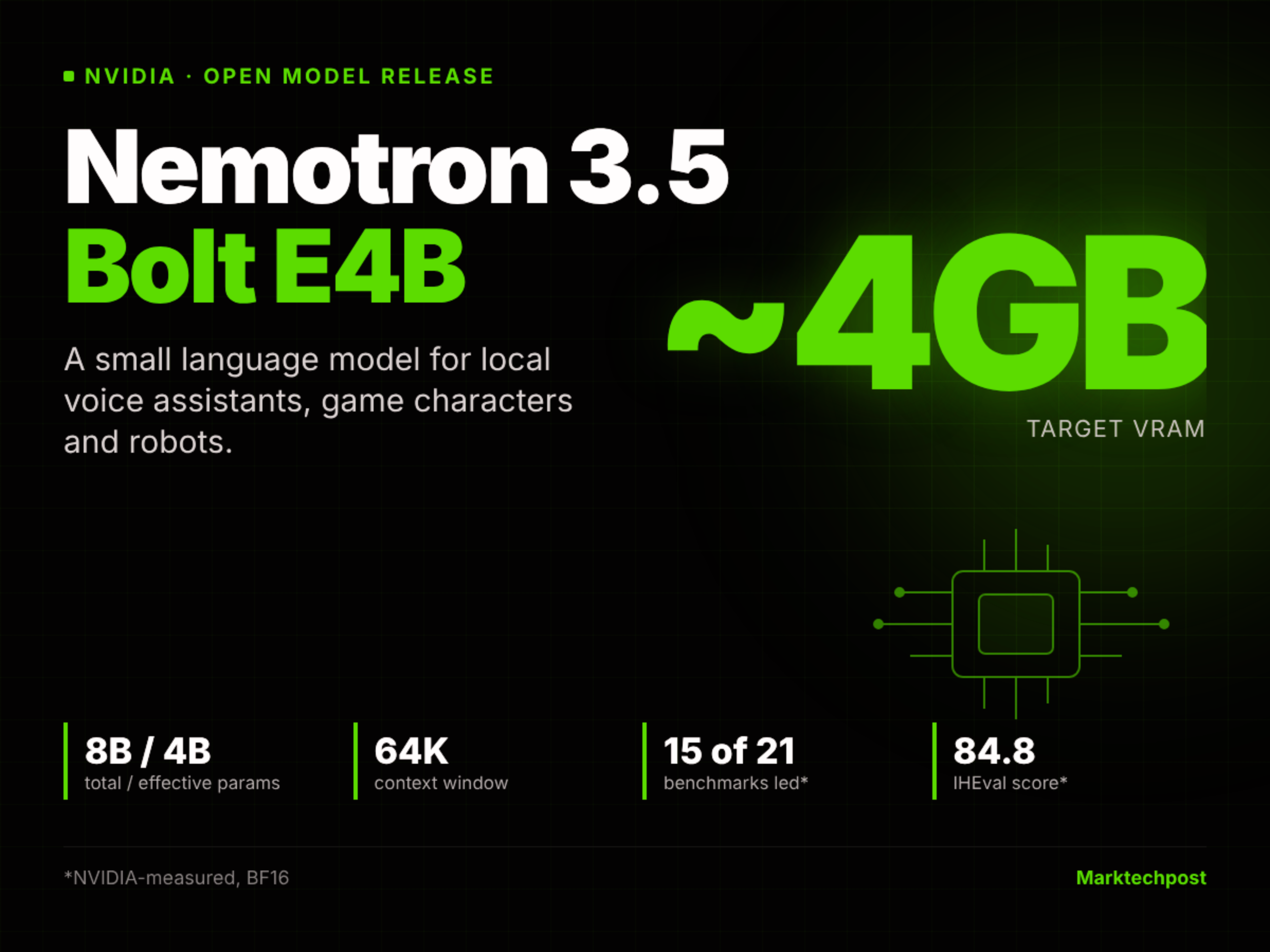
NVIDIA has released the open-source small language model Nemotron 3.5 Bolt E4B 4GB, optimized for on-device voice assistants, game NPCs, and robots.

NVIDIA, leveraging Google’s Gemma 4 E4B model and employing only reinforcement learning (RL) for post-training, has launched Nemotron 3.5 Bolt E4B 4GB—a small open-source language model with 8B total parameters, 4B effective parameters, and a 64K context window. It is designed to run on edge devices such as RTX and Jetson with approximately 4GB of VRAM, supporting multi-turn tool calls and low-latency voice interaction.

NVIDIA Releases Nemotron 3.5 Bolt E4B 4GB: An Open Small Language Model for Local Voice Agents, Game Characters and Robots
Timeline and related coverage