
The latest AI news we announced in October 2026
Here are Google’s latest AI updates from October 2026
Search headlines, summaries and articles to connect the dots.
Here are Google’s latest AI updates from October 2026
NVIDIA released Auto Ontology, an Apache 2.0 library that generates a semantic layer from enterprise metadata. It grounds agent SQL in certified definitions and serves context through MCP, CLI and API. The post NVIDIA Releases Auto Ontology: An Open Semantic Layer That Grounds AI Agent SQL appeared first on MarkTechPost.

(October 26–31) OpenAI is reportedly lowering its target for the next round of fundraising by $10 billion, aiming to raise $20 billion at a valuation of $1.25 trillion; Google has launched its latest world model, Genie 4, doubling the simulation duration to two minutes and achieving synchronized audio-video generation for the first time; Meta plans to raise $35 billion and intends to issue shares worth $60 billion; CITIC Securities: GPT-6 Astra has entered robot control, marking a major turning point for physics-based AI...
This morning, I woke up and opened Apple’s official website, originally intending to take a look at the newly released iPad mini. At first, I was still wondering—so expensive, yet no Apple Silicon or high refresh rate. Then, as I scrolled down, I saw the news Apple had just announced this morning. Apple said...

Author: Li Shuiqing | Editor: Xin Yuan — According to Zhidongxi (WeChat official account: zhidxcom), on October 31, Alibaba announced a partnership with Apple to integrate Qwen into Apple Intelligence. Chinese users will be able to directly access Qwen’s capabilities for text and image understanding, content generation, and more, within Siri, writing tools, and visual intelligence features. These functions will begin beta testing starting November 4 alongside the latest iOS Developer Beta version, and...

Instagram Direct migrated its Android user interface from the legacy Android View system to Jetpack Compose, thereby creating an AI-native UI codebase that makes it easier for AI coding agents to understand, modify, and maintain.
Since coding is solved, why code for the job?

Oracle Corp. today announced plans to make Google LLC’s TPU artificial intelligence accelerators available through its public cloud. The initiative marks the first time the search giant is supplying the chips to another hyperscaler. According to CNBC, Oracle will also add Cerebras Systems Inc.’s wafer-scale accelerators and OpenAI Group PBC’s Jalapeño inference processor. The latter […] The post Oracle brings Google’s TPUs to its cloud, adds ChatGPT integrations appeared first on SiliconANGLE.
How LangChain built Content Studio, an open-source design agent in Slack that makes on-brand videos, graphics and decks, and the harness that powers it.
arXiv:2610.33019v1 Announce Type: new Abstract: As multimodal agents engage in sustained interactions, long-term memory serves two distinct but complementary functions: fine-grained evidence recall and internalized interpretation for global understanding. Although episodic and latent memory address these demands through explicit historical records and internalized experience, neither paradigm alone can accommodate the diverse memory affinities across tasks, owing to limitations in episodic evidence coverage and integration, and in latent factual grounding. To bridge this divide, we propose a dual-memory framework, unifying a model-native latent memory as an intuitive prior with a multi-indexed episodic memory for exact evidence reconstruction via retrieval-conditioned joint alignment. At i

arXiv:2610.34436v1 Announce Type: new Abstract: A looped language model runs one block of layers $R$ times per token, so its key-value (KV) cache holds $R$ planes per recurrent layer, and self-speculative decoding (draft with a few loops, verify with all $R$) reads them all. We find that prefix keys and values matter late: at equal perturbation size, loops 25-32 are $e^{15.0}$ (Huginn-0125) and $e^{12.8}$ (Raven-Llama) times more sensitive than loops 2-9, and the planes approach the last one geometrically, at 0.88 and 0.81 per loop. Whether the deepest plane alone suffices then depends on how ripe the late planes are: on Raven, storing only it is indistinguishable from a bf16-to-fp32 change; on Huginn, 1% of positions carry 74% of its error. We turn this into RIPE, which stores the deepest
arXiv:2610.32177v1 Announce Type: new Abstract: Humans reason about the physical world by flexibly combining different forms of inference as a problem unfolds. Achieving this flexibility is a major open challenge in AI: capabilities often remain separated across specialized models, limiting how they can be composed and jointly adapted to a task. We introduce $\Psi$-0.6, a unified vision-language world model that adaptively composes perception, language, geometry, and simulation within a shared reasoning process we call streams of thought. These streams interleave images, text, and explicit representations of geometry and motion, all of which the model can generate and interpret through a shared token interface. $\Psi$-0.6 surpasses leading open-weight models zero-shot on multi-view spatial
arXiv:2610.31721v1 Announce Type: new Abstract: Optimizing high-dimensional physical systems under expensive evaluations and complex constraints is a central challenge in science and engineering. In offline model-based optimization (MBO), methods must improve designs using only a fixed dataset and no test-time access to the true objective. However, existing methods typically suffer from conservatism, unconstrained surrogate exploitation, or function as static inference-time samplers that cannot refine candidates against precise physical objectives. In this paper, we propose Differentiable Diffusion Conditioning (D2C) for offline MBO, which leverages the fact that deterministic sampling makes the reverse denoising chain differentiable with respect to the conditioning signal. D2C turns a fro

arXiv:2610.31894v1 Announce Type: new Abstract: Recent Sparse Autoencoders (SAEs) decompose the representations of large language models (LLMs) into interpretable features, enabling precise readout and control of encoded knowledge. However, existing SAEs treat each feature as a standalone unit, whereas real-world knowledge is often taxonomically organized. As a result, readout carries no guarantee of taxonomic consistency, and control lacks the granularity to specify the scope of an edit. We propose TaxoSAE, which explicitly encodes taxonomical information, built on is-a (hypernym-hyponym) relations, into the SAE feature space. TaxoSAE mirrors a taxonomy with a stack of SAEs, one per taxonomy level, and introduces a taxonomic alignment loss that trains each concept to be active whenever on
On October 25, 2026, Microsoft Research open-sourced Agensh, a multi-agent runtime framework that operates without a central coordinator, enabling 1 to 1,024 LLM-powered coding agents to self-organize and collaborate on ProgramBench. The system achieves decentralized coordination through shared dashboards inspired by Gitea, Mattermost, and DeLM, with all agents following the same prompt-driven five-step loop; its scalability has been validated in a Linux + Docker environment.
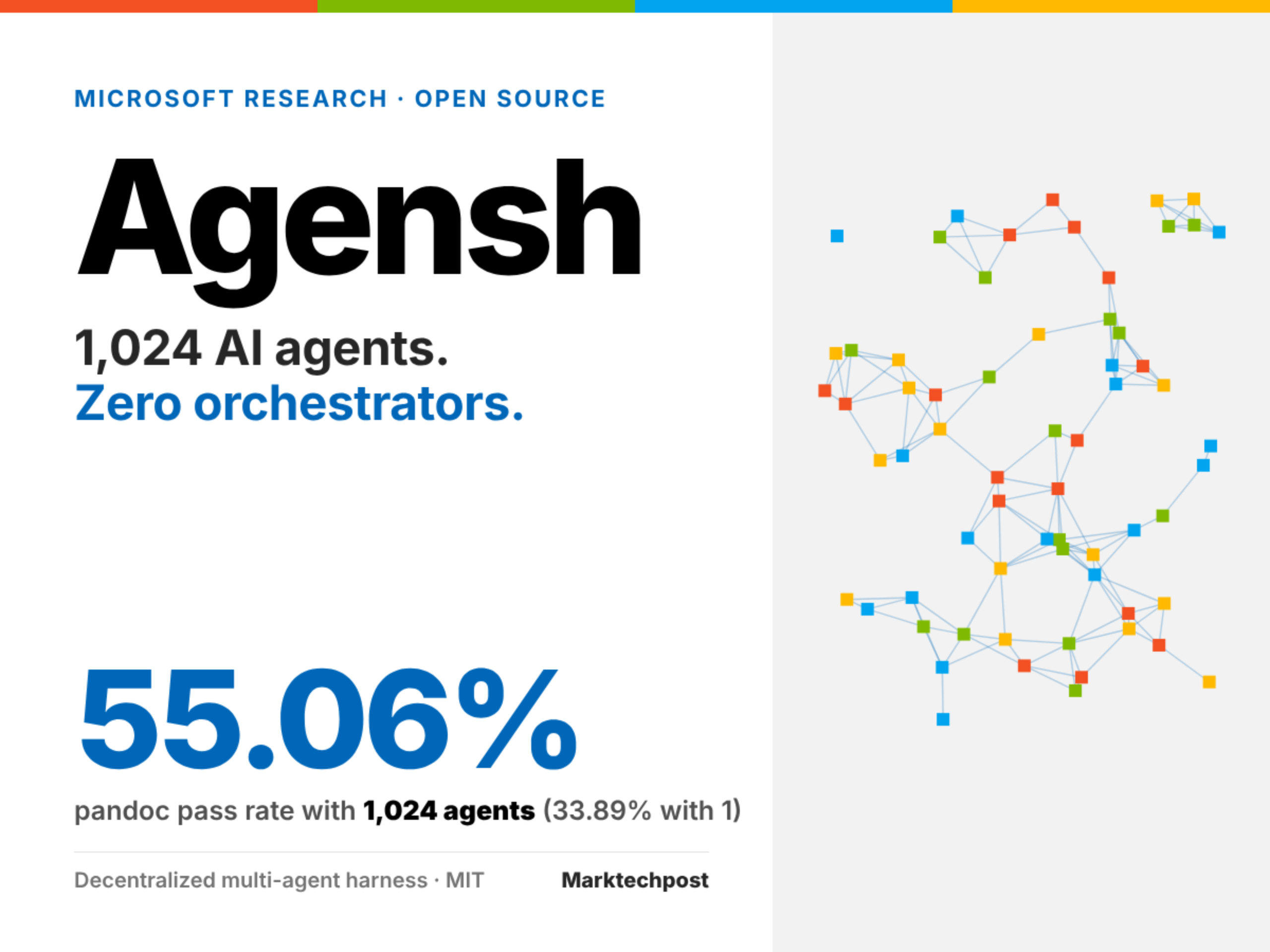
Why it matters:This achievement represents a significant evolution in multi-agent system architectures—abandoning the traditional “master‑agent” paradigm and enabling large‑scale self‑organization through prompt engineering and lightweight service composition. Empirical results on ProgramBench (e.g., 128 agents achieving a 49% improvement in task load balancing across five tasks) establish a new benchmark for distributed AI engineering. Released under the MIT License and compatible with mainstream single‑agent tools such as Copilot CLI, it offers valuable guidance for practical development.
Overview of adaptive parallel reasoning. What if a reasoning model could decide for itself when to decompose and parallelize independent subtasks, how many concurrent threads to spawn, and how to coordinate them based on the problem at hand? We provide a detailed analysis of recent progress in the field of parallel reasoning, especially Adaptive Parallel Reasoning. Disclosure: this post is part landscape survey, part perspective on adaptive parallel reasoning. One of the authors (Tony Lian) co-led ThreadWeaver (Lian et al., 2025), one of the methods discussed below. The authors aim to present each approach on its own terms. Motivation Recent progress in LLM reasoning capabilities has been largely driven by inference-time scaling, in addition to data and parameter scaling (OpenAI et al., 20