
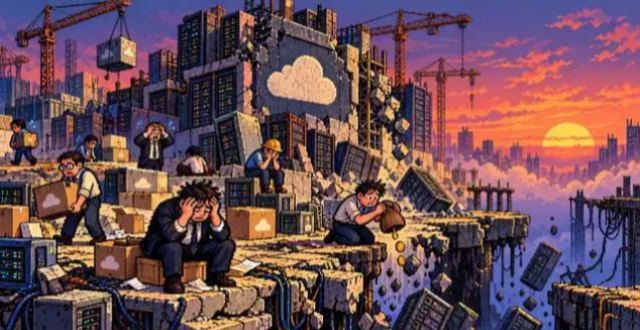
Jensen Huang is still struggling to prop up the Neocloud wall, while Musk has already predicted its collapse.
The first domino in the AI bubble may well be among this group of companies.
On October 25, Musk issued a warning on X: In recent weeks, the debt market has virtually stopped extending financing to companies that lack substantial revenue streams beyond their AI data centers.
He predicted that more than 200 Neocloud companies would face “guppy-level” deaths and consolidations, with only a handful ultimately surviving.
But just three days ago, NVIDIA CEO Jensen Huang offered a nearly opposite assessment.
On October 22, during an interview with CNBC, Jensen Huang firmly stated that Neocloud’s demand for computing power remains extremely strong; the only real constraint on its growth is insufficient working capital, and financing challenges will ultimately be resolved.
Both are optimistic about the demand for AI computing power, but they offer starkly different assessments of whether companies that operate in the computational‑power‑leasing business can survive.
Meanwhile, mounting evidence suggests that this business, once propelled to new heights by the AI boom, is beginning to show cracks.
01
Huang Renxun supports, Musk promotes
Neocloud, simply put, is a new type of cloud computing company that specializes in renting out AI computing power. Unlike traditional cloud providers such as Amazon AWS and Microsoft Azure, which offer a broad range of services, Neocloud focuses primarily on meeting AI‑related computing needs. It procures large numbers of GPUs, builds data centers, and then rents out this computing power to enterprises that need to train or run AI models.
Among them, the most representative companies are CoreWeave, Nebius, and Nscale.
Since entering the AI computing power leasing market, their business has been heavily reliant on NVIDIA GPUs. For NVIDIA, Neocloud is naturally a very important customer.
Jensen Huang’s support for them isn’t just lip service—he’s backed it with real money and even personally guaranteed Neocloud’s computing revenue.
In September 2025, NVIDIA signed a computing power procurement agreement with CoreWeave, valued at an initial $6.3 billion. Under the terms of the agreement, if CoreWeave’s data center capacity cannot be fully sold to other customers, NVIDIA will purchase the remaining capacity as stipulated, with these commitments extending through 2032.
In January this year, NVIDIA further invested $2 billion in CoreWeave to help accelerate its data center construction, with both companies planning to build over 5 gigawatts of AI computing infrastructure by 2030.
In March, NVIDIA announced another $2 billion investment in Nebius, a Neocloud company, to help it expand its AI cloud computing business.
In addition, NVIDIA has designed a more direct support mechanism. During its earnings call on August 26 this year, NVIDIA’s management disclosed that the company has begun offering minimum revenue guarantees to certain Neocloud customers, committing to purchase a portion of their computing power to help them secure bank financing.
In return, when the revenue generated by this computing power exceeds the guaranteed minimum level, NVIDIA will participate in the revenue share.
“Under this model, we can earn money twice: once from hardware sales and another from a share of rental revenue,” said NVIDIA Chief Financial Officer Colette Kress directly.
Image generated by AI
Some media outlets have even likened NVIDIA to the “central bank of the AI industry,” noting that it supplies GPUs to Neocloud while simultaneously providing financial support to these companies through equity investments, commitments to purchase computing power, and other means—helping them secure additional loans, expand their data centers, and keep the entire AI computing‑power market running.
Jensen Huang’s vigorous support for Neocloud, of course, stems from very tangible commercial interests. These companies must continually purchase the latest GPUs and expand their data center capacity to meet customer demand. Neocloud’s ongoing expansion means NVIDIA can consistently secure new chip orders.
However, NVIDIA’s willingness to provide financing for Neocloud does not mean that the capital markets are also willing to keep lending to them.
This is also why Musk issued a warning.
Notably, Musk himself is also taking on substantial debt to purchase GPUs. On October 25, he announced that SpaceX’s $40 billion debt financing for NVIDIA GPUs has been “closed,” primarily covering GPUs scheduled for delivery in the first and second quarters of 2027.
However, unlike Neocloud, which relies primarily on revenue from computing power leasing, SpaceX is backed by mature businesses such as Starlink and rocket launches. In Musk’s view, Neocloud, lacking alternative revenue streams, is unlikely to survive the upcoming industry reshuffle.
When some netizens speculated that Musk was deliberately downplaying Neocloud in order to acquire it at a lower price during the stock’s decline, Musk replied:
“SpaceX will not purchase any Neocloud. It makes no sense.”
02
Are Neocloud’s good days over?
Since 2023, with the explosion of generative AI, NVIDIA GPUs have been in short supply. Traditional cloud providers such as Microsoft, Google, and Amazon have been unable to meet market demand in a timely manner, allowing Neocloud to seize the opportunity and rise rapidly.
They don’t need to build a full-fledged cloud service ecosystem; as long as they can purchase GPUs and properly deploy a cluster, they stand a chance of securing large-scale orders.
CoreWeave is a prime example: in 2023, the company’s annual revenue was just $229 million, yet by 2025 it had already reached $5.13 billion—a roughly 22-fold increase in two years.
Nebius’s AI cloud business has also grown remarkably, with revenue of just $9.6 million in 2023 and already reaching $480 million by 2025.
However, a sharp surge in revenue does not necessarily mean sustained profitability.
Although CoreWeave’s revenue reached $5.131 billion in 2025, its net loss stood at $1.167 billion, with annual net interest expenses soaring to $1.229 billion.
Neocloud requires a substantial upfront investment to purchase GPUs and build data centers, with costs expected to be recouped through future rental revenues. However, as GPUs are updated and replaced, rental prices are also declining.
A McKinsey study from November 2025 shows that, between 2021 and 2025, the publicly listed rental rates for NVIDIA’s A100 dropped from $3.10 per hour to $1.50 per hour, a decline of more than 50%.
McKinsey also used the B200 GPU as an example to calculate that, when financed entirely with equity and without considering debt financing, the GPU leasing business would yield an operating profit margin of only about 8% after deducting depreciation and other costs. If equipment utilization falls below 80%, or if leasing rates decline slightly, the return on investment could be wiped out.
Meanwhile, major Neocloud customers such as Microsoft are continuously building out their own AI infrastructure. Traditional cloud giants like Google and Amazon are also expanding their AI computing capabilities.
Neocloud must both shoulder substantial capital expenditures and contend with GPU depreciation and competition from major clients. Once the supply-demand balance shifts, its past advantages could quickly vanish.
Image generated by AI
Recently, the capital markets have begun to reassess this business.
Since October, Neocloud’s flagship company, CoreWeave, has seen both its stock and bonds under pressure. As of October 26, its share price had fallen nearly 38% from the close on October 1, closing at $55.19. In mid-October, yields on some of its bonds briefly climbed to 15%–16%; by October 26, the price of certain CoreWeave bonds maturing in 2033 had dropped to record lows.
On October 22, according to foreign media reports, investors who shorted five AI infrastructure companies, including CoreWeave and Nebius, posted paper profits of approximately $6 billion that month. Meanwhile, CoreWeave’s stock price fell nearly 30% during the same period.
Interestingly, on October 26, CoreWeave’s stock price also rebounded. That day, its pre-market share price had briefly dropped by about 5% due to Elon Musk’s pessimistic remarks, but it was subsequently boosted by the news that Anthropic had publicly filed its IPO prospectus, ultimately closing up 1.76%.
However, this rebound has not reversed CoreWeave’s overall downward trend over the past month.
Beyond the capital markets, data center construction has also run into trouble.
On October 19, Microsoft withdrew from a Neocloud enterprise Nscale data center project in the United Kingdom. The project was originally scheduled to begin operations in early 2027, deploying more than 23,000 NVIDIA GB300 GPUs, but power supply may not be secured until the 2030s.
For Neocloud, which relies on debt financing to build its data centers, project delays mean that revenue cannot be realized for the time being, while upfront investments and financing costs continue to mount. The longer the delay, the greater the financial pressure.
Research firm Gartner predicts that by 2030, more than 80% of Neoclouds will cease independent operations due to cost pressures and a lack of differentiation, including being acquired, merged, or exiting the market.
This industry, which rose rapidly by capitalizing on the GPU shortage, is now beginning to pay the price for its fragile business model.
03
May I ask where the road leads?
Neocloud’s current troubles may only be the beginning.
On October 25, Chamath Palihapitiya, a Silicon Valley investor and founder of Social Capital, offered a bold yet pessimistic prediction in response to Musk: by 2027, the AI industry could see a significant surplus of idle computing power.
Chamas himself owns a portfolio of data center land assets that are already connected to the power grid, giving him direct insight into the state of AI infrastructure development. In his view, Neocloud generally suffers from insufficient funding and organizational disarray; while some companies perform well, the industry’s overall capacity for building out infrastructure remains cause for concern.
However, traditional cloud providers aren’t much better—Chamas complains that these large companies suffer from severe bureaucracy; just signing a non-disclosure agreement can take up to three months, and they also require an escrow period of as long as 18 months.
The bigger issue is that planned data center projects are experiencing delays.
Chamas believes these issues will come to a head in 2027. By then, major cloud providers may prioritize meeting their own computing needs, while many GPUs that have already been purchased might remain underutilized due to factors such as data centers failing to be completed or mismatches between supply and demand.
He therefore expects 2027 to be a year of industry upheaval, with numerous misguided investment decisions being liquidated and some companies disappearing amid consolidation.
Moreover, even if these construction and delivery issues are ultimately resolved, Neocloud’s situation may still not improve.
Research firm Gartner forecasts that spending on the AI-optimized cloud infrastructure market will grow from $66 billion in 2027 to $174 billion by 2030. Even so, this market growth may still fall short of enabling most AI compute providers to recoup their investments before the current generation of chips is replaced.
As tech giants such as Microsoft, Google, and Amazon continue to expand their AI infrastructure and GPU supply increases, the market conditions that have enabled Neocloud to rise may also gradually change.
As early as November 2025, McKinsey pointed out that Neocloud was initially created to address the GPU supply gap. If it fails to move beyond a business model that merely rents out computing power and establish a sustainable competitive advantage, it could repeat the fate of early cloud‑computing companies—ultimately being acquired by major cloud providers, forced out of the market, or relegated to niche segments.
NVIDIA can provide financing support and guaranteed procurement to help these companies navigate their current challenges, but it cannot ensure that they will always be able to profit from the GPU shortage.
Jensen Huang can provide temporary support, but he cannot sustain it indefinitely.
Image generated by AI
In particular, within the entire AI industry chain, Neocloud may be the most easily bypassed link and also the least resilient to risks.
For tech giants that truly require computing power, renting GPUs from Neocloud is just one way to meet their needs. They can build their own data centers, acquire ready-made computing assets, or lease computing power from major cloud providers.
However, large corporations such as Oracle, Microsoft, Amazon, and even SpaceX, despite incurring substantial capital expenditures, at least have other mature businesses to provide financial support, enabling them to withstand prolonged market volatility.
Neocloud, however, has little room for maneuver; if revenue from computing power leasing grows even slightly slower, its business model—built on expectations of rapid growth—could become unsustainable.
The same market shifts that might merely cause turbulence for large tech companies could spell an existential crisis for Neocloud.
As the GPU shortage gradually eases and customers gain more options, and since Neocloud has failed to demonstrate its irreplaceability, this group of companies could become among the first casualties in the AI industry’s expansion.