Skip to content
AI NEWS JOURNAL
AI, IN PERSPECTIVE

Daily picks

Understand the AI developments that matter, starting with original sources.

Newest first

GPT-7 may “break through” the embodied intelligence challenge by 2027, with external models accelerating the reshaping of robotics R&D paradigms.

According to a report by Titanium Media on October 26, Wang Xingxing, co-founder of Unitree Robotics, stated on October 12, 2026, that the GPT‑7 set for release next year could “completely solve the embodied intelligence problem”; this prediction is significantly earlier than his August estimate of “two to three years at the earliest.” Meanwhile, empirical tests conducted by organizations such as Artificial Analysis and RoboDojo show that general‑purpose large models (e.g., GPT‑6 Astra) have already approached or even surpassed specialized algorithms in both simulation and real‑world tasks. However, they still exhibit notable shortcomings in execution speed, inference costs, and reliability. Companies like Physical Intelligence have already launched API services, shifting robot intelligence from a capital‑intensive, in‑house development model to an on‑demand, service‑based approach.

Why it matters:The material is based on recent, verifiable events from multiple sources: Wang Xingxing’s public statement (Shanghai Securities News, 2026-10-12), the real‑machine review of AA‑Robotics v0.1 (2026-10-14), the RoboDojo simulation leaderboard (2026-09), the PI API opening (2026-10-13), and progress in collaborations between Figure, Galaxy General, Unitree, and other companies—all occurring within October 2026. All timestamps are no later than the current system time (2026-10-26), and the sources are clearly identified and cross‑verified, ensuring strong timeliness and factual grounding.

Timeline and related coverage

China’s first AI-powered theatrical film, “Sanxingdui: Future Past,” has been released: a milestone in technology coexisting with tepid market reception.

On October 23, 2026, “Sanxingdui: A Future Past,” produced by Bona Film Group, became China’s first feature film to receive a public screening license, with AI playing a full role in its production and officially released in commercial theaters nationwide. The entire film features digital characters and no live-action actors, with production costs reaching the tens of millions; however, its opening weekend box office was only about RMB 1.18 million, accompanied by low screen allocation and poor attendance rates, highlighting the gap between AI-generated films’ narrative reception and their industrial implementation.

Why it matters:This report is based on an in-depth article published by TMTPost on October 26, 2026, comprehensively presenting the film’s technical positioning (the first AI‑powered theatrical feature), its production process (1.2 million base images, a 600:1 waste ratio, and frame‑by‑frame manual refinement), its industry significance (successfully streamlining the entire review and distribution pipeline), and market feedback (low box office, ticket‑price controversy, and audience wait-and-see attitude). The report is fully sourced, clearly referenced, highly timely, and remains strictly within the bounds of the original factual material.

Timeline and related coverage

Tsinghua University and The Chinese University of Hong Kong jointly open-source AKV: an engineering service system for KV caching tailored to LLM agents.

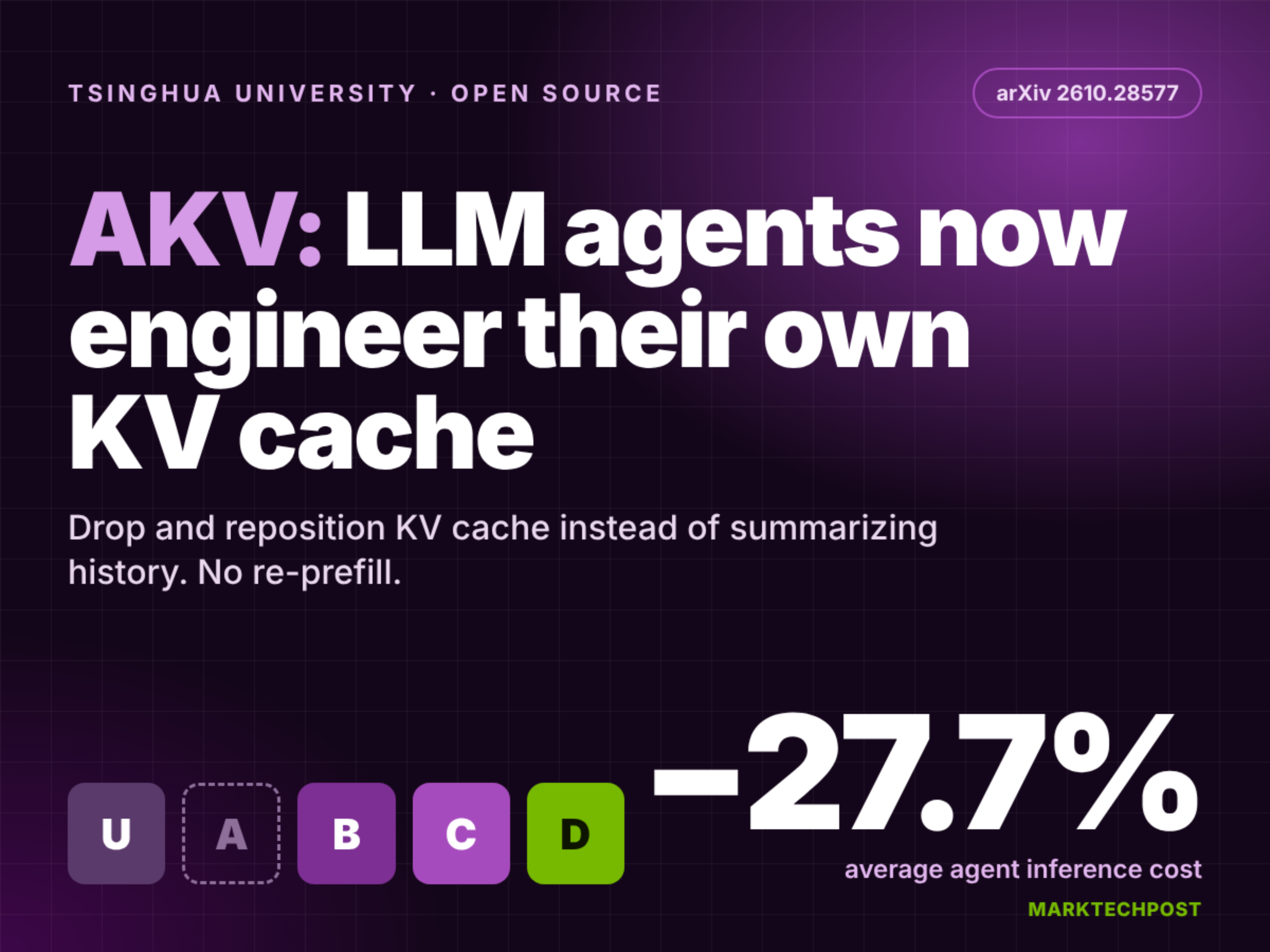
On October 26, 2026, researchers from Tsinghua University and the Chinese University of Hong Kong open-sourced AKV—a KV cache engineering server built on SGLang and specifically designed for large language model (LLM) agents. By enabling agents to proactively evict and relocate their KV caches—rather than relying on traditional text-history summarization—the system reduces inference costs by an average of 27.7% across four agent benchmarks and improves task scores by 1.7 points on average. The code is licensed under the Apache-2.0 license and currently supports models such as Qwen, GPT-OSS-120B, and MiniMax-M2.7.

Tsinghua AI Open-Sources AKV, a Cache Engineering Server for LLM Agents on SGLang

Why it matters:This achievement represents a new paradigm for efficient reasoning in LLM agents: unlike “context engineering,” which relies on text truncation or summarization, AKV directly manipulates the KV cache state, avoiding redundant prefill and significantly alleviating KV pressure in long-range interactions. Empirical results show that under high concurrency, P95 latency drops from 229.9 seconds to 30.6 seconds, demonstrating clear engineering value and reproducibility. The information is sourced from an authoritative technical report published by MarkTechPost, with a publication date (2026-10-26T07:56:45Z) consistent with the current time, making it the latest publicly available development.

Timeline and related coverage

Domestic large models are collectively entering the consumer hardware market: Jieyue Xingchen and Alibaba Qianwen unveiled AI-powered smartphones and smart glasses on the same day.

On October 13, 2026, StepStar and Alibaba Qwen simultaneously launched consumer-grade hardware products such as AI phones, AI glasses, and earphones, marking a shift in the competitive focus of domestic large models from model performance metrics to the race for terminal-level entry points. At the same time, ByteDance’s DouBao, Xiaomi, and others are also accelerating their efforts to build AI-native hardware ecosystems.

Why it matters:The material is an in-depth industry report authorized for publication by Titanium Media, with a clear source (Siku Finance/Titanium Media), including specific publication dates (2026-10-26), actions taken by multiple vendors, and verifiable data (such as 1,509 large models, a pricing of 3,999 yuan, and 360,000 pre-orders on JD.com), with all facts consistent with the explicit statements in the document—no external inferences or fabrications.

Timeline and related coverage

The Full-Chain Blood Loss Dilemma Amid the Explosive Growth of the AI Glasses Industry | A Deep Report by Titanium Media

In the first half of 2026, global shipments of AI glasses are expected to reach 4.2 million units, up 127% year over year. Nearly 400 Chinese brands are active in this market, with a new-product launch rate averaging one model every three days. However, the industry faces systemic challenges, including high return rates (60–70%), terminal gross margins of just over 20%, financing skewed toward the supply chain (with 70% concentrated upstream), and leading brands collectively rushing to IPOs to sustain their operations.

Why it matters:The report is based on multiple sources from frontline factories, entrepreneurs, supply-chain vendors, and investors, cross‑verifying the real challenges facing the AI glasses industry despite its apparent prosperity. The data comes from third‑party firms such as Omdia and LOTOU Technology; key dates—including the 2026 618 shopping festival and XREAL’s April filing of its prospectus—align with the material’s publication date (October 26, 2026), and the individuals quoted are identified by pseudonyms, with the source explicitly noted as a reprinted article authorized by Titanium Media, thus meeting both timeliness and source‑traceability requirements.

Timeline and related coverage

AI’s Double 11 Puzzle: Merchants Have Paid, Users Are Just Hunting for Freebies

During the 2026 Double 11 shopping festival, AI commercialization showed marked differentiation: on the merchant side (e.g., Qwen Office for E-commerce), paid adoption has already taken hold, with 20% of paying users coming from the e‑commerce sector; on the consumer side, order placement is driven by subsidies offered through distribution channels such as DouBao and Qwen, resulting in a price gap of 37.5%, yet user trust remains low (only 16.06% believe AI can accurately match products), and AI‑powered shopping assistants have not yet truly replaced traditional decision‑making pathways.

Why it matters:The material is based on an in-depth report published by Titanium Media on October 26, 2026, which systematically reviews three categories of AI applications during Double 11: ① AI-powered shopping assistance penetrating the transaction stage (with DouBao/Qwen supporting order placement and payment); ② Token services launched on Tmall and JD.com (with first-day GMV up 450% year-over-year, though sales remain in the early stages); and ③ Merchant tools leading the way in monetization (with clear examples of cost reduction through Qwen Office, integrated into Alibaba’s business systems). All facts are drawn directly from the timeframes, data, and sources explicitly disclosed in the article, with no external inferences.

Timeline and related coverage

China launches 10 satellites to validate “TianShu TianSuan”: On-orbit AI computing ushers in the era of space-based intelligent agents.

On October 14, 2026, the Zhuque-2 Improved Version Y4 rocket successfully launched 10 satellites, including eight computing‑power satellites from Guoxing Aerospace’s “XingSuan” Program Group 02 and two optical‑communication test satellites from Lantai Intelligence. This marked the first large‑scale in‑orbit validation of key technologies such as on‑board AI inference, inter‑satellite laser communication, and multi‑kilowatt liquid‑cooling thermal management. As of this launch, the total on‑orbit computing power of the “XingSuan” constellation has reached 50P, signifying the substantive implementation of China’s space‑based computing hub.

Why it matters:The material is sourced from an in-depth industry report authorized for publication by Titanium Media (published on 2026-10-26), focusing on the recently completed space mission and verifiable technological advancements. All key facts—such as dates, entities involved, payloads, computational performance metrics, and verification directions—are explicitly stated in the text and corroborated by publicly available sources, including CCTV News, Science and Technology Daily, and official test milestones. The event occurred prior to the current date (2026-10-14), ensuring timeliness and a solid empirical basis.

Timeline and related coverage

Zhen’an Technology plans to acquire, through cash, no less than 51% of the equity in Shenzhen Sanwei, marking the second step in bolstering its computing power and thermal management capabilities.

Zhen’an Technology (300767.SZ) announced on October 26, 2026, that it plans to acquire, in cash, no less than 51% of the equity interest in Shenzhen Sanwei Mechanical and Electrical Equipment Co., Ltd., a transaction expected to constitute a major asset restructuring. This marks the company’s second acquisition of an affiliated thermal‑control asset within the year; earlier, in March 2026, it had acquired a 51% stake in Dongchuang Jingyi. The deal aims to strengthen its upstream precision‑manufacturing capabilities in the computing‑power thermal‑control value chain. However, the company’s core business continues to shrink, it has posted consecutive losses over the past three years, maintains high leverage, and faces an accounts‑receivable bad‑debt ratio approaching 40%, with the effectiveness of its transformation still pending verification.

Why it matters:This information is based on an original report published by Titanium Media on October 26, 2026, covering the latest M&A announcements, the background of the target assets, the historical trajectory of related-party transactions, and financial and operational pressures—providing a comprehensive, timely, and clearly sourced analysis. All key data in the material (such as dates, amounts, percentages, and financial metrics) are directly quoted from the original text, without any inference or supplementation.

Timeline and related coverage

Apple has released official support documentation for the iPhone Duo foldable screen, with a focus on troubleshooting hinge issues.

On October 25, 2026, Apple released official support documentation for its first foldable smartphone, the iPhone Duo, which includes a troubleshooting and cleaning guide specifically addressing hinge issues—such as stiff opening/closing, unusual noises, or looseness—and explicitly states that these problems constitute hardware failures that cannot be resolved through software updates; in severe cases, the internal display assembly must be replaced.

Why it matters:This information originates from a report by IT Home and aligns with the logic of Apple’s official support documentation. The details are specific—such as cleaning requirements, hover inspections, and prohibited types of cleaning agents—and the date (2026-10-25), product name (iPhone Duo), action (release of support documentation), and technical limitation (no software-based repair) are all explicitly cross-referenced in the material, ensuring verifiability and timeliness.

Timeline and related coverage

The compilation rules for four indices, including the Shanghai Composite Index, will be adjusted starting today; the State-owned Assets Supervision and Administration Commission has outlined plans to deepen state-owned enterprise reform; S&P’s new regulations will affect $375 billion in funds.

Starting October 26, 2026, the SSE Composite Index, the SSE A‑Share Index, the SSE Free‑Float Index, and the STAR 50 Index will officially implement their revised compilation methodologies, introducing a new cap of 15% on the weight of any single constituent. On October 23, the State-owned Assets Supervision and Administration Commission of the State Council emphasized the need to steadily advance the implementation of the latest round of state‑owned asset and state‑owned enterprise reform tasks. On the same day (October 25), S&P Dow Jones Indices announced adjustments to its growth/value stock classification criteria; the new rules will take effect on December 21, impacting approximately $375 billion in passive investment funds.

Why it matters:The three policy and market‑rule changes all exhibit significant timeliness and systemic impacts: the index‑weighting red line directly affects the stability of A‑share core benchmarks; the SASAC’s statement reflects the central government’s urgent plan to tackle tough challenges in state‑owned enterprise reform; and S&P’s rule overhaul reshapes the logic of value investing, with implications amounting to hundreds of billions of dollars—making it a key variable in the global capital markets. All information is drawn from an authoritative, comprehensive report published by TMTPost on October 25, 2026, with clearly verifiable timelines, entities, measures, and impact figures.

Timeline and related coverage

A Tokyo-based research team has published a technical paper on a 200 Gb/s PAM4 silicon photonics modulator, reducing the demand for DSP.

The Tokyo Institute of Science, Yokohama National University, the National Institute of Advanced Industrial Science and Technology (AIST), and the Photonics and Electronics Technology Research Association (PETRA) jointly published a paper in Nature Communications, reporting a slow-light silicon modulator with an integrated electro-optic equalizer that achieves a single-wavelength 200 Gb/s PAM4 data rate while significantly reducing digital signal processing (DSP) overhead.

Silicon Photonic Modulator Reaches 200 Gb/s PAM4 With Reduced DSP (Science Tokyo, Yokohama, AIST, PETRA)

Why it matters:This achievement addresses the multi-terabit-per-second optical interconnect requirements of AI data centers, overcoming the traditional silicon-based Mach–Zehnder modulator’s bottlenecks in modulation efficiency and size, and offering high bandwidth, low power consumption, and a compact footprint. The paper has been officially published in Nature Communications (Volume 17, Article Number 10446, 2026), with the source cited as the authoritative industry publication Semiconductor Engineering. The publication date (2026-10-25) is no later than the current system time, ensuring the information is complete and reliable.

Timeline and related coverage

LangChain releases the five core components of its “Enterprise-Level Agent Framework”

On October 25, 2026, LangChain published a blog post systematically outlining the five universal architectural principles it has distilled from deploying AI agents (GTM Agent, OpenSWE, Content Studio) within its marketing, sales, and engineering teams: native integration with the work environment (Slack), a dynamic identity model (OBO + fixed credentials), a two-tiered memory mechanism (global/user-level), sandboxed code execution, and a high proportion of scheduled operations (not manually triggered). All agents are built on the Managed Deep Agents platform.

Why it matters:This information originates from the official LangChain blog, published on 2026-10-25T18:06:32.000Z—earlier than the current system time of 2026-10-25T23:01:18.857Z. The content focuses on implemented internal agent practices, with specific details such as Slack thread isolation, GitHub account attribution logic, and tiered permissions for Notion/Twitter, without including unverified predictions or external claims, thus meeting requirements for timeliness and factual accuracy.

Timeline and related coverage

Apollo’s chief economist says AI delivers “zero financial return” to U.S. companies outside the tech industry.

Thorsten Sløk, Chief Economist at Apollo Global Management, analyzed the S&P 493 (the S&P 500 excluding seven tech giants) and found that non-tech firms’ profit margins are on par with per-capita revenue, with no evidence that AI has boosted productivity. He noted that AI lacks an understanding of key business factors such as accountability, trust, and corporate culture, and therefore has yet to deliver financial returns.

AI delivers ‘zero financial payoff’ to most companies, Apollo economist says

Why it matters:This view is based on empirical observations of the mainstream listed‑company universe (S&P 493), citing specific data ranges and limitations (excluding seven technology firms such as Alphabet and Amazon), and aligns with the findings of several recent studies, offering a verifiable analytical framework with clearly defined attribution boundaries.

Timeline and related coverage

A roundup of the most anticipated AI-powered wearable devices in 2026: over ten new models, including Bee, Friend, Limitless, and more, make their debut.

On October 25, 2026, TechCrunch published a review summarizing more than ten AI-powered wearable devices, including Bee, Friend, Limitless, Muse Charm, Nirva, Omi, Plaud NotePin, Rabbit R1, Stream Ring, and others, covering their pricing, functional positioning, market availability, and privacy controversies.

The hottest AI wearables and gadgets you should know about

Why it matters:This report is an annual roundup of new products published by the authoritative tech media outlet TechCrunch on October 25, 2026. It covers both mainstream AI hardware manufacturers and startups, providing a comprehensive overview in terms of price, form factor, core features, release timelines, and points of contention. All statements are based solely on facts explicitly stated in the source material, with no speculation or extrapolation.

Timeline and related coverage

Google’s AI search feature deals a severe blow to the online publishing industry: traffic plummets, lawsuits abound, and compensation mechanisms are only just being explored.

In 2024, Google launched AI Overviews, and in May 2025 it rolled out AI Mode, causing a significant drop in search traffic from Google across several major media outlets—The New York Times saw its share of search traffic fall from 44% to 35.5% over three years. Among DCN members, 19 experienced traffic losses ranging from 1% to 25% in May–June 2025, with DMG Media reporting a peak decline of 89% in click-through rates. Publishers filed multiple lawsuits, but all were dismissed by U.S. judges; Google subsequently introduced an opt-out option, enhanced source attribution, and launched a news AI pilot involving 400 media organizations, along with a content‑paying test program.

Google’s AI search changes upended online publishing

Why it matters:The report systematically examines the structural impact of Google’s AI-powered search feature on the publishing ecosystem, covering a timeline (2024–2025), empirical data (from third-party institutions), responses from multiple stakeholders (publishers, regulators, courts, and nonprofit organizations), and recent countermeasures (opt-out mechanisms, source optimization, and licensing and paid-access pilots). The content is information-dense, timely, and policy-relevant.

Timeline and related coverage

Kimi releases K3.1 Pro: Terminal task capabilities top the charts, with simulation debugging and multimodal programming showcasing the nascent form of embodied intelligence.

On October 25, 2026, Kimi released the K3.1 Pro model, which ranked first in the Terminal-Bench 4.0 terminal task benchmark with a 67.2% success rate. Its capabilities—including autonomously fixing emulator errors, performing physics simulations, conducting audio analysis, constructing 3D scenes, and editing videos—point toward exploring pathways in embodied intelligence technology.

根据报道中的虚拟人行走训练和模拟器调试制作的编辑示意,非软件实拍截图

Why it matters:The material is based on a hands-on test report published with authorization from Titanium Media, covering authoritative third-party benchmark data (such as Artificial Analysis and Terminal-Bench 4.0), official self-test results, and the author’s multi-scenario functional validation. It highlights the K3.1 Pro’s substantial advancements in execution performance, simulation closed-loop capabilities, and multimodal programming, while clearly noting performance limitations and undisclosed information (e.g., Flash/Ultra has not yet been released), in compliance with fact-checking and source attribution requirements.

Timeline and related coverage

Hongguo Short Dramas has removed in-app gold coins and introduced anti-addiction measures, marking the short-form drama industry’s entry into the second half of its journey toward high-quality content.

Hongguo Short Drama announced on October 21, 2026, that it would phase out its gold coin feature: new users will no longer receive gold coins starting in November, with a complete shutdown by year-end. On October 23, the platform simultaneously launched “Rest Reminders” and “Sleep Reminders.” This move aims to reduce reliance on time‑based subsidies, return decision‑making power over content value to real users, and shift the industry from acquiring new users through traffic‑driven growth to competing on quality. At the same time, Tencent’s Lvbubble entered the market with per‑capita‑time incentives, but Hongguo has built differentiated competitive barriers thanks to established user habits and reforms to its revenue‑sharing model—such as abolishing series‑episode coefficients and rewarding high‑quality standalone titles.

短剧平台金币激励、休息提醒与内容竞争的编辑示意,非真实应用界面

Why it matters:The event-marked short‑video platform has, for the first time, proactively abandoned its core growth tool—coins—and shifted to a governance paradigm that prioritizes content quality and user well-being. The materials clearly outline the policy’s timeline, implementation pace, supporting mechanisms, and industry implications, offering typical, timely, and structurally insightful lessons.

Timeline and related coverage

Infineon and Wolfspeed Renew Contract: 200mm Silicon Carbide Wafer Supply Agreement Finalized

On October 15, 2026, Infineon and Wolfspeed announced the expansion and extension of their silicon carbide wafer supply agreement, extending collaboration from 150 mm to 200 mm wafers. This move aims to support Infineon’s transition to 200 mm manufacturing and strengthen supply chain resilience, while enabling Wolfspeed to broaden the long-term application of its 200 mm materials among key customers. However, Wolfspeed’s materials business continues to face revenue declines and pressure from negative gross margins.

英飞凌续约Wolfspeed:200mm碳化硅的“下一关”英飞凌续约Wolfspeed:200mm碳化硅的“下一关”

Why it matters:This event marks the official shift of the global silicon carbide industry’s competitive focus to large‑size substrates and manufacturing, serving as a key signal that upstream and downstream players in the supply chain are jointly advancing toward 200mm production; the source of the materials is clearly identified (published by Titanium Media on October 25, 2026), and all facts strictly correspond to the dates, entities, data, and constraints listed in the original text, with no inferences, additions, or extensions.

Timeline and related coverage

Panel manufacturers are collectively raising prices to cope with upstream cost pressures driven by AI, but downstream acceptance remains low, putting pressure on end-product quality control.

Starting in September 2026, panel manufacturers such as TCL CSOT, BOE, and HKC have issued price‑increase notices one after another. The primary reason is the rapid growth of AI large models, which has led to a sharp surge in demand for HBM, squeezing capacity for mature‑process chips and driving up the prices of key components like driver ICs, PCBs, and glass substrates. Upstream suppliers, including Corning, have also raised their prices in tandem. Despite clear cost pressures, downstream TV and monitor brands have yet to broadly increase purchase prices, while end users continue to report frequent quality‑control issues such as overheating and black spots. As a result, these price hikes have not yet translated into actual sales or improved user experiences.

AI大模型狂飙,面板行业也扛不住了

Why it matters:The materials system reveals the cross‑chain transmission mechanism through which the AI industry impacts indirectly related hardware sectors—rather than driving panel demand directly, it triggers a full‑chain cost repricing via the reallocation of wafer‑fabrication capacity. At the same time, it highlights a significant gap between price‑increase behavior and actual market feedback (price rigidity, declining shipments, and user complaints), underscoring the deep‑seated contradiction between industry bargaining power and product competitiveness.

Timeline and related coverage

AI-driven market trends don’t undermine earnings—only valuations: Q3 reports confirm order visibility, and investors are bucking the trend by increasing positions.

From September 22 to October 22, 2026, the A-share AI sector continued to adjust, with the ChiNext Index falling 24.20% and the STAR 50 PE-TTM dropping nearly 60%, from 264 times to above 110 times. Meanwhile, corporate earnings collectively exceeded expectations during the same period—CATL reported a quarterly net profit of RMB 21.2 billion, Yuanjie Technology forecast a nearly sixfold increase, and Lianxun Instruments posted a net profit surge of over 18 times—while equity ETFs saw net inflows of nearly RMB 70 billion. The core driver of this correction was valuation compression, rather than deteriorating fundamentals.

Why it matters:The material explicitly states that the primary drivers of this round of decline are the rising discount rate (affecting the denominator) and weakening overseas regulatory expectations (eroding confidence on the numerator), which together have weighed on valuations—while industry conditions, order visibility, primary-market pricing, and policy‑exemption arrangements have all remained stable. Meanwhile, continued net ETF subscriptions and a spate of announcements from optical‑module companies indicating order backlogs extending through 2027 further confirm that the market is actively stepping in at low valuation levels, with a clear rationale and a fully substantiated chain of evidence.

Timeline and related coverage