
Making Kubernetes AI-Ready for NVIDIA Vera Rubin on Day One
Configuring and optimizing Kubernetes for new GPU hardware such as NVIDIA Vera Rubin is complex and error-prone. Drivers, kernels, runtimes, networking,...
Search headlines, summaries and articles to connect the dots.
Configuring and optimizing Kubernetes for new GPU hardware such as NVIDIA Vera Rubin is complex and error-prone. Drivers, kernels, runtimes, networking,...
NVIDIA released Auto Ontology, an Apache 2.0 library that generates a semantic layer from enterprise metadata. It grounds agent SQL in certified definitions and serves context through MCP, CLI and API. The post NVIDIA Releases Auto Ontology: An Open Semantic Layer That Grounds AI Agent SQL appeared first on MarkTechPost.

Teams building AI applications need a repeatable path from a model configuration to a working inference endpoint. NVIDIA Dynamo is a distributed inference...
Mistral’s open-weight release, frontier monitoring, and the day’s AI Twitter and Reddit recaps.
### Added - 🧭 **Analytics session explorer.** Administrators can now open a Sessions tab in Admin Analytics that lists each chat with its tokens, responses, errors and time span, filters them by search, model, token range or sub-agents, and shows a chat's saved replies and tool calls with their timing and outcome, as long as "ENABLE_ADMIN_CHAT_ACCESS" is on. [Commit](https://github.com/open-webui/open-webui/commit/7b303cf496f22d665ff1f1013a2308de0d74a7a4) - 📑 **Pages in notes.** Notes can now hold several pages and subpages, which you can add, rename, reorder, move under another page, download, link to and delete from the page tabs, and search results and the model now work with notes page by page. [Commit](https://github.com/open-webui/open-webui/commit/b34885efc639c10cbf06c35cd2d4ff605
Infini-AI-Lab released Hermit, an Apache-2.0 harness adapter framework that trains an external layer of instructions, skills, memory and tools from task feedback, leaving the agent’s model and harness unchanged. The post Infini-AI-Lab Releases Hermit, an Open-Source Harness Adapter Framework for AI Agents appeared first on MarkTechPost.
Property Finder found that 96.8% of their vision-AI evaluation labels were inherited from the incumbent model, hiding its true accuracy. See how they built unbiased ground truth, applied evolutionary prompt optimization, and selected a more accurate, cost-effective model on Amazon Bedrock, cutting cost by 86% across 11 image-quality attributes.
## What's Changed * model_prefetch: syncrhonize all graph cleanups by @rattus128 in https://github.com/Comfy-Org/ComfyUI/pull/17178 * Add rope scaling support to MOSS-image by @kijai in https://github.com/Comfy-Org/ComfyUI/pull/17172 * [Partner Nodes] Renew partner-node sign-in tokens in API nodes by @dante01yoon in https://github.com/Comfy-Org/ComfyUI/pull/16943 * [Partner Nodes] feat(HeyGen): add HeyGen Voice instant clone and text-to-speech by @bigcat88 in https://github.com/Comfy-Org/ComfyUI/pull/17043 * [Partner Nodes] feat(ClarityAI): add Crystal Video Upscaler node by @bigcat88 in https://github.com/Comfy-Org/ComfyUI/pull/17192 * [Partner Nodes] feat(BFL): add 2K/4K resolutions to FLUX 3 Video nodes by @bigcat88 in https://github.com/Comfy-Org/ComfyUI/pull/17200 * Support MOSS-image
# Release v5.21.0 ## New Model additions ### MiniCPM-OCR MiniCPM-OCR is a document-understanding model from OpenBMB's MiniCPM-V family. It keeps the MiniCPM-V 4.6 architecture, which pairs a SigLIP vision encoder and a window-attention merger with a Qwen3.5 language model. It is specialized for reading text-dense images such as scanned pages, screenshots, receipts and tables. **Links:** [Documentation](https://huggingface.co/docs/transformers/main/en/model_doc/minicpm_ocr) | [Paper](https://huggingface.co/papers/2509.18154) * Feat test (#49920) by @guarin in [#49920](https://github.com/huggingface/transformers/pull/49920) ### Flint Flint is Recursive's mixture-of-experts language model. Compared to a standard SwiGLU MoE transformer such as Qwen3-MoE, it uses hybrid attention (sliding-windo
Careem's AI agent writes and validates dbt models end to end before a human ever reviews the PR.
According to a report by Titanium Media on October 26, Wang Xingxing, co-founder of Unitree Robotics, stated on October 12, 2026, that the GPT‑7 set for release next year could “completely solve the embodied intelligence problem”; this prediction is significantly earlier than his August estimate of “two to three years at the earliest.” Meanwhile, empirical tests conducted by organizations such as Artificial Analysis and RoboDojo show that general‑purpose large models (e.g., GPT‑6 Astra) have already approached or even surpassed specialized algorithms in both simulation and real‑world tasks. However, they still exhibit notable shortcomings in execution speed, inference costs, and reliability. Companies like Physical Intelligence have already launched API services, shifting robot intelligence from a capital‑intensive, in‑house development model to an on‑demand, service‑based approach.
Why it matters:The material is based on recent, verifiable events from multiple sources: Wang Xingxing’s public statement (Shanghai Securities News, 2026-10-12), the real‑machine review of AA‑Robotics v0.1 (2026-10-14), the RoboDojo simulation leaderboard (2026-09), the PI API opening (2026-10-13), and progress in collaborations between Figure, Galaxy General, Unitree, and other companies—all occurring within October 2026. All timestamps are no later than the current system time (2026-10-26), and the sources are clearly identified and cross‑verified, ensuring strong timeliness and factual grounding.
Open WebUI v0.12.4 is a major maintenance release of the open-source large language model frontend, published before the trusted metadata date of 2026-10-25. Key updates include on-demand skill loading (requires enabling the built-in Skills tool and is disabled by default), explicit marking of the context compression process during chat, accessibility enhancements that address over one hundred WCAG compliance issues, and 26 feature fixes and behavioral adjustments verified through GitHub PRs/issues—covering strengthened permission controls and bug fixes for scenarios such as Safari, RTL, and multi-folder support. No new models, APIs, or third-party services were introduced, nor were any performance benchmarks, user data, or regulatory information included.
On October 24, 2026, Anthropic open-sourced sandbox-runtime (srt), an OS-level sandboxing tool that operates without containers, designed to restrict file read/write and network access permissions for AI agents, MCP servers, and CLI tools. It supports macOS (Seatbelt), Linux (bubblewrap), and Windows (alpha), with npm package version 0.0.81 under the Apache-2.0 license.
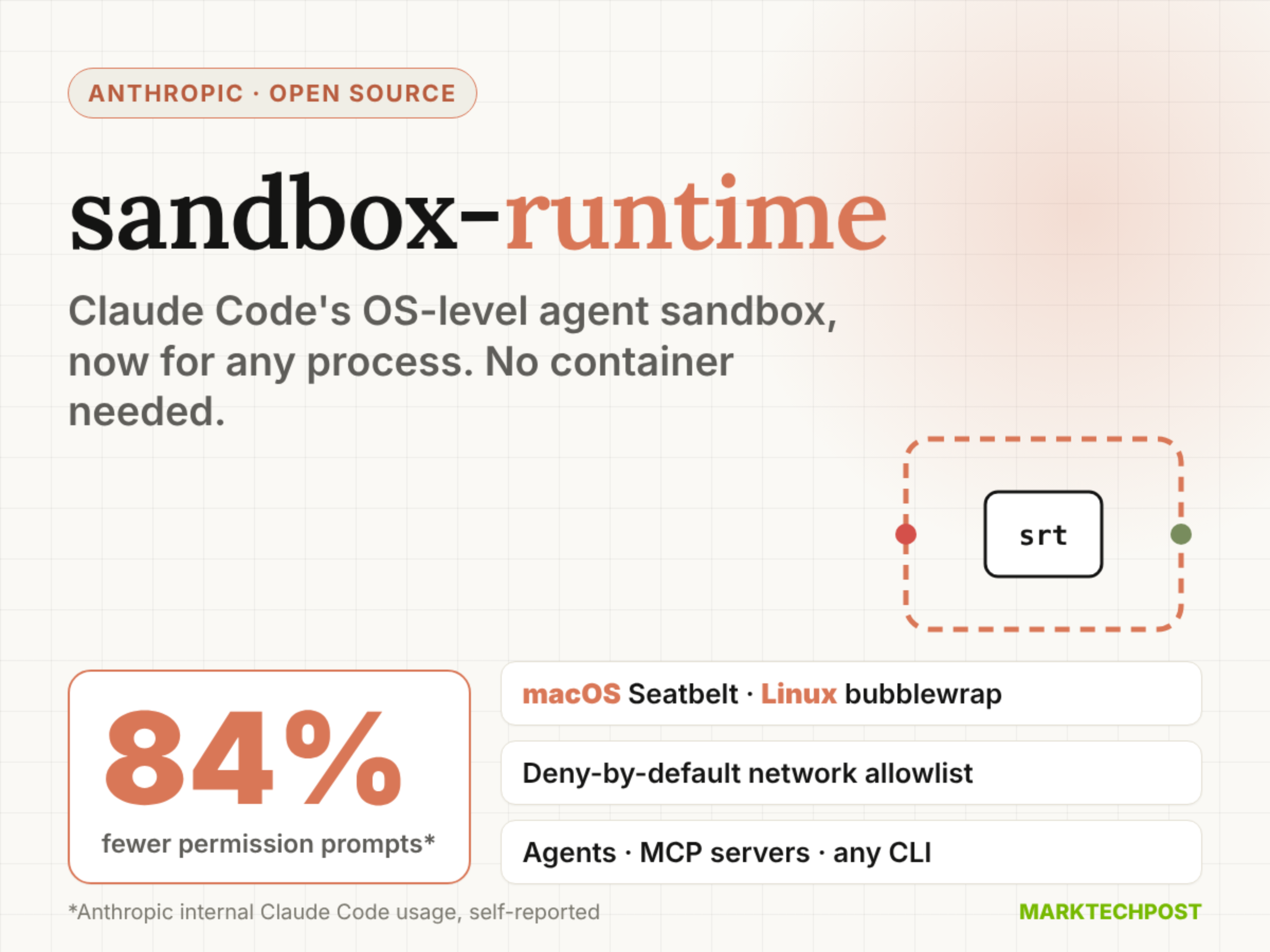
Why it matters:This tool represents a significant advancement in AI security infrastructure—achieving fine-grained, full-process-tree coverage through the operating system’s native isolation mechanisms, directly addressing the risks of prompt injection and privilege escalation, and has already been deployed for internal validation within Claude Code.
The AWS team conducted multilingual inference fine-tuning experiments on Amazon SageMaker HyperPod using GPT‑OSS‑20B, employing LoRA for parameter-efficient fine-tuning. SFT boosted the correctness rate of inference in five languages (English, French, German, Spanish, and Italian) from 22% to 100%, though the correctness rate for the answer language remained at only 62%. GRPO further improved the answer-language correctness rate to 70% without compromising inference-language performance; however, the gains varied across languages—for example, Spanish saw a +30 percentage-point increase, while Italian experienced a -20 percentage-point decline. The experiments clearly demonstrated that GRPO cannot bootstrap new capabilities from scratch and can only optimize behaviors that already occur sporadically.
DeepSeek V4.1, Flash 1017, and two other new models have been released, but they remain in the early deployment phase; China and the U.S. are simultaneously strengthening AI governance: the U.S. Department of Homeland Security has banned DeepSeek-related products, while China plans to impose export approval for ultra-large-scale models; Anthropic has launched a public-interest equity fund and drafted a federal AI bill; industry infrastructure and security research are advancing in tandem.
From October 16 to 19, 2026, three new models—DeepSeek V4.1 Flash 1017, MiniMax M3.1 Flash (Space Bunny), and Mercury 3 (Inception)—were released in quick succession. At the same time, the U.S. Department of Homeland Security ordered a ban on DeepSeek-related products, while China is drafting export control regulations for ultra-large-scale models, bringing the conflicts among the open-source ecosystem, computing infrastructure, and AI governance into sharp focus.
Hugging Face, in collaboration with AWS, has launched TorchNeuron—a PyTorch-native Trainium backend—available for public beta starting October 20, 2026. This technology enables mainstream libraries such as Transformers and Diffusers to run directly on Trainium chips without any modifications, significantly enhancing the usability and compatibility of text-generation and image-generation models.
LeRobot v0.6.0: Imagine, Evaluate, Improve