How to Build Proactive, Always-On Agents with the Schedules SDK in Managed Deep Agents
Most proactive agents run on a simple cron. Learn what scheduled runs unlock, from memory to smart triage, and how to add them to Managed Deep Agents.
Search headlines, summaries and articles to connect the dots.
Most proactive agents run on a simple cron. Learn what scheduled runs unlock, from memory to smart triage, and how to add them to Managed Deep Agents.
Work doesn’t always fit in a single repository or session. A feature can span several repositories. A launch plan can pull in specs, designs, and assets without touching a repository… The post GitHub Copilot app, Universe releases appeared first on The GitHub Blog.
Since coding is solved, why code for the job?

arXiv:2610.36339v1 Announce Type: new Abstract: In expert-parallel mixture-of-experts (MoE) serving, dispatch moves tokens to the accelerators hosting their selected experts, and combine returns expert outputs to each token's owner. Both operations lie on the critical path and can dominate MoE layer latency in multi-node deployments. We present INC-MoE, an expert-parallel MoE layer that offloads dispatch and combine to the network switch and overlaps both collectives with each other and with expert computation. Dispatch uses in-network AllGather through switch-side multicast, while combine uses in-network ReduceScatter through switch-side reduction. Both collectives use message semantics between the end hosts and the switch. Because the in-network collectives load opposite directions of ea
Katelyn Lesse and Angela Jiang on Opus 5.5, the Claude Platform, and the engineering behind AI agents.
Checkr gave its AI agent a structured dbt context layer, cutting a support-metric investigation from hours to minutes.
Why conversational analytics stalls and the data fundamentals that make it reliable.
AI agents need governed context, not just more data, to be trusted.
How LangChain built Content Studio, an open-source design agent in Slack that makes on-brand videos, graphics and decks, and the harness that powers it.
metal : add GGML_OP_TOP_K_MASK (#31230) * metal : add GGML_OP_TOP_K_MASK Port the fused top-k mask from the CUDA backend: a grid-stride kernel fills the output with -inf, then one threadgroup per row copies the mask values of the kept cells over it. Function constants drop the score, blocks and extra paths that a given graph does not use. Assisted-by: dsh:llama.cpp/ggml-org/Qwen3.8-Flash-Next-GGUF (MacBook, M5 Max, 128GB) * metal : clean up top-k mask kernel formatting Assisted-by: dsh:llama.cpp/ggml-org/Qwen3.8-Flash-Next-GGUF (MacBook, M5 Max, 128GB) **Website:** - **Attestations:** - **macOS/iOS:** - [macOS Apple Silicon (arm64)](https://github.com/ggml-org/llama.cpp/releases/download/b11927/llama-b11927-bin-macos-arm64.tar.gz) - macOS Apple Silicon (arm64, KleidiAI enabled) [DISABLED](
# [3.0.0](https://github.com/n8n-io/n8n/compare/n8n@2.45.0...n8n@3.0.0) (2026-10-27) ### Bug Fixes * Add file-type tooltip to artifact download button ([#41490](https://github.com/n8n-io/n8n/issues/41490)) ([4a74f02](https://github.com/n8n-io/n8n/commit/4a74f027e612f31098b354dd3a77b2c2ab98281c)) * **ai-builder:** Check execution:read in Assistant execution reads ([#41863](https://github.com/n8n-io/n8n/issues/41863)) ([a967486](https://github.com/n8n-io/n8n/commit/a9674866d075e989a5ce896432262c9a7dc8b0c7)) * **ai-builder:** Send Assistant model calls through the configured AI transport ([#41948](https://github.com/n8n-io/n8n/issues/41948)) ([9b63561](https://github.com/n8n-io/n8n/commit/9b63561cbb48f06d216f27be3b77722d97e4e74a)) * Allow custom OAuth2 scopes ([#41249](https://github.com/n8n-
# [2.46.0](https://github.com/n8n-io/n8n/compare/n8n@2.45.0...n8n@2.46.0) (2026-10-27) ### Bug Fixes * Add file-type tooltip to artifact download button ([#41490](https://github.com/n8n-io/n8n/issues/41490)) ([4a74f02](https://github.com/n8n-io/n8n/commit/4a74f027e612f31098b354dd3a77b2c2ab98281c)) * **ai-builder:** Check execution:read in Assistant execution reads ([#41863](https://github.com/n8n-io/n8n/issues/41863)) ([a967486](https://github.com/n8n-io/n8n/commit/a9674866d075e989a5ce896432262c9a7dc8b0c7)) * **ai-builder:** Send Assistant model calls through the configured AI transport ([#41948](https://github.com/n8n-io/n8n/issues/41948)) ([9b63561](https://github.com/n8n-io/n8n/commit/9b63561cbb48f06d216f27be3b77722d97e4e74a)) * Allow custom OAuth2 scopes ([#41249](https://github.com/n8
The S-1, the numbers, and the reactions.
arXiv:2610.34914v1 Announce Type: new Abstract: High-performance General Matrix Multiplication (GEMM) implementations rely on breaking down GEMM into carefully selected tiles to achieve peak performance. We present Waypoint, a new analytical model to automatically identify the optimal tile size for a given hardware and input matrix shape. Waypoint estimates the achievable performance for a given tile choice by capturing all the architectural effects including interactions with memory hierarchy, instruction-level parallelism, and multi-threading. Using the estimates as a proxy, we search through the space of possible tile sizes to identify the one that maximizes performance. Additionally, Waypoint helps hardware designers estimate realistic performance on experimental hardware optimizations
arXiv:2610.34521v1 Announce Type: new Abstract: Actor frameworks on mainstream runtimes advertise Erlang/OTP-style supervision, but OTP's consistency contracts assume a synchronous, single-threaded supervisor, and ports inherit that assumption's absence as unexamined risk. We evaluated every supervision guarantee against pinned OTP documentation and source read verbatim, against the source of three further Rust actor frameworks at fixed revisions, and against the actor-model literature, recording the evidence behind each design decision. Blind adversarial audits and the cross-framework study surfaced 24 defect classes, of which eight reduce to one root cause: reconstructing, by explicit mechanism, the atomicity a synchronous supervisor gets implicitly. We introduce a supervision runtime th
hexagon: add GGML_HEXAGON_VTCM_SIZE (#31221) * hexagon: add GGML_HEXAGON_VTCM_MB and GGML_HEXAGON_NTHREADS caps Change-Id: Idffe1613c8db6f96aa842d43d1b2efaed45462a8 * hexagon: rename VTCM cap to GGML_HEXAGON_VTCM_SIZE, drop NTHREADS cap Change-Id: If4c5b9ce9fd6b725c3561421c2295d40599d012d * hexagon: make GGML_HEXAGON_VTCM_SIZE an override, accept K/M/G suffixes Change-Id: Ib8eea84c22f24e6d986b37f215e504b046478c2c **Website:** - **Attestations:** - **macOS/iOS:** - [macOS Apple Silicon (arm64)](https://github.com/ggml-org/llama.cpp/releases/download/b11913/llama-b11913-bin-macos-arm64.tar.gz) - macOS Apple Silicon (arm64, KleidiAI enabled) [DISABLED](https://github.com/ggml-org/llama.cpp/pull/23780) - [macOS Intel (x64)](https://github.com/ggml-org/llama.cpp/releases/download/b11913/llama-b
· OpenAI releases GPT-6.1 Terra, with API prices cut in half and faster computer performance · Apple officially rolls out iOS 27.2: Apple Music gets a new black-and-white design, and the iPhone Duo now supports the Apple Pencil · Huawei’s Enjoy series has cumulatively shipped over 160 million units #Follow iFanr’s official WeChat account: iFanr (WeChat ID: ifanr) for more exciting content delivered to you第一时间.
Build specialized multimodal models with LFM3
ggml-cpu : rewrite concat as one row kernel for all types (#31179) Every dst row comes from src0 or src1, or for dim 0 from the row of src0 followed by the row of src1, so a single kernel covers every type: a dense source row is one memcpy, quantized types included, and a strided source is copied element by element with the element size known at compile time. Rows are split across threads instead of i2 alone, which is often 1, and are copied in tiles of 32: for a transposed source the elements are walked in the outer loop, so the rows of a tile read neighboring addresses instead of jumping a full row stride per element. Add transposed b cases to test_concat, the layout of the delta-net conv input, and a perf case for it. **Website:** - **Attestations:** - **macOS/iOS:** - [macOS Apple Sili
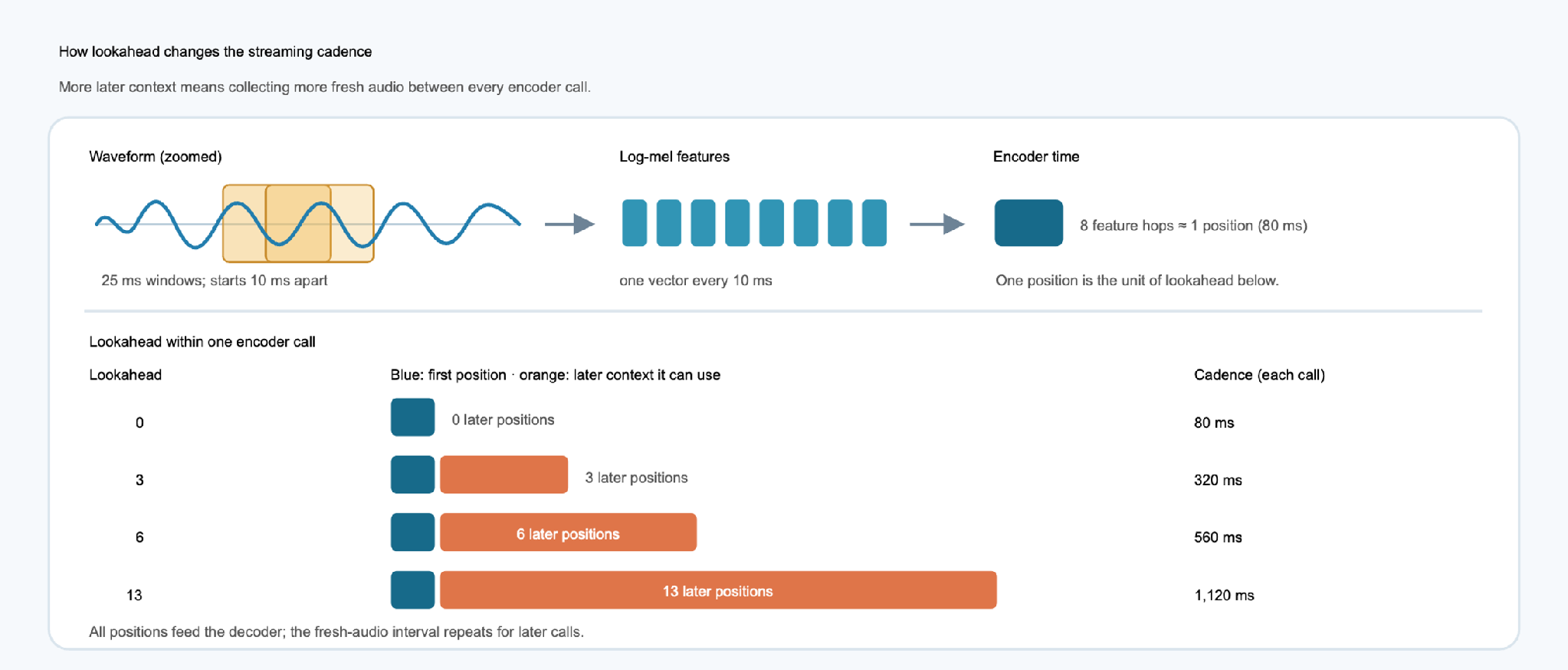
When you’re speaking to a device, you expect text to appear as you talk. That makes streaming automatic speech recognition (ASR) a different challenge from batch transcription, where the model... The post Optimizing Streaming Speech Recognition on Arm® Edge Devices with ExecuTorch appeared first on PyTorch.