
The Sequence Radar - Issue #963: This Week in AI: The Future Has a Payment Schedule
Next Week in The Sequence:
Search headlines, summaries and articles to connect the dots.
Next Week in The Sequence:
Continuous close, in which a company’s books are closed every day instead of weeks after month-end, could change how accounting firms serve clients. As artificial intelligence shrinks the lag between a transaction and the advice built on it, year-end cleanup can become a running conversation. Software makers are retooling their products around the firms that […] The post Continuous close could make accountants everyday business advisors appeared first on SiliconANGLE.
The weights of Mistral Large 4 (Le Chonk) are now open. A 1T parameter multimodal model, and best open-weight model for coding, trained in Europe.
Numeracle, a McLean, Virginia-based company that verifies businesses and links their identities to the phone numbers they use to contact customers, has raised $28 million from Edison Partners to help businesses whose calls are incorrectly labeled as spam or blocked by phone carriers.

After living as a monk while managing Graves’ disease, a former Facebook engineer left Big Tech to pursue meaningful work, eventually founding government software startup FSH Technologies which aims to improve processes such as school food services and public records management through the use of artificial intelligence.

Since coding is solved, why code for the job?

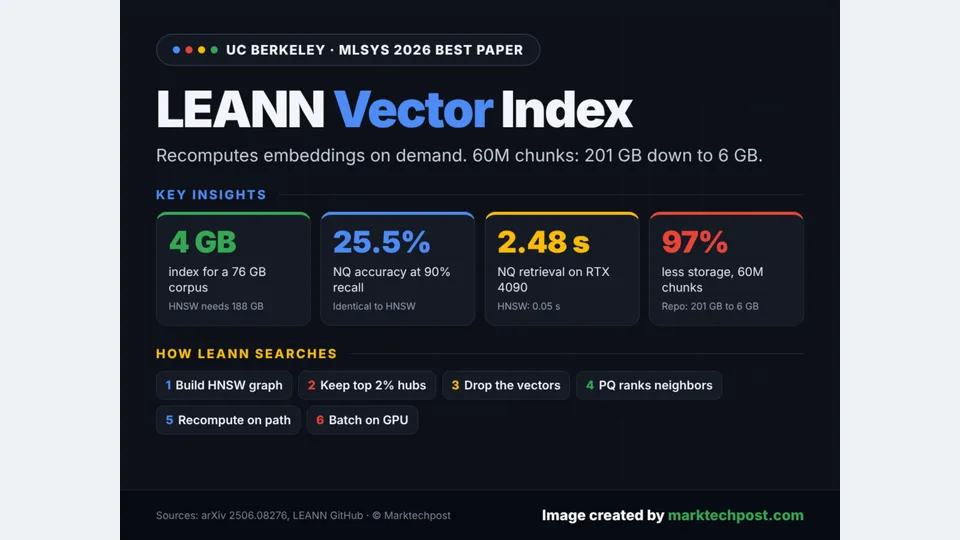
UC Berkeley’s LEANN vector index stores a pruned graph and recomputes embeddings at query time. It matches HNSW accuracy at 90% recall using 4 GB instead of 188 GB, at the cost of seconds-level search. The post Meet LEANN: An Open-Source Vector Index that Shrinks a 60M-Chunk RAG Index from 201 GB to 6 GB appeared first on MarkTechPost.
Checkr gave its AI agent a structured dbt context layer, cutting a support-metric investigation from hours to minutes.
Property Finder found that 96.8% of their vision-AI evaluation labels were inherited from the incumbent model, hiding its true accuracy. See how they built unbiased ground truth, applied evolutionary prompt optimization, and selected a more accurate, cost-effective model on Amazon Bedrock, cutting cost by 86% across 11 image-quality attributes.
The S-1, the numbers, and the reactions.
arXiv:2610.33019v1 Announce Type: new Abstract: As multimodal agents engage in sustained interactions, long-term memory serves two distinct but complementary functions: fine-grained evidence recall and internalized interpretation for global understanding. Although episodic and latent memory address these demands through explicit historical records and internalized experience, neither paradigm alone can accommodate the diverse memory affinities across tasks, owing to limitations in episodic evidence coverage and integration, and in latent factual grounding. To bridge this divide, we propose a dual-memory framework, unifying a model-native latent memory as an intuitive prior with a multi-indexed episodic memory for exact evidence reconstruction via retrieval-conditioned joint alignment. At i

Alexander Embiricos, the OpenAI executive responsible for dots, never wants to have a meeting with someone else's AI agent.
Fleet-wide computer vision needs a model per camera, not one model for the whole fleet. This post presents a working Amazon SageMaker SDK v3 reference architecture that trains, quality-gates, compiles per-camera models with SageMaker Neo, and versions thousands of them, with an AWS Step Functions layer pacing fleet-scale retraining within account quotas.
Coyotec is bilingual, swears, and tells listeners how to defend themselves against ICE. Its popularity comes as more broadcasters are experimenting with artificial personalities.
A recent study published on October 26, 2026, on arXiv (arXiv:2610.31821v1) shows that, in classical Arabic poetry retrieval tasks, the degree to which users retain fragments of poetic lines—such as whether they can recall half a line—plays a more critical role in determining retrieval performance than model capabilities. BM25 outperforms all dense encoders, including state-of-the-art models with 8B parameters, on “tip-of-the-tongue” queries, but falls significantly behind on abstract queries.
Why it matters:This study, through systematic benchmarking using a bilingual corpus, a three-index model, and a dual-evaluation protocol, for the first time quantitatively reveals the dominant influence of query abstraction on different retrieval paradigms (lexical vs. dense), and—after being validated by both human annotators and open-source weight models—the conclusions demonstrate methodological universality and empirical robustness.
TechCrunch reported on October 25, 2026, reviewing several AI projects from 2023 to 2026 that failed to meet expectations, including startups and products such as Relay, Character.ai, Sora, and Humane AI Pin, as well as failed attempts or major adjustments by major companies like OpenAI, Apple, and Microsoft.

Why it matters:This report provides an industry‑wide, phenomenon‑driven overview, with broad coverage and a clear timeline (including specific shutdown or delay dates), and cites S&P Global Market Intelligence data to substantiate the high attrition rate—42%—of enterprise‑level AI projects. It combines detailed case studies with structural analysis, making it a highly valuable reference.
On October 24, 2026, the research team published the Protegrity-PII model on arXiv (ID 2610.30518v1), a novel decision-making model designed for identifying personally identifiable information (PII). On the new benchmark PII-SCOPE, it achieves a typological recall of 0.915 and a precision of 0.907, with an inference speed of 0.49 seconds per million characters and a cost of only $0.0005 per million characters (using a single RTX 6000 GPU in batch mode).

Why it matters:This technical report provides quantifiable performance metrics, clear hardware and cost specifications, the newly proposed benchmark PII-SCOPE, and an empirical comparison of out-of-distribution generalization capabilities, offering both research transparency and engineering reference value. Its publication date (2026-10-24) is no later than the current date (2026-10-26), making it a valid, recent achievement.
arXiv:2610.31019v1 Announce Type: new Abstract: Chunking strategies for retrieval-augmented generation are almost always evaluated on a static snapshot, yet the documents underlying a knowledge base continue to change. Because chunks are embedded independently, a boundary that moves after an edit forces unchanged text to be re-embedded. We measure this update cost on 120 pairs of adjacent Chinese and English Wikipedia revisions for three stateless chunkers (non-overlapping fixed-size, recursive paragraph-first, and content-defined chunking) under a strict byte-identical reuse rule and a frozen dense encoder. On the 116-article common-success pool, with frozen, length-calibrated parameters, fixed-size chunking recomputes 57-68% of its full new-version embedding-input workload, recursive chu