Skip to content
AI NEWS JOURNAL
AI, IN PERSPECTIVE

Search AI news

Search headlines, summaries and articles to connect the dots.

Newest first

v0.13.3

Open WebUI v0.13.3 introduces agent-based automations with terminal and folder persistence, allows changing terminals and folders mid-chat, adds Brazilian Portuguese translations, and fixes issues including incorrect file tab behavior, agent visibility in model pickers, clipboard functionality over HTTP, DeepSeek reasoning mode compatibility, tool call labeling consistency, knowledge search punctuation handling, and Docker image build reliability.

Show HN: Umbel – Remote-control agent CLIs over tmux

Been using this in all my sessions the last months. Opus 5.5 (over MCP) spawns Deepseek flash agents - and codex for audits etc. Very curious to hear what the HN crowd thinks/makes of it. Comments URL: https://news.ycombinator.com/item?id=50383189 Points: 1 # Comments: 0

A new arXiv paper proposes an intelligent agent framework for traceable multimodal emotion reasoning, supporting evidence verification and prompt repair without weight updates.

On October 26, 2026, arXiv published a preprint paper (ID 2610.31685v1) that proposes a traceable multimodal emotion‑reasoning intelligent agent architecture based on frozen large models. By leveraging modality‑specific perception agents, an integration agent, an MLLM critic, and an evidence‑verification stage, the framework achieves error attribution and adaptive optimization of the prompt space, improving the F‑score for emotion recognition across several open‑source multimodal large models (with 2B–38B parameters) by 0.6–2.2 points on the MER2025 dataset.

An Agentic Approach with Evidence-Grounded Verification for Multimodal Emotion Reasoning in Conversation

Why it matters:This study addresses the trade-off between high instruction fine-tuning costs and the non‑debuggable pipeline of intelligent agents in current multimodal emotion‑reasoning systems by proposing the first end-to-end interpretable framework that integrates evidence citation, certainty verification, failure attribution, and targeted prompt repair. All improvements are implemented without modifying model weights and have been empirically validated across four open-source MLLMs of varying scales, demonstrating both methodological innovation and practical engineering utility.

Timeline and related coverage

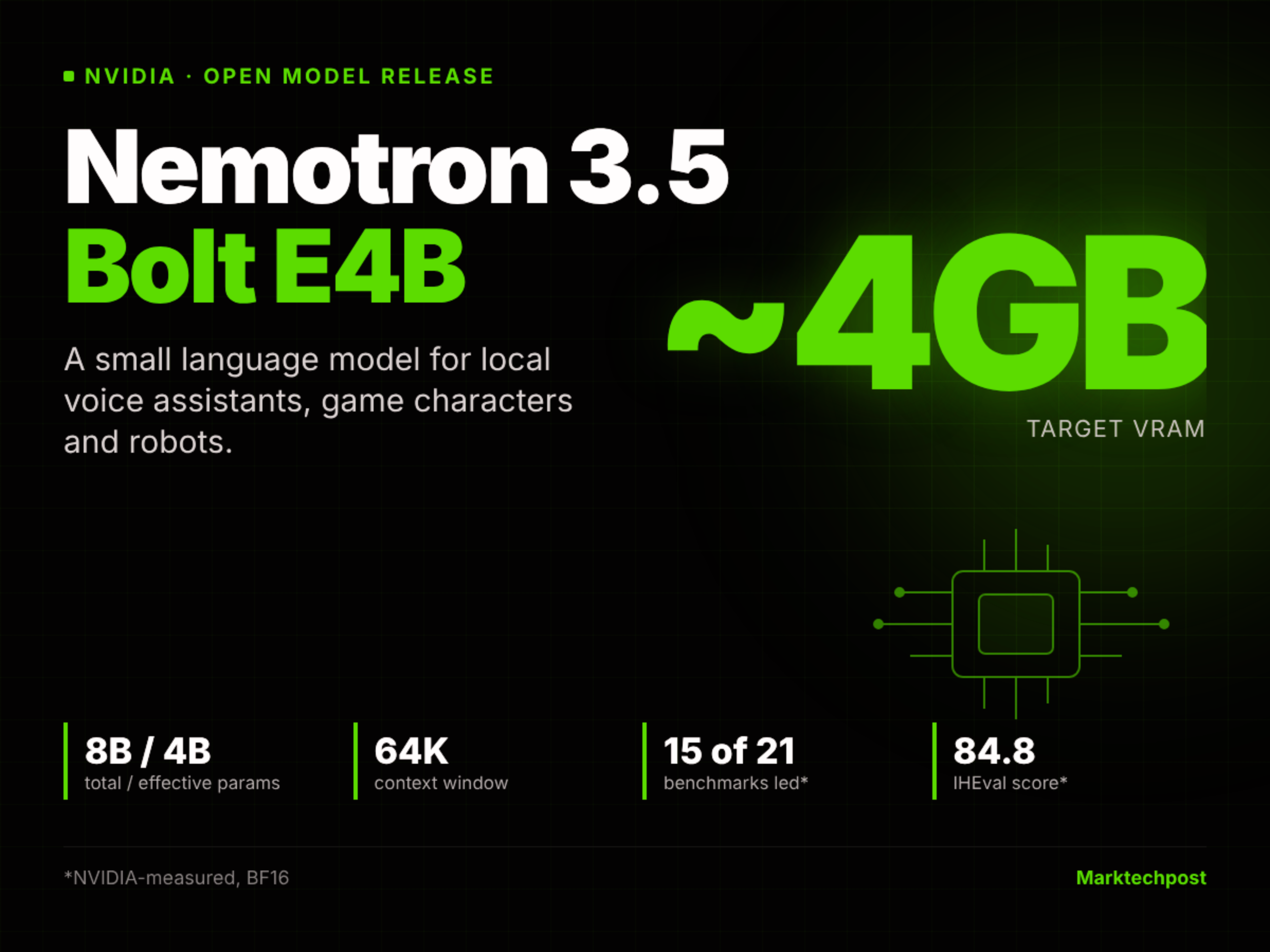
NVIDIA has released the open-source small language model Nemotron 3.5 Bolt E4B 4GB, optimized for on-device voice assistants, game NPCs, and robots.

NVIDIA, leveraging Google’s Gemma 4 E4B model and employing only reinforcement learning (RL) for post-training, has launched Nemotron 3.5 Bolt E4B 4GB—a small open-source language model with 8B total parameters, 4B effective parameters, and a 64K context window. It is designed to run on edge devices such as RTX and Jetson with approximately 4GB of VRAM, supporting multi-turn tool calls and low-latency voice interaction.

NVIDIA Releases Nemotron 3.5 Bolt E4B 4GB: An Open Small Language Model for Local Voice Agents, Game Characters and Robots
Timeline and related coverage

Self-Hosted Large Models vs. Cloud APIs: How to Route Requests Intelligently

This article compares the trade-offs between self-hosted large language models and cloud APIs in terms of data privacy, cost, latency, and capabilities. It outlines the hardware requirements (such as VRAM and quantization) for open-source deployable models, discusses typical technology stacks, and uses n8n as an example to demonstrate how to build hybrid routing workflows that dynamically distribute requests between on-premises and cloud-based models based on task sensitivity, complexity, or compliance requirements.

Timeline and related coverage

AWS releases the Adaptive Agent Framework (AAIF): a hierarchical AI task scheduling solution that enables edge-cloud collaboration based on Strands Agents.

AWS has introduced the Adaptive Agentic Intelligence Framework (AAIF), which leverages Strands Agents to build a hierarchical agent architecture. It dynamically routes tasks via local small language models (SLMs): routine IoT telemetry and visual analytics are executed at the edge, while complex reasoning is offloaded to Amazon Bedrock’s large cloud-based models. The framework supports hybrid deployment, keeps costs under control, and incorporates responsible AI governance recommendations; however, it currently exists as a proof-of-concept implementation and does not yet provide third-party validation or commercial deployment data.

Timeline and related coverage

Qwen2.5: A Party of Foundation Models!

GITHUB HUGGING FACE MODELSCOPE DEMO DISCORD Introduction In the past three months since Qwen2’s release, numerous developers have built new models on the Qwen2 language models, providing us with valuable feedback. During this period, we have focused on creating smarter and more knowledgeable language models. Today, we are excited to introduce the latest addition to the Qwen family: Qwen2.5. We are announcing what might be the largest opensource release in history!