
Skip to content
AI NEWS JOURNAL
AI, IN PERSPECTIVE

Search AI news

Search headlines, summaries and articles to connect the dots.

Newest first

GitHub Copilot Fusion Launches with Dual Capabilities: Intelligent Model Orchestration and Local Model Routing

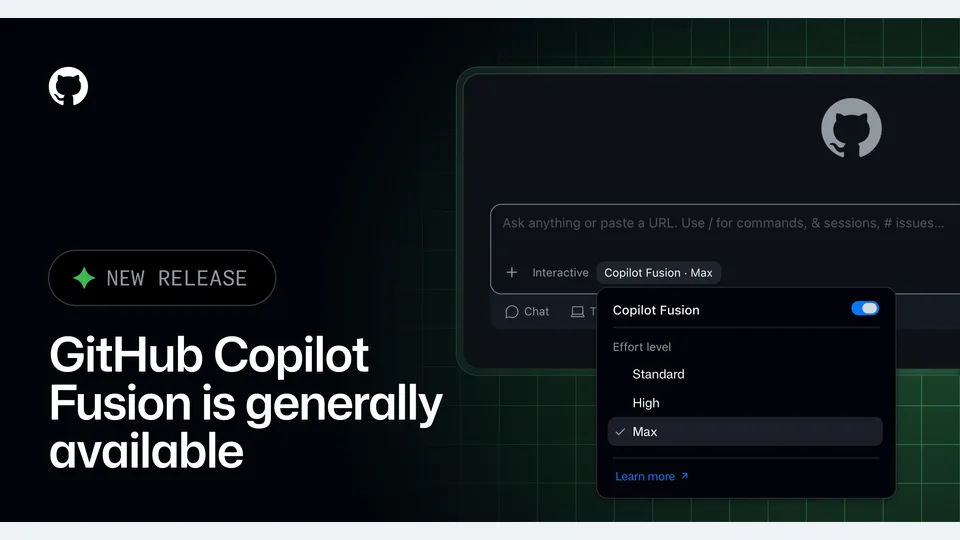
On October 28, 2026, GitHub released the official version of Copilot Fusion, simultaneously introducing an experimental local model routing feature. This capability enables automatic invocation of local models such as MAI Code 1.1 Flash on Windows devices and activates intelligent routing within VS Code, the CLI, and the Copilot App. The system automatically selects and combines cloud models—like those from OpenAI, Anthropic, and Google—based on three effort levels: Standard, High, and Max, achieving performance close to Claude Code while cutting costs in half during coding evaluations.

Timeline and related coverage

GitHub releases Copilot Fusion, an automated multi-model orchestration tool that boosts coding efficiency and cost-effectiveness.

At Universe 2026, GitHub unveiled Copilot Fusion, an intelligent orchestration layer that automatically routes and combines models from OpenAI, Anthropic, Google, and others to complete coding tasks—eliminating the need for developers to manually select models. It integrates existing automatic model-selection technologies with Project HydraFusion, previewed in September. Once the model selector is enabled, the system automatically adopts execution modes such as single-model, cascading, or critique, based on task complexity.

QQ20261029-155714.jpg
Timeline and related coverage

Circuit Mind lands $25M and puts AI agents to work checking circuit board schematics

British circuit board design startup Circuit Mind Ltd. today announced it has raised $25 million in new funding to extend its artificial intelligence platform across more of the hardware design process. A verification tool that puts AI agents to work hunting for errors in schematics launched at the same time. Circuit Mind offers software that […] The post Circuit Mind lands $25M and puts AI agents to work checking circuit board schematics appeared first on SiliconANGLE.

Timeline and related coverage

DMAIC-Bench: From Self-Reflection to Self-Restraint for Agents in Multi-Stage Analytical Tasks

arXiv:2610.32305v1 Announce Type: new Abstract: Multi-stage analytical tasks require LLM agents to use intermediate evidence to decide whether to continue, redirect or stop. Self-reflection, in which an agent critiques its output, is widely studied, yet a critique does not show whether evidence changed the next action. We call that capability self-restraint. Existing agent benchmarks largely measure task completion or output quality and leave it untested. DMAIC-Bench evaluates it with 97 seeded tasks across 15 industrial cases in four sectors, built around Lean Six Sigma's explicit statistical prerequisites. Paired counterfactual variants require opposite actions at the same workflow position, distinguishing warranted restraint from indiscriminate stopping. We assess execution traces with

Timeline and related coverage

POS-Signature Demonstration Retrieval for In-Context Dependency Parsing

arXiv:2610.31966v1 Announce Type: new Abstract: Demonstrations for in-context learning are often retrieved by semantic similarity, which may be a poor proxy for relevance in structured prediction. We study demonstration selection for Universal Dependencies parsing with a POS-signature policy that represents sentences with weighted part-of-speech statistics and retrieves three length-compatible, gold-parsed examples from the labeled training split. We evaluate two open-weight language models without fine-tuning on all 2,077 sentences of the UD English Web Treebank test set, comparing the policy with shot- and format-matched fixed and semantic three-shot baselines, as well as zero-shot, chain-of-thought, and critique-refinement systems. POS-signature retrieval yields the highest labeled atta

Timeline and related coverage

Towards Effective Process Supervision in Mathematical Reasoning

GITHUB HUGGING FACE MODELSCOPE DISCORD Introduction In recent years, Large Language Models (LLMs) have made remarkable advances in mathematical reasoning, yet they can make mistakes, such as miscalculations or logical errors, leading to wrong conclusions. Moreover, even when achieving correct final answers, these powerful models can still regularly make up plausible reasoning steps, where the final answers build upon flawed calculations or derivations, which undermine the reliability and trustworthiness of LLMs’ reasoning processes.