
Skip to content
AI NEWS JOURNAL
AI, IN PERSPECTIVE

Search AI news

Search headlines, summaries and articles to connect the dots.

Newest first

Show HN: FELF – AppImage-like single binaries without FUSE, root, or a runtime

Hello HN!I've always had a bad time redistributing programs that use shared libraries, AppImage in my opinion does too much, and a container is an overkill - not always integrates smoothly.I've moved to nix since long ago, but redistributing between nix and other distros or vice versa it's still a pain in the ass, more so if you want to run an alien app in nix or a nix app without the package manger in any other distro.For that, with the help of Claude, I've implemented a format that deduces at pack-time all the shared libraries a program needs, puts them, together with its own glibc and a patched dynamic linker into a single executable.This means that you don't actually need a runtime nor any special capability, it can run inside a FROM SCRATCH docker, alpine linux etc... And it also supports coreutils-like multiple programs accessible via symlinks, so it is a good fit for that purpose.You can just use:> felf pack $(which git) --output git.felfand you'll have already a git binary that works everywhere, no matter which distro you are building this from. This only packs the binary and their dependencies.Essentially, the effect is similar as if you LD_PRELOAD's all the libraries that it requires.In the end, we have been fighting these demons since long long ago, chroots/docker/appimage/flatpack/nix etc...So this xkcd applies: https://xkcd.com/927/I'm happy to share the project, I hope it inspires new discoveries/tools in this regard! Comments URL: https://news.ycombinator.com/item?id=50415219 Points: 2 # Comments: 0

Show HN: Throng, a project first, terminal 2nd IDE for command line people

I've been beavering away at this since July, and its finally getting to a point where its stabilising.It started Windows only, but I recently converted over to Linux, so I've been ironing out the kinks in the last week. You can install it via apt or rpm, or .exe or .msi on Windows.Many more features to come, including native agent support and more preview features (images, PDF, document formats). Claude works pretty well in it, but I've not tried many other agents yet.I rarely leave throng now - 99% of my work happens inside it. I stopped using Visual Studio around 10 months ago (in favour of VSCode), and now I don't even use VSCode. Comments URL: https://news.ycombinator.com/item?id=50412226 Points: 1 # Comments: 0

Show HN: CLI for Cybersecurity Triage

I built it to replace the repetitive workflows of moving tabs and copying indicators across many tools and tabs for every investigation. You use your own API keys, and functions like decoding, identifying commands, and man pages all run locally with no LLM.Please let me know what you think, you can try it here right now. More information about it can be found here: ceplang.org/start.htmlAs well as a short demo here: https://youtu.be/bzGGigpeiXg Comments URL: https://news.ycombinator.com/item?id=50391790 Points: 1 # Comments: 0

Show HN: Using GPUs for other bs than AI – important prime record for the geeks

Hey HN, if you want to be new prime gap hero here is the code that runs and gets you biggest merits (everyone knows what that is in prime world). I spent months to tune it, and in the last few days got couple of top 10 records just by testing. So get you precious GPU time, run the code and become world no 1 in prime merits because it will make you cool, just not to your friends, girlfriend or family. Help the geek cause! Comments URL: https://news.ycombinator.com/item?id=50372526 Points: 1 # Comments: 1

v1.19.0 - Trace Your Workflows, Layer by Layer

Dify 1.19.0 enhances observability with nested workflow tracing, allowing users to follow execution steps inside Workflow Tools, inspect LLM calls, and maintain context across nested invocations. The release also enables portable app packages via App packages, improves Agent file uploads and previews, introduces Skill Hub automation through CLI commands, and upgrades the bundled plugin daemon to version 0.6.14-local. Key changes include support for format v2 app packages, enhanced security, improved editing workflows, and updated environment variables and API endpoints.

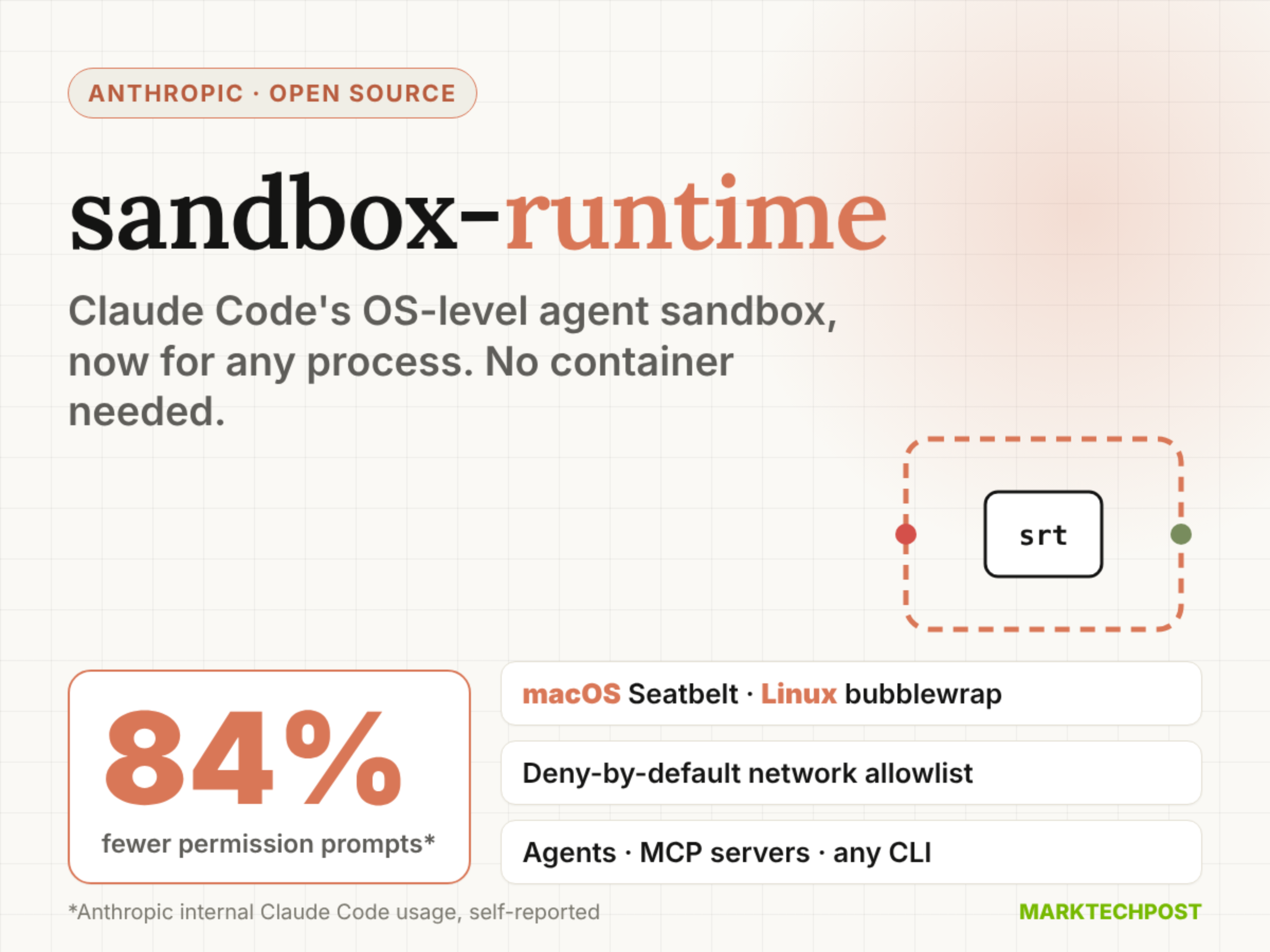
Anthropic open-sources the OS-level sandbox sandbox-runtime: providing container-free file and network isolation for AI agents.

On October 24, 2026, Anthropic open-sourced sandbox-runtime (srt), an OS-level sandboxing tool that operates without containers, designed to restrict file read/write and network access permissions for AI agents, MCP servers, and CLI tools. It supports macOS (Seatbelt), Linux (bubblewrap), and Windows (alpha), with npm package version 0.0.81 under the Apache-2.0 license.

Meet Anthropic’s sandbox-runtime: OS-Level Sandboxing for AI Agents, No Containers

Why it matters:This tool represents a significant advancement in AI security infrastructure—achieving fine-grained, full-process-tree coverage through the operating system’s native isolation mechanisms, directly addressing the risks of prompt injection and privilege escalation, and has already been deployed for internal validation within Claude Code.

Timeline and related coverage

Qwen2.5-LLM: Extending the boundary of LLMs

GITHUB HUGGING FACE MODELSCOPE DEMO DISCORD Introduction In this blog, we delve into the details of our latest Qwen2.5 series language models. We have developed a range of decoder-only dense models, with seven of them open-sourced, spanning from 0.5B to 72B parameters. Our research indicates a significant interest among users in models within the 10-30B range for production use, as well as 3B models for mobile applications. To meet these demands, we are open-sourcing Qwen2.

Hello Qwen2

GITHUB HUGGING FACE MODELSCOPE DEMO DISCORD Introduction After months of efforts, we are pleased to announce the evolution from Qwen1.5 to Qwen2. This time, we bring to you: Pretrained and instruction-tuned models of 5 sizes, including Qwen2-0.5B, Qwen2-1.5B, Qwen2-7B, Qwen2-57B-A14B, and Qwen2-72B; Having been trained on data in 27 additional languages besides English and Chinese; State-of-the-art performance in a large number of benchmark evaluations; Significantly improved performance in coding and mathematics; Extended context length support up to 128K tokens with Qwen2-7B-Instruct and Qwen2-72B-Instruct.

Code with CodeQwen1.5

GITHUB HUGGING FACE MODELSCOPE DEMO DISCORD Introduction The advent of advanced programming tools, which harnesses the power of large language models (LLMs), has significantly enhanced programmer productivity and accuracy. Notwithstanding these advancements, dominant coding assistants like Github Copilot, built upon proprietary LLMs, pose notable challenges in terms of cost, privacy, security, and potential copyright infringement. Recognizing the imperative for a more transparent and accessible alternative, the open-source community has embarked on a concerted endeavor to develop open codeLLMs.