
Who’s really in charge at Anthropic after the IPO?
Here's a clear explanation of Anthropic's incredibly complex governance structure.

Search headlines, summaries and articles to connect the dots.
Here's a clear explanation of Anthropic's incredibly complex governance structure.
Katelyn Lesse and Angela Jiang on Opus 5.5, the Claude Platform, and the engineering behind AI agents.
AWS has been named a Leader in the 2026 Gartner Magic Quadrant for Contact Center as a Service (CCaaS) for AWS Connect Customer. This recognition marks an important milestone for our team, and it reflects years of work pushing on what's possible in customer experience.
Why AI agents can make semantic layers stick, if teams can solve the trust problem.
How LangChain built Content Studio, an open-source design agent in Slack that makes on-brand videos, graphics and decks, and the harness that powers it.
Google DeepMind released Genie 4, a world model with real-time audio, more realistic simulations, and mid-simulation text prompts, in research preview for trusted testers.

# [3.0.0](https://github.com/n8n-io/n8n/compare/n8n@2.45.0...n8n@3.0.0) (2026-10-27) ### Bug Fixes * Add file-type tooltip to artifact download button ([#41490](https://github.com/n8n-io/n8n/issues/41490)) ([4a74f02](https://github.com/n8n-io/n8n/commit/4a74f027e612f31098b354dd3a77b2c2ab98281c)) * **ai-builder:** Check execution:read in Assistant execution reads ([#41863](https://github.com/n8n-io/n8n/issues/41863)) ([a967486](https://github.com/n8n-io/n8n/commit/a9674866d075e989a5ce896432262c9a7dc8b0c7)) * **ai-builder:** Send Assistant model calls through the configured AI transport ([#41948](https://github.com/n8n-io/n8n/issues/41948)) ([9b63561](https://github.com/n8n-io/n8n/commit/9b63561cbb48f06d216f27be3b77722d97e4e74a)) * Allow custom OAuth2 scopes ([#41249](https://github.com/n8n-
# [2.46.0](https://github.com/n8n-io/n8n/compare/n8n@2.45.0...n8n@2.46.0) (2026-10-27) ### Bug Fixes * Add file-type tooltip to artifact download button ([#41490](https://github.com/n8n-io/n8n/issues/41490)) ([4a74f02](https://github.com/n8n-io/n8n/commit/4a74f027e612f31098b354dd3a77b2c2ab98281c)) * **ai-builder:** Check execution:read in Assistant execution reads ([#41863](https://github.com/n8n-io/n8n/issues/41863)) ([a967486](https://github.com/n8n-io/n8n/commit/a9674866d075e989a5ce896432262c9a7dc8b0c7)) * **ai-builder:** Send Assistant model calls through the configured AI transport ([#41948](https://github.com/n8n-io/n8n/issues/41948)) ([9b63561](https://github.com/n8n-io/n8n/commit/9b63561cbb48f06d216f27be3b77722d97e4e74a)) * Allow custom OAuth2 scopes ([#41249](https://github.com/n8
Author | Cynthia Editor | Zheng Xuan In 2026, the AI 3D landscape stands at a delicate crossroads. Momentum in the primary market continues to surge, with new models and startups emerging one after another, and single-image-to-3D generation now delivers photorealistic results that are almost indistinguishable from real-world objects. Yet beneath the dazzling demo façade, most generated outputs remain stuck at the “turntable showcase” stage: a meticulously crafted character or mechanical model slowly rotates under lighting, its scales, fabric folds, and metallic engravings rendered with lifelike detail. But as soon as these details enter real‑world production workflows—such as game engine rigging, industrial simulation, or 3D printing—their limitations quickly surface: structural fractures, backside collapses, fused details, and uneditable meshes begin to erupt, swallowing up the efficiency gains brought by AI through costly manual post‑processing. Fidelity in frontal views no longer equates to overall 3D quality—a consensus that’s taking hold across the industry. The race for AI‑driven 3D has shifted from the first half—“Can we generate?”—to the second half—“Can we deliver in real‑world applications?” It is precisely at this juncture that leading player Hi3D has made two strategic moves: officially open‑sourcing its production‑proven Hi3D V1.0 platform, while simultaneously launching the creator‑centric Hi3D Agent, which bridges the industry’s foundational layers and deeply embeds itself within the full creative workflow. Prior to this, the company—founded less than three years ago—had already delivered a solid track record: securing two consecutive rounds of funding within six months, totaling nearly $50 million, with top-tier investors like Sequoia China, IDG Capital, and Meituan Longzhu all participating; its Hi3D platform now serves over 120 countries and regions, supporting more than 2 million creators, and enjoys deep integrations with leading hardware manufacturers such as Tuzhu Technology and xTool. From academic breakthroughs in sparse geometry to open‑source, production‑ready models, and end‑to‑end connectivity via its Agent creation system, Hi3D has secured its ticket to the next phase of 3D generation. 01 3D Generation: Overhyped Demos, Underestimated Production Gaps The underlying logic of single‑image‑to‑3D generation inherently carries a perspective bias. As metrics like ULIP and Uni3D have repeatedly set new benchmarks, the industry’s past few years have been marked by an emphasis on front-facing views at the expense of holistic understanding, and on outward appearance rather than internal structure. However, the essence of a 3D asset lies in its ability to be rotated, edited, and manufactured as a three‑dimensional object. In a single character image, the vertical…
The S-1, the numbers, and the reactions.
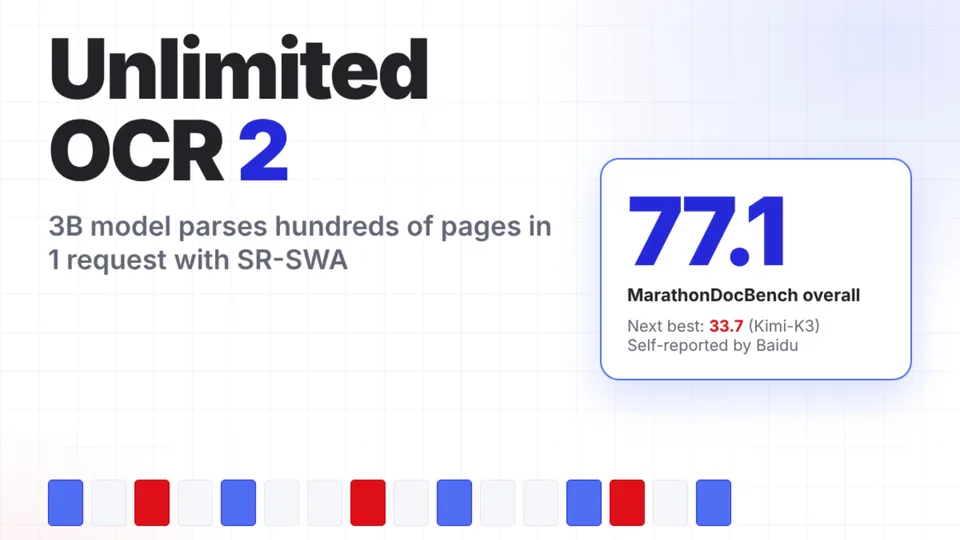
Baidu has released Unlimited OCR 2, an MIT-licensed 3B OCR model that parses hundred-page documents in one request. Its SR-SWA attention keeps per-step decoding cost nearly flat, scoring 77.1 on MarathonDocBench The post Baidu Open-Sources Unlimited OCR 2 for Hundred-Page Document Parsing appeared first on MarkTechPost.
arXiv:2610.33440v1 Announce Type: new Abstract: Selecting a compact training subset is an important step in adapting medical language models from existing question-answering banks. We investigate perturbation-based data selection using two signals derived from Gaussian perturbations of the final-block representation: prediction-change frequency and non-flipping margin contraction. After a shared entropy prefilter, Representation-Sensitivity Prioritization (RSP) combines the signals using automatic root-mean-square scaling, while RSP-Drop ranks candidates by contraction alone. Both selectors use only questions and answer options during selection. We evaluate them with MedGemma-4B on five medical QA datasets at retained-set budgets of 64, 128, and 256 examples. At the primary budget of 128,
## What's Changed * model_prefetch: syncrhonize all graph cleanups by @rattus128 in https://github.com/Comfy-Org/ComfyUI/pull/17178 * Add rope scaling support to MOSS-image by @kijai in https://github.com/Comfy-Org/ComfyUI/pull/17172 * [Partner Nodes] Renew partner-node sign-in tokens in API nodes by @dante01yoon in https://github.com/Comfy-Org/ComfyUI/pull/16943 * [Partner Nodes] feat(HeyGen): add HeyGen Voice instant clone and text-to-speech by @bigcat88 in https://github.com/Comfy-Org/ComfyUI/pull/17043 * [Partner Nodes] feat(ClarityAI): add Crystal Video Upscaler node by @bigcat88 in https://github.com/Comfy-Org/ComfyUI/pull/17192 * [Partner Nodes] feat(BFL): add 2K/4K resolutions to FLUX 3 Video nodes by @bigcat88 in https://github.com/Comfy-Org/ComfyUI/pull/17200 * Support MOSS-image
Build specialized multimodal models with LFM3
GPT-6.1 Terra, OpenAI’s newest model, is now generally available in GitHub Copilot. It is designed for everyday agentic coding and terminal work at a lower cost than GPT-6.1 Sol. In… The post GPT-6.1 Terra in GitHub Copilot appeared first on The GitHub Blog.
# Release v5.21.0 ## New Model additions ### MiniCPM-OCR MiniCPM-OCR is a document-understanding model from OpenBMB's MiniCPM-V family. It keeps the MiniCPM-V 4.6 architecture, which pairs a SigLIP vision encoder and a window-attention merger with a Qwen3.5 language model. It is specialized for reading text-dense images such as scanned pages, screenshots, receipts and tables. **Links:** [Documentation](https://huggingface.co/docs/transformers/main/en/model_doc/minicpm_ocr) | [Paper](https://huggingface.co/papers/2509.18154) * Feat test (#49920) by @guarin in [#49920](https://github.com/huggingface/transformers/pull/49920) ### Flint Flint is Recursive's mixture-of-experts language model. Compared to a standard SwiGLU MoE transformer such as Qwen3-MoE, it uses hybrid attention (sliding-windo
Fleet-wide computer vision needs a model per camera, not one model for the whole fleet. This post presents a working Amazon SageMaker SDK v3 reference architecture that trains, quality-gates, compiles per-camera models with SageMaker Neo, and versions thousands of them, with an AWS Step Functions layer pacing fleet-scale retraining within account quotas.
Artificial intelligence giant Anthropic PBC filed papers today for an initial public offering with the United States Securities and Exchange Commission, putting it on track for what will likely be the biggest stock market debut of an AI developer to come, amid warnings about advanced AI. In its filing, Anthropic said it plans to list […] The post Anthropic files S-1 paperwork for proposed IPO appeared first on SiliconANGLE.
Artificial intelligence giant Anthropic PBC filed papers today for an initial public offering with the U.S. Securities and Exchange Commission, putting it on track for what will likely be the biggest stock market debut of an AI developer to come, amid warnings about advanced AI. In its filing, Anthropic said it plans to list on […] The post Anthropic files S-1 paperwork for blockbuster AI IPO appeared first on SiliconANGLE.
Agents waste time and context on clumsy searches, oversized results and stale data. Learn the retrieval techniques LangChain's Deep Agents harness uses to get the right context in.