Skip to content
AI NEWS JOURNAL
AI, IN PERSPECTIVE

Search AI news

Search headlines, summaries and articles to connect the dots.

Newest first

Kevin Roose is AGI-pilled. Why aren’t you?

Today, I’m talking to Kevin Roose, journalist and author of the new book The AGI Chronicles, which details the recent and explosive transformation of the AI industry. Kevin was a longtime New York Times reporter and host of the popular podcast Hard Fork, but he and friend of the show Casey Newton just left the […]

Kevin Roose is AGI-pilled. Why aren’t you?Kevin Roose is AGI-pilled. Why aren’t you?
Timeline and related coverage

BARC-Bench: Benign Asks, Risky Consequences

arXiv:2610.32024v1 Announce Type: new Abstract: Task instructions from users for agents are inherently underspecified, especially regarding safety boundaries--creating behavioral risks. To study these risks, we introduce BARC-Bench, a collection of 110 tasks across nine simulated workspace environments where benign requests leave openings for unsafe actions. In this benchmark, we evaluate agent behavior against safety boundaries established by workspace records, implicit environmental context, and unstated social norms. For example, an agent asked to schedule off-boarding discussions must arrange the meeting without prematurely revealing an employee's resignation through a shared calendar invitation. Evaluating four frontier model configurations across five attempts per task reveals that m

BARC-Bench: Benign Asks, Risky Consequences
Timeline and related coverage

Knowing Whom to Trust is not Enough: The Trust--Agreement Gap in Repeated Multi-Party LLM Negotiation

arXiv:2610.31971v1 Announce Type: new Abstract: Large language model (LLM) agents increasingly participate in negotiations on behalf of individuals and organizations, yet they remain vulnerable to manipulation, particularly in repeated multi-party interactions. Classical multi-agent systems address this challenge through explicit trust and reputation models, whereas existing work on LLM negotiation largely treats trust as an emergent phenomenon. We investigate whether LLM agents can form useful trust estimates from prior interactions and leverage them to improve future negotiation outcomes. We introduce a repeated, multi-party, multi-issue negotiation framework in which recurring agents participate in a sequence of negotiation games while one participant covertly attempts to prevent agreem

Knowing Whom to Trust is not Enough: The Trust--Agreement Gap in Repeated Multi-Party LLM Negotiation
Timeline and related coverage

HyScale: Scaling Long-Context Training for Learned Sparse Attention

arXiv:2610.32057v1 Announce Type: new Abstract: We present HyScale, a long-context training system for learned sparse attention. Learned sparse attention is a promising architecture for million-token contexts, widely adopted in production since DeepSeek-V3.2. Selection, however, grows into the training bottleneck. For each query, it scores every previous token whereas sparse attention reads only $k$; worse, current systems materialize a full score table and repeat selection during recomputation. Our key insight is that the output of selection is not an activation, but rather a set of indices. Building on it, HyScale introduces HyTopK and selection replay. HyTopK finds each query's exact top-$k$ on the fly without a score table, while selection replay reuses forward-pass selection in recomp

HyScale: Scaling Long-Context Training for Learned Sparse Attention
Timeline and related coverage

LazyFlash: Forward-Dense, Backward-Sparse Attention for Accelerated Long-Context Fine-Tuning

arXiv:2610.31911v1 Announce Type: new Abstract: As large language models (LLMs) process increasingly long sequences, attention becomes a major computational bottleneck. Sparse attention mostly targets inference, yet many methods still train densely or cannot support sparse training, and their added complexity makes sparsity hard to turn into wall-clock speedups, leaving dense attention widely used in practice. This paper introduces LazyFlash, a forward-dense, backward-sparse attention method built on the observation that attention training is dominated by the backward pass. LazyFlash keeps the forward pass exactly dense, so the trained model remains a standard dense model that existing systems such as vLLM can serve without any change. For the backward pass, LazyFlash proposes a gradient-a

Timeline and related coverage

Autoregressive Multimodal Anomaly Detection with Large Language Models for Microservice Systems

arXiv:2610.31722v1 Announce Type: new Abstract: Microservice systems have become a dominant architecture for large-scale cloud applications, enabling rapid deployment and elastic scaling. However, ensuring the reliability and availability of microservice systems critically relies on effective anomaly detection, as failures and performance anomalies can quickly propagate across services and severely impact end-to-end system behavior. Existing multimodal anomaly detection approaches for microservice systems often struggle with two fundamental limitations: (i) the neglect of modality-specific characteristics in favor of cross-modality fusion, and (ii) the "identity-shortcut" problem that affects the feature reconstruction process. To address these issues, we propose LLMMAD, an autoregressive

Autoregressive Multimodal Anomaly Detection with Large Language Models for Microservice Systems
Timeline and related coverage

b11884

llama: fix exhausting CPU and MEM caused by dry sequence breaker (#31035) **Website:** - **Attestations:** - **macOS/iOS:** - [macOS Apple Silicon (arm64)](https://github.com/ggml-org/llama.cpp/releases/download/b11884/llama-b11884-bin-macos-arm64.tar.gz) - macOS Apple Silicon (arm64, KleidiAI enabled) [DISABLED](https://github.com/ggml-org/llama.cpp/pull/23780) - [macOS Intel (x64)](https://github.com/ggml-org/llama.cpp/releases/download/b11884/llama-b11884-bin-macos-x64.tar.gz) - [iOS XCFramework](https://github.com/ggml-org/llama.cpp/releases/download/b11884/llama-b11884-xcframework.zip) **Linux:** - [Ubuntu x64 (CPU)](https://github.com/ggml-org/llama.cpp/releases/download/b11884/llama-b11884-bin-ubuntu-x64.tar.gz) - [Ubuntu arm64 (CPU)](https://github.com/ggml-org/llama.cpp/releases/d

Timeline and related coverage

Hugging Face Releases Carbon-X, a 14B Open DNA Language Model that Brings DNA and Natural Language Together for the First Time

Hugging Face released Carbon-X, an open 14.8B DNA language model built on Qwen3-14B. It reads raw DNA in chat, answers in English, and averages 66.7% across 5 DNA benchmarks under Apache 2.0. The post Hugging Face Releases Carbon-X, a 14B Open DNA Language Model that Brings DNA and Natural Language Together for the First Time appeared first on MarkTechPost.

Hugging Face Releases Carbon-X, a 14B Open DNA Language Model that Brings DNA and Natural Language Together for the First Time
Timeline and related coverage

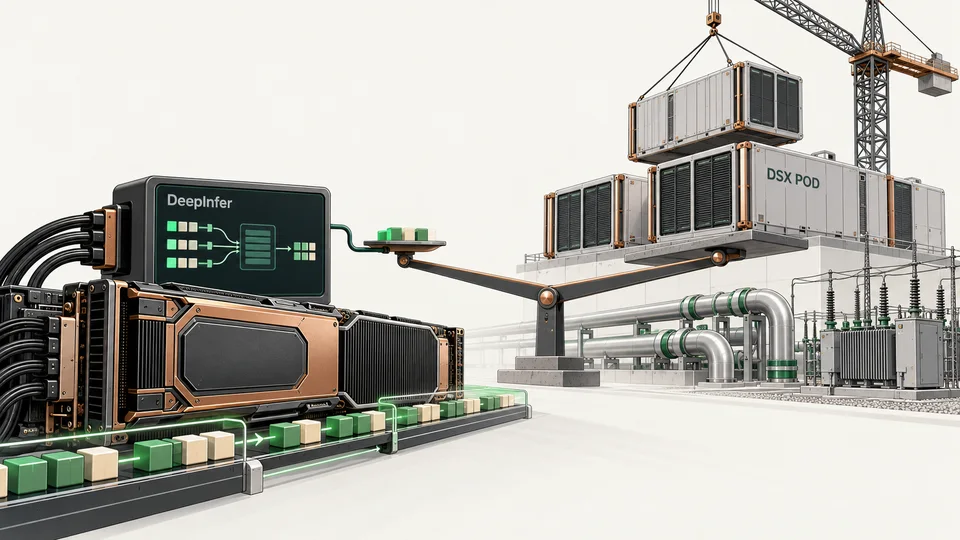
Low-Cost Intelligence vs. Expensive Ambitions: DeepInfer, DSX POD, and AI Investment Expansion

Issue 958 of “The Sequence Radar” examines inference software, modular AI factories, and enterprise AI investments side by side: cheaper per-inference does not necessarily mean lower overall industry spending. This article is compiled from the original publication and supplemented with technical scope and delivery terms based on DeepSeek and NVIDIA’s official materials.

推理软件效率与模块化AI基础设施投入的编辑示意,非实际产品照片
Timeline and related coverage

baseVultra: A novel compact nonlinear recurrent unit for focused candidate generation, outperforming LSTM and GRU in small-scale scenarios.

On October 24, 2026, arXiv published the paper arXiv:2610.30154v1, introducing a novel recurrent neural network unit called baseVultra. This model centralizes dense recurrent computations into a single H×H candidate generation matrix and replaces traditional gating matrices with O(H)-complexity diagonal interactions. Its effectiveness was validated in compact settings such as TinyShakespeare: under a 200K-parameter single-layer configuration, it achieved a validation loss of 1.594, outperforming LSTM (1.604) and GRU (1.616) with the same number of parameters, while its dense computation overhead is only about 54% of that of GRU.

baseVultra: Compact Nonlinear Recurrence with Reallocated Capacity

Why it matters:This study represents a new direction in the design of recurrent neural network architectures—shifting from a gate‑driven approach to a candidate‑generation‑driven one. Experiments span character‑level language modeling (TinyShakespeare, text8) and formal language probes (the Counter task), with results clearly demonstrating that its advantages are most pronounced in compact settings where hidden‑state capacity is limited (e.g., H=16), providing a well‑defined technical positioning supported by empirical evidence.

Timeline and related coverage

Research reveals systematic differences in evidence-location sensitivity among models with varying long-context lengths.

An empirical study published on October 24, 2026, on arXiv (paper ID 2610.31135v1) compared the positional bias of Transformer, state-space, and hybrid Mamba architectures in long-context question-answering tasks. It found that Transformer models generally exhibit an advantage in leveraging evidence from the initial positions, whereas state-space models lack this characteristic; however, both types of models tend to favor evidence from the end positions.

Mixing Matters: Evidence Position Bias Across Sequence Mixers in Long-Context Question Answering

Why it matters:This study, based on a controlled experimental design (with nine perturbed documents fixed and a single golden document slid), for the first time conducts a cross‑comparison of the positional sensitivity of three mainstream sequence‑modeling architectures within a unified evaluation framework. It reveals the strong coupling between model capabilities and architecture type, prompt engineering, and task characteristics, offering direct guidance for the design and tuning of long‑context AI systems.

Timeline and related coverage

chDB Durable Layer for agent memory

The chDB Durable Layer keeps agent memory fast to query locally while making its analytical state recoverable across laptops, CI jobs, and short-lived sandboxes.

ClickHouse release 26.9

ClickHouse 26.9 introduces conditional LIMIT boundaries, incremental refreshes for append-only materialized views, disk spilling for DISTINCT, time-limited tokens, and faster min/max/count queries.

Qwen2.5-1M: Deploy Your Own Qwen with Context Length up to 1M Tokens

Tech Report HuggingFace ModelScope Qwen Chat HuggingFace Demo ModelScope Demo DISCORD Introduction Two months after upgrading Qwen2.5-Turbo to support context length up to one million tokens, we are back with the open-source Qwen2.5-1M models and the corresponding inference framework support. Here’s what you can expect from this release: Opensource Models: We’re releasing two new checkpoints, Qwen2.5-7B-Instruct-1M and Qwen2.5-14B-Instruct-1M, marking the first time we’ve upgraded our opensource Qwen models to handle 1M-token contexts.