Skip to content
AI NEWS JOURNAL
AI, IN PERSPECTIVE

Search AI news

Search headlines, summaries and articles to connect the dots.

Newest first

SAGE Benchmark and GAR Framework Released: Advancing Multimodal Semantic Alignment Evaluation

On October 26, 2026, arXiv published the paper arXiv:2610.31838v1, introducing Sense-Aligned Grounding Evaluation (SAGE)—a unified 10-candidate image-selection benchmark—along with the training‑agnostic Gloss-Augmented Reasoning (GAR) framework, designed for cross‑noun, verb, and entity‑centered multimodal grounding evaluation.

新闻源配图 · arXiv cs.CL

Why it matters:This study is the first to unify three types of tasks—VWSD, VerSe, and WikiDiverse—under a term-centric grounded evaluation protocol, introducing a mechanism for identifying hard negative samples and context‑exchange diagnostics. Empirical results demonstrate that the synergistic effect of definition enhancement and constraint‑guided reasoning can significantly improve the Hits@1 metric (from 65.90 to 71.22), thereby providing a more fine-grained, interpretable new evaluation paradigm for multimodal semantic alignment.
Timeline and related coverage

How Much Do You Trust A Dog? Quantifying Hint-Following in Reasoning Language Models

arXiv:2610.32055v1 Announce Type: new Abstract: Large language models (LLMs) often exhibit sycophancy, altering their answers to align with user suggestions even on objective factual and reasoning tasks. Yet the quantitative form of this influence--- and whether it is calibrated to source reliability--- remains poorly understood. In this work, we investigate this behavior through hint-induced answer shifts on MMLU questions, evaluating prompts of the form ``[Source] thinks the answer is (X)''. We systematically vary the source to which the hint is attributed (a professor, a friend, or a dog) across three open-source model families, Qwen, Gemma, and SmolLM. We show that the change induced by the hint follows a predictable structure well-characterized by an exponential tilt: the hint induces

Timeline and related coverage

b11888

common, grammar: add recursive depth limit, make it a requirement (#31153) * common, grammar: add recursive depth limit, make it a requirement * catch more recursive functions * common : tidy up peg parser changes * grammar : reject candidates in a loop, without a depth limit The depth limit in llama_grammar_reject_candidates_for_stack counted the code points of a vocab token, so any token of 256 chars or more was always rejected under a grammar, such as the 512-space token of GLM-4.7-Flash or the long space tokens of Laguna-S-2.1. The rejection now walks the code points with its own stack of levels instead of recursing: there is no limit and no stack risk, whatever the length of a token from the GGUF, and the masks match master. * grammar : track rejected candidates as indices into the in

Timeline and related coverage

Research reveals the local geometric structure of semantic meaning in large language models

A paper published on October 24, 2026, on arXiv (ID 2610.30715v1) characterizes the local geometric properties of semantic meaning in embedding space across four decoder-only large language models—Gemma 4, Llama 3.2, Qwen 2.5, and Pythia—using cross-lingual probes and fine-grained probes.

Meaning Contracts: Local Semantic Geometry in Large Language Models

Why it matters:This study is the first to systematically characterize the invariance, variability, and refinement mechanisms within “the same semantic factor” in LLMs, proposing the “local anisotropic neighborhood” model. The approach has been validated through blind human evaluations, demonstrating rigorous methodology, broad model coverage, and cross-architecture consistency in its findings.

Timeline and related coverage

SIM-UT: A User Behavior Simulation and Evaluation Framework for Medical Triage Chatbots

Researchers have proposed SIM-UT (Simulation of User Behaviour for Triage), a multi-round, real-user-behavior–based evaluation method designed to identify eco‑valid failure patterns of large language model (LLM)-driven medical triage chatbots in real-world settings within low- and middle-income countries (LMICs).

SIM-UT: A User Simulation based Evaluation Framework for Medical Triage Chatbots

Why it matters:This framework breaks through the limitations of existing single-round, English‑centric evaluations by conducting over 5,000 rounds of multilingual simulated conversations, covering real‑world WhatsApp health programs in India, South Africa, and Kenya. For the first time, it systematically reveals “de‑escalation risk,” a critical failure mode, demonstrating both methodological innovation and significant clinical safety implications.

Timeline and related coverage

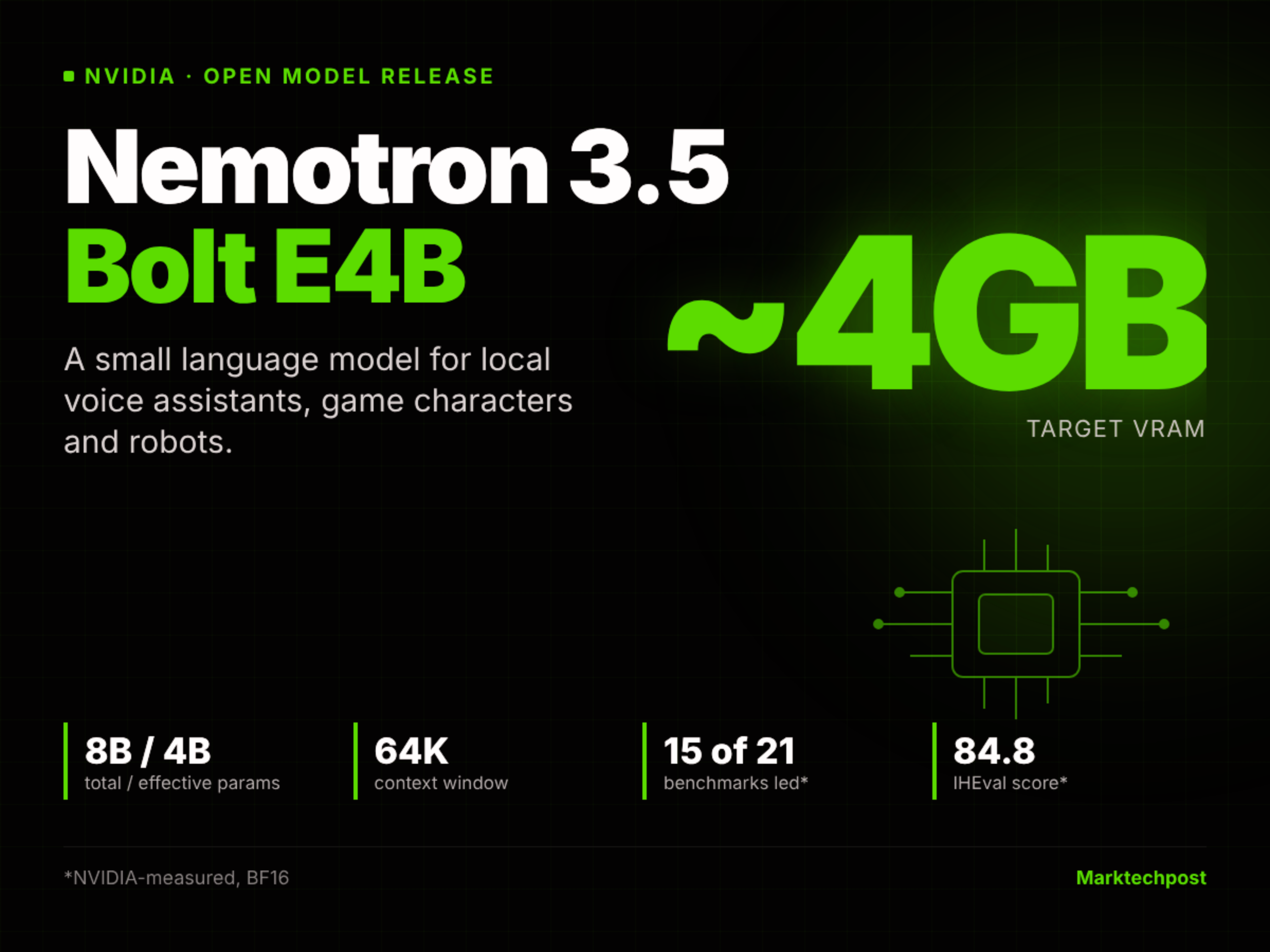
NVIDIA has released the open-source small language model Nemotron 3.5 Bolt E4B 4GB, optimized for on-device voice assistants, game NPCs, and robots.

NVIDIA, leveraging Google’s Gemma 4 E4B model and employing only reinforcement learning (RL) for post-training, has launched Nemotron 3.5 Bolt E4B 4GB—a small open-source language model with 8B total parameters, 4B effective parameters, and a 64K context window. It is designed to run on edge devices such as RTX and Jetson with approximately 4GB of VRAM, supporting multi-turn tool calls and low-latency voice interaction.

NVIDIA Releases Nemotron 3.5 Bolt E4B 4GB: An Open Small Language Model for Local Voice Agents, Game Characters and Robots
Timeline and related coverage

Google open-sources a medical foundation model to help implement global tuberculosis screening.

Google, together with partners such as Nexus AI, has brought a chest‑X‑ray–based AI tool for tuberculosis screening from the laboratory to primary‑care settings in six countries, and has open‑sourced multimodal foundation models like MedGemma and MedSigLIP, supporting offline deployment, localized adaptation, and data sovereignty.

Timeline and related coverage

Amazon SageMaker AI has launched a Multi-Step Reinforcement Learning (MTRL) framework, supporting end-to-end training of agents to accomplish multi-step tasks.

AWS has launched the Multi-Turn Reinforcement Learning (MTRL) feature, enabling users to train large‑model agents on SageMaker AI using full task trajectories and final outcome feedback, without requiring step‑level annotations. A end-to-end demonstration is provided using Wordle as an example, covering AgentCore deployment, data preparation, GRPO training, reward design, and cost analysis.

Timeline and related coverage

Amazon SageMaker AI has launched GPU-free managed model training sessions, now generally available.

AWS has announced that SageMaker AI’s serverless model customization feature now includes “Training Sessions,” which are fully available starting today. Users can independently define post-training logic—such as custom loss functions, reward signals, or multi‑round reinforcement learning—while the platform automatically handles GPU allocation, distributed execution, fault tolerance, and checkpoint storage.

Timeline and related coverage

Recursive releases Flint: a lightweight, AI-driven programming model that can run locally.

AI startup Recursive has unveiled Flint, an open-source coding model that it claims was developed primarily using its in-house AI research system, Eureka Machine. With just 40 billion parameters and only 2.5 billion activations in practice, the model can run offline on a standard laptop—such as an M4 Pro MacBook—at an inference speed of 131 tokens per second, outperforming most models of comparable size on benchmarks like SWE-Bench.

Timeline and related coverage

OpenAI's latest GPT-6 series models will be available on Google Cloud and the Antigravity platform.

OpenAI’s cutting-edge GPT-6 and 6.1 series models (Astra, Sol, Luna) will be launched on Google Cloud Model Garden in the coming weeks and integrated into Google’s agent-driven programming tool, Antigravity; this move makes Google the first mainstream cloud provider to offer all three major closed-source large models—Gemini, Claude, and GPT.

Timeline and related coverage

VocabX: Reduces the inference cost of domain-specific small language models by 77% through cost-weighted vocabulary specialization.

Dharma-AI has introduced the VocabX method, which reconfigures the vocabulary of language models for specific tasks—such as automated scoring of Portuguese essays—by optimizing for cost rather than word frequency. Without modifying the model architecture, parameters, or training pipeline, empirical results show a 77% reduction in inference costs, while the evaluation score (bench score) improved from 0.703 to 0.810.

Timeline and related coverage

AnyLanguageModel 1.0 released: a unified Swift interface supporting both local and hosted models, compatible with the entire Apple platform family of operating systems 27

Hugging Face has officially released AnyLanguageModel 1.0, an open-source Swift framework fully compatible with the Apple Foundation Models API. It supports seamless switching between local models (MLX, llama.cpp, Core ML) and hosted models (OpenAI, Anthropic, Gemini, Hugging Face Inference Providers, etc.), and introduces new features such as image input, tool invocation, guided generation, and automatic adaptation of inference chunks.

Timeline and related coverage

FairStress: A Novel Fairness Evaluation Framework for Symmetric Robustness in LLM Decision-Making

FairStress is a new benchmark that focuses on the decision stability, interpretability consistency, and internal representation symmetry of large language models (LLMs) in demographic identity substitution scenarios. It reveals systematic behavioral biases in these models, such as “anti-stereotypical over-correction,” and highlights that mainstream evaluation methods—like BBQ—may misjudge the direction of bias due to paradigmatic differences.

Timeline and related coverage

TorchNeuron launches public beta: Hugging Face models natively support AWS Trainium for training and inference.

Hugging Face, in collaboration with AWS, has launched TorchNeuron—a PyTorch-native Trainium backend—available for public beta starting October 20, 2026. This technology enables mainstream libraries such as Transformers and Diffusers to run directly on Trainium chips without any modifications, significantly enhancing the usability and compatibility of text-generation and image-generation models.

Timeline and related coverage