
Skip to content
AI NEWS JOURNAL
AI, IN PERSPECTIVE

Search AI news

Search headlines, summaries and articles to connect the dots.

Newest first

Apollo’s chief economist says AI delivers “zero financial return” to U.S. companies outside the tech industry.

Thorsten Sløk, Chief Economist at Apollo Global Management, analyzed the S&P 493 (the S&P 500 excluding seven tech giants) and found that non-tech firms’ profit margins are on par with per-capita revenue, with no evidence that AI has boosted productivity. He noted that AI lacks an understanding of key business factors such as accountability, trust, and corporate culture, and therefore has yet to deliver financial returns.

AI delivers ‘zero financial payoff’ to most companies, Apollo economist says

Why it matters:This view is based on empirical observations of the mainstream listed‑company universe (S&P 493), citing specific data ranges and limitations (excluding seven technology firms such as Alphabet and Amazon), and aligns with the findings of several recent studies, offering a verifiable analytical framework with clearly defined attribution boundaries.
Timeline and related coverage

b11881

llama : respect no_alloc in all memory caches (#31087) * llama : respect no_alloc in memory caches Assisted-by: dsh:llama.cpp/ggml-org/DeepSeek-V4-Flash-Vision-Exp-GGUF (Mac Studio, M2 Ultra, 192GB) * llama : TODO: move no_alloc out of llama_hparams Assisted-by: dsh:llama.cpp/ggml-org/DeepSeek-V4-Flash-Vision-Exp-GGUF (Mac Studio, M2 Ultra, 192GB) * llama : TODO: move no_alloc out of llama_hparams Assisted-by: dsh:llama.cpp/ggml-org/DeepSeek-V4-Flash-Vision-Exp-GGUF (Mac Studio, M2 Ultra, 192GB) **Website:** - **Attestations:** - **macOS/iOS:** - [macOS Apple Silicon (arm64)](https://github.com/ggml-org/llama.cpp/releases/download/b11881/llama-b11881-bin-macos-arm64.tar.gz) - macOS Apple Silicon (arm64, KleidiAI enabled) [DISABLED](https://github.com/ggml-org/llama.cpp/pull/23780) - [macOS

Timeline and related coverage

b11880

tools : reject truncated GGUF tensor data in merge (#31044) Co-authored-by: Shreya Agrawal **Website:** - **Attestations:** - **macOS/iOS:** - [macOS Apple Silicon (arm64)](https://github.com/ggml-org/llama.cpp/releases/download/b11880/llama-b11880-bin-macos-arm64.tar.gz) - macOS Apple Silicon (arm64, KleidiAI enabled) [DISABLED](https://github.com/ggml-org/llama.cpp/pull/23780) - [macOS Intel (x64)](https://github.com/ggml-org/llama.cpp/releases/download/b11880/llama-b11880-bin-macos-x64.tar.gz) - [iOS XCFramework](https://github.com/ggml-org/llama.cpp/releases/download/b11880/llama-b11880-xcframework.zip) **Linux:** - [Ubuntu x64 (CPU)](https://github.com/ggml-org/llama.cpp/releases/download/b11880/llama-b11880-bin-ubuntu-x64.tar.gz) - [Ubuntu arm64 (CPU)](https://github.com/ggml-org/lla

Timeline and related coverage

b11879

CUDA: fuse FFN gate/up matmuls and GLU in MMQ with interleaved gate/up rows (#29948) * cuda: fuse FFN gate/up and GLU in MMQ with interleaved gate/up rows For prompt processing, run the gate and up matmuls of a dense FFN as one mul_mat_q launch and apply the GLU in the write-back. - The loaders take the gate weights as a second pointer and fill the weight tile with up and gate rows interleaved in chunks of 8, so each thread holds an up value and the matching gate value (rows r and r + 8 of an MMA tile). - The MMA loop is unchanged: same tile, warp layout, vec_dot and one sum[] per thread. The fused write-back computes the GLU from registers and writes half the rows. - The fused path uses the regular tiling (no stream-k) with the column tiles innermost so that neighbouring blocks share weig

Timeline and related coverage

b11878

ggml-cuda: fuse qwen MRoPE + set-rows (#31025) **Website:** - **Attestations:** - **macOS/iOS:** - [macOS Apple Silicon (arm64)](https://github.com/ggml-org/llama.cpp/releases/download/b11878/llama-b11878-bin-macos-arm64.tar.gz) - macOS Apple Silicon (arm64, KleidiAI enabled) [DISABLED](https://github.com/ggml-org/llama.cpp/pull/23780) - [macOS Intel (x64)](https://github.com/ggml-org/llama.cpp/releases/download/b11878/llama-b11878-bin-macos-x64.tar.gz) - [iOS XCFramework](https://github.com/ggml-org/llama.cpp/releases/download/b11878/llama-b11878-xcframework.zip) **Linux:** - [Ubuntu x64 (CPU)](https://github.com/ggml-org/llama.cpp/releases/download/b11878/llama-b11878-bin-ubuntu-x64.tar.gz) - [Ubuntu arm64 (CPU)](https://github.com/ggml-org/llama.cpp/releases/download/b11878/llama-b11878

Timeline and related coverage

b11877

vulkan: Add a larger tile size for conv3d (coopmat2 only) (#29920) * vulkan: Add a larger tile size for conv3d (coopmat2 only) This adds a larger tile size, in practice it is only for coopmat2 where we don't need shared memory to store the output (would use more than 64KB). Add some additional representative backend tests. At least, this is what codex came up with from looking at sd.cpp Wan VAE. * only apply large tile size for newer driver versions **Website:** - **Attestations:** - **macOS/iOS:** - [macOS Apple Silicon (arm64)](https://github.com/ggml-org/llama.cpp/releases/download/b11877/llama-b11877-bin-macos-arm64.tar.gz) - macOS Apple Silicon (arm64, KleidiAI enabled) [DISABLED](https://github.com/ggml-org/llama.cpp/pull/23780) - [macOS Intel (x64)](https://github.com/ggml-org/llama

Timeline and related coverage

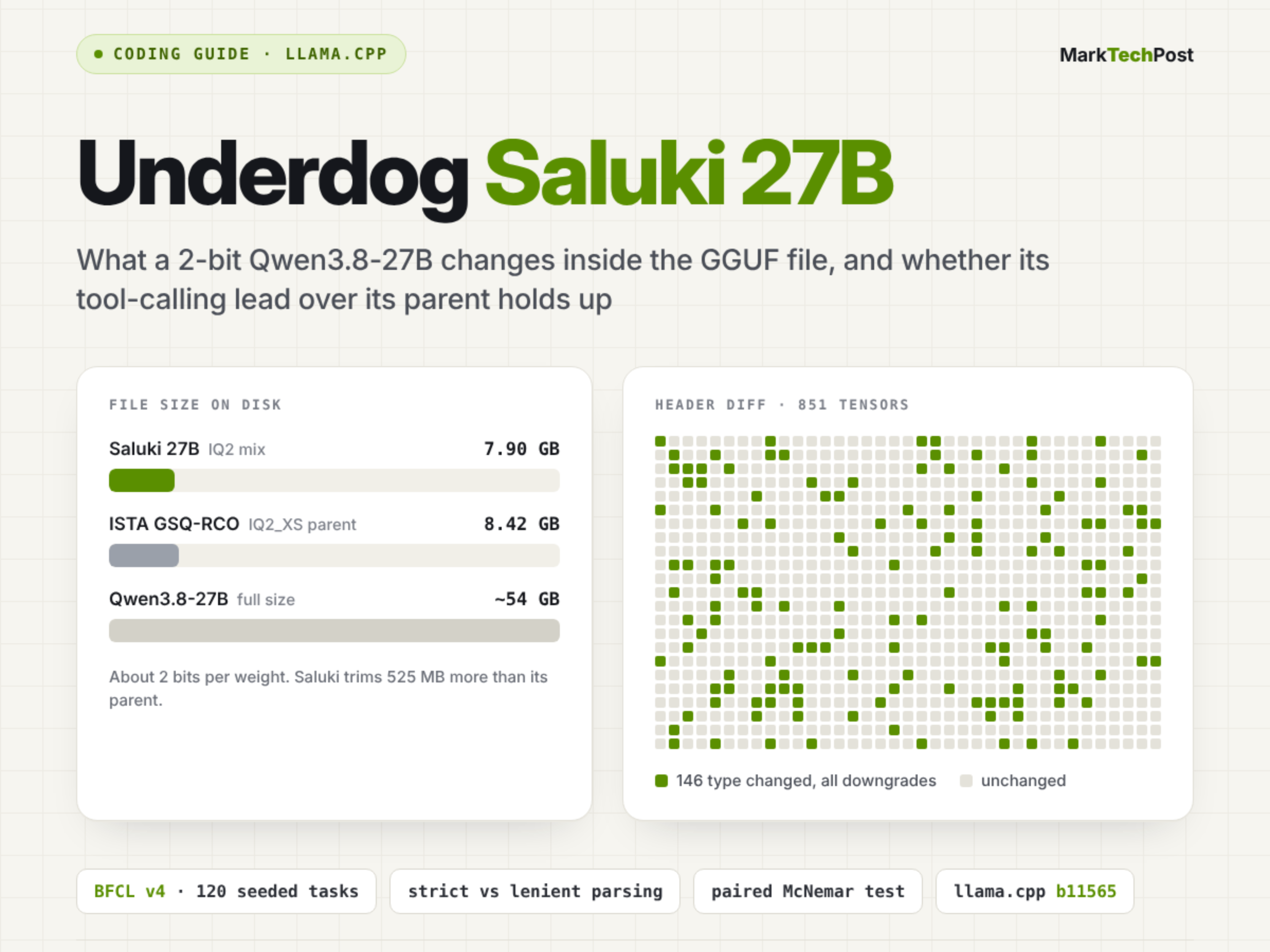
Underdog Saluki 27B: Technical Analysis of the 2-bit Qwen3.8-27B Tool-Calling Model Based on GSQ-RCO

This article introduces Saluki 27B, a model released by Underdog—a 7.9 GB, 2-bit quantized variant of Qwen3.8-27B—built using the GSQ-RCO method from ISTA-DASLab. It claims to outperform the original 54 GB full-precision model on the BFCL v4 benchmark across 120 tasks; however, all performance conclusions are based solely on the developers’ assertions and have not been independently verified.

How to Run Underdog Saluki 27B: 2-Bit Qwen3.8-27B Tool-Calling Guide
Timeline and related coverage

Apple’s first foldable-screen iPhone, the Duo, has already experienced widespread screen cracking shortly after going on sale.

Multiple users have reported that Apple’s first foldable smartphone, the iPhone Duo, develops screen cracks and splits right above the hinge shortly after unboxing, with failures occurring at a high rate. Cases have been documented in both Australia and China, reportedly due to tolerances in the hinge assembly. Apple has yet to issue an official response, and the outcome of the after-sales service assessment will determine whether the device will be replaced free of charge or require costly out-of-pocket repairs.

Why it matters:The incident involves widespread early‑stage quality issues with a new device, directly challenging the boundaries between consumer rights and corporate responsibility. Coupled with public concerns about the applicability of the “three‑guarantee” regulations and the positioning of AppleCare+ services, it carries significant warning implications and serves as a valuable reference for rights protection.

Timeline and related coverage

AI Graveyard: A Continuously Updated List of Failed AI Projects and Startups

TechCrunch reported on October 25, 2026, reviewing several AI projects from 2023 to 2026 that failed to meet expectations, including startups and products such as Relay, Character.ai, Sora, and Humane AI Pin, as well as failed attempts or major adjustments by major companies like OpenAI, Apple, and Microsoft.

The AI graveyard: a running list of projects and startups that didn’t make it

Why it matters:This report provides an industry‑wide, phenomenon‑driven overview, with broad coverage and a clear timeline (including specific shutdown or delay dates), and cites S&P Global Market Intelligence data to substantiate the high attrition rate—42%—of enterprise‑level AI projects. It combines detailed case studies with structural analysis, making it a highly valuable reference.

Timeline and related coverage

Recursive releases Flint: a lightweight, AI-driven programming model that can run locally.

AI startup Recursive has unveiled Flint, an open-source coding model that it claims was developed primarily using its in-house AI research system, Eureka Machine. With just 40 billion parameters and only 2.5 billion activations in practice, the model can run offline on a standard laptop—such as an M4 Pro MacBook—at an inference speed of 131 tokens per second, outperforming most models of comparable size on benchmarks like SWE-Bench.

Timeline and related coverage

eMudhra Intermediate CA Compromise

eMudhra Intermediate CA Compromise This is very, very bad news: The private keys of eight eMudhra intermediate CA certificates have been compromised. They chain to roots trusted by the Mozilla, Microsoft, Apple and Chrome root programs and by many downstream trust stores. Any software that bundles a list of trusted certificates needs to be updated. This site is tracking software updates via this GitHub repository - Linux distros need to update their ca-certificates packages. In Python world uv 0.13.4 and pip 26.2.2 and certifi 2026.10.19 have been released with upgraded certificate lists. There's a very informative thread about this on the official Python forum. Tags: encryption, https, pip, python, security, uv

Timeline and related coverage

AnyLanguageModel 1.0 released: a unified Swift interface supporting both local and hosted models, compatible with the entire Apple platform family of operating systems 27

Hugging Face has officially released AnyLanguageModel 1.0, an open-source Swift framework fully compatible with the Apple Foundation Models API. It supports seamless switching between local models (MLX, llama.cpp, Core ML) and hosted models (OpenAI, Anthropic, Gemini, Hugging Face Inference Providers, etc.), and introduces new features such as image input, tool invocation, guided generation, and automatic adaptation of inference chunks.

Timeline and related coverage