[AINews] Anthropic ends Coding Interviews: "Hunger beats tenure"
Since coding is solved, why code for the job?

Search headlines, summaries and articles to connect the dots.
Since coding is solved, why code for the job?
Researchers have proposed SIM-UT (Simulation of User Behaviour for Triage), a multi-round, real-user-behavior–based evaluation method designed to identify eco‑valid failure patterns of large language model (LLM)-driven medical triage chatbots in real-world settings within low- and middle-income countries (LMICs).

Why it matters:This framework breaks through the limitations of existing single-round, English‑centric evaluations by conducting over 5,000 rounds of multilingual simulated conversations, covering real‑world WhatsApp health programs in India, South Africa, and Kenya. For the first time, it systematically reveals “de‑escalation risk,” a critical failure mode, demonstrating both methodological innovation and significant clinical safety implications.
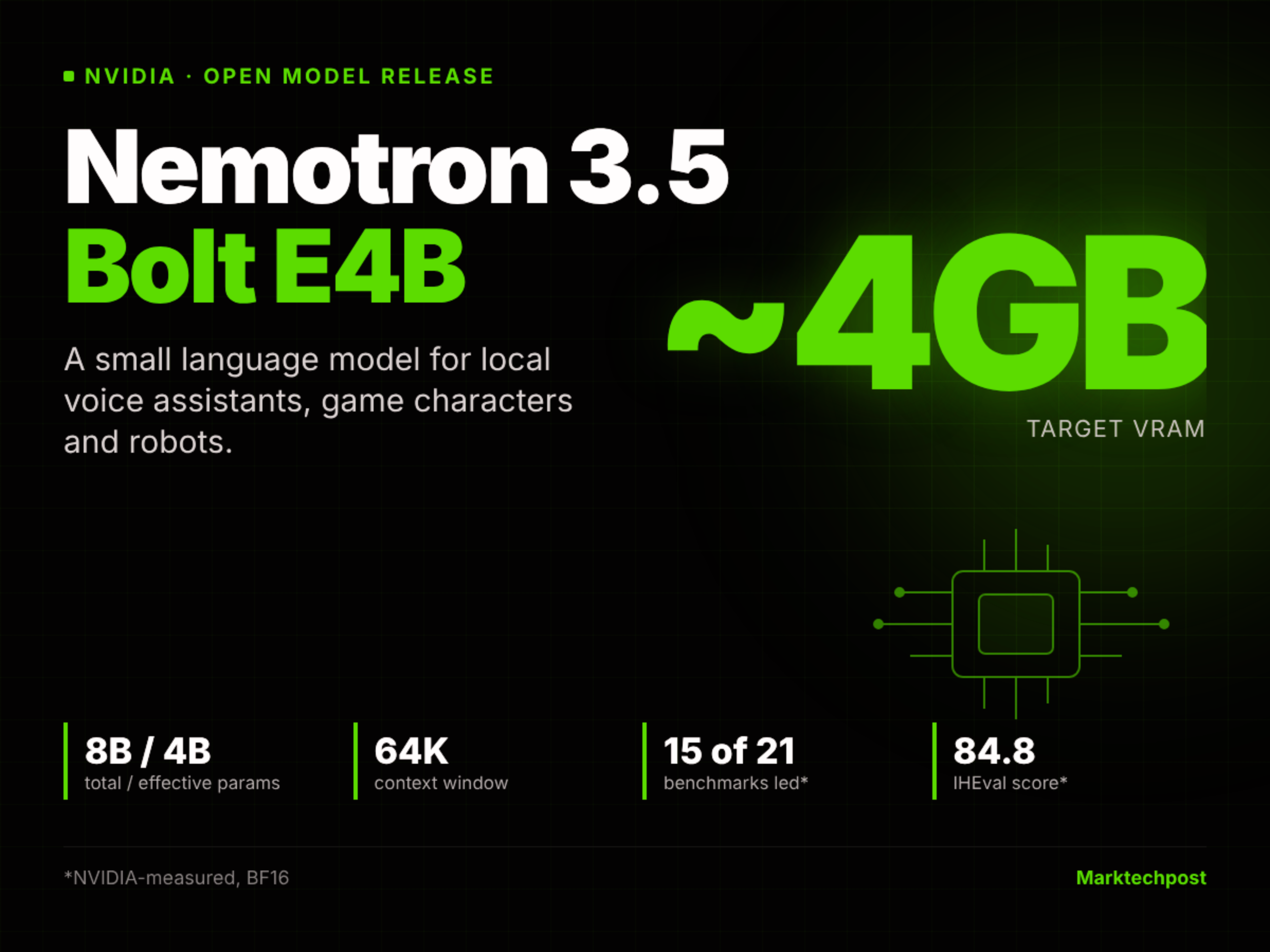
NVIDIA, leveraging Google’s Gemma 4 E4B model and employing only reinforcement learning (RL) for post-training, has launched Nemotron 3.5 Bolt E4B 4GB—a small open-source language model with 8B total parameters, 4B effective parameters, and a 64K context window. It is designed to run on edge devices such as RTX and Jetson with approximately 4GB of VRAM, supporting multi-turn tool calls and low-latency voice interaction.