
Measuring how AI agents handle everyday wet-lab science
OpenAI introduces BioBasicsBench, a 100-task benchmark measuring how well AI agents interpret raw experimental data and handle everyday wet-lab science.
Search headlines, summaries and articles to connect the dots.
OpenAI introduces BioBasicsBench, a 100-task benchmark measuring how well AI agents interpret raw experimental data and handle everyday wet-lab science.
arXiv:2611.07408v1 Announce Type: new Abstract: Panoptic Scene Graph generation (PSG) requires holistic yet fine-grained reasoning over complex relations among objects. However, current Multimodal Large Language Models (MLLMs) applied to PSG suffer from a perception bottleneck: they function as static observers limited by fixed-resolution views. As a result, models often overlook critical relations involving small or peripheral objects and struggle to differentiate ambiguous predicates in complex scenes. To address these limitations, we propose PSGAgent, an agentic framework that enhances visual perception for PSG through a think-act-observe loop. PSGAgent allows MLLMs to dynamically refine their visual perception using two tools: a Region Zoom-In Tool for local exploration of small or boundary relations and a Visual Highlight Tool for relation-focused segmentation that filters out irrelevant contextual noise. To optimize decision-making, we construct a two-stage training pipeline. First, we create a high-quality, error-aware Multimodal Chain-of-Thought (M-CoT) dataset that provides robust supervision for cold-start learning. Then, we design a novel hierarchical reward mechanism integrated with Group Sequence Policy Optimization (GSPO) to enable strategic and adaptive tool usage. Extensive experiments on the PSG benchmark show that PSGAgent achieves SOTA performance, demonstrating strong capability in both holistic and fine-grained scene understanding.
Phonon, a small text-to-speech model that runs entirely on the user's device without requiring internet access, has been released with support for English, French, German, Spanish, and Portuguese. Built on the Pocket TTS lineage using flow matching, Phonon achieves high-quality audio in compact sizes (65 MB and 75 MB), with the 31m version licensed under Apache 2.0 for commercial use. It excels in intelligibility and speed, ranking first in German and Spanish on Hugging Face's Open TTS Leaderboard and leading in CPU streaming benchmarks. The model supports voice cloning, custom voices via Gradium Studio, and integrates with Hugging Face Transformers. It is available in multiple formats and backends, including WebAssembly, GPU, and NPU, enabling deployment across phones, laptops, single-board computers, and browsers. Over 200,000 downloads were recorded in its first two weeks, with active developer adoption through tools like ExecuTorch, Micdrop, and Spaces. Future developments include support for additional languages, smaller models, and custom vocabulary fine-tuning.
arXiv:2611.05803v1 Announce Type: new Abstract: How much phonological knowledge do language models (LMs) possess about Chinese characters, and how is this knowledge represented and used? We introduce PinyinBench, a controlled benchmark covering homophones, phonological features (initials, finals, and tones), and polyphonic characters. We investigate 17 text-only and multimodal LMs through three complementary approaches: behavioral evaluation, layer-wise probing, and activation steering. Behaviorally, models demonstrate substantial knowledge of initials and finals, with a frontier model (DS-v4-flash) scoring 90%+ in homophone judgment, when two characters share no phonological features. However, its accuracy drops sharply to 72% when two characters differ only in lexical tone. Probing reveals that tone is highly decodable from embeddings and improves modestly across layers, whereas segmental information starts less decodable and improves substantially with depth. Activation steering shows that segmental representations can systematically influence generation, while tone exhibits much weaker effects. Furthermore, audio-bearing training improves phonological decodability, including tone, without corresponding improvements in steering effectiveness. Together, these findings reveal distinct representational and functional profiles for segmental and tonal information, with tonal information much harder to access and manipulate, demonstrating the necessity for combined evaluation, probing, and causal intervention for understanding linguistic knowledge in LMs.
arXiv:2611.04087v1 Announce Type: new Abstract: Scientific discovery builds on accurate observations interpreted through domain knowledge and reasoning. For scientific 3D data, this requires understanding structures and spatial relationships, from protein contacts to anatomical organization. Existing multimodal benchmarks largely evaluate text and 2D images, while scientific 3D evaluations vary in representations and protocols across disciplines, limiting cross-disciplinary comparison. To assess these foundational capabilities, we introduce ScienceVision, a cross-domain benchmark for scientific 3D understanding and reasoning through expert-level visual question answering (VQA). We construct 250 questions, with 50 each from Biology, Chemistry, Medical Imaging, Mechanical CAD, and Architecture, through a pipeline combining synthetic question generation with domain-expert review and annotation. Each task pairs a native 3D artifact with a scientific question, a specified response format, and a task-specific reference answer, requiring domain knowledge to be applied to geometric or topological evidence. We evaluate 12 models on the same questions in three settings: visual question answering with native 3D artifacts accessed through an agent harness's file and code-execution tools; the same workflow augmented with expert-inspired viewer inspection and measurement tools exposed through the Model Context Protocol (MCP); and visual question answering from prescribed rendered 2D images using an agent harness. All settings use the same task-specific deterministic final-answer scoring. The inspection environment supports view changes, target isolation, and slice inspection. In this main comparison, the best mean answer score is 0.53 out of 1. Mean scores in the native-artifact workflow without additional MCP tools exceed those in the rendered-image workflow for every model, by 17.2 percentage points on average.
arXiv:2610.38355v1 Announce Type: new Abstract: KV cache reuse accelerates LLM serving, but existing systems manage host DRAM and NVMe SSD as a tiered hierarchy where DRAM acts as an intermediate cache. Production LLM workloads break both premises of this hierarchy. First, bimodal reuse defeats DRAM temporal filtering, since workloads are dominated either by one-shot blocks with long reuse distances or by multi-gigabyte agentic sessions that exceed DRAM capacity, putting SSD on the critical read path. Second, DRAM staging and eviction-ordered layout bottleneck SSD restoration. Holding host staging buffers for in-flight prefixes causes contention under load that aborts prefetches, while incremental eviction scatters a session's blocks across the SSD and prevents large sequential reads. We p
Google DeepMind released Genie 4 as a research preview. The real-time world model adds native audio, live dialogue and text steering, with Gemini 3.8 Flash planning events inside the simulation loop. The post Meet Google DeepMind’s Genie 4: Real-Time World Model With Native Audio appeared first on MarkTechPost.

arXiv:2610.36178v1 Announce Type: new Abstract: We measure, without sampling error, the probability a language model assigns to each integer from 1 to N when asked for a random number. For a fixed prompt the model defines one probability vector, which we compute by summing over each integer's scored spellings rather than estimate by sampling, removing the noise that limits earlier studies [1, 4]. We evaluate 18 open-weight model lines at five ranges up to N = 100, under 29 decoding configurations, on two inference stacks; 15 of them have matched base and instruction-tuned checkpoints that both give usable answers. Instruction tuning makes the distribution less uniform in all 15 pairs. It installs one heuristic, round-number avoidance, and sharpens another, endpoint avoidance. Base checkpoi
NVIDIA Nemotron 3.5 Transcribe and Granary v2: Intelligent Multilingual Transcription You Can Prompt and Adapt
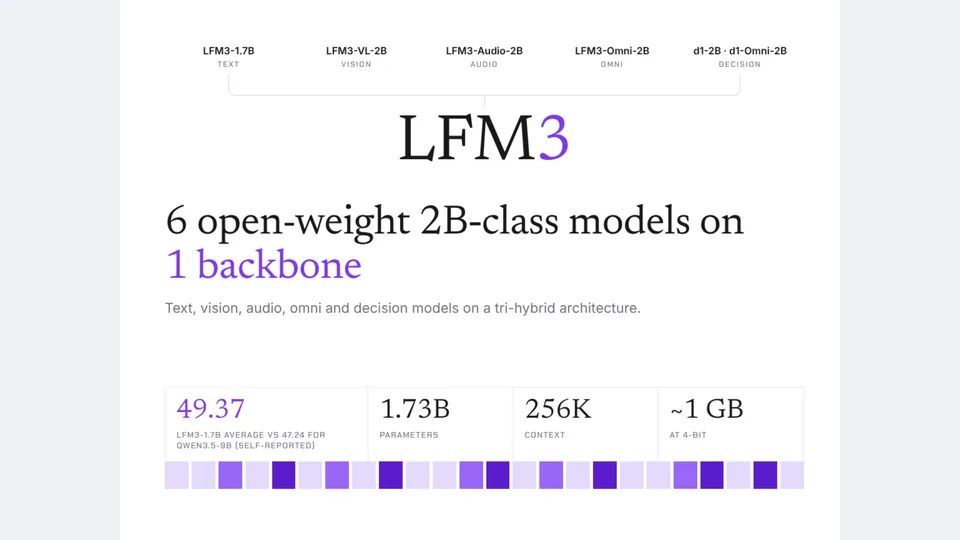
Liquid AI released LFM3, 6 open-weight 2B-class models for text, vision, audio, omni and decisions. LFM3-1.7B uses a tri-hybrid backbone, a 256K context window and fits in about 1 GB at 4-bit. The post Liquid AI Releases LFM3: 6 Open-Weight 2B-Class Multimodal Models appeared first on MarkTechPost.
We're at the start of a major effort to speed up drug development with Claude. Over the past several months, our scientists have engaged in deep research partnerships with six organizations developing new medicines.
Build specialized multimodal models with LFM3
On October 26, 2026, arXiv published the paper arXiv:2610.31838v1, introducing Sense-Aligned Grounding Evaluation (SAGE)—a unified 10-candidate image-selection benchmark—along with the training‑agnostic Gloss-Augmented Reasoning (GAR) framework, designed for cross‑noun, verb, and entity‑centered multimodal grounding evaluation.

Why it matters:This study is the first to unify three types of tasks—VWSD, VerSe, and WikiDiverse—under a term-centric grounded evaluation protocol, introducing a mechanism for identifying hard negative samples and context‑exchange diagnostics. Empirical results demonstrate that the synergistic effect of definition enhancement and constraint‑guided reasoning can significantly improve the Hits@1 metric (from 65.90 to 71.22), thereby providing a more fine-grained, interpretable new evaluation paradigm for multimodal semantic alignment.
On October 24, 2026, researchers published the paper arXiv:2610.30841v1 on arXiv, officially introducing the TRIAD benchmark—a new evaluation framework designed to assess the ability of text–image–audio tri-modal systems to resolve cross-modal ambiguities. The benchmark comprises 327 hand-crafted tri-modal samples, spanning 86 scenario groups and 18 categories of cross-modal ambiguity types.

Why it matters:This achievement directly addresses a core blind spot in current multimodal large-model evaluations: existing benchmarks focus on perception or reasoning under deterministic, single-modal inputs. In contrast, TRIAD is the first to systematically target “modal-complementary disambiguation” as its evaluation objective. Through rigorously designed leave-one-modal-out counterfactual tests, it reveals critical shortcomings—particularly in audio processing—and highlights weak scene-level robustness, thereby providing a reproducible diagnostic protocol and taxonomy for assessing next-generation all‑modal models.
The paper arXiv:2610.30158v1, published on October 24, 2026, introduces Lighthouse, the first digital assistant dedicated to exploring the history of the U.S. Civil Rights Movement, based on archival data from South Carolina. Its core innovation lies in adopting trustworthy content and user harm mitigation as design principles, employing a neuro-symbolic hybrid architecture that integrates large language models with rule-based symbolic reasoning.
Why it matters:This study is the first to apply AI‑assisted historical exploration to the sensitive and pivotal period of the Civil Rights Movement, explicitly introducing dual constraints—“trustworthiness” and “harm modeling”—which set it apart from general‑purpose chatbots. Its methodology (neurosymbolic integration), evaluation approach (including a human‑consensus‑based gold standard for subjective questions), and data scale (over 18,000 original archival documents) all hold significant academic demonstrative value.
GITHUB HUGGING FACE MODELSCOPE DEMO DISCORD Introduction In the past three months since Qwen2’s release, numerous developers have built new models on the Qwen2 language models, providing us with valuable feedback. During this period, we have focused on creating smarter and more knowledgeable language models. Today, we are excited to introduce the latest addition to the Qwen family: Qwen2.5. We are announcing what might be the largest opensource release in history!
GITHUB HUGGING FACE MODELSCOPE DISCORD 🚨 Qwen2.5-Math mainly supports solving English and Chinese math problems through CoT and TIR. We do not recommend using this series of models for other tasks. Introduction A month ago, we released the first series of mathematical LLMs - Qwen2-Math - of our Qwen family. Today, we have upgraded it and open-sourced Qwen2.5-Math series, including base models Qwen2.5-Math-1.5B/7B/72B, instruction-tuned models Qwen2.5-Math-1.5B/7B/72B-Instruct, and mathematical reward model Qwen2.
DEMO PAPER GITHUB HUGGING FACE MODELSCOPE DISCORD To achieve the objective of building an AGI system, the model should be capable of understanding information from different modalities. Thanks to the rapid development of large language models, LLMs are now capable of understanding language and reasoning. Previously we have taken a step forward to extend our LLM, i.e., Qwen, to more modalities, including vision and audio, and built Qwen-VL and Qwen-Audio. Today, we release Qwen2-Audio, the next version of Qwen-Audio, which is capable of accepting audio and text inputs and generating text outputs.
GITHUB HUGGING FACE MODELSCOPE DEMO DISCORD Introduction After months of efforts, we are pleased to announce the evolution from Qwen1.5 to Qwen2. This time, we bring to you: Pretrained and instruction-tuned models of 5 sizes, including Qwen2-0.5B, Qwen2-1.5B, Qwen2-7B, Qwen2-57B-A14B, and Qwen2-72B; Having been trained on data in 27 additional languages besides English and Chinese; State-of-the-art performance in a large number of benchmark evaluations; Significantly improved performance in coding and mathematics; Extended context length support up to 128K tokens with Qwen2-7B-Instruct and Qwen2-72B-Instruct.