
As AI agents reshape the web, Google opens Gemini and Search to more apps
A new developer platform will let businesses bring their services to Google's AI experiences, potentially changing how consumers discover and use apps.

Search headlines, summaries and articles to connect the dots.
A new developer platform will let businesses bring their services to Google's AI experiences, potentially changing how consumers discover and use apps.
The champion on the AI rankings may change, but the products users rely on every day don’t necessarily. The next round of competition in large models will hinge not just on whose model is stronger, but on turning a single use into a habit.
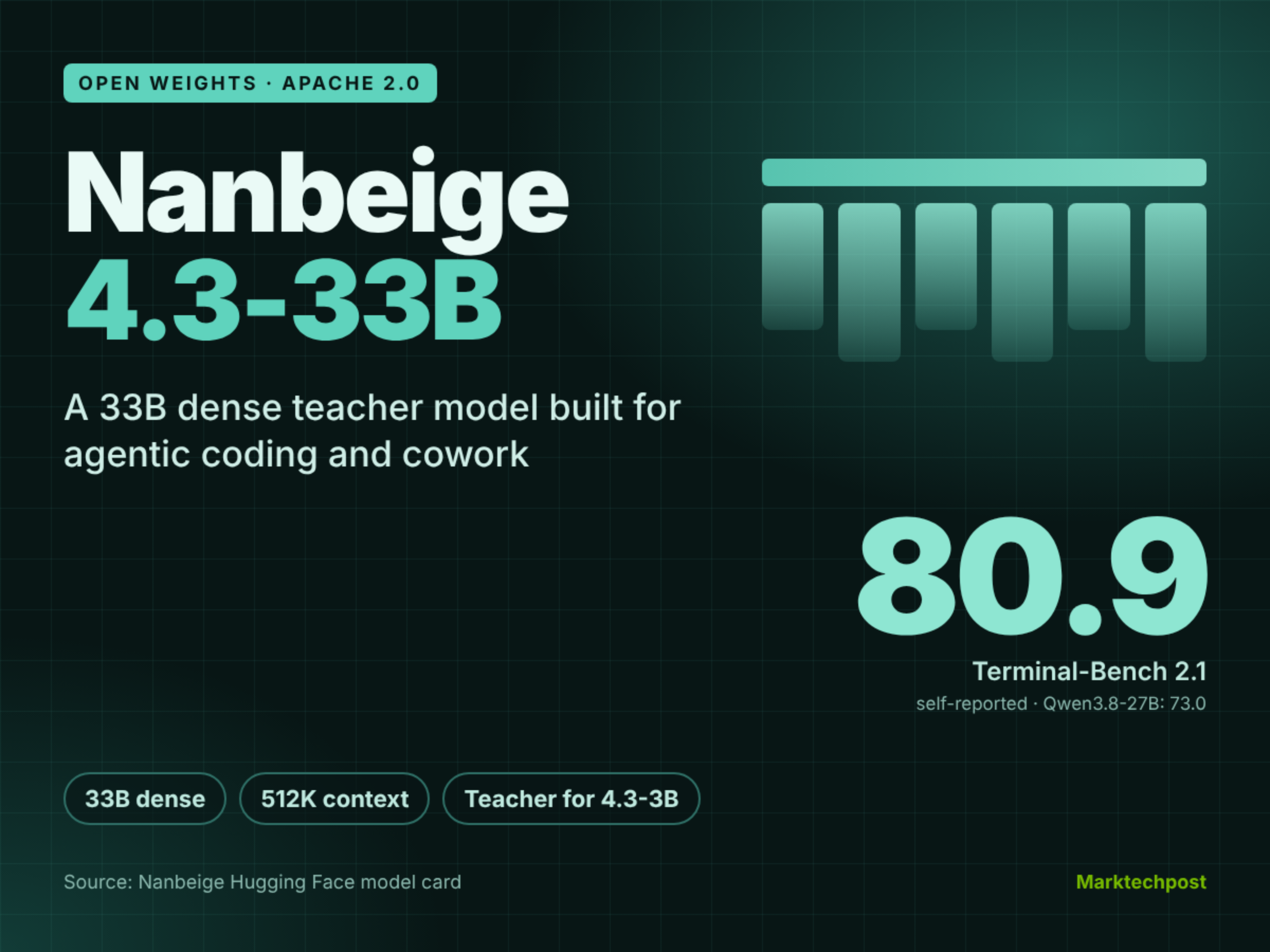
Nanbeige LLM Lab released Nanbeige4.3-33B, a 33B dense Apache 2.0 model with 512K context. It reports 80.9 on Terminal-Bench 2.1 and will teach the upcoming Nanbeige4.3-3B. The post Nanbeige Releases Nanbeige4.3-33B, a 33B Open Agentic Coding Model appeared first on MarkTechPost.
The study was published on October 24, 2026, on the arXiv platform (arXiv:2610.31193v1). Using a two-stage empirical framework, it analyzes how metadata composition influences large language models’ generation of artifact descriptions. The findings reveal that the sheer quantity of metadata does not account for differences in generative behavior; rather, the type of metadata field determines whether the model accurately anchors to factual information, ignores it, or fabricates details. Additionally, images can both support visual anchoring and exacerbate unfounded inferences.

Why it matters:This study challenges the common assumption that “more metadata necessarily enhances grounding,” designing controlled experiments based on the heterogeneity and regional imbalances of real museum collection metadata. It proposes that metadata-driven data-to-text systems should be evaluated at the field- and claim-level for support, rather than relying on coarse-grained metrics such as overall input coverage or reference similarity.
On October 22, 2026, 1Password launched a new platform called “1Password for Agents,” which allows users to authorize AI agents—such as Claude Duet, ChatGPT Work, Grok Bot, and others—to log into their personal accounts on their behalf. The agents themselves cannot access, store, or view the original passwords; the entire process relies on digital identity verification, real-time user confirmation, and automatic password filling by the password manager.
Anthropic has officially launched Claude Duet—an AI agent application for professionals and small businesses, built on the Claude Opus 5.5 model. It supports over 6,000 connectors, can automatically generate daily briefs, build dashboards, suggest actions, and perform background tasks; currently, it is available only to Pro and Max subscribers on a waitlist for trial use.
Walmart has officially launched Agent Gateway (an AI agent gateway) along with its accompanying Agent Profiles feature, enabling authorized AI agents—such as ChatGPT, Gemini, Meta Muse, and others—to perform searches and place orders on behalf of users across Walmart and Sam’s Club platforms. User control over agent activities is ensured through mechanisms like independent account configuration, transaction approvals, and spending limits. This move stands in stark contrast to Amazon’s recent ban on AI‑powered shopping agents.
Release: llm-meta-ai 0.2 Meta AI release Muse Wonder (and Muse Wonder Full), their new "most capable models". These look like they may be Meta's first Fable class models - Artificial Analysis scores Muse Wonder (Max) as equivalent to GPT-6.1 Sol. I updated my llm-meta-ai plugin for the new model. Here are pelicans for Muse Wonder for the six reasoning levels: minimal, low, medium, high, xhigh, max. This is the max one: For comparison, here are pelicans for Muse 1.3 (released September 2nd) and Muse 1.2 (released August 5th). Meta AI are putting out a new model a month, and the improvements between each model (at least in terms of drawing pelicans) are material. Tags: ai, generative-ai, llms, meta, pelican-riding-a-bicycle, llm-release