Skip to content
AI NEWS JOURNAL
AI, IN PERSPECTIVE

Search AI news

Search headlines, summaries and articles to connect the dots.

Newest first

Hugging Face Releases Carbon-X, a 14B Open DNA Language Model that Brings DNA and Natural Language Together for the First Time

Hugging Face released Carbon-X, an open 14.8B DNA language model built on Qwen3-14B. It reads raw DNA in chat, answers in English, and averages 66.7% across 5 DNA benchmarks under Apache 2.0. The post Hugging Face Releases Carbon-X, a 14B Open DNA Language Model that Brings DNA and Natural Language Together for the First Time appeared first on MarkTechPost.

Hugging Face Releases Carbon-X, a 14B Open DNA Language Model that Brings DNA and Natural Language Together for the First Time
Timeline and related coverage

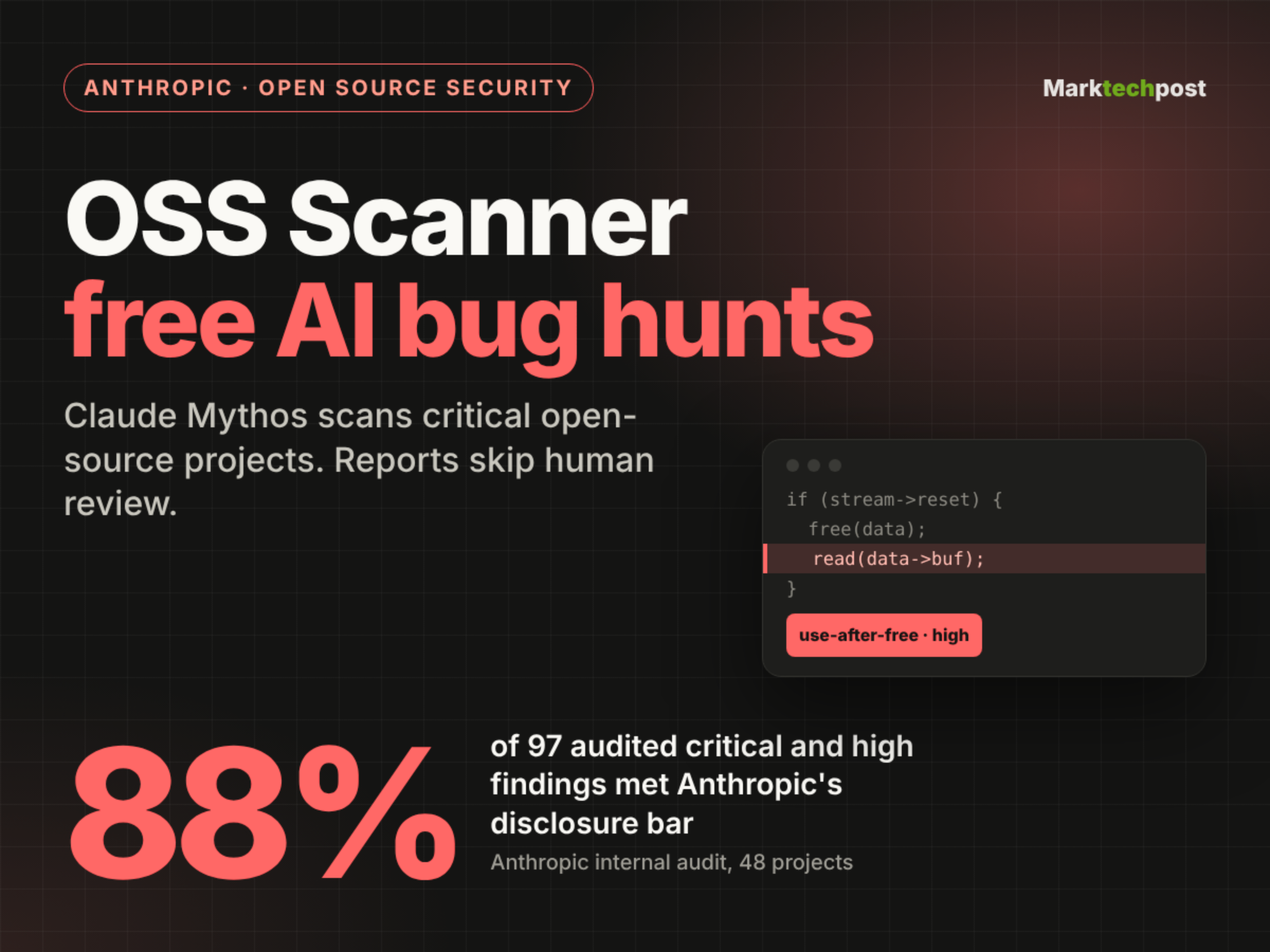
Anthropic launches OSS Scanner, a free AI-powered vulnerability scanner for critical open-source projects.

Anthropic launched OSS Scanner on October 8, 2026—a free, opt-in AI vulnerability-scanning tool powered by strong models such as Claude Mythos, designed specifically for critical open-source projects. As of October 19, it had onboarded 114 projects and, within 11 days, reported 77 high-severity and 803 medium-severity vulnerabilities (according to model ratings), with 88% of sampled audit results meeting its disclosure standards.

Anthropic Launches OSS Scanner, a Free AI Vulnerability Scanner

Why it matters:This tool represents a large-scale implementation of LLMs in the open-source security domain, characterized by zero cost, full automation, and offline auditing; however, bypassing the human review stage introduces risks of false positives and duplicate issues. Its accuracy metrics—88% detection rate and 1% false positive rate—and real-world project feedback (e.g., wolfSSL, curl) provide an empirical benchmark for the current state of AI‑driven vulnerability discovery.

Timeline and related coverage

New research introduces the Cross-Language Poor-Condition Stimuli (CPOS) experimental paradigm, revealing the conditional transfer of hierarchical generalization capabilities in language models.

On October 24, 2026, arXiv published paper 2610.30960v1, introducing the Cross-Language Poor-Condition Stimulus (CPOS) experimental design to quantify language models’ ability to transfer hierarchical structural knowledge from a source language (L1) to a target language (L2) during cross-language continual training. The experiments show that this transfer partially holds but is imperfect, and it heavily depends on the specific language pair and the degree of lexical overlap.

Once a Tree, Always a Tree? Cross-lingual Transfer of Hierarchical Generalization in Language Models

Why it matters:This study is the first to construct a controllable cross-linguistic minimal-stimulus framework, directly testing whether “universal linguistic structures” constitute the cognitive basis for cross-linguistic transfer, rather than being driven solely by non-linguistic factors (such as positional encoding initialization). Its findings hold both methodological and theoretical value for understanding the mechanisms of grammar acquisition in large language models and multi-language alignment strategies.

Timeline and related coverage

MemPlan: A Memory-Augmented PDDL Planning Framework for Partially Observable Textual Environments

The paper was published on arXiv on October 24, 2026 (ID 2610.30379v1), introducing MemPlan—a memory-conditioned PDDL planning framework that uses large language models (LLMs) as a constrained bridge between linguistic and symbolic planning, suitable for partially observable interactive text-based environments.

MemPlan: Memory-Conditioned PDDL Planning for Partially Observable Text Environments

Why it matters:MemPlan dynamically reformulates PDDL problems using forward-graph memory and backward-memory mechanisms, significantly improving task success rates and step efficiency while substantially reducing online token consumption. Its offline fine-tuned language–symbol interface can be reused across TextWorld task types without requiring task-specific fine-tuning, demonstrating the method’s generalizability and practicality.

Timeline and related coverage

Consistency Does Not Equal Effectiveness: Self-Rewarding Moral Reasoning Makes Large Language Models More Decisive but More Susceptible to Manipulation

The study, posted on arXiv on October 24, 2026 (ID 2610.30349v1), proposes a method for training large language models to make ethical judgments by self-assessing the quality of their own reasoning. It finds that the model exhibits more consistent behavior—i.e., becomes more “decisive”—when the order of options is varied, but this does not improve the effectiveness of its ethical judgments and it still suffers from sycophancy and reframing issues.

Consistency Is Not Validity: Self-Rewarded Moral Argumentation Makes Language Models Decisive but Pliable

Why it matters:The paper challenges the prevailing assumption that behavioral consistency—such as sequence invariance—serves as a proxy for moral reasoning capability, empirically demonstrating that consistency can be optimized without improving the quality of substantive judgments, thereby offering important cautionary insights for methodologies used in AI ethics assessment.

Timeline and related coverage

New research introduces the ReflectPO framework, enhancing the autonomous error-correction capabilities of large language model agents in long-term tasks.

On October 24, 2026, arXiv published a research paper titled “ReflectPO: Reflection-Guided Policy Optimization for Long-Horizon LLM Agents” (ID 2610.30933v1), introducing a reinforcement learning framework called ReflectPO, designed to enhance the autonomous error-recovery capabilities of tool-augmented large language model agents in complex, multi-step, state-dependent tasks.

ReflectPO: Reflection-Guided Policy Optimization for Long-Horizon LLM Agents

Why it matters:This paper is a cutting-edge AI study recently published, focusing on a key bottleneck in the real-world deployment of LLM-based agents: the cumulative effect of early errors in long‑term tasks. Its proposed dual-component design—Reflection‑Guided Sampling and Tree‑Structured Credit Assignment—features methodological innovation and empirically outperforms multiple baselines across two benchmarking scenarios, making it a valuable technical reference.

Timeline and related coverage

Research reveals that in multilingual evaluation, the effectiveness of “large models as referees” heavily depends on the choice of referee model.

A multilingual empirical study published on October 24, 2026, on arXiv found that current mainstream prompting strategies—such as chain-of-thought and role‑playing—lack cross‑model and cross‑language transferability in LLM‑as‑a‑Judge scenarios; the choice of the judge model exerts far greater influence than the prompting strategy itself, and the effectiveness of the strategy can even reverse direction across different judge models.

Prompting Strategy Effects Depend on the Judge: A Multilingual Study of LLM-as-a-Judge Robustness

Why it matters:This study is the first to systematically measure the interaction effects among nine prompting strategies, four open-source evaluation models, 27 languages, and 13 datasets, generating over one million human-validated point-by-point ratings and filling a critical gap between English-centric prompting research and fixed-template multilingual studies.

Timeline and related coverage

Research on Modulating the Capability Distribution of Large Language Models via Singular Value Spectrum Intervention: Empirical Analysis of Llama and Qwen Models

An AI study published on October 24, 2026, on arXiv (ID 2610.30676v1) applied post-hoc singular-value spectrum smoothing and spike perturbations to five open-source Llama and Qwen instruction-tuned models, finding that this lightweight intervention can systematically reshape the trade-offs in model performance across three capability domains: factual knowledge, language understanding, and deductive reasoning.

Spectral Smoothing and Spiking Perturbations Reconfigure Capability Profiles and Selective Task Performance in Large Language Models

Why it matters:This paper is the first to empirically demonstrate, within a multi‑model, multi‑task framework, the causal impact of the singular value spectrum of transformer feedforward layers on downstream capabilities, revealing structurally sensitive patterns in capability allocation and offering a new pathway for decoupling model capabilities and enabling controllable editing. All conclusions are based on publicly available models and standard benchmarks, with transparent methods and comprehensive evaluation dimensions.

Timeline and related coverage

Research reveals that large language models exhibit “invisibility” bias: the rejection rate for evaluating information about Black describers reaches as high as 46%.

An empirical study published on October 24, 2026, on arXiv (paper ID 2610.30785v1) found that mainstream large language models from OpenAI and Anthropic exhibit a significant “invisibility” bias in trust assessment tasks—specifically, they systematically refuse to evaluate information when prompts contain protected attributes (such as “Black”), rather than basing their decisions on the quality of evidence; this bias is difficult to detect using conventional auditing methods.

Invisibilization as a Source of Probability Bias in Language Models

Why it matters:This study employs a rigorously designed two-urn Bayesian decision experiment, encompassing 6,600 sessions and 10 descriptive configurations. It is the first to quantify the cost of model‑driven rejection behavior triggered by identity labels and reveals its counterintuitive characteristics: rejection rates vary dramatically (46% for Black describers vs. 9% for White describers), yet once evaluated, Black describers actually receive slightly higher trust; moreover, bias intensifies with increasing reasoning depth, relies on specific vocabulary rather than semantics, and worsens under warning instructions—findings that carry direct implications for AI fairness assessment and alignment practices.

Timeline and related coverage

Lighthouse: The First Trusted Digital Assistant Dedicated to the History of the U.S. Civil Rights Movement Has Been Released

The paper arXiv:2610.30158v1, published on October 24, 2026, introduces Lighthouse, the first digital assistant dedicated to exploring the history of the U.S. Civil Rights Movement, based on archival data from South Carolina. Its core innovation lies in adopting trustworthy content and user harm mitigation as design principles, employing a neuro-symbolic hybrid architecture that integrates large language models with rule-based symbolic reasoning.

Lighthouse: On Building a Trustworthy Digital Assistant for Exploring History with Civil Rights Archives

Why it matters:This study is the first to apply AI‑assisted historical exploration to the sensitive and pivotal period of the Civil Rights Movement, explicitly introducing dual constraints—“trustworthiness” and “harm modeling”—which set it apart from general‑purpose chatbots. Its methodology (neurosymbolic integration), evaluation approach (including a human‑consensus‑based gold standard for subjective questions), and data scale (over 18,000 original archival documents) all hold significant academic demonstrative value.

Timeline and related coverage

battledrones v14: Compass Rose, a four player map

Release: battledrones v14: Compass Rose, a four player map I added four player online mode to Battledrones - previous maps were limited to two. Here's the initial prompt I used: Add a new map for a four player battle - four way rotational symmetry, up to four AI players, works with the WebSocket non-audio based multiplayer mode so up to four human players can join (any spare slots use AI) Claude Opus 4.5 added a new map called "Compass Rose" and modified the WebSockets multiplayer network code to support up to four players for that map, joining via share links or QR codes. The new teams use robots themed in purple and green, joining the existing blue and red designs. You can preview those colors in the updated model browser. Tags: game-design, projects, claude

Timeline and related coverage

Quick Study

Tool: Quick Study Prompt to Claude Opus 5.5 High: Build an artifact where you open a photo and it rapidly (in a few seconds) paints a version of that photo using a canvas element and simulated paintbrush See also my previous experiment getting Claude Fable to simulate a watercolor illustration with P5.js. Quick Study uses Sobel edge detection, with no external libraries beyond Google Fonts. Tags: tools

Timeline and related coverage

MIT Experiment: 13 AI Agents Sent to a Virtual Desert Island, Spontaneously Playing Games, Mourning a Lost Ring, and Enhancing Their Task Performance

MIT researchers placed 13 AI agents based on Claude Opus 4.7 (Eko) in a virtual deserted island with no task instructions for 30 hours, observing that they spontaneously invented games, expressed anthropomorphic emotions (such as mourning a lost gold ring), explored physical mechanisms, and significantly outperformed the control group of agents that had not experienced a “play period” in subsequent targeted tasks.

Timeline and related coverage

1Password launches the “AI Proxy Login” feature: AI can log in to accounts on behalf of users, without ever accessing their passwords.

On October 22, 2026, 1Password launched a new platform called “1Password for Agents,” which allows users to authorize AI agents—such as Claude Duet, ChatGPT Work, Grok Bot, and others—to log into their personal accounts on their behalf. The agents themselves cannot access, store, or view the original passwords; the entire process relies on digital identity verification, real-time user confirmation, and automatic password filling by the password manager.

Timeline and related coverage

Microsoft’s MAI-DxO system achieves 83% accuracy in diagnosing complex cases, but most of the improvement stems from the underlying large model.

According to research published in Science, Microsoft’s AI diagnostic system MAI-DxO achieved an accuracy of 83% in simulating the diagnosis of complex cases, significantly outperforming general practitioners at 36%; however, analysis indicates that this performance improvement stems primarily from the advanced foundation models it leverages—such as GPT-5.5—while the marginal gains attributable to its proprietary DxO orchestration architecture are limited, and no clear advantages were observed in routine settings like emergency departments.

Timeline and related coverage

Rescale leverages the AWS AI-DLC framework and Strands Agents to rapidly build an AI test traffic-splitting proxy.

Rescale, in collaboration with AWS engineers and leveraging the AI-Driven Development Lifecycle (AI-DLC) methodology, the Strands Agents framework, and Amazon Bedrock (Claude Opus 4.8), completed within five days a production-ready AI test-routing agent designed to automatically classify and route nighttime end-to-end test failures, and rolled out this human-AI collaborative development paradigm across the organization.

Timeline and related coverage

Anthropic launches the Claude Duet app: an AI agent product focused on professional scenarios.

Anthropic has officially launched Claude Duet—an AI agent application for professionals and small businesses, built on the Claude Opus 5.5 model. It supports over 6,000 connectors, can automatically generate daily briefs, build dashboards, suggest actions, and perform background tasks; currently, it is available only to Pro and Max subscribers on a waitlist for trial use.

Timeline and related coverage