
How We Built Our Design Agent
How LangChain built Content Studio, an open-source design agent in Slack that makes on-brand videos, graphics and decks, and the harness that powers it.
Explore the complete news stream by source, topic and date.
How LangChain built Content Studio, an open-source design agent in Slack that makes on-brand videos, graphics and decks, and the harness that powers it.
Seekable OCI (SOCI) indexing for Amazon SageMaker AI training and processing jobs takes full container image download off the critical path. SageMaker AI lazy-loads your image to start containers in seconds instead of minutes, with no changes to your job definition. See the benchmarks and how to adopt it.
NVIDIA RTX Spark is a new Windows PC platform for AI development, creation, and gaming in slim laptops and compact desktops. Powered by an NVIDIA Blackwell RTX...
Property Finder found that 96.8% of their vision-AI evaluation labels were inherited from the incumbent model, hiding its true accuracy. See how they built unbiased ground truth, applied evolutionary prompt optimization, and selected a more accurate, cost-effective model on Amazon Bedrock, cutting cost by 86% across 11 image-quality attributes.
In this post, we show how Exowatt used Amazon SageMaker AI serverless model customization to build a repeatable AI pipeline that produces task-specific fine-tuned models for two deployment targets, edge and cloud, achieving higher accuracy than frontier models at up to 49x lower cost.
Enterprises racing toward AI automation are finding that where their models and data run matters as much as what the models can do. Regulatory pressure, rising token costs and fear of lock-in are pushing companies to demand more control over their AI workloads. That demand is shaping how data platform providers pitch their next act. […] The post Cloudera bets portability, not agents, will set it apart in enterprise AI appeared first on SiliconANGLE.
Google DeepMind released Genie 4, a world model with real-time audio, more realistic simulations, and mid-simulation text prompts, in research preview for trusted testers.

KOHO explains why AI self-serve analytics needs a strong data culture and a governed dbt foundation first.
On October 27, 2026, Mozilla updated Firefox’s AI browsing feature, Smart Window, introducing a new capability to intelligently fill out forms based on the user’s currently open tabs. This feature supports extracting information from websites such as LinkedIn and personal portfolios to automatically populate multi-field forms like job application forms.
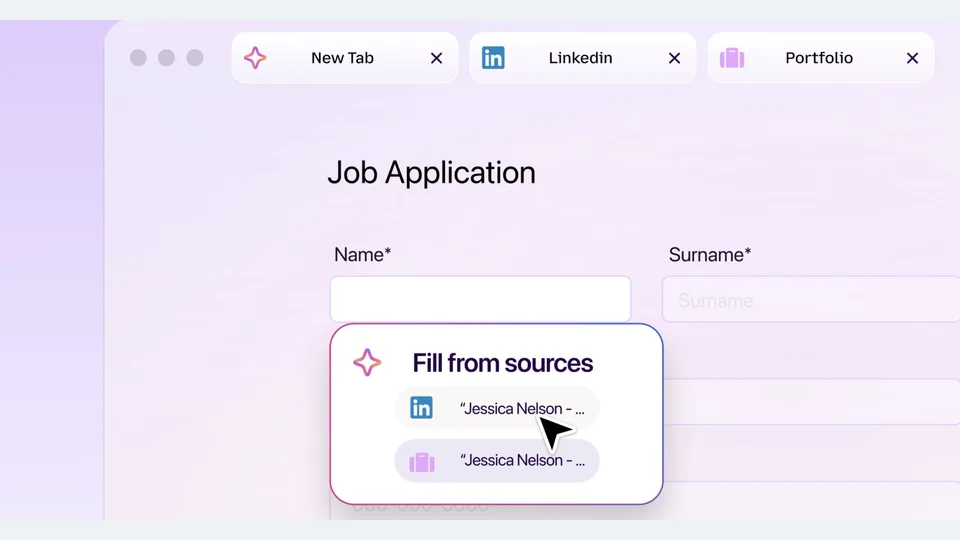
Why it matters:This update represents a significant advancement in Firefox’s recent AI feature iterations. As reported by The Verge and clearly dated October 27, 2026, the announcement focuses on specific interaction logic and use cases, with complete information elements and clear sources. However, it does not disclose technical implementation details, data processing methods, or privacy policies, nor does it specify whether this feature has been rolled out to all users or remains limited to certain testing channels.
As AI adoption expands globally, people across languages and cultures are using it in more aspects of their daily lives. General-purpose language models serve...
A government watchdog is considering a probe into the Home Office’s use of ChatGPT technology to process asylum claims amid concerns over the tools’ accuracy and secrecy surrounding their use.
There are 57 million people worldwide living with dementia today. For the researchers working to help them, the obstacle isn’t a lack of effort — it’s too much data, too few experts to synthesize it and a pace of discovery that can’t keep up with the disease. The Consortium for Biomedical Research and AI in […]

Generating tokens faster starts with identifying what limits inference performance. In the batch-size-1 evaluation of Ling-3.0-flash from Inclusion AI on NVIDIA...
Rohit Patel is departing Meta after eight years working on AI evaluations and reinforcement learning, TechCrunch has exclusively learned. His startup, Ndoc, aims to take on Microsoft Office Suite.

How to set up and run an offline coding agent using OpenCode, Ollama and Qwen.
Lots of visuals to use and learn with.
This episode of Lex Fridman was divided into 13 topics. The guests were three: Steven Brunton, who researches fluid dynamics at the University of Washington; Ankur Moitra, who works on theoretical computer science at MIT; and Alex Kontorovich, who studies number theory and Lean at Rutgers University. The video discussed the Navier–Stokes equations, the Riemann hypothesis, and computational complexity theory, prompted by AI’s claims—within just a few weeks—to have solved long-standing open problems in each of these fields. Drawing on their respective areas of expertise, the three mathematicians dissected...

Enterprise voice artificial intelligence company Regal Voice Inc. today added Goal Oriented Agents to its platform, enabling businesses using them to define what a call has to accomplish, and providing two AI models that split the work of getting there. The new agents are aimed at a problem Regal says shows up in calls such […] The post Regal debuts Goal Oriented Agents, putting an actor and a director model on every call appeared first on SiliconANGLE.
After the release of K3.1 Pro, due to numerous users reporting that their quotas were being depleted too quickly, Moonshot AI urgently issued an announcement stating, “The issue lies with us, and we should have fixed it sooner.” Alongside compensating affected users, Moonshot AI also indicated that it would “reduce unnecessary sub-agent calls and output lengths.” Just two days before the model went live, Anthropic published an article titled “Building agents: When to fold subagents into your main agent loop,” which addressed precisely the topic of sub-agents. Anthropic concluded that, by comparing Claude deployments across multiple companies, they found that a single agent equipped with specific skills actually outperformed “a group of...”

With an increasing number of vehicle models being designated for specific suppliers, business conditions are not necessarily improving; TianTong Weishi’s mass-production experience highlights the commercialization challenges faced by autonomous-driving system providers.