Skip to content
AI NEWS JOURNAL
AI, IN PERSPECTIVE

All AI updates

Explore the complete news stream by source, topic and date.

Newest first

b11895

metal : stop overflow from happening in large matrix output offsets (#30072) * Metal : stop overflow from happening in large matrix output offsets Assisted-by: Codex * metal : widen batch offsets and MUL_MAT_ID token indices Assisted-by: Codex --------- Co-authored-by: feni6 <270037094+feni6@users.noreply.github.com> **Website:** - **Attestations:** - **macOS/iOS:** - [macOS Apple Silicon (arm64)](https://github.com/ggml-org/llama.cpp/releases/download/b11895/llama-b11895-bin-macos-arm64.tar.gz) - macOS Apple Silicon (arm64, KleidiAI enabled) [DISABLED](https://github.com/ggml-org/llama.cpp/pull/23780) - [macOS Intel (x64)](https://github.com/ggml-org/llama.cpp/releases/download/b11895/llama-b11895-bin-macos-x64.tar.gz) - [iOS XCFramework](https://github.com/ggml-org/llama.cpp/releases/dow

Timeline and related coverage

b11890

deepseekv4.1: follow-up review fixes (#31137) * kv-cache : use ggml_backend_tensor_copy to refill the DSV4 K mirrors * llama : move the Engram pad id to llama_hparams and the token map to llama_model The saver no longer needs the deepseek41 model class. * deepseek41 : drop the F32 src1 request on the HC mixes matmul * ggml : add softplus TODOs in the backends that still use log(1 + exp(x)) * convert : make the DSV4/DSV4.1 modify_tensors generators, drop the redundant vision filter * deepseek41 : clean up comments * deepseek41 : drop the F32 src1 requests on the router and indexer matmuls * convert : use format_tensor_name directly in DeepseekV4Model * s/comp_kv_src/comp_il_src/g * cont : fix TODOs for log1p --------- Co-authored-by: Georgi Gerganov **Website:** - **Attestations:** - **macO

Timeline and related coverage

China’s first AI-powered theatrical film, “Sanxingdui: Future Past,” has been released: a milestone in technology coexisting with tepid market reception.

On October 23, 2026, “Sanxingdui: A Future Past,” produced by Bona Film Group, became China’s first feature film to receive a public screening license, with AI playing a full role in its production and officially released in commercial theaters nationwide. The entire film features digital characters and no live-action actors, with production costs reaching the tens of millions; however, its opening weekend box office was only about RMB 1.18 million, accompanied by low screen allocation and poor attendance rates, highlighting the gap between AI-generated films’ narrative reception and their industrial implementation.

Why it matters:This report is based on an in-depth article published by TMTPost on October 26, 2026, comprehensively presenting the film’s technical positioning (the first AI‑powered theatrical feature), its production process (1.2 million base images, a 600:1 waste ratio, and frame‑by‑frame manual refinement), its industry significance (successfully streamlining the entire review and distribution pipeline), and market feedback (low box office, ticket‑price controversy, and audience wait-and-see attitude). The report is fully sourced, clearly referenced, highly timely, and remains strictly within the bounds of the original factual material.

Timeline and related coverage

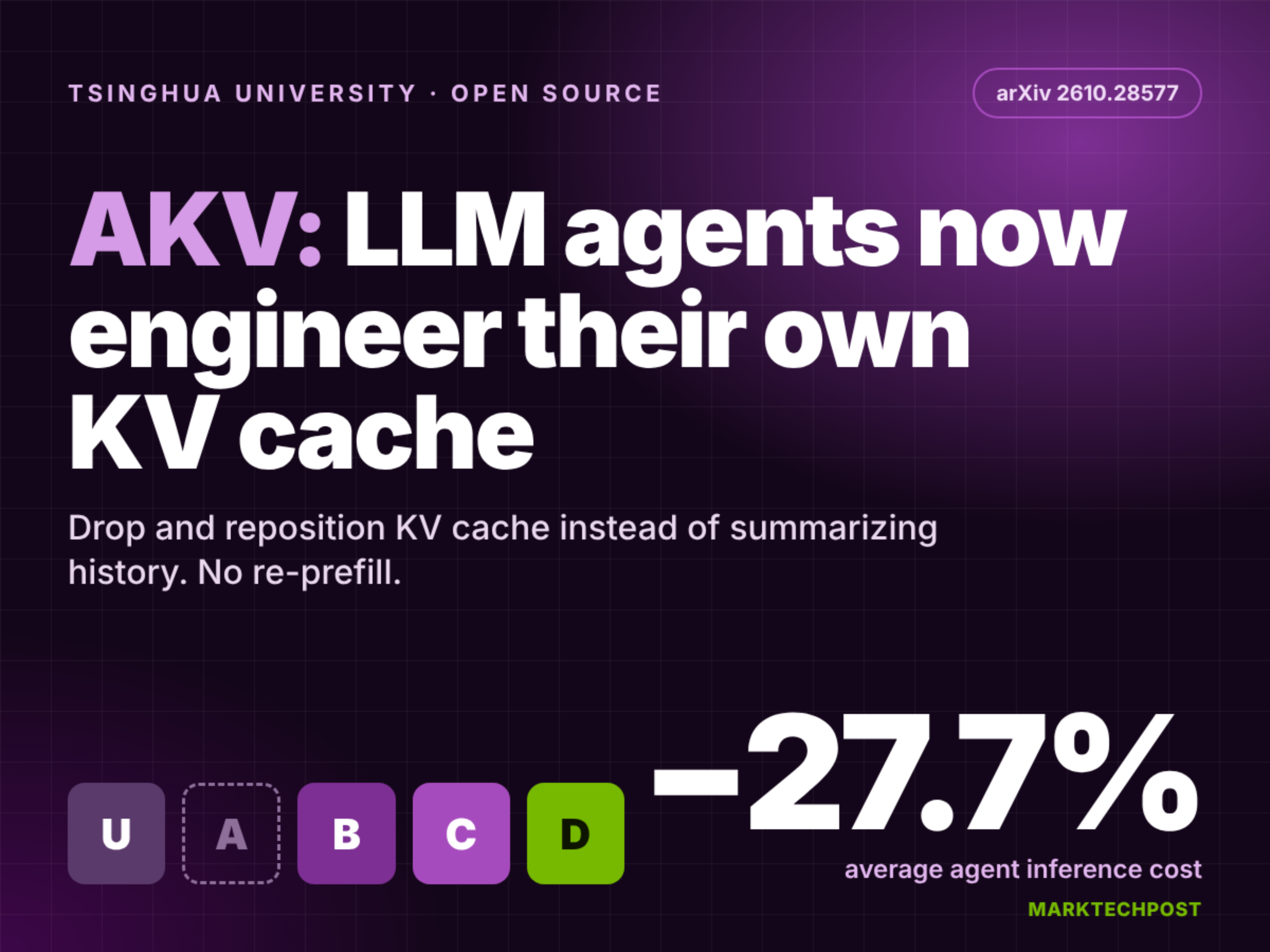
Tsinghua University and The Chinese University of Hong Kong jointly open-source AKV: an engineering service system for KV caching tailored to LLM agents.

On October 26, 2026, researchers from Tsinghua University and the Chinese University of Hong Kong open-sourced AKV—a KV cache engineering server built on SGLang and specifically designed for large language model (LLM) agents. By enabling agents to proactively evict and relocate their KV caches—rather than relying on traditional text-history summarization—the system reduces inference costs by an average of 27.7% across four agent benchmarks and improves task scores by 1.7 points on average. The code is licensed under the Apache-2.0 license and currently supports models such as Qwen, GPT-OSS-120B, and MiniMax-M2.7.

Tsinghua AI Open-Sources AKV, a Cache Engineering Server for LLM Agents on SGLang

Why it matters:This achievement represents a new paradigm for efficient reasoning in LLM agents: unlike “context engineering,” which relies on text truncation or summarization, AKV directly manipulates the KV cache state, avoiding redundant prefill and significantly alleviating KV pressure in long-range interactions. Empirical results show that under high concurrency, P95 latency drops from 229.9 seconds to 30.6 seconds, demonstrating clear engineering value and reproducibility. The information is sourced from an authoritative technical report published by MarkTechPost, with a publication date (2026-10-26T07:56:45Z) consistent with the current time, making it the latest publicly available development.

Timeline and related coverage

Edge AI Daily 早报(10月26日)

苹果终结二十年触控抵制,首款触屏OLED MacBook Pro定档发布,成为特努斯接任CEO后首个硬件答卷;Meta自由现金流转为-21亿美元,7600亿美元行业资本支出迎盈亏平衡审判;谷歌以1070兆瓦虚拟电厂重构数据中心供能,特斯拉自研AI地图弃用谷歌;Anthropic被指静默削弱Claude Opus 5.5逆向能力;亚马逊、Meta、OpenAI以50美元级AI硬件切入可穿戴赛道。

Translation queued · Original text · zh
Edge AI Daily 早报(10月26日)
Timeline and related coverage

b11889

cuda : use std::string instead of VLA for archName (#30463) * cuda : use std::string instead of VLA for archName Modernize the code (old C style) and fix the following warnings: ``` ggml/src/ggml-cuda/ggml-cuda.cu:180:19: warning: variable length arrays in C++ are a Clang extension [-Wvla-cxx-extension] 180 | char archName[archLen + 1]; | ^~~~~~~~~~~ ggml/src/ggml-cuda/ggml-cuda.cu:180:19: note: read of non-const variable 'archLen' is not allowed in a constant expression ggml/src/ggml-cuda/ggml-cuda.cu:179:9: note: declared here 179 | int archLen = strlen(devName); | ^ ``` Signed-off-by: Adrien Gallouët * Add a comment about archName Signed-off-by: Adrien Gallouët --------- Signed-off-by: Adrien Gallouët Signed-off-by: Adrien Gallouët **Website:** - **Attestations:** - **macOS/iOS:** - [ma

Timeline and related coverage

b11888

common, grammar: add recursive depth limit, make it a requirement (#31153) * common, grammar: add recursive depth limit, make it a requirement * catch more recursive functions * common : tidy up peg parser changes * grammar : reject candidates in a loop, without a depth limit The depth limit in llama_grammar_reject_candidates_for_stack counted the code points of a vocab token, so any token of 256 chars or more was always rejected under a grammar, such as the 512-space token of GLM-4.7-Flash or the long space tokens of Laguna-S-2.1. The rejection now walks the code points with its own stack of levels instead of recursing: there is no limit and no stack risk, whatever the length of a token from the GGUF, and the masks match master. * grammar : track rejected candidates as indices into the in

Timeline and related coverage

The compilation rules for four indices, including the Shanghai Composite Index, will be adjusted starting today; the State-owned Assets Supervision and Administration Commission has outlined plans to deepen state-owned enterprise reform; S&P’s new regulations will affect $375 billion in funds.

Starting October 26, 2026, the SSE Composite Index, the SSE A‑Share Index, the SSE Free‑Float Index, and the STAR 50 Index will officially implement their revised compilation methodologies, introducing a new cap of 15% on the weight of any single constituent. On October 23, the State-owned Assets Supervision and Administration Commission of the State Council emphasized the need to steadily advance the implementation of the latest round of state‑owned asset and state‑owned enterprise reform tasks. On the same day (October 25), S&P Dow Jones Indices announced adjustments to its growth/value stock classification criteria; the new rules will take effect on December 21, impacting approximately $375 billion in passive investment funds.

Why it matters:The three policy and market‑rule changes all exhibit significant timeliness and systemic impacts: the index‑weighting red line directly affects the stability of A‑share core benchmarks; the SASAC’s statement reflects the central government’s urgent plan to tackle tough challenges in state‑owned enterprise reform; and S&P’s rule overhaul reshapes the logic of value investing, with implications amounting to hundreds of billions of dollars—making it a key variable in the global capital markets. All information is drawn from an authoritative, comprehensive report published by TMTPost on October 25, 2026, with clearly verifiable timelines, entities, measures, and impact figures.

Timeline and related coverage

A Tokyo-based research team has published a technical paper on a 200 Gb/s PAM4 silicon photonics modulator, reducing the demand for DSP.

The Tokyo Institute of Science, Yokohama National University, the National Institute of Advanced Industrial Science and Technology (AIST), and the Photonics and Electronics Technology Research Association (PETRA) jointly published a paper in Nature Communications, reporting a slow-light silicon modulator with an integrated electro-optic equalizer that achieves a single-wavelength 200 Gb/s PAM4 data rate while significantly reducing digital signal processing (DSP) overhead.

Silicon Photonic Modulator Reaches 200 Gb/s PAM4 With Reduced DSP (Science Tokyo, Yokohama, AIST, PETRA)

Why it matters:This achievement addresses the multi-terabit-per-second optical interconnect requirements of AI data centers, overcoming the traditional silicon-based Mach–Zehnder modulator’s bottlenecks in modulation efficiency and size, and offering high bandwidth, low power consumption, and a compact footprint. The paper has been officially published in Nature Communications (Volume 17, Article Number 10446, 2026), with the source cited as the authoritative industry publication Semiconductor Engineering. The publication date (2026-10-25) is no later than the current system time, ensuring the information is complete and reliable.

Timeline and related coverage

b11887

tests : adjust default threads for test-llama-context (#31157) **Website:** - **Attestations:** - **macOS/iOS:** - [macOS Apple Silicon (arm64)](https://github.com/ggml-org/llama.cpp/releases/download/b11887/llama-b11887-bin-macos-arm64.tar.gz) - macOS Apple Silicon (arm64, KleidiAI enabled) [DISABLED](https://github.com/ggml-org/llama.cpp/pull/23780) - [macOS Intel (x64)](https://github.com/ggml-org/llama.cpp/releases/download/b11887/llama-b11887-bin-macos-x64.tar.gz) - [iOS XCFramework](https://github.com/ggml-org/llama.cpp/releases/download/b11887/llama-b11887-xcframework.zip) **Linux:** - [Ubuntu x64 (CPU)](https://github.com/ggml-org/llama.cpp/releases/download/b11887/llama-b11887-bin-ubuntu-x64.tar.gz) - [Ubuntu arm64 (CPU)](https://github.com/ggml-org/llama.cpp/releases/download/b11

Timeline and related coverage

b11886

qwen: merge tensors on convert (#31028) * qwen: merge tensors on convert * convert: use generator functions * qwen4exp: remove conts and pre-scale **Website:** - **Attestations:** - **macOS/iOS:** - [macOS Apple Silicon (arm64)](https://github.com/ggml-org/llama.cpp/releases/download/b11886/llama-b11886-bin-macos-arm64.tar.gz) - macOS Apple Silicon (arm64, KleidiAI enabled) [DISABLED](https://github.com/ggml-org/llama.cpp/pull/23780) - [macOS Intel (x64)](https://github.com/ggml-org/llama.cpp/releases/download/b11886/llama-b11886-bin-macos-x64.tar.gz) - [iOS XCFramework](https://github.com/ggml-org/llama.cpp/releases/download/b11886/llama-b11886-xcframework.zip) **Linux:** - [Ubuntu x64 (CPU)](https://github.com/ggml-org/llama.cpp/releases/download/b11886/llama-b11886-bin-ubuntu-x64.tar.gz

Timeline and related coverage

b11884

llama: fix exhausting CPU and MEM caused by dry sequence breaker (#31035) **Website:** - **Attestations:** - **macOS/iOS:** - [macOS Apple Silicon (arm64)](https://github.com/ggml-org/llama.cpp/releases/download/b11884/llama-b11884-bin-macos-arm64.tar.gz) - macOS Apple Silicon (arm64, KleidiAI enabled) [DISABLED](https://github.com/ggml-org/llama.cpp/pull/23780) - [macOS Intel (x64)](https://github.com/ggml-org/llama.cpp/releases/download/b11884/llama-b11884-bin-macos-x64.tar.gz) - [iOS XCFramework](https://github.com/ggml-org/llama.cpp/releases/download/b11884/llama-b11884-xcframework.zip) **Linux:** - [Ubuntu x64 (CPU)](https://github.com/ggml-org/llama.cpp/releases/download/b11884/llama-b11884-bin-ubuntu-x64.tar.gz) - [Ubuntu arm64 (CPU)](https://github.com/ggml-org/llama.cpp/releases/d

Timeline and related coverage

b11883

llama-quant : fix 4D tensor quantization using ggml_nrows() and name-based expert detection (#30820) * llama-quant : fix quantizing 4D tensors nrows_total was ne[1]*ne[2], so for a 4D tensor only the first ne[2] slices were quantized and the rest of the rows were dropped. Use ggml_nrows(tensor) to count all rows, including ne[3]. Fixes #29916 * llama-quant : detect expert tensors by name and fix imatrix size for 4D tensors The MXFP4_MOE path used ne[2] > 1 to detect MoE expert tensors. This is wrong for non-expert tensors with 3 or more dims, e.g. MLA projections (BailingMoE3) and 4D conv kernels. Use the tensor name instead: all tensors used by GGML_OP_MUL_MAT_ID are named *_exps or *_chexps. This also removes the BailingMoE3 special case. The imatrix holds one vector of ne[0] values per

Timeline and related coverage

b11882

grammar: limit recursion depth to prevent stack overflow (#29495) (#29755) **Website:** - **Attestations:** - **macOS/iOS:** - [macOS Apple Silicon (arm64)](https://github.com/ggml-org/llama.cpp/releases/download/b11882/llama-b11882-bin-macos-arm64.tar.gz) - macOS Apple Silicon (arm64, KleidiAI enabled) [DISABLED](https://github.com/ggml-org/llama.cpp/pull/23780) - [macOS Intel (x64)](https://github.com/ggml-org/llama.cpp/releases/download/b11882/llama-b11882-bin-macos-x64.tar.gz) - [iOS XCFramework](https://github.com/ggml-org/llama.cpp/releases/download/b11882/llama-b11882-xcframework.zip) **Linux:** - [Ubuntu x64 (CPU)](https://github.com/ggml-org/llama.cpp/releases/download/b11882/llama-b11882-bin-ubuntu-x64.tar.gz) - [Ubuntu arm64 (CPU)](https://github.com/ggml-org/llama.cpp/releases/

Timeline and related coverage

b11881

llama : respect no_alloc in all memory caches (#31087) * llama : respect no_alloc in memory caches Assisted-by: dsh:llama.cpp/ggml-org/DeepSeek-V4-Flash-Vision-Exp-GGUF (Mac Studio, M2 Ultra, 192GB) * llama : TODO: move no_alloc out of llama_hparams Assisted-by: dsh:llama.cpp/ggml-org/DeepSeek-V4-Flash-Vision-Exp-GGUF (Mac Studio, M2 Ultra, 192GB) * llama : TODO: move no_alloc out of llama_hparams Assisted-by: dsh:llama.cpp/ggml-org/DeepSeek-V4-Flash-Vision-Exp-GGUF (Mac Studio, M2 Ultra, 192GB) **Website:** - **Attestations:** - **macOS/iOS:** - [macOS Apple Silicon (arm64)](https://github.com/ggml-org/llama.cpp/releases/download/b11881/llama-b11881-bin-macos-arm64.tar.gz) - macOS Apple Silicon (arm64, KleidiAI enabled) [DISABLED](https://github.com/ggml-org/llama.cpp/pull/23780) - [macOS

Timeline and related coverage

b11880

tools : reject truncated GGUF tensor data in merge (#31044) Co-authored-by: Shreya Agrawal **Website:** - **Attestations:** - **macOS/iOS:** - [macOS Apple Silicon (arm64)](https://github.com/ggml-org/llama.cpp/releases/download/b11880/llama-b11880-bin-macos-arm64.tar.gz) - macOS Apple Silicon (arm64, KleidiAI enabled) [DISABLED](https://github.com/ggml-org/llama.cpp/pull/23780) - [macOS Intel (x64)](https://github.com/ggml-org/llama.cpp/releases/download/b11880/llama-b11880-bin-macos-x64.tar.gz) - [iOS XCFramework](https://github.com/ggml-org/llama.cpp/releases/download/b11880/llama-b11880-xcframework.zip) **Linux:** - [Ubuntu x64 (CPU)](https://github.com/ggml-org/llama.cpp/releases/download/b11880/llama-b11880-bin-ubuntu-x64.tar.gz) - [Ubuntu arm64 (CPU)](https://github.com/ggml-org/lla

Timeline and related coverage

b11879

CUDA: fuse FFN gate/up matmuls and GLU in MMQ with interleaved gate/up rows (#29948) * cuda: fuse FFN gate/up and GLU in MMQ with interleaved gate/up rows For prompt processing, run the gate and up matmuls of a dense FFN as one mul_mat_q launch and apply the GLU in the write-back. - The loaders take the gate weights as a second pointer and fill the weight tile with up and gate rows interleaved in chunks of 8, so each thread holds an up value and the matching gate value (rows r and r + 8 of an MMA tile). - The MMA loop is unchanged: same tile, warp layout, vec_dot and one sum[] per thread. The fused write-back computes the GLU from registers and writes half the rows. - The fused path uses the regular tiling (no stream-k) with the column tiles innermost so that neighbouring blocks share weig

Timeline and related coverage

b11878

ggml-cuda: fuse qwen MRoPE + set-rows (#31025) **Website:** - **Attestations:** - **macOS/iOS:** - [macOS Apple Silicon (arm64)](https://github.com/ggml-org/llama.cpp/releases/download/b11878/llama-b11878-bin-macos-arm64.tar.gz) - macOS Apple Silicon (arm64, KleidiAI enabled) [DISABLED](https://github.com/ggml-org/llama.cpp/pull/23780) - [macOS Intel (x64)](https://github.com/ggml-org/llama.cpp/releases/download/b11878/llama-b11878-bin-macos-x64.tar.gz) - [iOS XCFramework](https://github.com/ggml-org/llama.cpp/releases/download/b11878/llama-b11878-xcframework.zip) **Linux:** - [Ubuntu x64 (CPU)](https://github.com/ggml-org/llama.cpp/releases/download/b11878/llama-b11878-bin-ubuntu-x64.tar.gz) - [Ubuntu arm64 (CPU)](https://github.com/ggml-org/llama.cpp/releases/download/b11878/llama-b11878

Timeline and related coverage