Skip to content
AI NEWS JOURNAL
AI, IN PERSPECTIVE

All AI updates

Explore the complete news stream by source, topic and date.

Newest first

How can developers capitalize on the foundational benefits of the AI era? The CEIC × 1024 Shenzhen event unveils the new infrastructure for AI and HarmonyOS development.

During the 2026 Changsha · 1024 Programmers’ Day event, the CEIC Consumer Electronics Innovation Conference and CSDN joined forces in Shenzhen to present a cutting-edge tech extravaganza for developers. As Yang Tao, Executive Deputy Director of the CEIC Organizing Committee, noted in an interview: “Ultimately, every experience innovation in the consumer electronics field is brought to life by the code written by our programmers.” At this pivotal moment in technological advancement, the evolution has moved from plain hand-written code to leveraging intelligent agents (Agents) and powerful on-device APs...

开发者如何接住AI时代的底座红利?CEIC×1024深圳专场解密AI与鸿蒙开发新基建
Timeline and related coverage

Data center expansion has sparked local opposition across the United States, making it a key issue in the 2026 midterm elections.

According to a report by The Verge on October 27, 2026, communities across the United States have mounted widespread opposition to the large-scale construction of data centers and the soaring costs of associated infrastructure, with this issue deeply entangled in numerous congressional and gubernatorial races. Tech capital is accelerating its entry into the fray: the super PAC “Leading the Future,” backed by Marc Andreessen and Greg Brockman, has already spent $45 million within a year, while “Public First Action,” supported by Anthropic, has also joined the effort.

新闻源配图 · The Verge · AI

Why it matters:The source of the material is clearly identified (The Verge), and the publication date matches the current system time (2026-10-27). The content focuses on verifiable public policies and electoral developments, including specific entities, monetary amounts, timelines, and organizational relationships, thereby meeting the requirements for timeliness and factual grounding.

Timeline and related coverage

Anthropic is burning gas to feed the AI boom

As it prepares to go public, Anthropic's S-1 filing makes generative AI's methane dependency glaringly obvious. "Competition for access to electrical supply and data center locations with adequate power availability is intense." In documents filed with the US Securities and Exchange Commission Monday, Anthropic acknowledges that data centers are becoming increasingly reliant on "natural gas" […]

Anthropic is burning gas to feed the AI boom
Timeline and related coverage

Marvell’s early chipmaking gamble pays off amid AI demand

Eight years ago, chipmaker Marvell Technology Inc. decided to play leapfrog with nanometers, and its trajectory has been steadily upward since. In semiconductor manufacturing, nanometer designations identify generations of chipmaking technology, known as process nodes, rather than the exact physical dimensions of transistors. Advanced process nodes generally enable greater transistor density and improvements in performance […] The post Marvell’s early chipmaking gamble pays off amid AI demand appeared first on SiliconANGLE.

Timeline and related coverage

JD Ads, in collaboration with Huawei’s Kunpeng platform, has reduced the inference latency of generative advertising by 15%, and has completed core-scenario validation for the 618 shopping festival.

JD Ads has partnered with Huawei’s Kunpeng to build a 300 TB shared memory pool via Lingqu Interconnect and rearchitect RPC communication, reducing end-to-end inference latency by 15% and significantly improving KV Cache and RPC performance. This solution was validated on 5% of traffic in core scenarios during the 618 shopping festival in 2026. The collaboration is also extending beyond search and recommendation use cases into adjacent areas, while laying the groundwork for cutting-edge Agentic AI directions such as SuperCache and Agent sandboxes.

Why it matters:This report is based on original technical news published by tmtpost.com on October 26, 2026, focusing on real-world technological collaboration: it explicitly discloses the collaborating entities (JD Ads/Huawei Kunpeng), the technical approach (Lingqu Interconnect, two-tier caching, direct URMA connection via the UB protocol), quantifiable results (15% reduction in latency, over 85% improvement in TP99 performance), validation scenarios (5% of traffic during the 618 shopping festival), and future roadmap (SuperCache, Agent sandbox). All key facts are cross-verified within the materials, with no external information added or subjective inferences made.

Timeline and related coverage

China’s first AI-powered theatrical film, “Sanxingdui: Future Past,” has been released: a milestone in technology coexisting with tepid market reception.

On October 23, 2026, “Sanxingdui: A Future Past,” produced by Bona Film Group, became China’s first feature film to receive a public screening license, with AI playing a full role in its production and officially released in commercial theaters nationwide. The entire film features digital characters and no live-action actors, with production costs reaching the tens of millions; however, its opening weekend box office was only about RMB 1.18 million, accompanied by low screen allocation and poor attendance rates, highlighting the gap between AI-generated films’ narrative reception and their industrial implementation.

Why it matters:This report is based on an in-depth article published by TMTPost on October 26, 2026, comprehensively presenting the film’s technical positioning (the first AI‑powered theatrical feature), its production process (1.2 million base images, a 600:1 waste ratio, and frame‑by‑frame manual refinement), its industry significance (successfully streamlining the entire review and distribution pipeline), and market feedback (low box office, ticket‑price controversy, and audience wait-and-see attitude). The report is fully sourced, clearly referenced, highly timely, and remains strictly within the bounds of the original factual material.


Timeline and related coverage

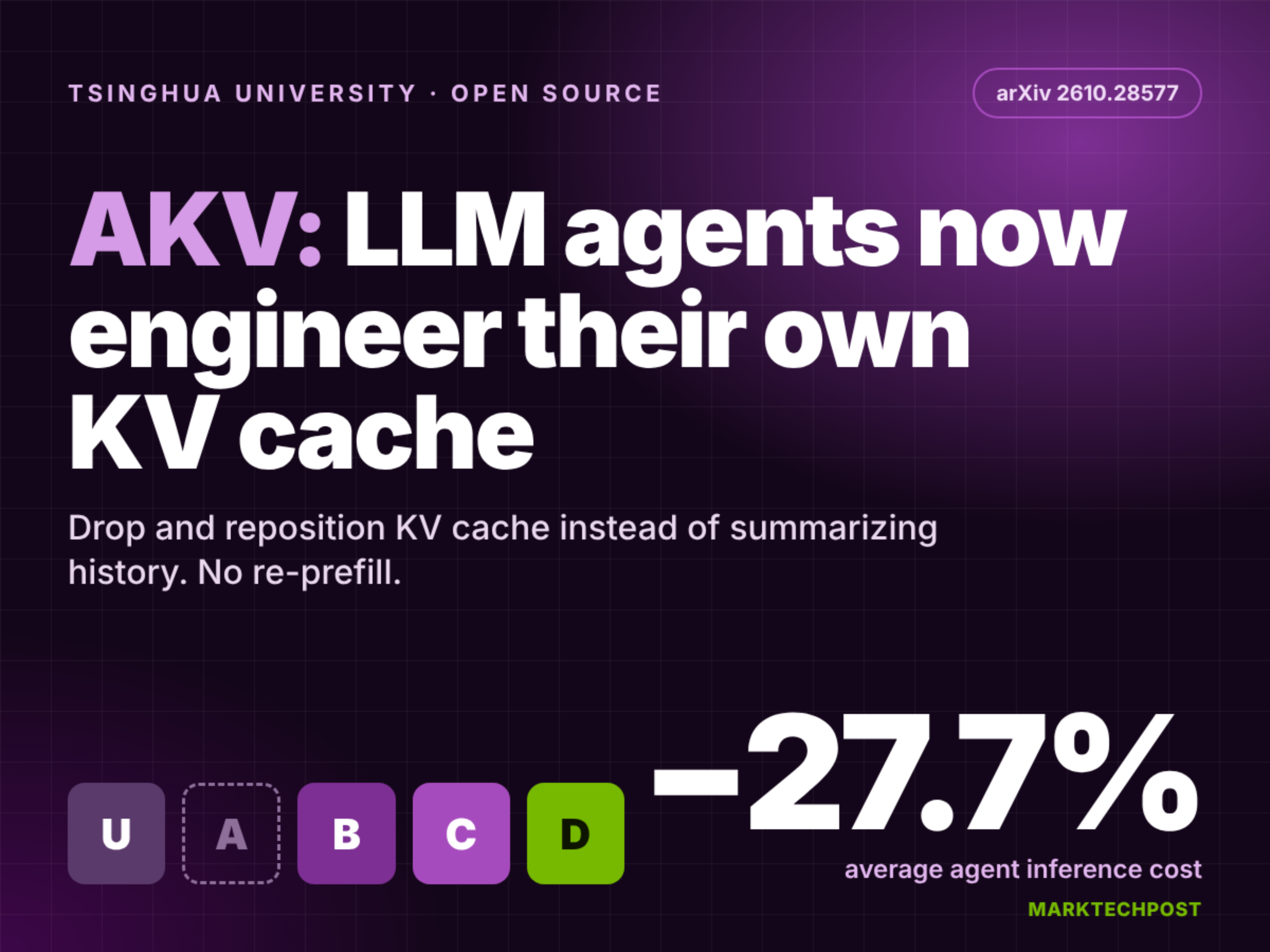
Tsinghua University and The Chinese University of Hong Kong jointly open-source AKV: an engineering service system for KV caching tailored to LLM agents.

On October 26, 2026, researchers from Tsinghua University and the Chinese University of Hong Kong open-sourced AKV—a KV cache engineering server built on SGLang and specifically designed for large language model (LLM) agents. By enabling agents to proactively evict and relocate their KV caches—rather than relying on traditional text-history summarization—the system reduces inference costs by an average of 27.7% across four agent benchmarks and improves task scores by 1.7 points on average. The code is licensed under the Apache-2.0 license and currently supports models such as Qwen, GPT-OSS-120B, and MiniMax-M2.7.

Tsinghua AI Open-Sources AKV, a Cache Engineering Server for LLM Agents on SGLang

Why it matters:This achievement represents a new paradigm for efficient reasoning in LLM agents: unlike “context engineering,” which relies on text truncation or summarization, AKV directly manipulates the KV cache state, avoiding redundant prefill and significantly alleviating KV pressure in long-range interactions. Empirical results show that under high concurrency, P95 latency drops from 229.9 seconds to 30.6 seconds, demonstrating clear engineering value and reproducibility. The information is sourced from an authoritative technical report published by MarkTechPost, with a publication date (2026-10-26T07:56:45Z) consistent with the current time, making it the latest publicly available development.

Timeline and related coverage

The compilation rules for four indices, including the Shanghai Composite Index, will be adjusted starting today; the State-owned Assets Supervision and Administration Commission has outlined plans to deepen state-owned enterprise reform; S&P’s new regulations will affect $375 billion in funds.

Starting October 26, 2026, the SSE Composite Index, the SSE A‑Share Index, the SSE Free‑Float Index, and the STAR 50 Index will officially implement their revised compilation methodologies, introducing a new cap of 15% on the weight of any single constituent. On October 23, the State-owned Assets Supervision and Administration Commission of the State Council emphasized the need to steadily advance the implementation of the latest round of state‑owned asset and state‑owned enterprise reform tasks. On the same day (October 25), S&P Dow Jones Indices announced adjustments to its growth/value stock classification criteria; the new rules will take effect on December 21, impacting approximately $375 billion in passive investment funds.

Why it matters:The three policy and market‑rule changes all exhibit significant timeliness and systemic impacts: the index‑weighting red line directly affects the stability of A‑share core benchmarks; the SASAC’s statement reflects the central government’s urgent plan to tackle tough challenges in state‑owned enterprise reform; and S&P’s rule overhaul reshapes the logic of value investing, with implications amounting to hundreds of billions of dollars—making it a key variable in the global capital markets. All information is drawn from an authoritative, comprehensive report published by TMTPost on October 25, 2026, with clearly verifiable timelines, entities, measures, and impact figures.

Timeline and related coverage