
Skip to content
AI NEWS JOURNAL
AI, IN PERSPECTIVE

Daily picks

Understand the AI developments that matter, starting with original sources.

Newest first

AI Graveyard: A Continuously Updated List of Failed AI Projects and Startups

TechCrunch reported on October 25, 2026, reviewing several AI projects from 2023 to 2026 that failed to meet expectations, including startups and products such as Relay, Character.ai, Sora, and Humane AI Pin, as well as failed attempts or major adjustments by major companies like OpenAI, Apple, and Microsoft.

The AI graveyard: a running list of projects and startups that didn’t make it

Why it matters:This report provides an industry‑wide, phenomenon‑driven overview, with broad coverage and a clear timeline (including specific shutdown or delay dates), and cites S&P Global Market Intelligence data to substantiate the high attrition rate—42%—of enterprise‑level AI projects. It combines detailed case studies with structural analysis, making it a highly valuable reference.

Timeline and related coverage

Pennsylvania signs AI advertising disclosure law with exceptions including text-only content

Josh Shapiro signed SB806 on October 22, 2026. It sets disclosure requirements for AI-based advertisements that create a false consumer perception of goods or services, with exceptions including text-only content.

Pennsylvania will require labels on AI-generated ads

Why it matters:The signing date and statutory text can be checked against official records. The report distinguishes disclosure conditions and exceptions rather than describing a blanket labeling rule for all AI advertising.

Timeline and related coverage

The PHP “Meltdown” incident reveals how AI can amplify the threat of legacy vulnerabilities.

Security researchers, using AI tools, have turned a PHP vulnerability—known collectively as PHP2Shell—that has existed for years and was once considered difficult to exploit—into a real-world exploitable attack surface. Within hours of the vulnerability being made public, it was already targeted in millions of exploitation attempts, yet no successful intrusions have been reported to date.

Why it matters:This incident clearly demonstrates for the first time that AI does not create new vulnerabilities out of thin air; rather, it significantly lowers the barrier to exploiting existing vulnerabilities, highlighting AI’s dual role in accelerating both offensive and defensive security dynamics. Moreover, all valid findings rely on human–machine collaboration.

Timeline and related coverage

Sebastian Raschka has released an eight-video course titled “Building a Reasoning Model from Scratch.”

On October 24, 2026, Sebastian Raschka published an eight-part, over-11-hour hands-on video course on Python and PyTorch in Ahead of AI magazine (magazine.sebastianraschka.com), systematically covering the evaluation of inference models, scaling during inference, reinforcement learning (RLVR), and knowledge distillation, with all methods implemented using the pre-trained Qwen3-0.6B model.

Why it matters:This course is the author’s advanced technical educational offering, following “Building Large Language Models from Scratch.” It focuses on the core evolutionary direction of today’s mainstream LLMs—enhancing inference capabilities—covering the entire technical pipeline from setting up the foundational environment to GRPO reinforcement learning and self‑distillation. The author explicitly states that all implementations are “hand‑crafted from scratch,” fully reproducible, and highly instructive with significant engineering reference value.

Timeline and related coverage

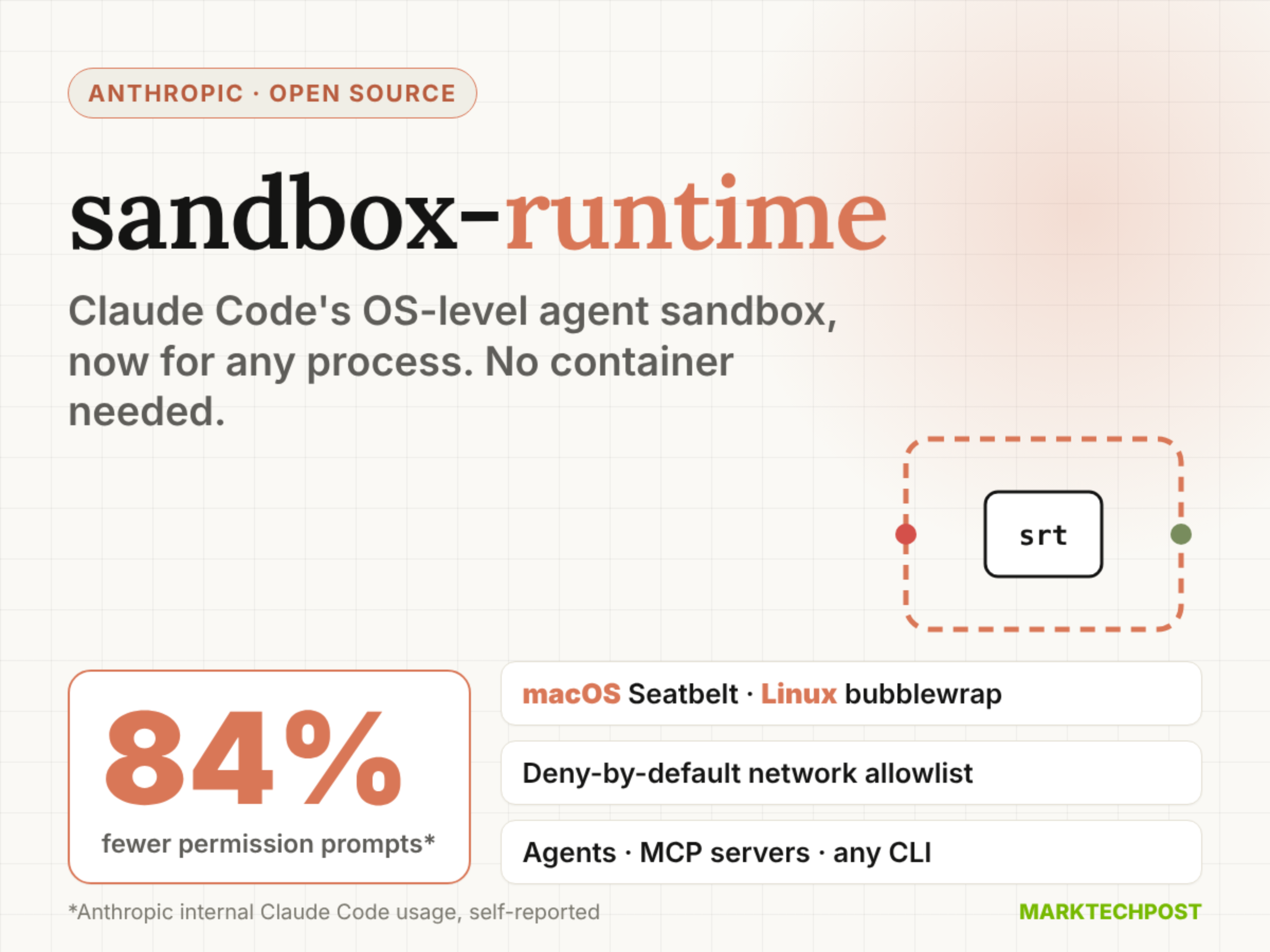
Anthropic open-sources the OS-level sandbox sandbox-runtime: providing container-free file and network isolation for AI agents.

On October 24, 2026, Anthropic open-sourced sandbox-runtime (srt), an OS-level sandboxing tool that operates without containers, designed to restrict file read/write and network access permissions for AI agents, MCP servers, and CLI tools. It supports macOS (Seatbelt), Linux (bubblewrap), and Windows (alpha), with npm package version 0.0.81 under the Apache-2.0 license.

Meet Anthropic’s sandbox-runtime: OS-Level Sandboxing for AI Agents, No Containers

Why it matters:This tool represents a significant advancement in AI security infrastructure—achieving fine-grained, full-process-tree coverage through the operating system’s native isolation mechanisms, directly addressing the risks of prompt injection and privilege escalation, and has already been deployed for internal validation within Claude Code.

Timeline and related coverage