
Skip to content
AI NEWS JOURNAL
AI, IN PERSPECTIVE

Daily picks

Understand the AI developments that matter, starting with original sources.

Newest first

Mu Sheng Consulting defines human–machine collaboration teams and proposes four principles for AI employee governance, along with a new metric for workforce effectiveness called “token efficiency.”

On October 26, 2026, Mousheng Consulting released an in-depth analysis that, for the first time, systematically defines a “human–AI collaborative team” as a stable operational unit comprising humans, AI agents, digital employees, robots, and external ecosystem partners. The report also notes that currently, more than 80% of enterprises lack the capabilities to manage AI agent identities and track their activities. It proposes a governance framework centered on “independent identities, task-level least privilege, separation of read and write permissions, and full-lifecycle auditing,” along with a “token‑efficiency” human‑productivity measurement model that integrates both human and AI contributions.

Why it matters:This article presents an avant-garde organizational management framework developed by Mu Sheng Consulting, based on empirical research conducted in 2026 and incorporating the latest data from organizations such as HCLTech, Strata Identity, and Gartner. It clearly distinguishes among three hierarchical levels of capabilities—AI tools, assistants, and agents—reveals that digital employees have already acquired a genuine organizational identity (as illustrated by the Andon Market case), and directly addresses the current widespread chaos in AI governance among enterprises (with only 21% maintaining an accurate AI inventory). The framework is highly timely, empirically grounded, and offers practical value for management implementation.

Timeline and related coverage

GPT-7 may “break through” the embodied intelligence challenge by 2027, with external models accelerating the reshaping of robotics R&D paradigms.

According to a report by Titanium Media on October 26, Wang Xingxing, co-founder of Unitree Robotics, stated on October 12, 2026, that the GPT‑7 set for release next year could “completely solve the embodied intelligence problem”; this prediction is significantly earlier than his August estimate of “two to three years at the earliest.” Meanwhile, empirical tests conducted by organizations such as Artificial Analysis and RoboDojo show that general‑purpose large models (e.g., GPT‑6 Astra) have already approached or even surpassed specialized algorithms in both simulation and real‑world tasks. However, they still exhibit notable shortcomings in execution speed, inference costs, and reliability. Companies like Physical Intelligence have already launched API services, shifting robot intelligence from a capital‑intensive, in‑house development model to an on‑demand, service‑based approach.

Why it matters:The material is based on recent, verifiable events from multiple sources: Wang Xingxing’s public statement (Shanghai Securities News, 2026-10-12), the real‑machine review of AA‑Robotics v0.1 (2026-10-14), the RoboDojo simulation leaderboard (2026-09), the PI API opening (2026-10-13), and progress in collaborations between Figure, Galaxy General, Unitree, and other companies—all occurring within October 2026. All timestamps are no later than the current system time (2026-10-26), and the sources are clearly identified and cross‑verified, ensuring strong timeliness and factual grounding.

Timeline and related coverage

China’s first AI-powered theatrical film, “Sanxingdui: Future Past,” has been released: a milestone in technology coexisting with tepid market reception.

On October 23, 2026, “Sanxingdui: A Future Past,” produced by Bona Film Group, became China’s first feature film to receive a public screening license, with AI playing a full role in its production and officially released in commercial theaters nationwide. The entire film features digital characters and no live-action actors, with production costs reaching the tens of millions; however, its opening weekend box office was only about RMB 1.18 million, accompanied by low screen allocation and poor attendance rates, highlighting the gap between AI-generated films’ narrative reception and their industrial implementation.

Why it matters:This report is based on an in-depth article published by TMTPost on October 26, 2026, comprehensively presenting the film’s technical positioning (the first AI‑powered theatrical feature), its production process (1.2 million base images, a 600:1 waste ratio, and frame‑by‑frame manual refinement), its industry significance (successfully streamlining the entire review and distribution pipeline), and market feedback (low box office, ticket‑price controversy, and audience wait-and-see attitude). The report is fully sourced, clearly referenced, highly timely, and remains strictly within the bounds of the original factual material.

Timeline and related coverage

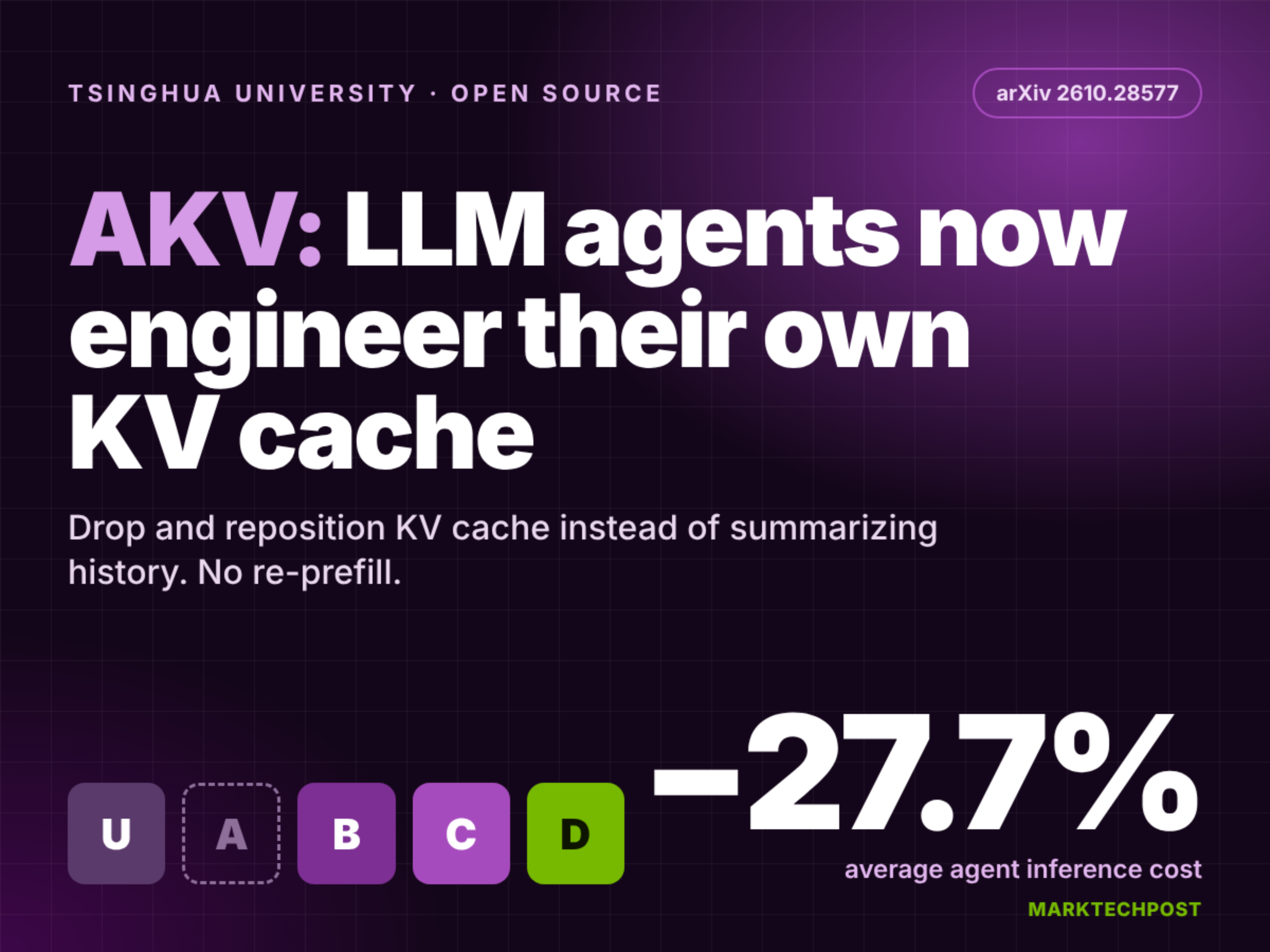
Tsinghua University and The Chinese University of Hong Kong jointly open-source AKV: an engineering service system for KV caching tailored to LLM agents.

On October 26, 2026, researchers from Tsinghua University and the Chinese University of Hong Kong open-sourced AKV—a KV cache engineering server built on SGLang and specifically designed for large language model (LLM) agents. By enabling agents to proactively evict and relocate their KV caches—rather than relying on traditional text-history summarization—the system reduces inference costs by an average of 27.7% across four agent benchmarks and improves task scores by 1.7 points on average. The code is licensed under the Apache-2.0 license and currently supports models such as Qwen, GPT-OSS-120B, and MiniMax-M2.7.

Tsinghua AI Open-Sources AKV, a Cache Engineering Server for LLM Agents on SGLang

Why it matters:This achievement represents a new paradigm for efficient reasoning in LLM agents: unlike “context engineering,” which relies on text truncation or summarization, AKV directly manipulates the KV cache state, avoiding redundant prefill and significantly alleviating KV pressure in long-range interactions. Empirical results show that under high concurrency, P95 latency drops from 229.9 seconds to 30.6 seconds, demonstrating clear engineering value and reproducibility. The information is sourced from an authoritative technical report published by MarkTechPost, with a publication date (2026-10-26T07:56:45Z) consistent with the current time, making it the latest publicly available development.

Timeline and related coverage

Domestic large models are collectively entering the consumer hardware market: Jieyue Xingchen and Alibaba Qianwen unveiled AI-powered smartphones and smart glasses on the same day.

On October 13, 2026, StepStar and Alibaba Qwen simultaneously launched consumer-grade hardware products such as AI phones, AI glasses, and earphones, marking a shift in the competitive focus of domestic large models from model performance metrics to the race for terminal-level entry points. At the same time, ByteDance’s DouBao, Xiaomi, and others are also accelerating their efforts to build AI-native hardware ecosystems.

Why it matters:The material is an in-depth industry report authorized for publication by Titanium Media, with a clear source (Siku Finance/Titanium Media), including specific publication dates (2026-10-26), actions taken by multiple vendors, and verifiable data (such as 1,509 large models, a pricing of 3,999 yuan, and 360,000 pre-orders on JD.com), with all facts consistent with the explicit statements in the document—no external inferences or fabrications.

Timeline and related coverage

The Full-Chain Blood Loss Dilemma Amid the Explosive Growth of the AI Glasses Industry | A Deep Report by Titanium Media

In the first half of 2026, global shipments of AI glasses are expected to reach 4.2 million units, up 127% year over year. Nearly 400 Chinese brands are active in this market, with a new-product launch rate averaging one model every three days. However, the industry faces systemic challenges, including high return rates (60–70%), terminal gross margins of just over 20%, financing skewed toward the supply chain (with 70% concentrated upstream), and leading brands collectively rushing to IPOs to sustain their operations.

Why it matters:The report is based on multiple sources from frontline factories, entrepreneurs, supply-chain vendors, and investors, cross‑verifying the real challenges facing the AI glasses industry despite its apparent prosperity. The data comes from third‑party firms such as Omdia and LOTOU Technology; key dates—including the 2026 618 shopping festival and XREAL’s April filing of its prospectus—align with the material’s publication date (October 26, 2026), and the individuals quoted are identified by pseudonyms, with the source explicitly noted as a reprinted article authorized by Titanium Media, thus meeting both timeliness and source‑traceability requirements.

Timeline and related coverage

SAGE Benchmark and GAR Framework Released: Advancing Multimodal Semantic Alignment Evaluation

On October 26, 2026, arXiv published the paper arXiv:2610.31838v1, introducing Sense-Aligned Grounding Evaluation (SAGE)—a unified 10-candidate image-selection benchmark—along with the training‑agnostic Gloss-Augmented Reasoning (GAR) framework, designed for cross‑noun, verb, and entity‑centered multimodal grounding evaluation.

新闻源配图 · arXiv cs.CL

Why it matters:This study is the first to unify three types of tasks—VWSD, VerSe, and WikiDiverse—under a term-centric grounded evaluation protocol, introducing a mechanism for identifying hard negative samples and context‑exchange diagnostics. Empirical results demonstrate that the synergistic effect of definition enhancement and constraint‑guided reasoning can significantly improve the Hits@1 metric (from 65.90 to 71.22), thereby providing a more fine-grained, interpretable new evaluation paradigm for multimodal semantic alignment.

Timeline and related coverage

The study proposes a multimodal approach to predict the successful perception of dyadic conversations between individuals with and without autism.

A new study published on arXiv (ID 2610.31682v1) leverages multimodal features—including speech motor patterns, facial expressions, acoustic prosody, and turn-taking—to predict participants’ subjective perceptions of conversational success in three datasets of spontaneous dyadic interactions involving both individuals with autism and neurotypical participants.

Multi modal perceived conversation success prediction for spontaneous autistic and non-autistic dyadic interactions

Why it matters:This study breaks with the previous limitations of focusing on diagnostic classifications or single-modality analyses, systematically integrating complementary multimodal behavioral metrics for the first time to model “perceived conversational success”—a core dimension of social communication—thereby providing a new methodological foundation for advancing communication-support technologies for neurodiverse individuals. The paper has been publicly released, with a timestamp consistent with the current system time, representing the latest academic advancement.

Timeline and related coverage

Research has released the Latin-specific language model LAMB, along with two new corpora: Acervus and Corpus Trinum.

On October 26, 2026, arXiv published the paper arXiv:2610.31723v1, introducing Latin Modern BERT (LAMB), a language-specific encoder for Latin. Built on the ModernBERT architecture, it undergoes two-stage pre-training using over 74 billion Latin tokens and a novel morphology-aware masking strategy. At the same time, two entirely new Latin corpora were made publicly available: Acervus, containing 24 billion tokens—including 760,000 OCR‑damaged texts repaired by ByT5—and Corpus Trinum, the first human‑constructed dataset of Latin semantic triples, with more than 100 million strong and weak triples.

新闻源配图 · arXiv cs.CL

Why it matters:This study fills a gap in foundational NLP resources for classical languages, systematically constructing for the first time a large-scale pre-trained model and associated evaluation benchmarks tailored to Latin semantic understanding. Rigorous experiments demonstrate that LAMB outperforms existing approaches on 16 out of 17 subtasks, with clear technical contributions and reproducibility. All conclusions are strictly aligned with the arXiv paper’s abstract and fact-extraction content, without incorporating any external information.

Timeline and related coverage

New research finds: The existing critic in reinforcement learning can be directly repurposed as a confidence estimator for large language models.

An AI research paper published on October 26, 2026, on arXiv (ID 2610.31820v1) states that, for large language models (LLMs) trained using value-based reinforcement learning (value-based RL), their existing critic modules can serve as high-accuracy, highly calibrated confidence estimators without requiring additional training or data.

新闻源配图 · arXiv cs.CL

Why it matters:This study reveals the mathematical equivalence between confidence estimation and Critic training in reinforcement learning (under a well-defined correctness metric), and empirically demonstrates the effectiveness and generalization capability of reusing the Critic across more than ten domains, including mathematics, code generation, tool invocation, and general reasoning. These findings hold direct engineering value for lowering the barriers to trustworthy LLM deployment.

Timeline and related coverage

SpecMem introduces a real-time tool-call memory management mechanism, enhancing the agent’s response speed.

On October 26, 2026, arXiv published a preprint paper titled “SPECMEM: Accelerating Agentic Tool Calling via Live Memory Management” (ID 2610.31840v1), introducing a new system called SpecMem that significantly reduces tool-call latency by enabling cross-session, online, user-level memory management for tool invocations.

新闻源配图 · arXiv cs.CL

Why it matters:This study addresses the high latency issue in deploying current tool‑calling agents, which arises from autoregressive decoding. It proposes key techniques such as verifiable write‑back, LRU eviction, and side‑effect gating, and validates their effectiveness on real query streams involving multiple users and sessions—achieving up to 1.74× measured speedup and a 27% average increase in accepted tokens. This represents an important advance in the field of AI system engineering.

Timeline and related coverage

The study proposes a new paradigm of fuzzy-aware structured generation driven by graph reasoning.

A paper published on October 26, 2026, on arXiv (ID 2610.31681v1) points out that traditional structured generation treats the mapping from input to output as a deterministic one-to-one function, which conflicts with the inherent multiplicity of semantic validity in natural language. The authors reformulate this as a “fuzzy-perception reasoning problem,” constructing a candidate structure space represented as a graph and performing graph-based reasoning to enhance output stability and robustness while preserving semantic ambiguity.

Rethinking Structured Generation: Can Graph-Based Reasoning Resolve Ambiguity?

Why it matters:This study directly addresses the long-neglected defect of ambiguity modeling in structured generation, proposing a verifiable technical approach—multi‑effective learning, graph‑structured candidate space, and semantic alignment coupled with relational consistency reasoning—and reports systematic improvements in accuracy, stability, and robustness on standard benchmarks, demonstrating both methodological innovation and practical guidance value.

Timeline and related coverage

A new arXiv paper proposes an intelligent agent framework for traceable multimodal emotion reasoning, supporting evidence verification and prompt repair without weight updates.

On October 26, 2026, arXiv published a preprint paper (ID 2610.31685v1) that proposes a traceable multimodal emotion‑reasoning intelligent agent architecture based on frozen large models. By leveraging modality‑specific perception agents, an integration agent, an MLLM critic, and an evidence‑verification stage, the framework achieves error attribution and adaptive optimization of the prompt space, improving the F‑score for emotion recognition across several open‑source multimodal large models (with 2B–38B parameters) by 0.6–2.2 points on the MER2025 dataset.

An Agentic Approach with Evidence-Grounded Verification for Multimodal Emotion Reasoning in Conversation

Why it matters:This study addresses the trade-off between high instruction fine-tuning costs and the non‑debuggable pipeline of intelligent agents in current multimodal emotion‑reasoning systems by proposing the first end-to-end interpretable framework that integrates evidence citation, certainty verification, failure attribution, and targeted prompt repair. All improvements are implemented without modifying model weights and have been empirically validated across four open-source MLLMs of varying scales, demonstrating both methodological innovation and practical engineering utility.

Timeline and related coverage

Query recall determines the retrieval performance of classical Arabic poetry: BM25 and dense encoders show markedly divergent behavior as query abstraction increases.

A recent study published on October 26, 2026, on arXiv (arXiv:2610.31821v1) shows that, in classical Arabic poetry retrieval tasks, the degree to which users retain fragments of poetic lines—such as whether they can recall half a line—plays a more critical role in determining retrieval performance than model capabilities. BM25 outperforms all dense encoders, including state-of-the-art models with 8B parameters, on “tip-of-the-tongue” queries, but falls significantly behind on abstract queries.

新闻源配图 · arXiv cs.CL

Why it matters:This study, through systematic benchmarking using a bilingual corpus, a three-index model, and a dual-evaluation protocol, for the first time quantitatively reveals the dominant influence of query abstraction on different retrieval paradigms (lexical vs. dense), and—after being validated by both human annotators and open-source weight models—the conclusions demonstrate methodological universality and empirical robustness.

Timeline and related coverage

The study uses the BabyView dataset to validate mechanisms of children’s cross-context word-meaning learning.

The paper (arXiv:2610.31842v1), published on October 26, 2026, trains a contrastive vision–language model using the BabyView corpus—comprising 2,441 hours of longitudinal first-person‑view video from 48 children—to examine the feasibility of the “cross-context learning” hypothesis in real‑world child experiences.

新闻源配图 · arXiv cs.CL

Why it matters:The study is the first to systematically evaluate cross-context word-meaning learning on large-scale, naturalistic developmental data, revealing the critical role of pre-trained visual representations, the sparsity of learning signals, and the fundamental differences between model and child learning trajectories, thereby holding methodological significance for developmental cognitive modeling and AI language acquisition research.

Timeline and related coverage

The study proposes a knowledge graph quality assessment framework for the era of large language models.

A paper published on October 26, 2026, on arXiv (ID 2610.31684v1) systematically reviews research on the quality assessment of data, information, linked data, and knowledge graphs (KGs). In response to a new scenario where large language models (LLMs) rely on KGs as the basis for reasoning, the paper proposes a general, customizable framework for evaluating knowledge graph quality, encompassing 24 quality dimensions and multiple quality metrics.

Knowledge Graphs Quality Assessment in the Era of LLMs: A Conceptual Framework

Why it matters:This paper directly addresses the critical issue of knowledge trustworthiness in the context of the deep integration of large language models (LLMs) and knowledge graphs (KGs). For the first time, it integrates quality-assessment theories from multiple domains to construct a comprehensive evaluation framework tailored to real-world applications. Its publication date—2026-10-26—matches the current date, making it one of the most recent academic advances, and it was posted on the authoritative preprint platform arXiv, ensuring clear provenance and adherence to academic standards.

Timeline and related coverage

In LLM evaluation, relying solely on the overall F1 score to validate automated scorers carries the risk of misleading results: a new study underscores the need to calibrate for prompt-specific differences.

An arXiv paper (2610.31678v1) points out that, in interactive evaluations of large language models, relying solely on the overall accuracy or F1 score of automated scorers can mask prompt-specific errors, leading to misjudgments of prompt effects. Empirical evidence shows that the same scorer exhibits substantial variation in its false-positive rate across different prompts (2.6%–33.3%), and a seemingly significant 9.3-point effect shrinks to 2.3 points—and becomes non-significant—under dual-LLM review.

Validating the Comparison, Not Just the Scorer: Why Overall Accuracy Can Mislead in Interactive LLM Evaluation

Why it matters:This study, based on real experimental data (6 models, 180 fictional entity‑based questions, and 6 prompt conditions), reveals a widespread methodological flaw in current LLM evaluations: equating the scorer’s overall performance with its reliability on key benchmark tasks. Its central claim—that each prompt must be audited separately and uncertainty must be incorporated—rests on clear empirical evidence and offers actionable recommendations, making it highly timely (published on 2026‑10‑26) and backed by a credible source (the arXiv preprint platform).

Timeline and related coverage

Research reveals that activation interventions struggle to achieve conditional reuse in tool usage models.

The paper was posted on arXiv on October 26, 2026 (ID 2610.31686), and, based on the Qwen3.5-27B model, it systematically examined the impact of activation interventions on “conditional reuse” capabilities in tool-use tasks that depend on temporal or permission-based eligibility assessments. The experiments showed that while the intervention significantly improved the accuracy of target selection, it failed to generalize in scenarios involving fact‑based and identifier‑recombination tasks, and it did not enhance independent judgments of candidate eligibility.

From Target Selection to Condition Reuse: Auditing Residual Interventions in Tool-Use Models

Why it matters:This study is the first to clearly distinguish among three types of capabilities—“goal-selection control,” “condition-sensitive judgment,” and “complete-action correctness”—and demonstrates that merely optimizing output answers is insufficient to ensure that a model truly understands and reuses the conditions set by an intervention (such as time or permissions), thereby offering methodological implications for trustworthy tool invocation and the design of controllable AI systems.

Timeline and related coverage

New research reveals serious measurement bias in LLM-based math tutoring assessments: exact-match scoring underestimates effectiveness by nearly 40 percentage points.

The paper “MisconceptDialogue: Evaluation Criteria Shape Measured Success in LLM Math Tutoring,” published on arXiv on October 26, 2026, introduces the MISCONCEPTDIALOGUE automated evaluation framework, which assesses the performance of five open-source small-parameter LLMs (7B–14B) as math tutoring models through over 5,000 rounds of dialogue. The study finds that the mainstream exact-match scoring method achieves only a 42.1% remediation success rate, whereas an expert‑calibrated LLM referee evaluates the same dialogues at 81.3%, a gap of 39.2 percentage points; moreover, this discrepancy is not accidental—four types of LLM referees show high agreement with 200 human‑annotated results, with a maximum kappa coefficient of 0.91. In addition, the models exhibit virtually no differentiation in their responses to diagnostic information (correct or incorrect concepts), indicating their limited ability to effectively leverage such diagnostic inputs.

MisconceptDialogue: Evaluation Criteria Shape Measured Success in LLM Math Tutoring

Why it matters:This study directly addresses the core flaw in current methodologies for evaluating LLM-based educational applications: reliance on a single, rigid automated scoring system can severely distort assessments of actual competence. Its large-scale simulation experiments, multi-rater convergence validation, and empirical analysis of the breakdown in diagnostic–instructional coupling provide critical warnings and a replicable methodological benchmark for standardizing AI-driven educational assessment.

Timeline and related coverage

The study proposes the “Schema Consistency Index” (SCI) to assess the coherence of belief representations in language models.

On October 26, 2026, arXiv published the paper arXiv:2610.31683v1, introducing the Schema Coherence Inventory (SCI)—a 96-item forced-choice scale designed to assess whether the beliefs attributed to persona-conditioned language models genuinely structure their cognition, rather than merely eliciting emotional responses.

The Schema Coherence Inventory: Measuring Whether an Assigned Belief Organizes a Language Model's Cognition

Why it matters:This study fills the current gap in the lack of a verifiable measurement method for the “degree of belief internalization” in language models; through validation by clinical experts, testing across multiple model backbones, and the design of target-specific criteria, it provides the first assessment framework that focuses on cognitive structures rather than emotional representations, and has open-sourced all its tools.

Timeline and related coverage