Skip to content
AI NEWS JOURNAL
AI, IN PERSPECTIVE

Search AI news

Search headlines, summaries and articles to connect the dots.

Newest first

Reproducible Evaluation as the Substrate for Safe Prompt Compression in Production Agents

arXiv:2610.31972v1 Announce Type: new Abstract: Evaluating conversational agents that act on live, mutable enterprise data is hard: replayed sessions drift as backend state changes, and a benchmark built today can silently go stale as the data it describes moves on. We present an offline evaluation harness for a production conversational agent that stays reproducible despite the live data it operates on changing, and that can be regenerated on demand once it goes stale. We then use this harness as the fitness function for GEPA-based prompt optimization under a correctness gate that guards against reward hacking. Applied to a production merchant-facing agent, correctness-gated compression shrinks the agent's full prompt surface by 3.5-7.6% without regressing held-out task correctness, consi

Reproducible Evaluation as the Substrate for Safe Prompt Compression in Production Agents
Timeline and related coverage

POS-Signature Demonstration Retrieval for In-Context Dependency Parsing

arXiv:2610.31966v1 Announce Type: new Abstract: Demonstrations for in-context learning are often retrieved by semantic similarity, which may be a poor proxy for relevance in structured prediction. We study demonstration selection for Universal Dependencies parsing with a POS-signature policy that represents sentences with weighted part-of-speech statistics and retrieves three length-compatible, gold-parsed examples from the labeled training split. We evaluate two open-weight language models without fine-tuning on all 2,077 sentences of the UD English Web Treebank test set, comparing the policy with shot- and format-matched fixed and semantic three-shot baselines, as well as zero-shot, chain-of-thought, and critique-refinement systems. POS-signature retrieval yields the highest labeled atta

Timeline and related coverage

Semantically Rich, Metrically Affect-Blind: A Geometric Blind Spot in Modern Text Embedders

arXiv:2610.32122v1 Announce Type: new Abstract: We report a systematic dissociation in modern text embedders: sentiment is almost perfectly decodable from their embeddings, yet almost entirely absent from their metric. Across eleven frozen encoders spanning 2021 to 2026, including 2026-generation models and the 4B-parameter LLM embedder Qwen3-Embedding-4B, a linear probe recovers sentence polarity at up to 91.3% accuracy while cosine similarity separates polarity by a margin of only 0.003-0.064. Qwen3-Embedding-4B, the strongest probe in the panel, reaches 91.3% probe accuracy but only 64.3 retrieval MAP. Because retrieval, clustering, deduplication, and retrieval-augmented generation operate on the metric rather than on a trained probe, these systems are effectively blind to information t

Timeline and related coverage

Collaborative In-Context Learning for Indoor Radio Map Estimation

arXiv:2610.31702v1 Announce Type: new Abstract: Indoor radio map estimation (RME) is essential for wireless applications such as coverage planning, localization, and network deployment. However, most existing methods follow a supervised learning paradigm that requires costly labeled data and task-specific model training. Moreover, indoor environments involve privacy-sensitive information, such as building layouts and structures, that often cannot be centralized. To address these challenges, we make the first attempt to formulate indoor RME as a collaborative in-context learning (ICL) problem. We propose Poly-Ripple, a framework in which multiple clients perform ICL using large autoregressive vision models (LAVMs) without model updates. Each client is prompted by its private demonstrations

Collaborative In-Context Learning for Indoor Radio Map Estimation
Timeline and related coverage

Context or Knowledge: How LLMs Attribute Their Own Answers

arXiv:2610.32109v1 Announce Type: new Abstract: Language models can answer a question from a supplied document or from their parametric knowledge. When later asked where the answer came from, what determines their source report? We study this by intervening on the model's key-value (KV) cache after the answer is generated and before the source question is asked. On a controlled factual task with four models (7B-32B), changing or removing the document's cache never changes the report. In contrast, transplanting the question-and-answer (Q+A) cache between runs with identical question and answer tokens transfers it: every eligible report follows the donor, while the recipient's document is unchanged. On the two smaller models, steering Q+A values along directions fitted before any source ques

Timeline and related coverage

Do AI-for-Science Agents Preserve Model Safety?

arXiv:2610.32045v1 Announce Type: new Abstract: AI-for-Science agents are increasingly being used for formulating scientific hypotheses, running autonomous experiments, and interpreting evidence. These agents are constructed by integrating a large language model (LLM) into a domain-specific agent harness, which in turn can improve the LLM's scientific capability and enable the model to orchestrate scientific tools. In this work, we ask whether model safety is preserved when an LLM is integrated in an AI-for-Science agent harness. We evaluate five agent harnesses on 50 harmful chemistry requests. Specifically, we study how the safety behavior changes under direct prompting, two simple adversarial prompting strategies, and an adaptive attack. Across four recent GPT variants, our results show

Do AI-for-Science Agents Preserve Model Safety?
Timeline and related coverage

A new arXiv paper proposes an intelligent agent framework for traceable multimodal emotion reasoning, supporting evidence verification and prompt repair without weight updates.

On October 26, 2026, arXiv published a preprint paper (ID 2610.31685v1) that proposes a traceable multimodal emotion‑reasoning intelligent agent architecture based on frozen large models. By leveraging modality‑specific perception agents, an integration agent, an MLLM critic, and an evidence‑verification stage, the framework achieves error attribution and adaptive optimization of the prompt space, improving the F‑score for emotion recognition across several open‑source multimodal large models (with 2B–38B parameters) by 0.6–2.2 points on the MER2025 dataset.

An Agentic Approach with Evidence-Grounded Verification for Multimodal Emotion Reasoning in Conversation

Why it matters:This study addresses the trade-off between high instruction fine-tuning costs and the non‑debuggable pipeline of intelligent agents in current multimodal emotion‑reasoning systems by proposing the first end-to-end interpretable framework that integrates evidence citation, certainty verification, failure attribution, and targeted prompt repair. All improvements are implemented without modifying model weights and have been empirically validated across four open-source MLLMs of varying scales, demonstrating both methodological innovation and practical engineering utility.

Timeline and related coverage

In LLM evaluation, relying solely on the overall F1 score to validate automated scorers carries the risk of misleading results: a new study underscores the need to calibrate for prompt-specific differences.

An arXiv paper (2610.31678v1) points out that, in interactive evaluations of large language models, relying solely on the overall accuracy or F1 score of automated scorers can mask prompt-specific errors, leading to misjudgments of prompt effects. Empirical evidence shows that the same scorer exhibits substantial variation in its false-positive rate across different prompts (2.6%–33.3%), and a seemingly significant 9.3-point effect shrinks to 2.3 points—and becomes non-significant—under dual-LLM review.

Validating the Comparison, Not Just the Scorer: Why Overall Accuracy Can Mislead in Interactive LLM Evaluation

Why it matters:This study, based on real experimental data (6 models, 180 fictional entity‑based questions, and 6 prompt conditions), reveals a widespread methodological flaw in current LLM evaluations: equating the scorer’s overall performance with its reliability on key benchmark tasks. Its central claim—that each prompt must be audited separately and uncertainty must be incorporated—rests on clear empirical evidence and offers actionable recommendations, making it highly timely (published on 2026‑10‑26) and backed by a credible source (the arXiv preprint platform).

Timeline and related coverage

Behaviour analysis for large language model-driven agents

arXiv:2610.32087v1 Announce Type: new Abstract: Understanding language-agent behaviour requires learning how actions are organised across a trajectory and how this organisation relates to context and outcomes. We propose a general framework that connects data-driven behavioural discovery with analysis and experimental investigation. Categories developed from recorded activity define what is measured. Analyses preserve the behaviours' positions in the process and express their relationships as interpretable hypotheses. Statistical assessment and tests in held-out contexts examine the strength and scope of the evidence. Experiments, including prompt steering, then test how behaviour and outcomes change under deliberately varied conditions. A study of iterative self-reflection illustrates how

Timeline and related coverage

Hugging Face Releases Carbon-X, a 14B Open DNA Language Model that Brings DNA and Natural Language Together for the First Time

Hugging Face released Carbon-X, an open 14.8B DNA language model built on Qwen3-14B. It reads raw DNA in chat, answers in English, and averages 66.7% across 5 DNA benchmarks under Apache 2.0. The post Hugging Face Releases Carbon-X, a 14B Open DNA Language Model that Brings DNA and Natural Language Together for the First Time appeared first on MarkTechPost.

Hugging Face Releases Carbon-X, a 14B Open DNA Language Model that Brings DNA and Natural Language Together for the First Time
Timeline and related coverage

b11879

CUDA: fuse FFN gate/up matmuls and GLU in MMQ with interleaved gate/up rows (#29948) * cuda: fuse FFN gate/up and GLU in MMQ with interleaved gate/up rows For prompt processing, run the gate and up matmuls of a dense FFN as one mul_mat_q launch and apply the GLU in the write-back. - The loaders take the gate weights as a second pointer and fill the weight tile with up and gate rows interleaved in chunks of 8, so each thread holds an up value and the matching gate value (rows r and r + 8 of an MMA tile). - The MMA loop is unchanged: same tile, warp layout, vec_dot and one sum[] per thread. The fused write-back computes the GLU from registers and writes half the rows. - The fused path uses the regular tiling (no stream-k) with the column tiles innermost so that neighbouring blocks share weig

Timeline and related coverage

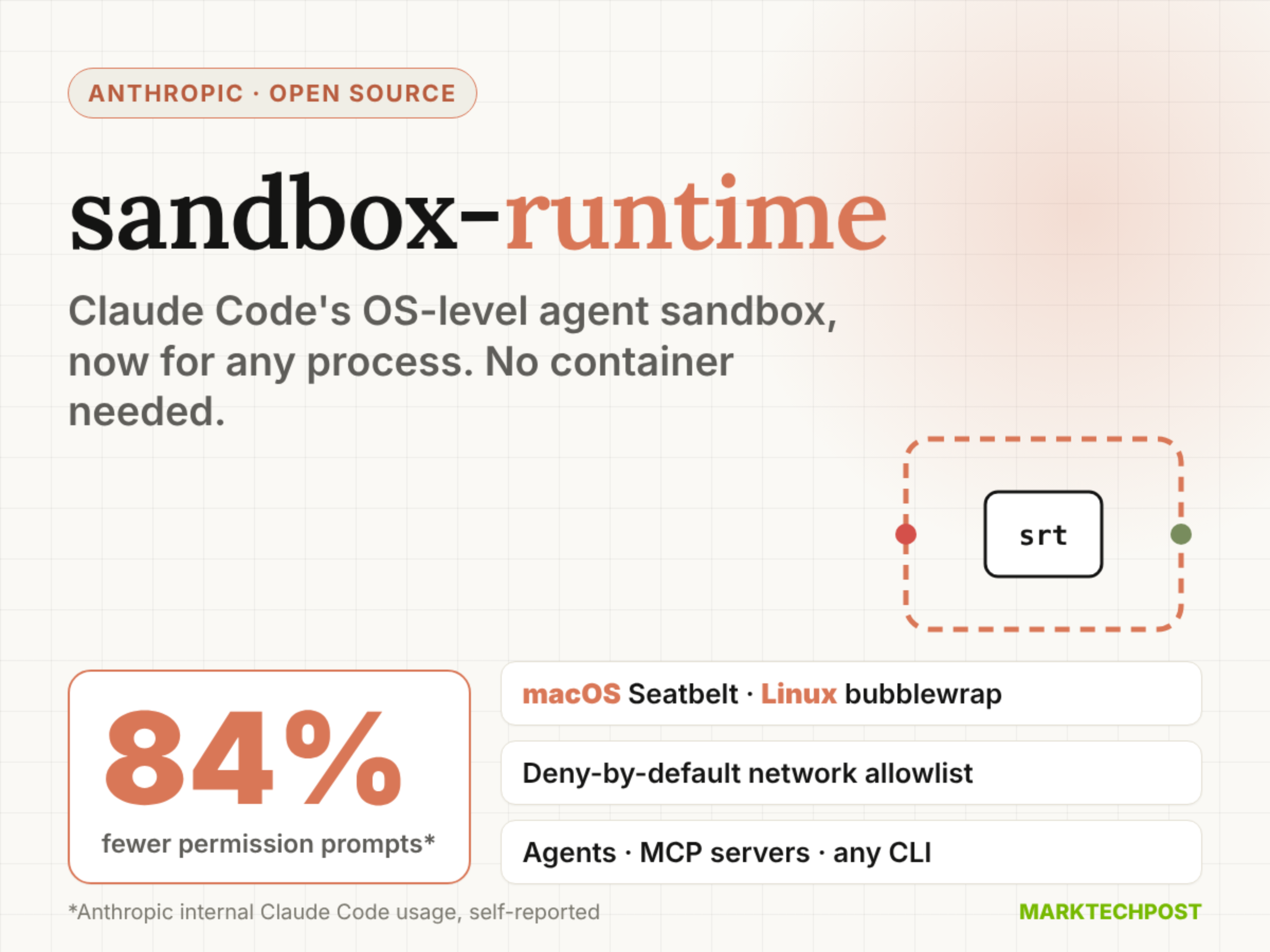
Anthropic open-sources the OS-level sandbox sandbox-runtime: providing container-free file and network isolation for AI agents.

On October 24, 2026, Anthropic open-sourced sandbox-runtime (srt), an OS-level sandboxing tool that operates without containers, designed to restrict file read/write and network access permissions for AI agents, MCP servers, and CLI tools. It supports macOS (Seatbelt), Linux (bubblewrap), and Windows (alpha), with npm package version 0.0.81 under the Apache-2.0 license.

Meet Anthropic’s sandbox-runtime: OS-Level Sandboxing for AI Agents, No Containers

Why it matters:This tool represents a significant advancement in AI security infrastructure—achieving fine-grained, full-process-tree coverage through the operating system’s native isolation mechanisms, directly addressing the risks of prompt injection and privilege escalation, and has already been deployed for internal validation within Claude Code.

Timeline and related coverage

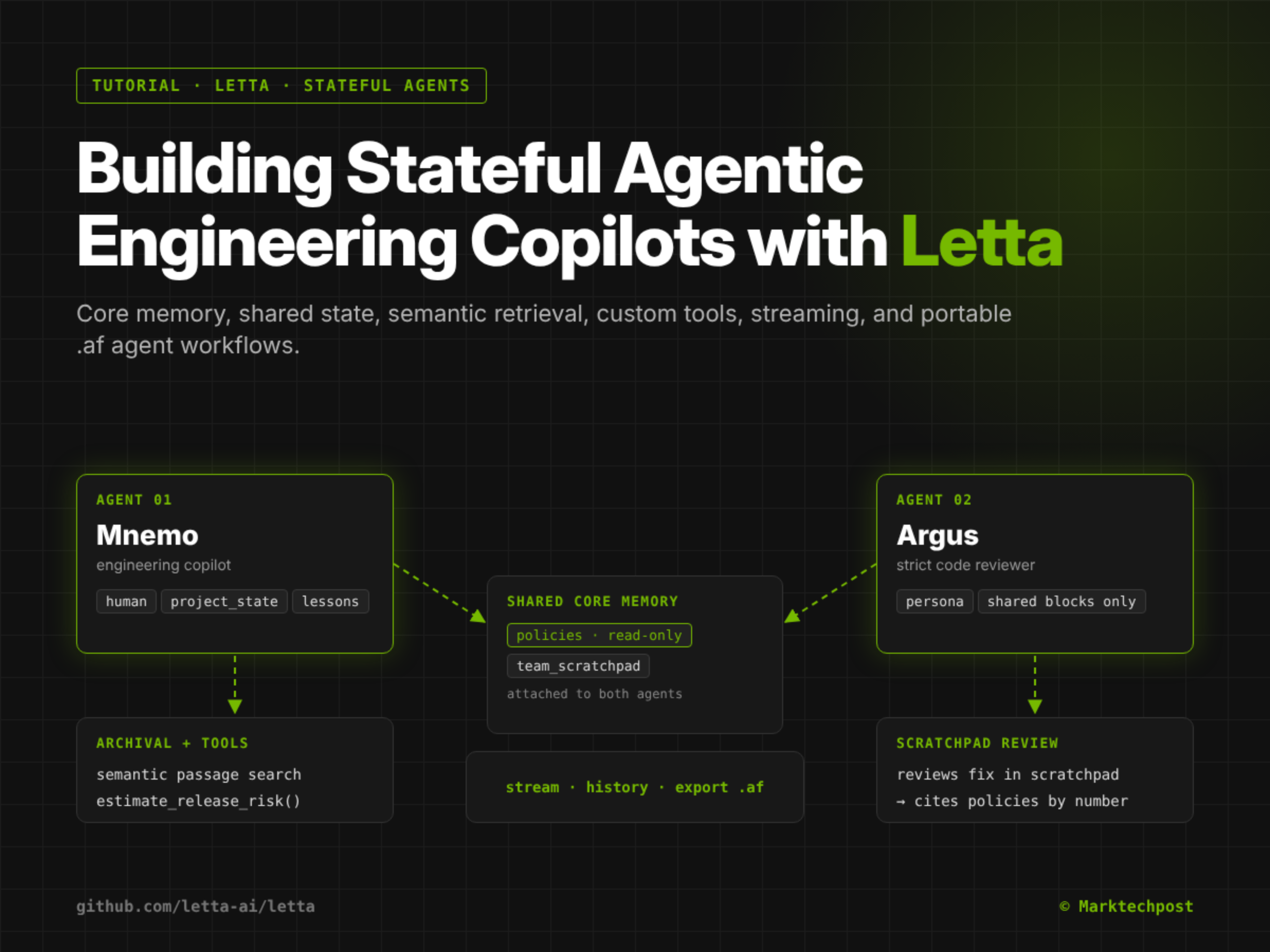
Letta platform releases a tutorial on building stateful engineering collaborators: supporting core memory, shared state, and portable workflows.

MarkTechPost published a tutorial on October 24, 2026, detailing how to build an agentic copilot with persistent state using the Letta framework. The guide covers capabilities such as verifiable core memory, multi-agent shared memory, semantic retrieval of archived knowledge, custom Python tool integration, streaming responses, and .agent format (.af) export. The content serves as a technical practice guide and does not provide performance metrics, security audits, or production‑environment validation.

Stateful Agentic Engineering Copilots with Letta: Core Memory, Shared State, Semantic Retrieval, Custom Tools, Streaming, and Portable Agent Workflows
Timeline and related coverage

Research reveals that reward model scoring exhibits significant prompt dependency: pairwise evaluation fails to detect this bias.

An AI research paper published on arXiv on October 24, 2026, points out that current mainstream pairwise evaluation methods automatically cancel out the scoring components common to all responses under the same prompt, leaving a critical “prompt-level bias” in reward models unexamined. Using human ratings as a benchmark, the authors conducted an audit of 18 publicly available scorers and found that, on the HelpSteer2 dataset, 6 models exhibited 34%–64% of their rating variance attributable to the prompt itself—whereas human ratings show virtually no such phenomenon.

What Pairwise Evaluation Misses: Reward Scores across Prompts

Why it matters:The study highlights a long-overlooked fundamental flaw in the alignment process of large language models: reward model scores are heavily biased toward the prompt text rather than the actual quality of the response. Its methodology—human‑reference auditing, prompt substitution, and variance decomposition—is reproducible, and its conclusions are grounded in empirical analysis across multiple mainstream open-source scorers, offering direct implications for preference optimization, RLHF, and safety‑assessment practices.

Timeline and related coverage

Research reveals systematic differences in evidence-location sensitivity among models with varying long-context lengths.

An empirical study published on October 24, 2026, on arXiv (paper ID 2610.31135v1) compared the positional bias of Transformer, state-space, and hybrid Mamba architectures in long-context question-answering tasks. It found that Transformer models generally exhibit an advantage in leveraging evidence from the initial positions, whereas state-space models lack this characteristic; however, both types of models tend to favor evidence from the end positions.

Mixing Matters: Evidence Position Bias Across Sequence Mixers in Long-Context Question Answering

Why it matters:This study, based on a controlled experimental design (with nine perturbed documents fixed and a single golden document slid), for the first time conducts a cross‑comparison of the positional sensitivity of three mainstream sequence‑modeling architectures within a unified evaluation framework. It reveals the strong coupling between model capabilities and architecture type, prompt engineering, and task characteristics, offering direct guidance for the design and tuning of long‑context AI systems.

Timeline and related coverage

A Study on the Prompt Sensitivity of Tool-Augmented Language Models: Tools Improve Accuracy but Exacerbate the Impact of Statement Variability

A study published on October 24, 2026, on the arXiv platform (ID 2610.31148v1) indicates that, under tool-augmented conditions, the comparative robustness of six open-source language models across five domains and five problem formulations did not improve; on the contrary, while tools increased the accuracy of questions that programs could answer, they also heightened the sensitivity of model ranking changes across different phrasings.

Prompt Sensitivity in Tool-Augmented Model Comparisons

Why it matters:This study employs a newly designed matching protocol that decouples key stages in the entire tool-call process—such as call decision-making, tool responses, and no-call reports—and empirically demonstrates that “improved accuracy” does not necessarily translate into “greater stability.” It further highlights that interface design and instruction details significantly modulate the degree of sensitivity, offering direct guidance for model evaluation practices.

Timeline and related coverage

Research reveals that in multilingual evaluation, the effectiveness of “large models as referees” heavily depends on the choice of referee model.

A multilingual empirical study published on October 24, 2026, on arXiv found that current mainstream prompting strategies—such as chain-of-thought and role‑playing—lack cross‑model and cross‑language transferability in LLM‑as‑a‑Judge scenarios; the choice of the judge model exerts far greater influence than the prompting strategy itself, and the effectiveness of the strategy can even reverse direction across different judge models.

Prompting Strategy Effects Depend on the Judge: A Multilingual Study of LLM-as-a-Judge Robustness

Why it matters:This study is the first to systematically measure the interaction effects among nine prompting strategies, four open-source evaluation models, 27 languages, and 13 datasets, generating over one million human-validated point-by-point ratings and filling a critical gap between English-centric prompting research and fixed-template multilingual studies.

Timeline and related coverage

battledrones v14: Compass Rose, a four player map

Release: battledrones v14: Compass Rose, a four player map I added four player online mode to Battledrones - previous maps were limited to two. Here's the initial prompt I used: Add a new map for a four player battle - four way rotational symmetry, up to four AI players, works with the WebSocket non-audio based multiplayer mode so up to four human players can join (any spare slots use AI) Claude Opus 4.5 added a new map called "Compass Rose" and modified the WebSockets multiplayer network code to support up to four players for that map, joining via share links or QR codes. The new teams use robots themed in purple and green, joining the existing blue and red designs. You can preview those colors in the updated model browser. Tags: game-design, projects, claude

Timeline and related coverage

Quick Study

Tool: Quick Study Prompt to Claude Opus 5.5 High: Build an artifact where you open a photo and it rapidly (in a few seconds) paints a version of that photo using a canvas element and simulated paintbrush See also my previous experiment getting Claude Fable to simulate a watercolor illustration with P5.js. Quick Study uses Sobel edge detection, with no external libraries beyond Google Fonts. Tags: tools

Timeline and related coverage

Donating Agent Skills to the Agentic AI Foundation

Donating Agent Skills to the Agentic AI Foundation News today from Anthropic: We’re committed to keeping Agent Skills open, community-driven, and vendor-neutral. Today, we are donating the standard to the Agentic AI Foundation (AAIF) under the Linux Foundation, which we co-founded with Block and OpenAI last year, and to which we donated the Model Context Protocol (MCP). I'm pleased to note I called this one last December, when Anthropic first declared skills to be an "open standard": I wouldn't be surprised to see this end up in the AAIF, recently the new home of the MCP specification. Fun side note: since my blog content is available to Claude via the datasette-mcp plugin I found that post by prompting Claude to "Use simonwillison.net MCP to find if I ever talked about how I want skills t

Timeline and related coverage