
Skip to content
AI NEWS JOURNAL
AI, IN PERSPECTIVE

Search AI news

Search headlines, summaries and articles to connect the dots.

Newest first

New research reveals that open-book assessments primarily measure reading behavior rather than knowledge retention.

An arXiv paper published on October 24, 2026 (2610.31017v1) points out that, in document-level LoRA adapter evaluations, open-book scoring relies heavily on the model’s ability to read on the fly, rather than on whether the adapter has truly encoded knowledge specific to the document; random adapters can reproduce 82% of the performance advantage of expert adapters on open-book tasks, but on cloze tasks involving unstructured text, they only replicate 2%—statistically indistinguishable from zero.

Mostly Reading: What Open-Book Scores Measure in Document-Level LoRA Adapters

Why it matters:This study, through systematic controlled experiments—comprising 150 Wikipedia articles, the Llama-3.1-8B-Instruct model, and a two-task comparison—reveals the fundamental limitations of the current open-book evaluation paradigm: it fails to effectively distinguish between “reading” and “remembering,” posing methodological challenges to the practical utility of knowledge-editing and retrieval‑oriented adapters. The paper also reports four silent errors that lead to “clean yet incorrect results,” highlighting risks to reproducibility.
Timeline and related coverage

FusionEval Released: A New Benchmark for Large Language Model Fusion

On October 24, 2026, researchers published the paper arXiv:2610.30162v1 on arXiv, introducing FusionEval—the first unified benchmark specifically designed to evaluate fusion methods for large language models. It covers vulnerable aspects such as reasoning chain length and tool invocation, and supports comparisons between fine-tuning-based and zero-shot fusion approaches.

FusionEval: Benchmarking Model Fusion for Large Language Models

Why it matters:This benchmark fills the gap left by existing evaluations, which inadequately cover long-chain reasoning and tool usage; it clearly distinguishes between average performance and worst-case capability retention, provides a reproducible expert pool (based on Qwen3/Llama), multi-dimensional metrics (including GPU memory and runtime), and open-source code, offering strong practical guidance.

Timeline and related coverage

Research on Modulating the Capability Distribution of Large Language Models via Singular Value Spectrum Intervention: Empirical Analysis of Llama and Qwen Models

An AI study published on October 24, 2026, on arXiv (ID 2610.30676v1) applied post-hoc singular-value spectrum smoothing and spike perturbations to five open-source Llama and Qwen instruction-tuned models, finding that this lightweight intervention can systematically reshape the trade-offs in model performance across three capability domains: factual knowledge, language understanding, and deductive reasoning.

Spectral Smoothing and Spiking Perturbations Reconfigure Capability Profiles and Selective Task Performance in Large Language Models

Why it matters:This paper is the first to empirically demonstrate, within a multi‑model, multi‑task framework, the causal impact of the singular value spectrum of transformer feedforward layers on downstream capabilities, revealing structurally sensitive patterns in capability allocation and offering a new pathway for decoupling model capabilities and enabling controllable editing. All conclusions are based on publicly available models and standard benchmarks, with transparent methods and comprehensive evaluation dimensions.

Timeline and related coverage

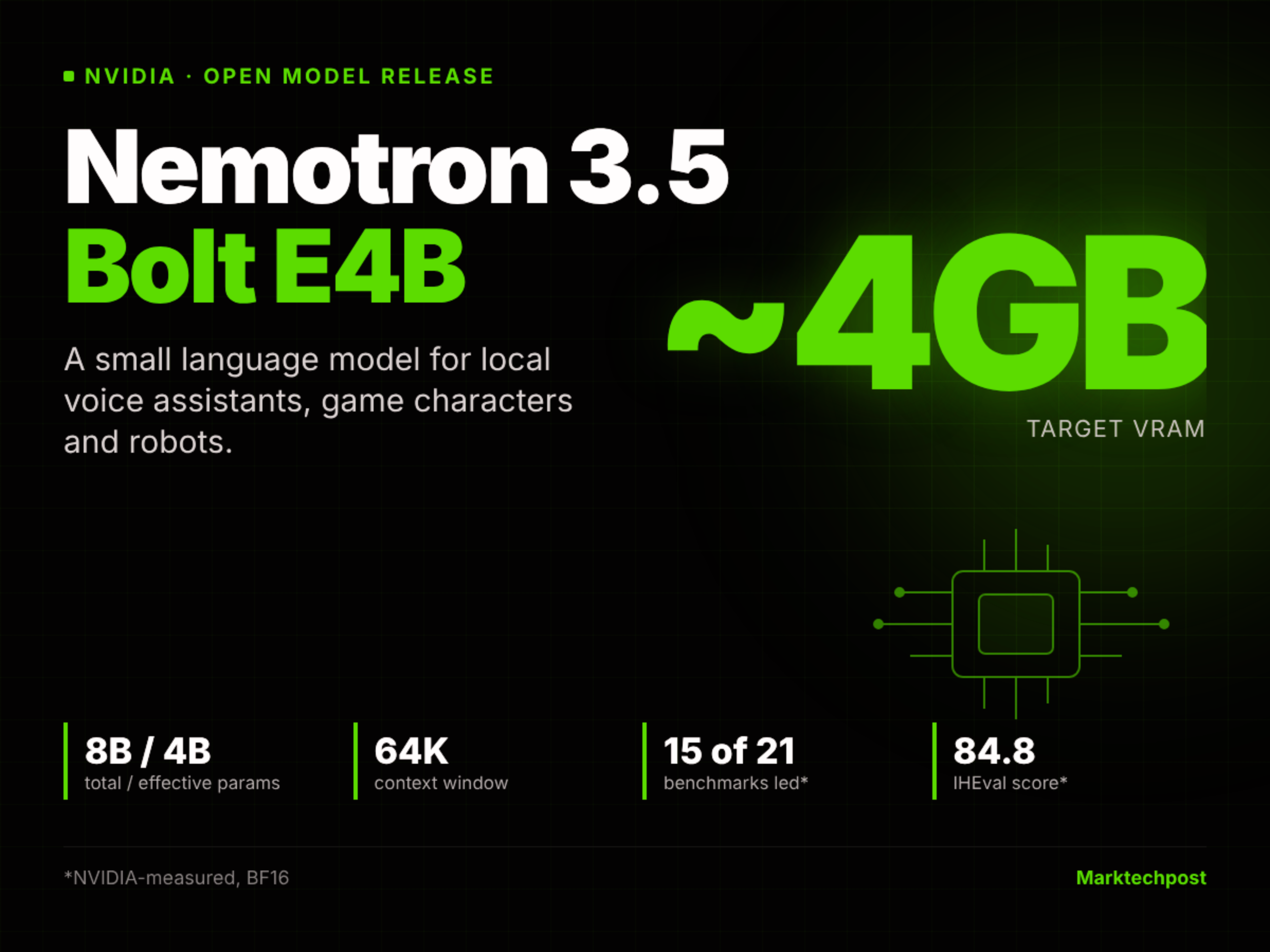
NVIDIA has released the open-source small language model Nemotron 3.5 Bolt E4B 4GB, optimized for on-device voice assistants, game NPCs, and robots.

NVIDIA, leveraging Google’s Gemma 4 E4B model and employing only reinforcement learning (RL) for post-training, has launched Nemotron 3.5 Bolt E4B 4GB—a small open-source language model with 8B total parameters, 4B effective parameters, and a 64K context window. It is designed to run on edge devices such as RTX and Jetson with approximately 4GB of VRAM, supporting multi-turn tool calls and low-latency voice interaction.

NVIDIA Releases Nemotron 3.5 Bolt E4B 4GB: An Open Small Language Model for Local Voice Agents, Game Characters and Robots
Timeline and related coverage

Black October: A Comprehensive Overview of the AI-Driven Cybersecurity Crisis—From Its Peak to Defensive Response

Around October 21–22, 2026, over a span of approximately 48 hours, more than a dozen high‑severity AI‑related vulnerabilities and intrusion incidents were reported worldwide, including PHP2Shell, GitLab RCE (CVSS 10), NGINX/HTTP/3 DoS, LiteLLM password theft, eMudhra CA key leakage, and Quest Diagnostics medical data exposure. State actors such as Storm‑0940 leveraged open‑source intelligent penetration‑testing frameworks like ARTEX to launch large‑scale attacks. Concurrently, AI security defense systems were rapidly being developed, encompassing formal verification, open‑source patching agents, standardization of agent capabilities, and hardware‑level optimizations.

Timeline and related coverage

Self-Hosted Large Models vs. Cloud APIs: How to Route Requests Intelligently

This article compares the trade-offs between self-hosted large language models and cloud APIs in terms of data privacy, cost, latency, and capabilities. It outlines the hardware requirements (such as VRAM and quantization) for open-source deployable models, discusses typical technology stacks, and uses n8n as an example to demonstrate how to build hybrid routing workflows that dynamically distribute requests between on-premises and cloud-based models based on task sensitivity, complexity, or compliance requirements.

Timeline and related coverage

AWS releases the Adaptive Agent Framework (AAIF): a hierarchical AI task scheduling solution that enables edge-cloud collaboration based on Strands Agents.

AWS has introduced the Adaptive Agentic Intelligence Framework (AAIF), which leverages Strands Agents to build a hierarchical agent architecture. It dynamically routes tasks via local small language models (SLMs): routine IoT telemetry and visual analytics are executed at the edge, while complex reasoning is offloaded to Amazon Bedrock’s large cloud-based models. The framework supports hybrid deployment, keeps costs under control, and incorporates responsible AI governance recommendations; however, it currently exists as a proof-of-concept implementation and does not yet provide third-party validation or commercial deployment data.

Timeline and related coverage

OpenAI's latest GPT-6 series models will be available on Google Cloud and the Antigravity platform.

OpenAI’s cutting-edge GPT-6 and 6.1 series models (Astra, Sol, Luna) will be launched on Google Cloud Model Garden in the coming weeks and integrated into Google’s agent-driven programming tool, Antigravity; this move makes Google the first mainstream cloud provider to offer all three major closed-source large models—Gemini, Claude, and GPT.

Timeline and related coverage

NVIDIA unveiled its full lineup of on-premises AI hardware at GTC Berlin: RTX Spark, DGX Spark, and DGX Station have now launched in Europe.

At the GTC conference held in Berlin in October 2026, NVIDIA officially unveiled three on-premises AI hardware platforms for individual users, developers, and enterprise customers: RTX Spark (a personal agent for Windows PCs), DGX Spark (a Linux development cluster), and DGX Station (a cutting-edge AI workstation), while simultaneously announcing numerous software updates, model support, and ecosystem integrations.

Timeline and related coverage

VocabX: Reduces the inference cost of domain-specific small language models by 77% through cost-weighted vocabulary specialization.

Dharma-AI has introduced the VocabX method, which reconfigures the vocabulary of language models for specific tasks—such as automated scoring of Portuguese essays—by optimizing for cost rather than word frequency. Without modifying the model architecture, parameters, or training pipeline, empirical results show a 77% reduction in inference costs, while the evaluation score (bench score) improved from 0.703 to 0.810.

Timeline and related coverage

IBM releases the Granite Speech 5.0 series of speech models: supporting multilingual transcription, translation, and speaker attribution.

IBM has released three open-source speech models in the Granite Speech 5.0 series—granite-speech-5.0-2b (high-precision multilingual ASR/MT), granite-speech-5.0-470m-turboctc (ultra-fast edge-side multilingual transcription), and the updated granite-speech-4.1-2b-plus (enhanced multi-speaker conversational modeling)—all licensed under Apache 2.0 and compatible with mainstream inference frameworks.

Timeline and related coverage

DeepSeek V4.1 Flash, MiniMax M3.1 Flash, and Mercury 3 have been released; model regulation in China and the U.S. has been upgraded; Anthropic has launched a public-interest fund and an AI legislation draft.

DeepSeek V4.1, Flash 1017, and two other new models have been released, but they remain in the early deployment phase; China and the U.S. are simultaneously strengthening AI governance: the U.S. Department of Homeland Security has banned DeepSeek-related products, while China plans to impose export approval for ultra-large-scale models; Anthropic has launched a public-interest equity fund and drafted a federal AI bill; industry infrastructure and security research are advancing in tandem.

Timeline and related coverage

AnyLanguageModel 1.0 released: a unified Swift interface supporting both local and hosted models, compatible with the entire Apple platform family of operating systems 27

Hugging Face has officially released AnyLanguageModel 1.0, an open-source Swift framework fully compatible with the Apple Foundation Models API. It supports seamless switching between local models (MLX, llama.cpp, Core ML) and hosted models (OpenAI, Anthropic, Gemini, Hugging Face Inference Providers, etc.), and introduces new features such as image input, tool invocation, guided generation, and automatic adaptation of inference chunks.

Timeline and related coverage

FairStress: A Novel Fairness Evaluation Framework for Symmetric Robustness in LLM Decision-Making

FairStress is a new benchmark that focuses on the decision stability, interpretability consistency, and internal representation symmetry of large language models (LLMs) in demographic identity substitution scenarios. It reveals systematic behavioral biases in these models, such as “anti-stereotypical over-correction,” and highlights that mainstream evaluation methods—like BBQ—may misjudge the direction of bias due to paradigmatic differences.

Timeline and related coverage

Qwen2.5-Max: Exploring the Intelligence of Large-scale MoE Model

QWEN CHAT API DEMO DISCORD It is widely recognized that continuously scaling both data size and model size can lead to significant improvements in model intelligence. However, the research and industry community has limited experience in effectively scaling extremely large models, whether they are dense or Mixture-of-Expert (MoE) models. Many critical details regarding this scaling process were only disclosed with the recent release of DeepSeek V3. Concurrently, we are developing Qwen2.

Qwen2.5: A Party of Foundation Models!

GITHUB HUGGING FACE MODELSCOPE DEMO DISCORD Introduction In the past three months since Qwen2’s release, numerous developers have built new models on the Qwen2 language models, providing us with valuable feedback. During this period, we have focused on creating smarter and more knowledgeable language models. Today, we are excited to introduce the latest addition to the Qwen family: Qwen2.5. We are announcing what might be the largest opensource release in history!

Qwen2.5-LLM: Extending the boundary of LLMs

GITHUB HUGGING FACE MODELSCOPE DEMO DISCORD Introduction In this blog, we delve into the details of our latest Qwen2.5 series language models. We have developed a range of decoder-only dense models, with seven of them open-sourced, spanning from 0.5B to 72B parameters. Our research indicates a significant interest among users in models within the 10-30B range for production use, as well as 3B models for mobile applications. To meet these demands, we are open-sourcing Qwen2.

Reduce hallucinations with Bespoke-Minicheck

Bespoke-Minicheck is a new grounded factuality checking model developed by Bespoke Labs that is now available in Ollama. It can fact-check responses generated by other models to detect and reduce hallucinations.