Skip to content
AI NEWS JOURNAL
AI, IN PERSPECTIVE

Search AI news

Search headlines, summaries and articles to connect the dots.

Newest first

Democratizing LLM Training with the Edge: Challenges, Systems, and the Road Ahead

arXiv:2610.32215v1 Announce Type: new Abstract: The growing computational power of modern GPU data centers has let a few industrial giants train and deploy large language models (LLMs) on massive amounts of data. Yet the sheer scale of these models and their training data makes centralized development increasingly hard to sustain, and at the same time shuts out smaller institutions that hold relevant private data but lack comparable infrastructure. In this paper, we organize our positions on distributed LLM training around the pretraining and fine-tuning paradigms, covering federated learning, split learning, and decentralized approaches, and we assess their readiness for geo-distributed settings with heterogeneous hardware and unreliable connectivity. We then present a {\em unified} syste


Democratizing LLM Training with the Edge: Challenges, Systems, and the Road Ahead
Timeline and related coverage

b11889

cuda : use std::string instead of VLA for archName (#30463) * cuda : use std::string instead of VLA for archName Modernize the code (old C style) and fix the following warnings: ``` ggml/src/ggml-cuda/ggml-cuda.cu:180:19: warning: variable length arrays in C++ are a Clang extension [-Wvla-cxx-extension] 180 | char archName[archLen + 1]; | ^~~~~~~~~~~ ggml/src/ggml-cuda/ggml-cuda.cu:180:19: note: read of non-const variable 'archLen' is not allowed in a constant expression ggml/src/ggml-cuda/ggml-cuda.cu:179:9: note: declared here 179 | int archLen = strlen(devName); | ^ ``` Signed-off-by: Adrien Gallouët * Add a comment about archName Signed-off-by: Adrien Gallouët --------- Signed-off-by: Adrien Gallouët Signed-off-by: Adrien Gallouët **Website:** - **Attestations:** - **macOS/iOS:** - [ma

Timeline and related coverage

b11888

common, grammar: add recursive depth limit, make it a requirement (#31153) * common, grammar: add recursive depth limit, make it a requirement * catch more recursive functions * common : tidy up peg parser changes * grammar : reject candidates in a loop, without a depth limit The depth limit in llama_grammar_reject_candidates_for_stack counted the code points of a vocab token, so any token of 256 chars or more was always rejected under a grammar, such as the 512-space token of GLM-4.7-Flash or the long space tokens of Laguna-S-2.1. The rejection now walks the code points with its own stack of levels instead of recursing: there is no limit and no stack risk, whatever the length of a token from the GGUF, and the masks match master. * grammar : track rejected candidates as indices into the in

Timeline and related coverage

b11887

tests : adjust default threads for test-llama-context (#31157) **Website:** - **Attestations:** - **macOS/iOS:** - [macOS Apple Silicon (arm64)](https://github.com/ggml-org/llama.cpp/releases/download/b11887/llama-b11887-bin-macos-arm64.tar.gz) - macOS Apple Silicon (arm64, KleidiAI enabled) [DISABLED](https://github.com/ggml-org/llama.cpp/pull/23780) - [macOS Intel (x64)](https://github.com/ggml-org/llama.cpp/releases/download/b11887/llama-b11887-bin-macos-x64.tar.gz) - [iOS XCFramework](https://github.com/ggml-org/llama.cpp/releases/download/b11887/llama-b11887-xcframework.zip) **Linux:** - [Ubuntu x64 (CPU)](https://github.com/ggml-org/llama.cpp/releases/download/b11887/llama-b11887-bin-ubuntu-x64.tar.gz) - [Ubuntu arm64 (CPU)](https://github.com/ggml-org/llama.cpp/releases/download/b11

Timeline and related coverage

b11886

qwen: merge tensors on convert (#31028) * qwen: merge tensors on convert * convert: use generator functions * qwen4exp: remove conts and pre-scale **Website:** - **Attestations:** - **macOS/iOS:** - [macOS Apple Silicon (arm64)](https://github.com/ggml-org/llama.cpp/releases/download/b11886/llama-b11886-bin-macos-arm64.tar.gz) - macOS Apple Silicon (arm64, KleidiAI enabled) [DISABLED](https://github.com/ggml-org/llama.cpp/pull/23780) - [macOS Intel (x64)](https://github.com/ggml-org/llama.cpp/releases/download/b11886/llama-b11886-bin-macos-x64.tar.gz) - [iOS XCFramework](https://github.com/ggml-org/llama.cpp/releases/download/b11886/llama-b11886-xcframework.zip) **Linux:** - [Ubuntu x64 (CPU)](https://github.com/ggml-org/llama.cpp/releases/download/b11886/llama-b11886-bin-ubuntu-x64.tar.gz

Timeline and related coverage

b11884

llama: fix exhausting CPU and MEM caused by dry sequence breaker (#31035) **Website:** - **Attestations:** - **macOS/iOS:** - [macOS Apple Silicon (arm64)](https://github.com/ggml-org/llama.cpp/releases/download/b11884/llama-b11884-bin-macos-arm64.tar.gz) - macOS Apple Silicon (arm64, KleidiAI enabled) [DISABLED](https://github.com/ggml-org/llama.cpp/pull/23780) - [macOS Intel (x64)](https://github.com/ggml-org/llama.cpp/releases/download/b11884/llama-b11884-bin-macos-x64.tar.gz) - [iOS XCFramework](https://github.com/ggml-org/llama.cpp/releases/download/b11884/llama-b11884-xcframework.zip) **Linux:** - [Ubuntu x64 (CPU)](https://github.com/ggml-org/llama.cpp/releases/download/b11884/llama-b11884-bin-ubuntu-x64.tar.gz) - [Ubuntu arm64 (CPU)](https://github.com/ggml-org/llama.cpp/releases/d

Timeline and related coverage

b11883

llama-quant : fix 4D tensor quantization using ggml_nrows() and name-based expert detection (#30820) * llama-quant : fix quantizing 4D tensors nrows_total was ne[1]*ne[2], so for a 4D tensor only the first ne[2] slices were quantized and the rest of the rows were dropped. Use ggml_nrows(tensor) to count all rows, including ne[3]. Fixes #29916 * llama-quant : detect expert tensors by name and fix imatrix size for 4D tensors The MXFP4_MOE path used ne[2] > 1 to detect MoE expert tensors. This is wrong for non-expert tensors with 3 or more dims, e.g. MLA projections (BailingMoE3) and 4D conv kernels. Use the tensor name instead: all tensors used by GGML_OP_MUL_MAT_ID are named *_exps or *_chexps. This also removes the BailingMoE3 special case. The imatrix holds one vector of ne[0] values per

Timeline and related coverage

b11882

grammar: limit recursion depth to prevent stack overflow (#29495) (#29755) **Website:** - **Attestations:** - **macOS/iOS:** - [macOS Apple Silicon (arm64)](https://github.com/ggml-org/llama.cpp/releases/download/b11882/llama-b11882-bin-macos-arm64.tar.gz) - macOS Apple Silicon (arm64, KleidiAI enabled) [DISABLED](https://github.com/ggml-org/llama.cpp/pull/23780) - [macOS Intel (x64)](https://github.com/ggml-org/llama.cpp/releases/download/b11882/llama-b11882-bin-macos-x64.tar.gz) - [iOS XCFramework](https://github.com/ggml-org/llama.cpp/releases/download/b11882/llama-b11882-xcframework.zip) **Linux:** - [Ubuntu x64 (CPU)](https://github.com/ggml-org/llama.cpp/releases/download/b11882/llama-b11882-bin-ubuntu-x64.tar.gz) - [Ubuntu arm64 (CPU)](https://github.com/ggml-org/llama.cpp/releases/

Timeline and related coverage

Hugging Face Releases Carbon-X, a 14B Open DNA Language Model that Brings DNA and Natural Language Together for the First Time

Hugging Face released Carbon-X, an open 14.8B DNA language model built on Qwen3-14B. It reads raw DNA in chat, answers in English, and averages 66.7% across 5 DNA benchmarks under Apache 2.0. The post Hugging Face Releases Carbon-X, a 14B Open DNA Language Model that Brings DNA and Natural Language Together for the First Time appeared first on MarkTechPost.

Hugging Face Releases Carbon-X, a 14B Open DNA Language Model that Brings DNA and Natural Language Together for the First Time
Timeline and related coverage

b11881

llama : respect no_alloc in all memory caches (#31087) * llama : respect no_alloc in memory caches Assisted-by: dsh:llama.cpp/ggml-org/DeepSeek-V4-Flash-Vision-Exp-GGUF (Mac Studio, M2 Ultra, 192GB) * llama : TODO: move no_alloc out of llama_hparams Assisted-by: dsh:llama.cpp/ggml-org/DeepSeek-V4-Flash-Vision-Exp-GGUF (Mac Studio, M2 Ultra, 192GB) * llama : TODO: move no_alloc out of llama_hparams Assisted-by: dsh:llama.cpp/ggml-org/DeepSeek-V4-Flash-Vision-Exp-GGUF (Mac Studio, M2 Ultra, 192GB) **Website:** - **Attestations:** - **macOS/iOS:** - [macOS Apple Silicon (arm64)](https://github.com/ggml-org/llama.cpp/releases/download/b11881/llama-b11881-bin-macos-arm64.tar.gz) - macOS Apple Silicon (arm64, KleidiAI enabled) [DISABLED](https://github.com/ggml-org/llama.cpp/pull/23780) - [macOS

Timeline and related coverage

b11880

tools : reject truncated GGUF tensor data in merge (#31044) Co-authored-by: Shreya Agrawal **Website:** - **Attestations:** - **macOS/iOS:** - [macOS Apple Silicon (arm64)](https://github.com/ggml-org/llama.cpp/releases/download/b11880/llama-b11880-bin-macos-arm64.tar.gz) - macOS Apple Silicon (arm64, KleidiAI enabled) [DISABLED](https://github.com/ggml-org/llama.cpp/pull/23780) - [macOS Intel (x64)](https://github.com/ggml-org/llama.cpp/releases/download/b11880/llama-b11880-bin-macos-x64.tar.gz) - [iOS XCFramework](https://github.com/ggml-org/llama.cpp/releases/download/b11880/llama-b11880-xcframework.zip) **Linux:** - [Ubuntu x64 (CPU)](https://github.com/ggml-org/llama.cpp/releases/download/b11880/llama-b11880-bin-ubuntu-x64.tar.gz) - [Ubuntu arm64 (CPU)](https://github.com/ggml-org/lla

Timeline and related coverage

b11879

CUDA: fuse FFN gate/up matmuls and GLU in MMQ with interleaved gate/up rows (#29948) * cuda: fuse FFN gate/up and GLU in MMQ with interleaved gate/up rows For prompt processing, run the gate and up matmuls of a dense FFN as one mul_mat_q launch and apply the GLU in the write-back. - The loaders take the gate weights as a second pointer and fill the weight tile with up and gate rows interleaved in chunks of 8, so each thread holds an up value and the matching gate value (rows r and r + 8 of an MMA tile). - The MMA loop is unchanged: same tile, warp layout, vec_dot and one sum[] per thread. The fused write-back computes the GLU from registers and writes half the rows. - The fused path uses the regular tiling (no stream-k) with the column tiles innermost so that neighbouring blocks share weig

Timeline and related coverage

b11878

ggml-cuda: fuse qwen MRoPE + set-rows (#31025) **Website:** - **Attestations:** - **macOS/iOS:** - [macOS Apple Silicon (arm64)](https://github.com/ggml-org/llama.cpp/releases/download/b11878/llama-b11878-bin-macos-arm64.tar.gz) - macOS Apple Silicon (arm64, KleidiAI enabled) [DISABLED](https://github.com/ggml-org/llama.cpp/pull/23780) - [macOS Intel (x64)](https://github.com/ggml-org/llama.cpp/releases/download/b11878/llama-b11878-bin-macos-x64.tar.gz) - [iOS XCFramework](https://github.com/ggml-org/llama.cpp/releases/download/b11878/llama-b11878-xcframework.zip) **Linux:** - [Ubuntu x64 (CPU)](https://github.com/ggml-org/llama.cpp/releases/download/b11878/llama-b11878-bin-ubuntu-x64.tar.gz) - [Ubuntu arm64 (CPU)](https://github.com/ggml-org/llama.cpp/releases/download/b11878/llama-b11878

Timeline and related coverage

b11877

vulkan: Add a larger tile size for conv3d (coopmat2 only) (#29920) * vulkan: Add a larger tile size for conv3d (coopmat2 only) This adds a larger tile size, in practice it is only for coopmat2 where we don't need shared memory to store the output (would use more than 64KB). Add some additional representative backend tests. At least, this is what codex came up with from looking at sd.cpp Wan VAE. * only apply large tile size for newer driver versions **Website:** - **Attestations:** - **macOS/iOS:** - [macOS Apple Silicon (arm64)](https://github.com/ggml-org/llama.cpp/releases/download/b11877/llama-b11877-bin-macos-arm64.tar.gz) - macOS Apple Silicon (arm64, KleidiAI enabled) [DISABLED](https://github.com/ggml-org/llama.cpp/pull/23780) - [macOS Intel (x64)](https://github.com/ggml-org/llama

Timeline and related coverage

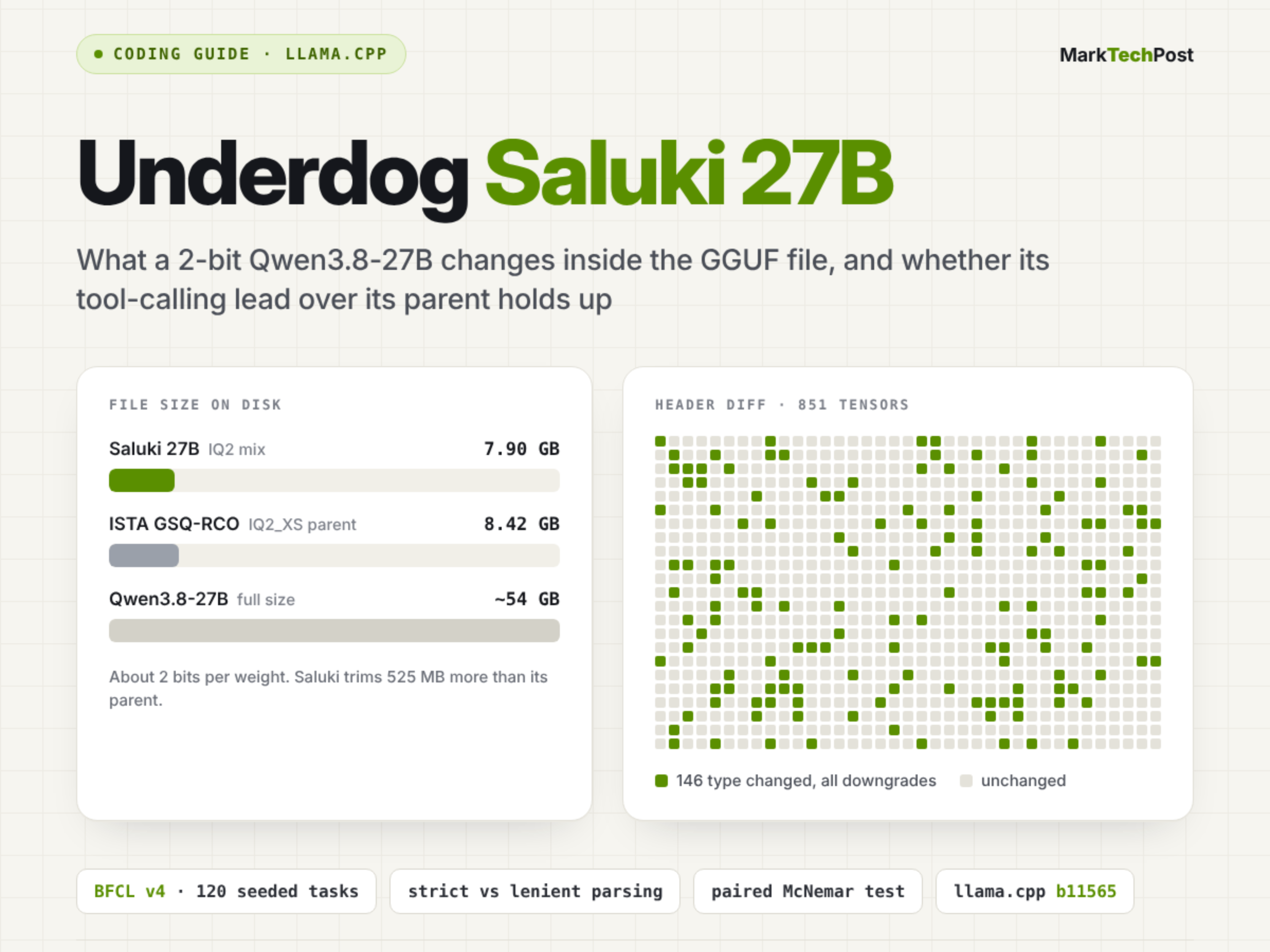
Underdog Saluki 27B: Technical Analysis of the 2-bit Qwen3.8-27B Tool-Calling Model Based on GSQ-RCO

This article introduces Saluki 27B, a model released by Underdog—a 7.9 GB, 2-bit quantized variant of Qwen3.8-27B—built using the GSQ-RCO method from ISTA-DASLab. It claims to outperform the original 54 GB full-precision model on the BFCL v4 benchmark across 120 tasks; however, all performance conclusions are based solely on the developers’ assertions and have not been independently verified.

How to Run Underdog Saluki 27B: 2-Bit Qwen3.8-27B Tool-Calling Guide
Timeline and related coverage

ULME Framework Achieves True Unification of Text Embedding and Language Modeling: A New Paper on arXiv Proposes a Predictive Coupling Mechanism

On October 24, 2026, arXiv published the paper arXiv:2610.30705v1, introducing ULME—a post-training framework for causal-decoder–based large language models that, through a predictive coupling mechanism, achieves, for the first time, a mutually reinforcing unification of text embedding and language-generation capabilities. This approach was validated on the Qwen2.5/Qwen3 series (with 0.5B–8B parameters), yielding MTEB improvements of 3.3–4.1 points while maintaining performance on generation tasks such as MMLU.

ULME: Predictive Coupling for Mutually Reinforcing Embedding and Language Modeling

Why it matters:This paper directly addresses the core issue of fragmented multimodal LLM capabilities: embeddings and generation have long been handled either by separate models or by “pseudo-unified” models that rely solely on parameter sharing. ULME achieves a substantial architectural breakthrough by employing learnable slots and joint training with three objectives—including a stop-gradient prediction loss—enabling the generation process to actively shape the embedding representations. The study features broad experimental coverage, strong baselines, comprehensive metrics, and was published on a reputable preprint platform, balancing timeliness with technical rigor.

Timeline and related coverage

Research reveals the local geometric structure of semantic meaning in large language models

A paper published on October 24, 2026, on arXiv (ID 2610.30715v1) characterizes the local geometric properties of semantic meaning in embedding space across four decoder-only large language models—Gemma 4, Llama 3.2, Qwen 2.5, and Pythia—using cross-lingual probes and fine-grained probes.

Meaning Contracts: Local Semantic Geometry in Large Language Models

Why it matters:This study is the first to systematically characterize the invariance, variability, and refinement mechanisms within “the same semantic factor” in LLMs, proposing the “local anisotropic neighborhood” model. The approach has been validated through blind human evaluations, demonstrating rigorous methodology, broad model coverage, and cross-architecture consistency in its findings.

Timeline and related coverage

Clinicians Lead the Development of Verifiable Safety Guidelines: Establishing a Traceable Layer of Safeguards for Mental Health Chatbots

On October 24, 2026, arXiv published the paper arXiv:2610.30690v1, which proposes a four‑rule safety‑check rulebook defined, finalized, and adjudicated under the guidance of two clinical physicians. After formal verification, this rulebook is deployed as a guardrail layer to govern the outputs of large language models (LLMs) in mental health contexts. All judgments within this guardrail can be traced back to a single naming rule and sixteen factual verifications, aiming to enhance the interpretability and testability of safety assessments.

From Clinical Judgment to Checkable Rules: Clinician-Led Guardrails for Mental-Health Chatbots

Why it matters:This study offers a safety‑enhancing approach distinct from mainstream prompt engineering, LLM‑as‑a‑Judge, or Constitutional AI. Its core innovation lies in structuring and formalizing clinical decision‑making while maintaining a complete audit trail throughout the process. All key claims—such as the number of rules, validation methods, factual base, comparative experimental data, and cost metrics—are explicitly stated in the original text, and the publication date (2026‑10‑24) aligns with the current UTC date (2026‑10‑25), ensuring timeliness and a solid foundation of credibility.

Timeline and related coverage

New research reveals that open-book assessments primarily measure reading behavior rather than knowledge retention.

An arXiv paper published on October 24, 2026 (2610.31017v1) points out that, in document-level LoRA adapter evaluations, open-book scoring relies heavily on the model’s ability to read on the fly, rather than on whether the adapter has truly encoded knowledge specific to the document; random adapters can reproduce 82% of the performance advantage of expert adapters on open-book tasks, but on cloze tasks involving unstructured text, they only replicate 2%—statistically indistinguishable from zero.

Mostly Reading: What Open-Book Scores Measure in Document-Level LoRA Adapters

Why it matters:This study, through systematic controlled experiments—comprising 150 Wikipedia articles, the Llama-3.1-8B-Instruct model, and a two-task comparison—reveals the fundamental limitations of the current open-book evaluation paradigm: it fails to effectively distinguish between “reading” and “remembering,” posing methodological challenges to the practical utility of knowledge-editing and retrieval‑oriented adapters. The paper also reports four silent errors that lead to “clean yet incorrect results,” highlighting risks to reproducibility.

Timeline and related coverage