Skip to content
AI NEWS JOURNAL
AI, IN PERSPECTIVE

Search AI news

Search headlines, summaries and articles to connect the dots.

Newest first

Show HN: Rendering 3D Models in the Terminal

This is something that I've been making for a little under a year now. It has support for the new stuff like Kitty Graphics Protocol and Sixel, but still has fallbacks for terminals that don't support those. Also has textures, animations, wireframe, keyboard and mouse controls, and neovim support.https://github.com/Murat65536/dcat https://github.com/Murat65536/dcat.nvim Comments URL: https://news.ycombinator.com/item?id=50361230 Points: 2 # Comments: 0

SSPE: Robust Sequential Staypoint Extraction in Degraded Trajectory Data

arXiv:2611.03737v1 Announce Type: new Abstract: Extracting semantically meaningful staypoints from raw trajectory streams is a foundational prerequisite for mobility analytics. However, real-world trajectory data is frequently degraded by severe spatial noise and protracted temporal dropouts. Classic threshold-based extraction methods, such as the widely adopted sliding-window algorithm, are highly sensitive to these anomalies, routinely fracturing continuous stationary episodes into disjointed fragments. To overcome this limitation, we propose the Sequential Staypoint Extraction (SSPE) algorithm. SSPE employs a resilient, state-driven architecture that replaces static spatial anchors with a dynamic centroid and introduces an $n$-step lookahead heuristic to structurally tolerate transient coordinate drift. Concurrently, it utilizes temporal bridging mechanisms to prevent artificial fragmentation during prolonged signal loss. Since optimal extraction parameters vary significantly across datasets, we further introduce a fully unsupervised, consensus-based parameter estimation framework. This framework derives baseline statistical scales directly from the raw trajectory data and identifies the optimal parameter configuration by maximizing structural agreement, thereby eliminating the reliance on annotated ground truth. We evaluate SSPE on the ExtraSensory dataset, a real-world mobility corpus with manually verified ground-truth staypoints, against the sliding-window implementation of Trackintel, one of the most widely adopted extraction baselines in the field. Empirical results demonstrate that SSPE achieves superior accuracy, yielding higher F1-scores while simultaneously improving computational efficiency over this standard.

v0.44.0

ComfyUI v0.44.0 introduces multiple new partner nodes for tools like Patina, VEED, BFL, Ideogram, Pruna, MiniMax, Topaz, Sonilo, and OpenAI, adding features such as higher resolution video upscaling, context window editing, and new models. Enhancements include support for ProRes and custom chroma subsampling in video saving, improved frontend handling with pinned versions, optimized tensor comparisons, and better VAE compute dtype control. Performance optimizations address redundant concatenations and memory management, while bug fixes resolve crashes related to VAE decoding and prefetch queue cleanup. The release also updates workflow templates, embedded documentation, and default settings, with contributions from new developers.

v1.19.0 - Trace Your Workflows, Layer by Layer

Dify 1.19.0 enhances observability with nested workflow tracing, allowing users to follow execution steps inside Workflow Tools, inspect LLM calls, and maintain context across nested invocations. The release also enables portable app packages via App packages, improves Agent file uploads and previews, introduces Skill Hub automation through CLI commands, and upgrades the bundled plugin daemon to version 0.6.14-local. Key changes include support for format v2 app packages, enhanced security, improved editing workflows, and updated environment variables and API endpoints.

vLLM Delivers Day-0 Support for Kimi K3.1 Pro

vLLM supports Kimi K3.1 Pro on day 0: sparse attention on a KDA hybrid, a packed KV cache with FP8 or NVFP4 latents and MXFP4 index keys, token-sharded prefill, decode context parallelism, and fused low-latency decode.

GitHub Copilot Fusion Launches with Dual Capabilities: Intelligent Model Orchestration and Local Model Routing

On October 28, 2026, GitHub released the official version of Copilot Fusion, simultaneously introducing an experimental local model routing feature. This capability enables automatic invocation of local models such as MAI Code 1.1 Flash on Windows devices and activates intelligent routing within VS Code, the CLI, and the Copilot App. The system automatically selects and combines cloud models—like those from OpenAI, Anthropic, and Google—based on three effort levels: Standard, High, and Max, achieving performance close to Claude Code while cutting costs in half during coding evaluations.

Timeline and related coverage

A Comparative Study of Parallel Implementations of Short-Time Fourier Transform

arXiv:2610.38069v1 Announce Type: new Abstract: The short-time Fourier transform (STFT) computes the Fourier transform of a short-duration window of a longer signal, which characterizes how a frequency changes over time. While the Fourier transform algorithms, particularly the Fast Fourier Transform (FFT) algorithm, has been well developed to take advantage of parallel computing, there is limited work on understanding the performance of parallel short-time Fourier transform algorithms. In this study, two parallel short-time Fourier transform algorithms, one is FFT-based and the other a quasi-parallel feedforward algorithm, are implemented and analyzed in comparison with each other. It is found that while the quasi-parallel algorithm outperforms in runtime under low concurrency settings, th

Timeline and related coverage

FlatCake: A Flat KVCache Storage Architecture for LLM Serving

arXiv:2610.38355v1 Announce Type: new Abstract: KV cache reuse accelerates LLM serving, but existing systems manage host DRAM and NVMe SSD as a tiered hierarchy where DRAM acts as an intermediate cache. Production LLM workloads break both premises of this hierarchy. First, bimodal reuse defeats DRAM temporal filtering, since workloads are dominated either by one-shot blocks with long reuse distances or by multi-gigabyte agentic sessions that exceed DRAM capacity, putting SSD on the critical read path. Second, DRAM staging and eviction-ordered layout bottleneck SSD restoration. Holding host staging buffers for in-flight prefixes causes contention under load that aborts prefetches, while incremental eviction scatters a session's blocks across the SSD and prevents large sequential reads. We p

Timeline and related coverage

Scoring Explanations Without Reading Them: Structural Shortcuts in Automated-Interpretability Evaluation Data

arXiv:2610.37676v1 Announce Type: new Abstract: Automated interpretability scores an explanation of a sparse-autoencoder (SAE) feature by asking a model to predict, token by token, where the feature fires on evaluation examples or to judge whether marked tokens fit it. We find that the evaluation data standard pipelines build can be scored without reading the explanation. On Neuronpedia's stored fuzzing runs for 500 random GPT-2 small features, 91.3% of activating examples are cropped with the peak on the centre token, and a rule that says "yes" when the centre token is marked reaches balanced accuracy 0.979, against 0.838 for the stored LLM scorers (recomputed from the stored per-item verdicts, on marks rebuilt from the pipeline's code); a rule reading only the mark count reaches 0.969. T

Timeline and related coverage

Wabi reels in $55M for its consumer-focused AI assistant

Wabi Inc., the developer of an artificial intelligence assistant for consumers, today announced that it has raised $55 million in funding. IVP led the seed round with contributions from Amazon Alexa Fund, Andreessen Horowitz and Forerunner. They were joined by a group of angel investors that included Salesforce Inc. CEO Marc Benioff and Shopify Inc. […] The post Wabi reels in $55M for its consumer-focused AI assistant appeared first on SiliconANGLE.

Timeline and related coverage

GitHub releases Copilot Fusion, an automated multi-model orchestration tool that boosts coding efficiency and cost-effectiveness.

At Universe 2026, GitHub unveiled Copilot Fusion, an intelligent orchestration layer that automatically routes and combines models from OpenAI, Anthropic, Google, and others to complete coding tasks—eliminating the need for developers to manually select models. It integrates existing automatic model-selection technologies with Project HydraFusion, previewed in September. Once the model selector is enabled, the system automatically adopts execution modes such as single-model, cascading, or critique, based on task complexity.

QQ20261029-155714.jpg
Timeline and related coverage

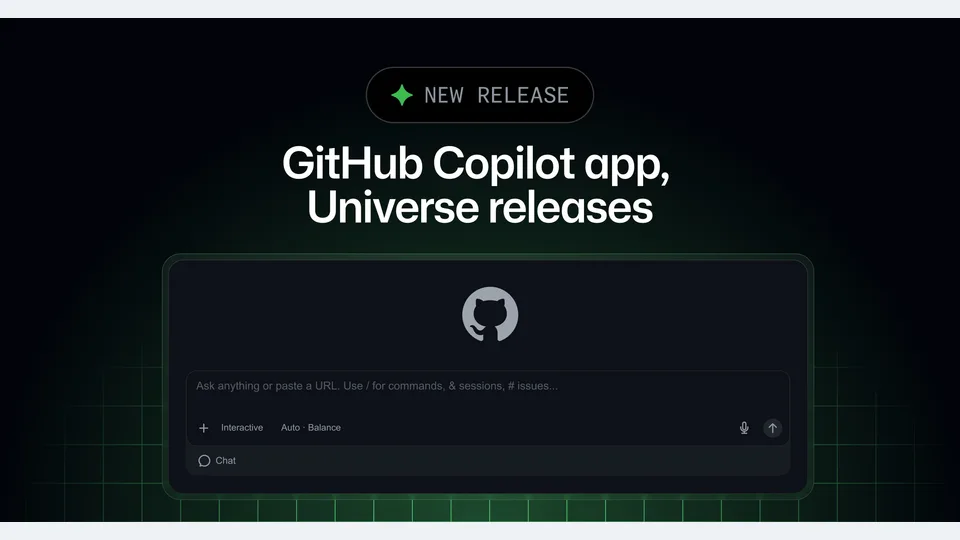
GitHub Copilot app, Universe releases

Work doesn’t always fit in a single repository or session. A feature can span several repositories. A launch plan can pull in specs, designs, and assets without touching a repository… The post GitHub Copilot app, Universe releases appeared first on The GitHub Blog.

新闻源配图 · GitHub Copilot changelog
Timeline and related coverage

b11954

tests : adjust constants to reduce irrelevant warnings (#31254) **Website:** - **Attestations:** - **macOS/iOS:** - [macOS Apple Silicon (arm64)](https://github.com/ggml-org/llama.cpp/releases/download/b11954/llama-b11954-bin-macos-arm64.tar.gz) - macOS Apple Silicon (arm64, KleidiAI enabled) [DISABLED](https://github.com/ggml-org/llama.cpp/pull/23780) - [macOS Intel (x64)](https://github.com/ggml-org/llama.cpp/releases/download/b11954/llama-b11954-bin-macos-x64.tar.gz) - [iOS XCFramework](https://github.com/ggml-org/llama.cpp/releases/download/b11954/llama-b11954-xcframework.zip) **Linux:** - [Ubuntu x64 (CPU)](https://github.com/ggml-org/llama.cpp/releases/download/b11954/llama-b11954-bin-ubuntu-x64.tar.gz) - [Ubuntu arm64 (CPU)](https://github.com/ggml-org/llama.cpp/releases/download/b1

Timeline and related coverage

b11953

cuda : add top-k MoE fusion for 384 experts (#31288) Assisted-by: Codex **Website:** - **Attestations:** - **macOS/iOS:** - [macOS Apple Silicon (arm64)](https://github.com/ggml-org/llama.cpp/releases/download/b11953/llama-b11953-bin-macos-arm64.tar.gz) - macOS Apple Silicon (arm64, KleidiAI enabled) [DISABLED](https://github.com/ggml-org/llama.cpp/pull/23780) - [macOS Intel (x64)](https://github.com/ggml-org/llama.cpp/releases/download/b11953/llama-b11953-bin-macos-x64.tar.gz) - [iOS XCFramework](https://github.com/ggml-org/llama.cpp/releases/download/b11953/llama-b11953-xcframework.zip) **Linux:** - [Ubuntu x64 (CPU)](https://github.com/ggml-org/llama.cpp/releases/download/b11953/llama-b11953-bin-ubuntu-x64.tar.gz) - [Ubuntu arm64 (CPU)](https://github.com/ggml-org/llama.cpp/releases/dow

Timeline and related coverage