
NVIDIA Nemotron 3.5 Transcribe and Granary v2: Intelligent Multilingual Transcription You Can Prompt and Adapt
NVIDIA Nemotron 3.5 Transcribe and Granary v2: Intelligent Multilingual Transcription You Can Prompt and Adapt
Search headlines, summaries and articles to connect the dots.
NVIDIA Nemotron 3.5 Transcribe and Granary v2: Intelligent Multilingual Transcription You Can Prompt and Adapt
Education Innovation
There are 57 million people worldwide living with dementia today. For the researchers working to help them, the obstacle isn’t a lack of effort — it’s too much data, too few experts to synthesize it and a pace of discovery that can’t keep up with the disease. The Consortium for Biomedical Research and AI in […]

Mirendil released Fern 0.1, its first model, pretrained from scratch with a 10M-token context window. It targets agentic AI R&D work, scores 100% on RULER single needle at 10M, but trails frontier models on agentic coding. The post Mirendil Launches Fern 0.1, Its First Model, With 10M-Token Context appeared first on MarkTechPost.
The S-1, the numbers, and the reactions.
For most of its 30-year history, Cisco Partner Summit has focused on how partners sell Cisco Systems Inc. technology. This year’s event in Vancouver was about something different: how partners make money in a world where the transaction is no longer the main event. Cisco entered the event with tremendous momentum, as its stock was […] The post Cisco Partner Summit: Five insights that will define the channel in the AI era appeared first on SiliconANGLE.
arXiv:2610.32322v1 Announce Type: new Abstract: LLM agents retrieve skills from public hubs that hold up to about 100,000 entries and serve many models. As models improve, a hub must find the skills a given model has internalized, meaning it can do without them, and retire them for that model, yet internalization has not been measured with known reliability. Published rules that compare runs with and without a skill retire on the gain alone. The gain is near zero both for an internalized skill and when neither the model nor the skill delivers the capability, a state we call uncovered. We instead withhold the skill, score the model on a task synthesized from it, and trust a high unaided score only when another model gains from the skill, since nearly half of high scores come from tasks no m
arXiv:2610.33475v1 Announce Type: new Abstract: The widespread deployment of foundational Large Language Models (LLM) across cloud datacenters marks a fundamental paradigm shift from stateless deep learning toward distributed, memory-intensive generative workloads. However, serving massive foundation models under stringent Service Level Objectives (SLO) exposes critical physical and system bottlenecks. These challenges include the persistent High Bandwidth Memory (HBM) wall, operational asymmetry between compute-bound prefilling and memory-bandwidth-bound decoding, explosive Key-Value (KV) cache expansion, prohibitive serverless cold starts, and hardware reliability vulnerabilities. Existing literature reviews remain layer-siloed, decoupling low-level accelerator virtualization from cluste
arXiv:2610.32308v1 Announce Type: new Abstract: Multi-step retrosynthesis requires recursively transforming a target molecule through successive reaction steps into purchasable building blocks, and recent work has begun to draw on large language model (LLM) reasoning to tackle the task. In its latest evolution, LLM reasoning has entered the long-horizon regime: models pursue objectives across interdependent steps, interact with environments, and adapt to feedback. This shift has markedly advanced LLM capabilities, as illustrated by breakthroughs in AI-driven mathematical research. At this frontier, we introduce Solvent, an 8B LLM that successfully extends long-horizon reasoning to multi-step retrosynthesis. Through a two-round post-training curriculum, Solvent learns to interleave iterativ
arXiv:2610.33070v1 Announce Type: new Abstract: Image-to-Video (I2V) diffusion models can animate a single portrait or photograph, enabling shared images to be repurposed for motion synthesis without the subject's authorization. We study proactive visual protection against such use: before an image is released, its owner applies a bounded perturbation that preserves the sharing workflow but disrupts downstream motion generation. Existing spectral disruption objectives globally attenuate temporal representations and therefore provide limited control over subtle or spatially localized motion. Our key idea is that generated dynamics depend not only on temporal feature strength, but also on the order in which feature events occur. We propose PhaseBreak, a white-box spectral retiming protection
Build specialized multimodal models with LFM3
Can we trust LLMs to judge whether a research idea is novel?
dbt v2 bundles adapters, speeds up parsing, and replaces manifest.json with smaller, queryable files for people and AI.

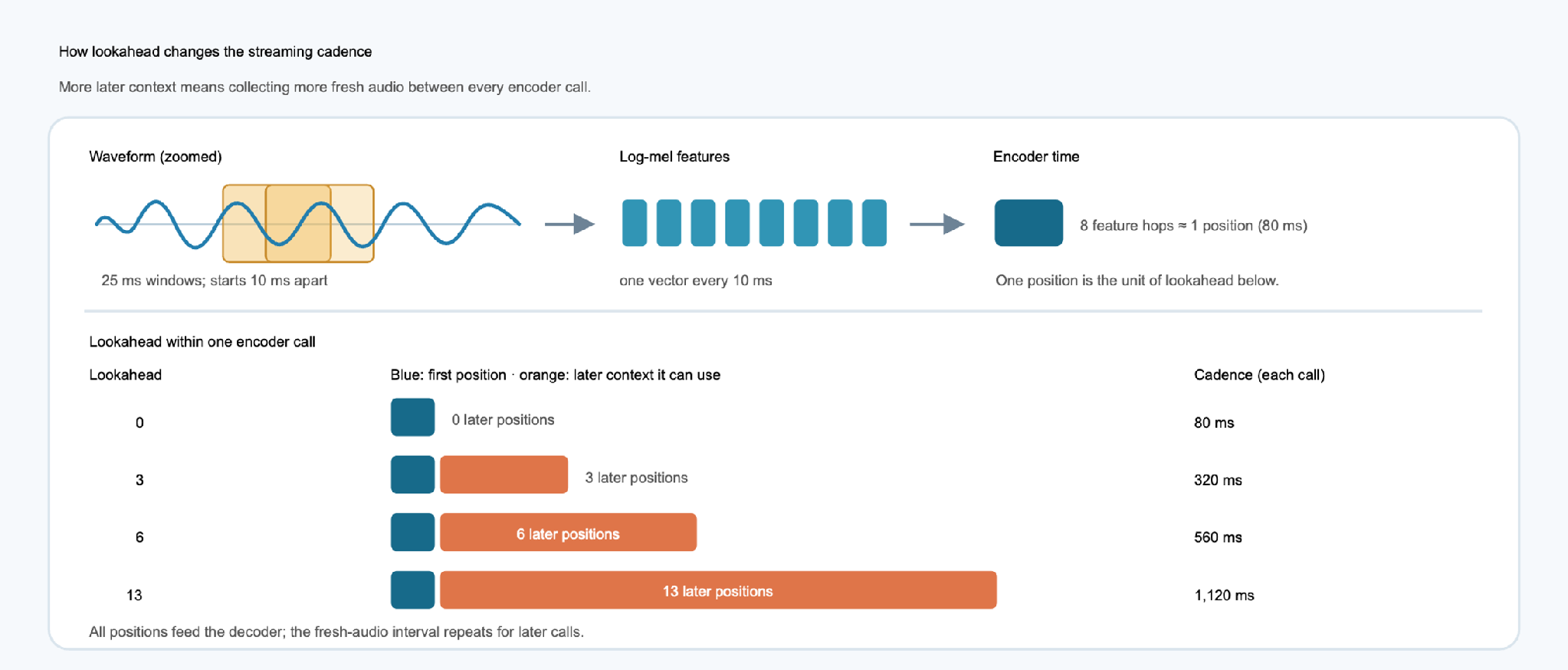
When you’re speaking to a device, you expect text to appear as you talk. That makes streaming automatic speech recognition (ASR) a different challenge from batch transcription, where the model... The post Optimizing Streaming Speech Recognition on Arm® Edge Devices with ExecuTorch appeared first on PyTorch.

Fleet-wide computer vision needs a model per camera, not one model for the whole fleet. This post presents a working Amazon SageMaker SDK v3 reference architecture that trains, quality-gates, compiles per-camera models with SageMaker Neo, and versions thousands of them, with an AWS Step Functions layer pacing fleet-scale retraining within account quotas.
We ran one AI skill 80 times against four context sources. Engineered summaries cut cost 48.5% and run time 43.2%.
Agents waste time and context on clumsy searches, oversized results and stale data. Learn the retrieval techniques LangChain's Deep Agents harness uses to get the right context in.
What is “night” to a machine?
arXiv:2610.31882v1 Announce Type: new Abstract: We present the framework of TACS-RF - a Tool-driven Agentic Circuit Synthesis of RF and mmWave modules. In this framework, a large-language-model (LLM) coding agent (Claude Opus 4.8) directly drives industry-standard electronic-design-automation (EDA) tools such as Cadence Virtuoso/Spectre, Calibre, Cadence EMX, and Ansys HFSS to design RF and mmWave modules. We validate the framework through the agentic design of a 240-251 GHz sub-THz transmitter in a 90 nm SiGe BiCMOS process. The agent semi-autonomously designed the sub-blocks including a 60 GHz push-push Colpitts VCO with second-harmonic extraction, multistage differential cascode power drivers, a push-push frequency doubler, a differential bowtie antenna, and all the interstage matching

arXiv:2610.32022v1 Announce Type: new Abstract: Intent recognition in human-robot interaction requires agents to resolve ambiguous natural language instructions by inferring the speaker's underlying goals. Research has increasingly focused on two notable paradigms for addressing this task: structured symbolic reasoning and multimodal input enrichment. However, it remains unclear whether enrichment-based methods provide benefit in settings where the ambiguity concerns unstated human intent rather than missing observable scene information. In this paper, we present a comparative and diagnostic study benchmarking FISER - a framework utilizing structured social and embodied reasoning - against CEMIR (Context-Enriched Multimodal Intent Recognition), a method that performs multimodal enrichment