Skip to content
AI NEWS JOURNAL
AI, IN PERSPECTIVE

Search AI news

Search headlines, summaries and articles to connect the dots.

Newest first

v1.19.0 - Trace Your Workflows, Layer by Layer

Dify 1.19.0 enhances observability with nested workflow tracing, allowing users to follow execution steps inside Workflow Tools, inspect LLM calls, and maintain context across nested invocations. The release also enables portable app packages via App packages, improves Agent file uploads and previews, introduces Skill Hub automation through CLI commands, and upgrades the bundled plugin daemon to version 0.6.14-local. Key changes include support for format v2 app packages, enhanced security, improved editing workflows, and updated environment variables and API endpoints.

vLLM Delivers Day-0 Support for Kimi K3.1 Pro

vLLM supports Kimi K3.1 Pro on day 0: sparse attention on a KDA hybrid, a packed KV cache with FP8 or NVFP4 latents and MXFP4 index keys, token-sharded prefill, decode context parallelism, and fused low-latency decode.

Fairway: Load-Aware KV Cache Reuse for LLM Prefill Scheduling

arXiv:2611.02082v1 Announce Type: new Abstract: LLM-based applications often employ agentic workflows and retrieval-augmented generation (RAG), which build long prompts from shared context. When prefixes are shared across requests, serving engines reuse the key-value (KV) cache to skip parts of the prefill computation. Reuse is typically graded: the uncached work of requests in a queue can differ by up to 100x. In this setting, the order of scheduling determines the time-to-first-token (TTFT) for the queued requests. KV reuse-first scheduling, which prioritizes the requests with the longest KV cache hit, gives the lowest median TTFT but starves expensive requests under load spikes; first-come-first-served (FCFS) scheduling bounds the tail but raises the median TTFT. We present Fairway, a prefill scheduler built on adaptive reuse prioritization: it favors KV cache reuse while queues are short, and shifts toward fair allocation as requests wait longer relative to their own prefill time. Fairway employs a virtual dual lane model: a KV reuse-first Fast lane and a Fair lane atop the serving engine's waiting queue that enables speeding up of cheap reuse requests without starving expensive ones. This model automatically adapts to the workload without any per-workload tuning. Fairway lowers the tail TTFT at no cost to the median in transient overload. Across workloads and load levels, Fairway matches or beats the best baseline, with a p99 TTFT up to 8.6x lower than prior prefix-aware schedulers. During load spikes, it keeps the tail of FCFS at a 6x lower median TTFT.

Exposure Is Not Commitment: Double-Stratified Evaluation of Latent Monitors for Tool-Using Agents

arXiv:2610.37679v1 Announce Type: new Abstract: Tool-using language agents are vulnerable to indirect prompt injection, and a growing literature probes model internals to catch unsafe actions before they execute, with sharply conflicting results. We argue much of the conflict is an evaluation artifact, and propose a double-stratification protocol: separate injection exposure from behavioral commitment, in both the evaluation and the training population. On the primary Qwen AgentDojo grid, monitors trained on the naive mixed unsafe-versus-rest contrast mostly learn exposure: they flag exposed trajectories whether or not the agent complies, and barely predict which cases turn unsafe. Retrained on exposed cases only, the same probe families predict the model's own unsafe tool call up to two s

Timeline and related coverage

Locating Sycophancy Across Training Stages in Open Language Models

arXiv:2610.37788v1 Announce Type: new Abstract: Language model assistants sometimes change a correct answer when the user suggests a wrong one. The behavior, called sycophancy, is usually attributed to preference-based post-training, yet early measurements found it in pretrained models. We ask where it comes from by measuring it at every available stage of training: 13 open checkpoints from 5 lineages, from base model through supervised fine-tuning and preference optimization to release. We separate how far an injected claim moves a model's answer from how firmly the answer was held, and vary who makes the claim, how reliable they are said to be, and how strongly they make it. Two sycophancy behaviors with different origins emerge, and both replicate across datasets. Deference to a claim i

Timeline and related coverage

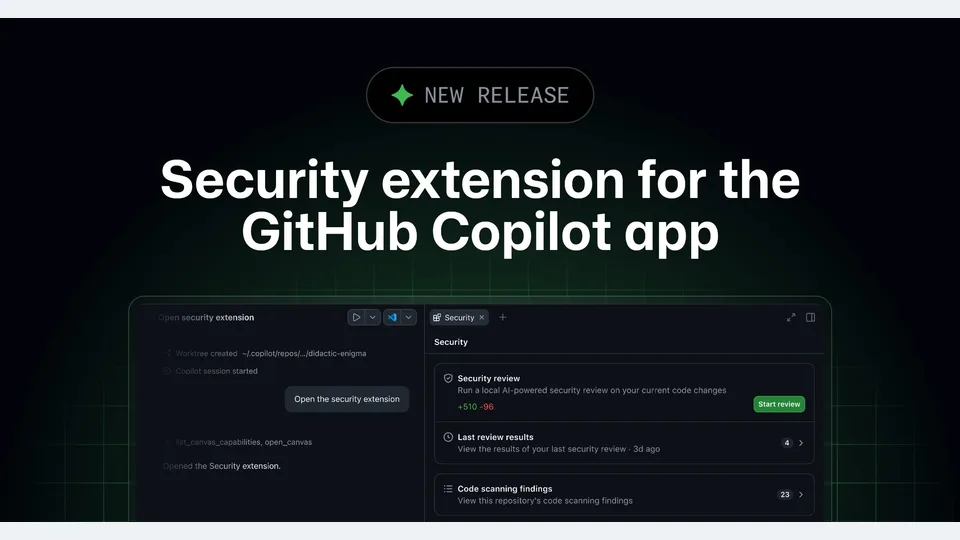
Security extension for the GitHub Copilot app

You can now work through your repository’s GitHub code scanning alerts without leaving the GitHub Copilot app. The new GitHub security extension, now in public preview, lets you find the… The post Security extension for the GitHub Copilot app appeared first on The GitHub Blog.

新闻源配图 · GitHub Copilot changelog
Timeline and related coverage

Nvidia releases all-in-one adaptable Nemotron 3.5 audio transcription and translation model

Nvidia Corp. today released a leaderboard-winning open artificial intelligence model for multilingual audio transcription and translation, along with an open data pipeline for fine-tuning Nemotron 3.5 Transcribe. Traditional transcription AI models follow a workflow that detects speech, transcribes it, identifies and labels different speakers, then answers questions about the transcription. Transcribe does all of this […] The post Nvidia releases all-in-one adaptable Nemotron 3.5 audio transcription and translation model appeared first on SiliconANGLE.

Timeline and related coverage