Skip to content
AI NEWS JOURNAL
AI, IN PERSPECTIVE

Search AI news

Search headlines, summaries and articles to connect the dots.

Newest first

Circuit Mind lands $25M and puts AI agents to work checking circuit board schematics

British circuit board design startup Circuit Mind Ltd. today announced it has raised $25 million in new funding to extend its artificial intelligence platform across more of the hardware design process. A verification tool that puts AI agents to work hunting for errors in schematics launched at the same time. Circuit Mind offers software that […] The post Circuit Mind lands $25M and puts AI agents to work checking circuit board schematics appeared first on SiliconANGLE.

Timeline and related coverage

Liquid AI unveils the LFM3 multimodal model family, emphasizing efficient, specialized intelligence

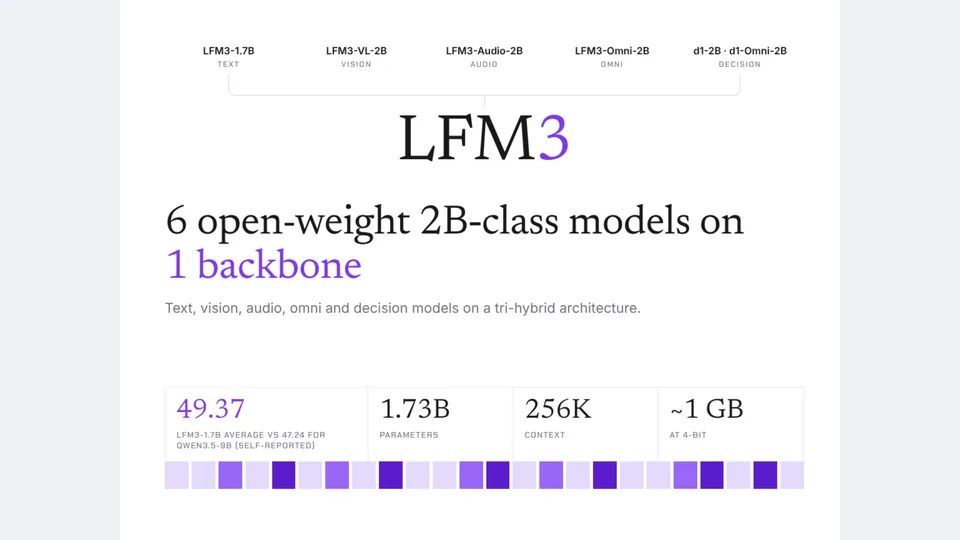
Recently, Liquid AI officially launched its next-generation foundation model family, LFM3. The first release includes six models with approximately 2 billion parameters, covering text, vision, audio, omni-modal, and decision-making capabilities—all built on the LFM3-1.7B-Base foundation and achieving a pre-training throughput of 22 trillion tokens. This series adopts a novel tri-hybrid layer architecture, integrating gated short convolutions, sliding windows, and other mechanisms, prioritizing fewer parameters and higher efficiency.

Liquid AI重磅发布LFM3 多模态模型家族,主打高效专用智能
Timeline and related coverage

INC-MoE: Overlapping In-Network Collectives and Expert Computation for Expert-Parallel Mixture-of-Experts Inference

arXiv:2610.36339v1 Announce Type: new Abstract: In expert-parallel mixture-of-experts (MoE) serving, dispatch moves tokens to the accelerators hosting their selected experts, and combine returns expert outputs to each token's owner. Both operations lie on the critical path and can dominate MoE layer latency in multi-node deployments. We present INC-MoE, an expert-parallel MoE layer that offloads dispatch and combine to the network switch and overlaps both collectives with each other and with expert computation. Dispatch uses in-network AllGather through switch-side multicast, while combine uses in-network ReduceScatter through switch-side reduction. Both collectives use message semantics between the end hosts and the switch. Because the in-network collectives load opposite directions of ea

Timeline and related coverage

LLM Hallucination Detection via Low-rank Multilinear Decomposition

arXiv:2610.36191v1 Announce Type: new Abstract: Large language models (LLMs) frequently generate fluent yet factually incorrect responses, raising concerns about their reliability. Recent hallucination detectors increasingly exploit internal representations, but extracting informative signals from high-dimensional hidden states remains challenging. Existing approaches often rely on selected activations or pooling-based compression, potentially overlooking discriminative information distributed across Transformer layers, feature modes, and tokens. We propose LOTUS (Low-rank Order-statistic TUcker-based Subspace learning), a multilinear low-rank decomposition framework for hallucination detection that extracts compact representations from LLM hidden states while reducing dependence on labele

Timeline and related coverage

Causal Localization of Evidence Effects in Transformers

arXiv:2610.36524v1 Announce Type: new Abstract: Can controlled symbolic inputs reveal attention heads that influence a language model's decisions from natural language evidence? We introduce controlled evidence aggregation (CEA), which varies the counts and order of two symbols in otherwise fixed prompts and measures changes in a frozen Transformer's preference between two answer tokens. The preference is measured by their logit difference; the prompts prescribe no correct answer. Balanced utility causal selection (BUC) identifies compact head sets by jointly evaluating how much ablating their outputs removes the count effect and how closely patching mean outputs between count conditions recovers the effect in both directions. We derive conditional bounds linking head attribution to interv

Timeline and related coverage

KORA: Deterministic-First Execution Control for AI Workloads

arXiv:2610.35869v1 Announce Type: new Abstract: AI applications often invoke a model before they determine whether inference is necessary. That default is useful for ambiguous generative tasks, but it is poorly matched to work that is structured, deterministic, policy-bound, lookup-oriented, or directly verifiable. KORA introduces deterministic-first execution control: a pre-inference control layer that represents requests as task paths, attempts deterministic or structured routes first, validates route outcomes, records telemetry, and escalates to a model-candidate path only when deterministic handling is insufficient. This paper presents KORA as a deterministic-first execution-control architecture and reports bounded evidence from reproducible benchmark and validation workloads. In a rep

Timeline and related coverage

Beyond IceBERT: Open-Data ModernBERT Encoders for Icelandic from 12M to 1B Parameters

arXiv:2610.36230v1 Announce Type: new Abstract: IceBERT, the reference encoder for Icelandic, found that a cleaned web crawl is enough to train a strong model and that starting from a multilingual model can help on some tasks. We revisit both findings with the ModernBERT architecture. We train Icelandic encoders from 12M to 1B parameters on 9B tokens of open data, and rerun IceBERT's benchmarks and five newer tasks for 30 encoders under one protocol with confidence intervals. Our 1B model trained from scratch, to our knowledge the first monolingual Icelandic encoder of that size, is significantly better than IceBERT on all eleven tasks; warm-started from the English Ettin encoder of the same shape, it has the best score of all encoders on every task we rank. Because our model shapes match

Timeline and related coverage

A Quantitative Approach to Asch Conformity in Frontier Large Language Models

arXiv:2610.36668v1 Announce Type: new Abstract: The Asch conformity experiment has recently gained considerable attention as a way of measuring conformity in large language models (LLMs). While previous studies have focused on demonstrating conformity in LLMs, our work adds a further quantitative layer to this approach. Instead of sampling a frontier LLM on a suite of questions, our approach samples a single question repeatedly, leveraging the probabilistic nature of LLMs to produce a distribution of answers. In doing so, we can compare the distributions of answers before and after the model is presented with the manufactured consensus. Our experiments confirm that frontier LLMs do conform, reinforcing prior literature, and, through our distribution-to-distribution comparisons, provide add

Timeline and related coverage

Dell expands cyber recovery tools to protect identity

Restoring data after a cyberattack isn’t enough if the identity systems that control access are compromised. Dell Technologies Inc. is extending its cyber recovery tools to cover those systems, putting identity resilience alongside data protection. That gap is widening as AI ties data, identity, infrastructure and applications into interdependent systems, making data protection a core […] The post Dell expands cyber recovery tools to protect identity appeared first on SiliconANGLE.

Timeline and related coverage

b11936

llama : build the k-pool sparse selection independently of the kq_mask shape (#31243) * llama : build the k-pool sparse selection independently of the kq_mask shape qwen4exp (QSA) and glm5-next pick cache cells by index and no longer read the kq_mask values, but they still shaped the selection like the dense kq_mask. Build the selection as [n_kv, n_tokens] over the cache cells instead, and split it into the streams of the K view right before the attention. This lets the dense mask change its layout (e.g. per-sequence row lists) without touching the sparse layers. * improve comment Co-authored-by: Georgi Gerganov * llama : drop the unused build_fused_top_k_mask args, review nits --------- Co-authored-by: Georgi Gerganov **Website:** - **Attestations:** - **macOS/iOS:** - [macOS Apple Silico

Timeline and related coverage