Show HN: Lmux – A Lightweight macOS Terminal for Claude Code and Codex
Article URL: https://github.com/sooftware/lmux Comments URL: https://news.ycombinator.com/item?id=50378582 Points: 2 # Comments: 0
Search headlines, summaries and articles to connect the dots.
Article URL: https://github.com/sooftware/lmux Comments URL: https://news.ycombinator.com/item?id=50378582 Points: 2 # Comments: 0
arXiv:2611.05542v1 Announce Type: new Abstract: Whole-page ranking jointly optimizes advertisements and organic content to balance business outcomes and user engagement under complex layout and business constraints. Existing non-autoregressive (NAR) approaches enable efficient page generation but typically score candidate items independently of previously selected items, limiting their ability to capture order-dependent interactions. Autoregressive (AR) methods address this limitation through sequential conditioning, but incur substantial inference overhead that challenges large-scale deployment. Bridging this quality-efficiency gap remains a challenge in industrial whole-page ranking. We propose Multi-Item Scoring (MIS), a prefix-aware NAR-style framework that incorporates sequential context into efficient multi-item scoring. MIS integrates global candidate interactions, localized prefix conditioning, and position-aware scoring within a shared representation architecture. By computing reusable representations once per request and performing lightweight prefix-conditioned scoring during constrained beam search, MIS captures important sequential dependencies without repeated full-model inference. Experiments on KuaiRand-1K and RL4RS demonstrate that MIS approaches the generation quality of an autoregressive CGA baseline while achieving 4.07x and 3.54x faster CPU decoding, respectively. In a randomized evaluation on a large-scale social-video platform, MIS improves the realization metric by 0.104% and watch time by 0.058%, while reducing ranking-service CPU consumption by 9.73%. These results demonstrate that prefix-aware multi-item scoring can narrow the quality gap between NAR and AR generation while retaining the efficiency required for industrial scalability.
Some agent-evaluation questions are narrow and repeatable, and decision models answer exactly that kind of question. This post shows how to connect two decision models, Jev and Strands Decider, to Amazon Bedrock AgentCore Evaluations through code-based evaluators, and how to validate a decision-model check before you gate a release on it.
OpenAI built an autonomous pipeline that found, validated, and generated patches for 948 local privilege-escalation vulnerabilities in the Linux kernel.
arXiv:2611.04092v1 Announce Type: new Abstract: Capturing an image in a low-light environment produces a weak, noisy sensor signal. Low-light image enhancement (LLIE) aims to restore it. Auto white balance (AWB) is also required for every image, and the same noisy signal degrades its ability to infer the scene illuminant. LLIE is typically performed first, followed by AWB, but this strategy remains largely unexamined because existing low-light datasets span a narrow range of illuminants and lack illuminant ground truth for evaluating AWB. We address this with CHROMA-MILL, a RAW dataset of 50 scenes captured with a DSLR and smartphone under four calibrated illuminants at eleven intensity levels. Because light is additive, we blend these captures in the linear RAW domain to synthesize physically valid illuminant mixtures with exact chromaticity ground truth. Benchmarking on this data, we find joint correction is best, and introduce CTI-Retinexformer, which supervises an illumination map, a chromaticity prediction, and an illumination-invariant scene embedding, outperforming the best cascade by 0.7 dB PSNR$_L$ and 1.1 $\Delta E_{00}$.
arXiv:2611.03952v1 Announce Type: new Abstract: A substantial line of work builds rotation invariance directly into point cloud architectures. We benchmark 10 architectures (PointNet, PointNet++, DGCNN, RIConv, RIConv++, RISurConv, PointMLP, PointTransformer, and the equivariant VN-PointNet and VN-DGCNN) across 5 domains under pose, noise, and occlusion, and analyze the results with confirmatory hypothesis tests rather than point estimates. The three rotation-invariant (RI) architectures achieve the best pose robustness but rank among the lowest on noise robustness in 4 of 5 domains. We ask whether this cost is intrinsic to invariance or specific to how invariance is obtained. We retrain all 10 architectures unchanged, with a simple invariance loss on the embedding and three training seeds each, and evaluate all models on the independently designed ModelNet40-C. Invariance training transfers narrowly but reliably. It improves exactly the corruption families its perturbations target wherever the baseline has headroom (mean occlusion +10.5, lidar +13.4 percentage points of accuracy). At matched training budget the best standard backbone and the best RI architecture end on par on unseen corruptions (within 2.5 percentage points in every seed), and invariance-trained RIConv++ is the most seed-stable top model. Once rotation augmentation is widened, standard backbones concede only a flat, angle-independent accuracy offset under full-sphere rotation. We release the benchmark along with a package for analyzing point cloud robustness and reproducing our results.
Images 2.6 brings faster image generation, GIF creation, more precise editing, and new API controls across ChatGPT, Codex, and the API.
Article URL: https://github.com/biolend83/tubehaus Comments URL: https://news.ycombinator.com/item?id=50363507 Points: 1 # Comments: 0
Mercor reduced batch job processing time from 12 hours to 2–3 hours by using Vercel AI Gateway, which provided increased inference capacity and failover routing across providers. In its first 10 days on the platform, Mercor routed 18 million requests and 63 billion tokens without hitting rate limits. The company also leveraged Vercel Passport and its internal Audiences product to provision secure access for hundreds of business teams and over 2,000 projects in seconds, enabling rapid deployment of client-specific applications while maintaining strict usage controls and automated offboarding.
In distributed AI workloads, a single error can produce a cascade of symptoms. A GPU or fabric event may surface as NCCL errors on other ranks, scheduler state...
MiniMax has open-sourced MCode Stack, an MIT-licensed repo of 17 SKILL.md skills and 5 checklists that its MiniMax Code team uses daily for code review, subagent splits, context budgets and long-running commands. The post MiniMax Open-Sources MCode Stack: 15 Agent Skills Its Coding Team Uses Daily appeared first on MarkTechPost.

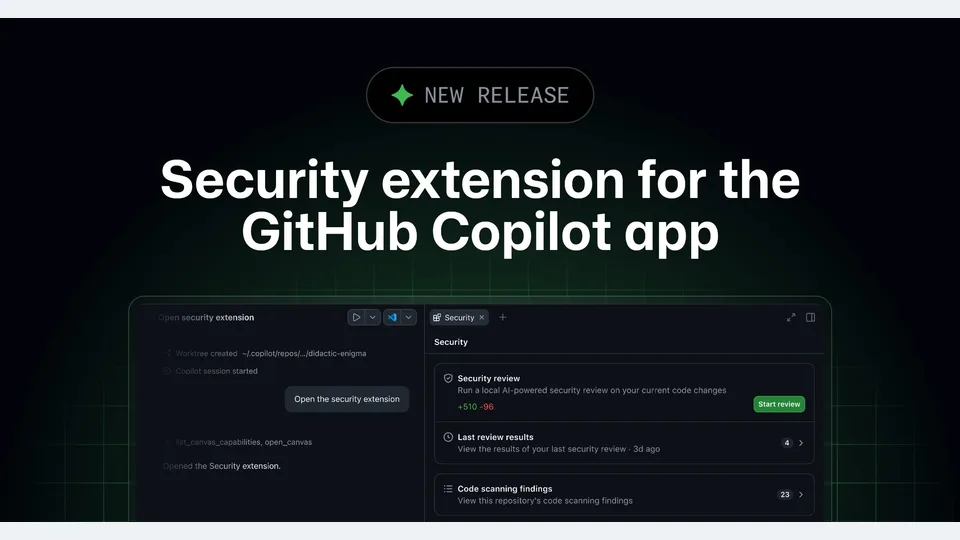
You can now work through your repository’s GitHub code scanning alerts without leaving the GitHub Copilot app. The new GitHub security extension, now in public preview, lets you find the… The post Security extension for the GitHub Copilot app appeared first on The GitHub Blog.
Agents should understand more than your codebase—they should understand how your team works. Your preferences, repository conventions, skills, and custom instructions guide how changes should be made, while code in… The post GitHub intelligence puts your code, context, and history to work appeared first on The GitHub Blog.

Since coding is solved, why code for the job?

Jev ranks warehouse tables and labels agent failures in under a second, but adding retrieval hints leaves accuracy flat across 20 models on the Agentic Analytics Benchmark.
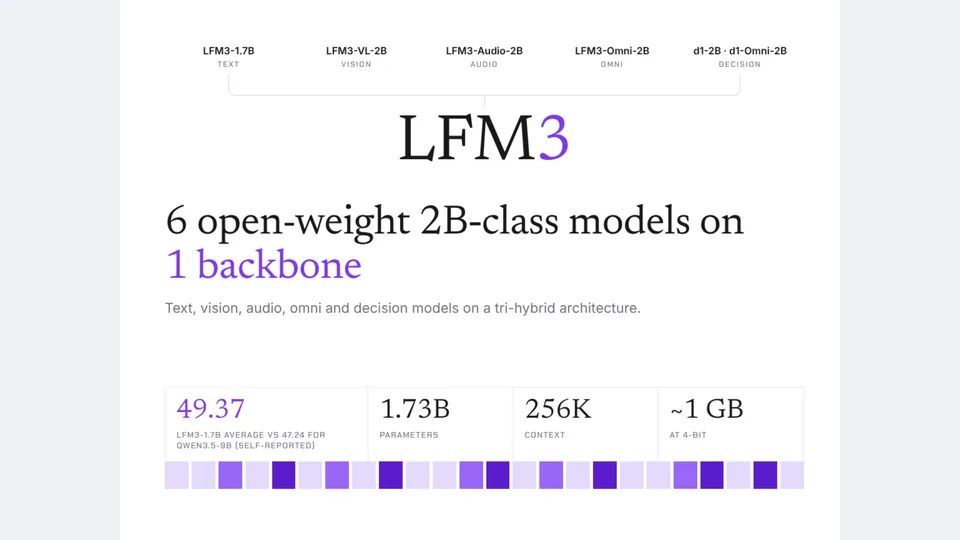
Liquid AI released LFM3, 6 open-weight 2B-class models for text, vision, audio, omni and decisions. LFM3-1.7B uses a tri-hybrid backbone, a 256K context window and fits in about 1 GB at 4-bit. The post Liquid AI Releases LFM3: 6 Open-Weight 2B-Class Multimodal Models appeared first on MarkTechPost.
Supply chain security is taking on new importance as enterprises bring AI into core business operations. Those deployments introduce risks that require security teams to examine how infrastructure, data and autonomous systems are protected. As AI agents gain the ability to act on their own, executives need to rethink where risk lives and who controls […] The post Dell links supply chain security to the challenges of agentic AI appeared first on SiliconANGLE.
In this post, we show how Exowatt used Amazon SageMaker AI serverless model customization to build a repeatable AI pipeline that produces task-specific fine-tuned models for two deployment targets, edge and cloud, achieving higher accuracy than frontier models at up to 49x lower cost.
Scaling AI agents requires treating them like employees in regulated roles, with written rules, clearly defined responsibilities and a named human manager accountable for their performance. Guest author Rick Folgmann, COO at Get Covered, tells companies they should start with tasks governed by established rules, adjust autonomy to each workflow’s risks, and regularly review results before expanding agents’ authority.