Skip to content
AI NEWS JOURNAL
AI, IN PERSPECTIVE

Search AI news

Search headlines, summaries and articles to connect the dots.

Newest first

PaperFormalizer: Author-in-the-Loop Autoformalization of Research Papers in Lean

arXiv:2610.31810v1 Announce Type: new Abstract: Even a carefully proofread paper can leave small gaps in its proofs or its stated assumptions. We introduce PaperFormalizer, a Lean-based agentic pipeline that helps authors find and close such gaps in their own papers and turn each paper into a Lean-verified version. Starting from the LaTeX source, PaperFormalizer transcribes the paper into a dependency graph of statements, audits each statement in natural language for faithfulness, ambiguity and correctness, and then formalizes and proves the statements in Lean against Mathlib, optional domain libraries and the author's personal toolkit. Only the author knows what a statement is meant to say and how a formalization gap in a result is best fixed. The pipeline therefore stops and asks the aut

PaperFormalizer: Author-in-the-Loop Autoformalization of Research Papers in Lean
Timeline and related coverage

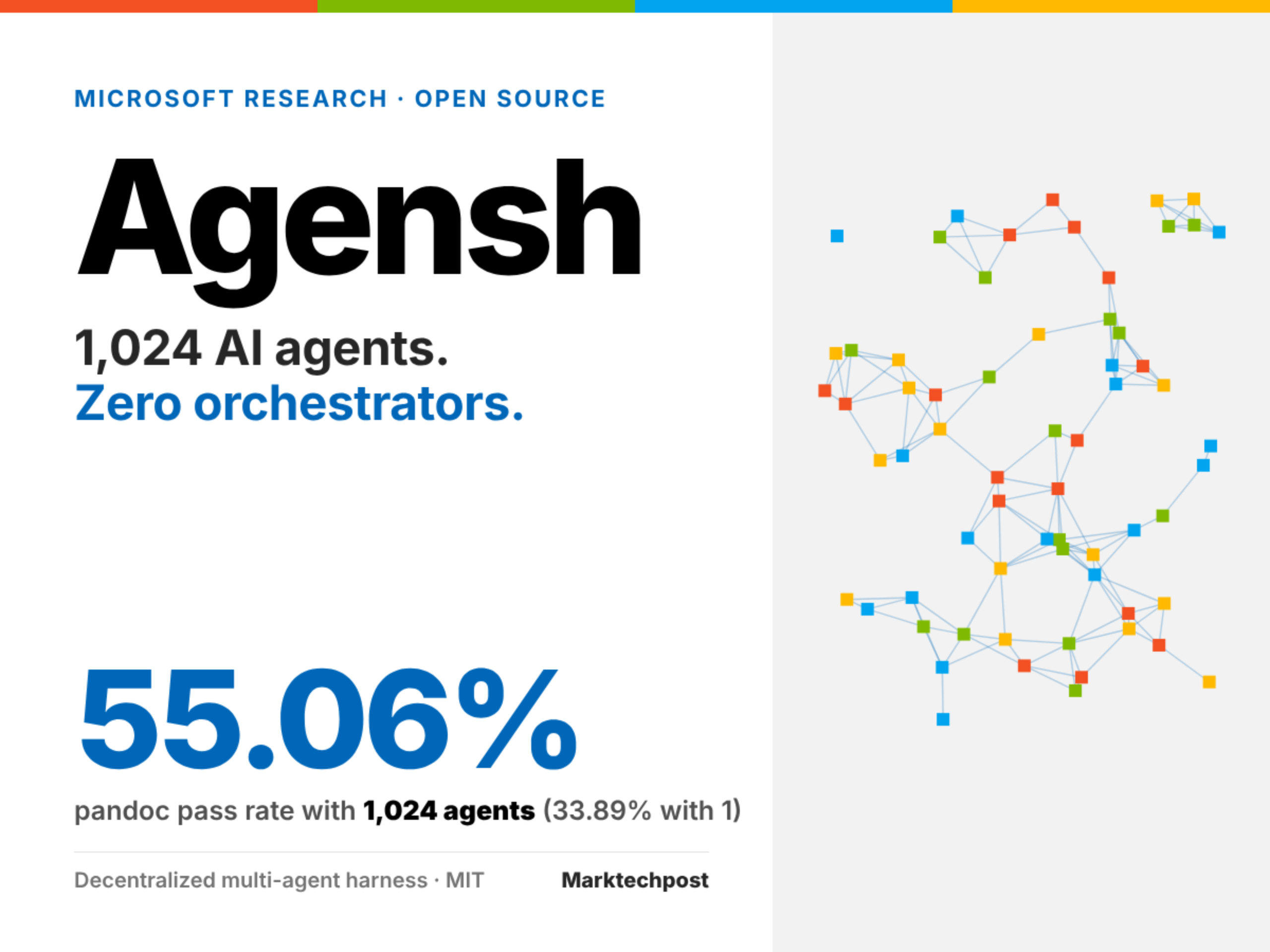
Microsoft open-sources Agensh: a decentralized framework that supports 1024 autonomous, collaboratively operating AI coding agents.

On October 25, 2026, Microsoft Research open-sourced Agensh, a multi-agent runtime framework that operates without a central coordinator, enabling 1 to 1,024 LLM-powered coding agents to self-organize and collaborate on ProgramBench. The system achieves decentralized coordination through shared dashboards inspired by Gitea, Mattermost, and DeLM, with all agents following the same prompt-driven five-step loop; its scalability has been validated in a Linux + Docker environment.

Microsoft Open-Sources Agensh: A Multi-Agent Harness for 1,024 Agents

Why it matters:This achievement represents a significant evolution in multi-agent system architectures—abandoning the traditional “master‑agent” paradigm and enabling large‑scale self‑organization through prompt engineering and lightweight service composition. Empirical results on ProgramBench (e.g., 128 agents achieving a 49% improvement in task load balancing across five tasks) establish a new benchmark for distributed AI engineering. Released under the MIT License and compatible with mainstream single‑agent tools such as Copilot CLI, it offers valuable guidance for practical development.

Timeline and related coverage

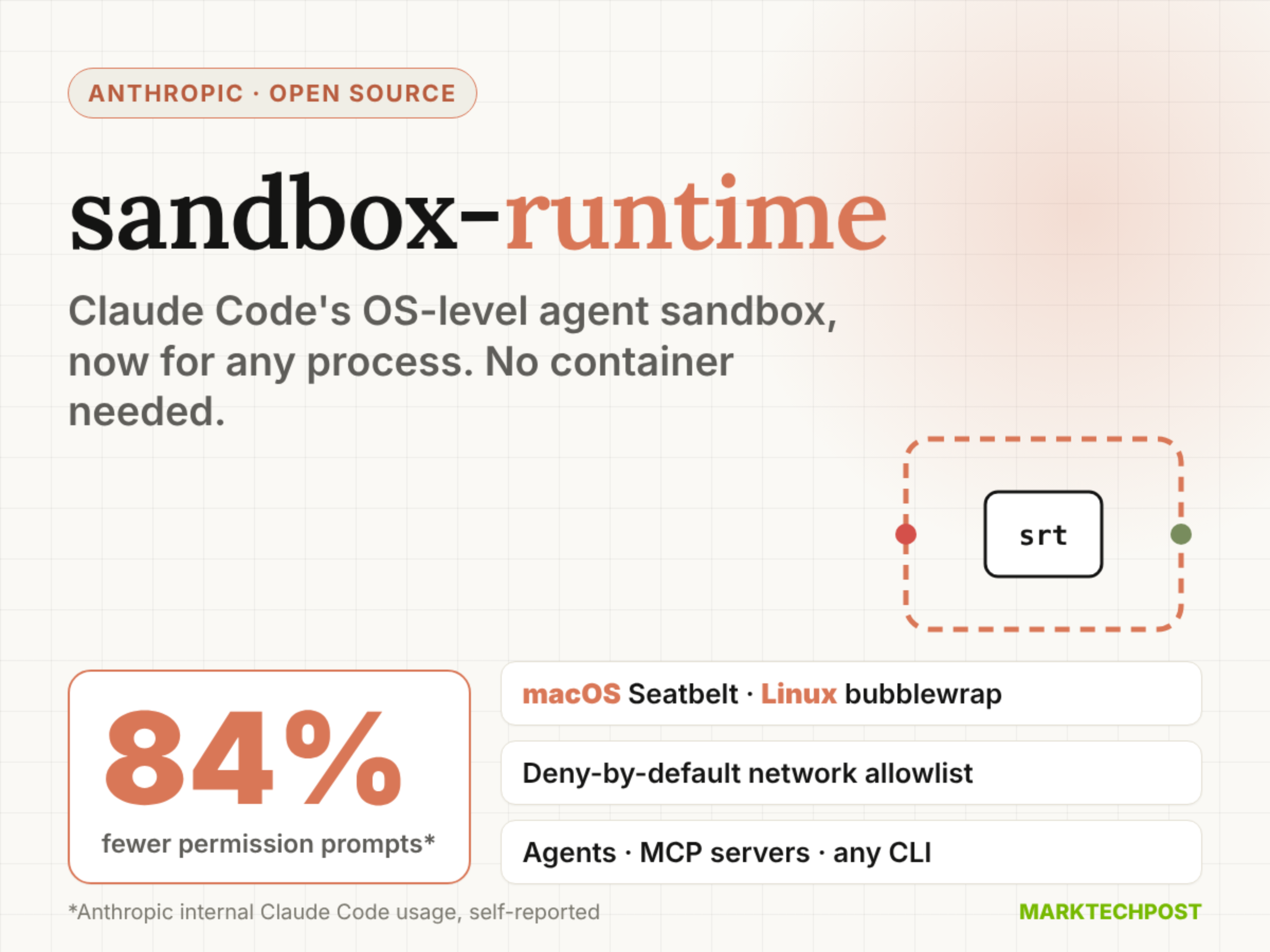
Anthropic open-sources the OS-level sandbox sandbox-runtime: providing container-free file and network isolation for AI agents.

On October 24, 2026, Anthropic open-sourced sandbox-runtime (srt), an OS-level sandboxing tool that operates without containers, designed to restrict file read/write and network access permissions for AI agents, MCP servers, and CLI tools. It supports macOS (Seatbelt), Linux (bubblewrap), and Windows (alpha), with npm package version 0.0.81 under the Apache-2.0 license.

Meet Anthropic’s sandbox-runtime: OS-Level Sandboxing for AI Agents, No Containers

Why it matters:This tool represents a significant advancement in AI security infrastructure—achieving fine-grained, full-process-tree coverage through the operating system’s native isolation mechanisms, directly addressing the risks of prompt injection and privilege escalation, and has already been deployed for internal validation within Claude Code.

Timeline and related coverage

Amazon SageMaker AI has launched GPU-free managed model training sessions, now generally available.

AWS has announced that SageMaker AI’s serverless model customization feature now includes “Training Sessions,” which are fully available starting today. Users can independently define post-training logic—such as custom loss functions, reward signals, or multi‑round reinforcement learning—while the platform automatically handles GPU allocation, distributed execution, fault tolerance, and checkpoint storage.

Timeline and related coverage

Claude Mods: The first implementation of an attention interface, a human-programmable agent interaction layer

Claude Mods is Anthropic’s programmable plugin system for Claude Code, representing an early form of the “Attention Interface”—it shifts the traditional machine-oriented agent harness toward a customizable interaction layer centered on human attention. Users can write Mods in TypeScript/JS or have Claude generate them automatically using natural language, thereby determining when to be interrupted, what content to see, and what decisions to make.

Timeline and related coverage

Claude Mods: A programmable attention interface that reshapes the collaboration paradigm between humans and AI agents

Claude Mods is a programmable plugin system for developers launched by Anthropic, marking a shift of the ‘agent harness’ from a machine-side interface to a human-side interface—namely, the ‘Attention Interface’. It enables users to customize Claude Code’s behavior, rendering, and interaction logic via TypeScript/JavaScript, thereby facilitating co-design workflows between humans and AI. This mechanism has already been applied to built-in features (such as You Should Know) and supports users in building plugins themselves or having them generated with Claude’s assistance.

Timeline and related coverage

Quoting Addy Osmani, Morgan Westlee Lunt, and Qing Wang

We think "did a human read the code?" is an imprecise proxy for "what could go wrong with this change, and which check—automated or human—is the right one to catch it?" Asking that question also changed when review happens. Before, review was a gate at the end of the road: write the code, open a PR, wait for your colleague. Now, review runs continuously, more like spellcheck while you write. Most changes have been reviewed and fixed by Claude at least once before a human is asked to look. This catches most routine mistakes, and saves team attention for higher-level questions and scrutiny. — Addy Osmani, Morgan Westlee Lunt, and Qing Wang, How the Claude Code team does code review Tags: anthropic, claude, ai, claude-code, llms, addy-osmani, coding-agents, generative-ai, agentic-engineering,

Timeline and related coverage

sparqlite: SPARQL 1.1 inside SQLite, written in Rust

Research: sparqlite: SPARQL 1.1 inside SQLite, written in Rust This research task is really an experiment in running Claude Code for web in "Ultracode" mode, as described in Orchestrate subagents at scale with dynamic workflows in the Claude Code documentation. With Ultracode turned on, Claude Code makes aggressive use of dynamic workflows - it generates JavaScript that defines and coordinates a network of subagents to take on complex problems. My initial prompt was this - I meant "hit the rows directly", the word "delete" was an accidental typo on my phone: Write a SQLite extension in Rust that implants SPARQL and runs really fast because it can hit the delete rows directly This caused Claude Code for web to churn for over 12 hours. I checked in on its progress the next day and sent a sin

Timeline and related coverage

Chirp Pong

Tool: Chirp Pong Another game experiment - I wanted to see if it was feasible to have a two player game on two separate phones running in static HTML where the networking code uses chirps sent via the microphone. It seems to work! Build a two player competitive pong like game where two players use their phones close to each other and the game state is sent via audio noises which the web microphone API can interpret - but add graphical and gameplay twists to make it a lot more fun and intertwine than pong Claude Opus 5.5 Extra in Claude Code. Tags: game-design, ai, generative-ai, llms, claude-code

Timeline and related coverage

LaTeX renderer

Tool: LaTeX renderer Inspired by Paul Ford and Aboard Foundary's new web app Tiny Little Office, which provides a suite of web app content editors (a Word Processor, Outliner, Presentation Builder, Spreadsheet, Calculator, Drawing Tool, Diagram Maker, Animator, Calendar, and Trip Planner). Tiny Little Office's signature trick is to store all of the document data in the #fragment section of the URL, so every document created using it becomes a bookmarkable and shareable link. It also has an llms.txt file telling agents how to construct URLs that will render as documents. Claude used that file to generate this link to a deck that explains how the URL format works: Tiny Little Office inspired me to have Claude Code (Opus 5.5 Extra) build a similar tool that works with LaTeX. Here's the sequen

Timeline and related coverage

Tree Appreciator

Tool: Tree Appreciator Another game experiment with Claude. This one used the default Claude iPhone app (chat mode, not Claude Code mode), where I prompted Claude Opus 5.5 Max with: Build a three js game called "Tree appreciator" - it shows you two algorithmically generated trees and the game mechanics is about appreciating the differences between them. Think hard about how to make sure it is both fun and beautiful. Somewhat embarrassingly given my recent talk, I've found that telling Opus 5.5 "make sure it is fun" works uncomfortably well. In this case Claude crunched for 3 hours and 7 minutes before retuning a cosy little spot-the-difference game with music and animation and achievements that's quite compelling to play. Tags: game-design, javascript, ai, generative-ai, llms, claude, vibe

Timeline and related coverage

chDB Durable Layer for agent memory

The chDB Durable Layer keeps agent memory fast to query locally while making its analytical state recoverable across laptops, CI jobs, and short-lived sandboxes.