Skip to content
AI NEWS JOURNAL
AI, IN PERSPECTIVE

Search AI news

Search headlines, summaries and articles to connect the dots.

Newest first

Microsoft offers buyouts to 60,000 employees

Microsoft is offering voluntary buyouts to up to 60,000 employees across the US, UK, Canada, and India. In a message to employees, Microsoft chief people officer Amy Coleman writes that this gives staff members "the opportunity to leave Microsoft with financial support and career planning resources" as the company looks to trim staff without another […]

Microsoft offers buyouts to 60,000 employees
Timeline and related coverage

Microsoft open-sources Agensh: a decentralized framework that supports 1024 autonomous, collaboratively operating AI coding agents.

On October 25, 2026, Microsoft Research open-sourced Agensh, a multi-agent runtime framework that operates without a central coordinator, enabling 1 to 1,024 LLM-powered coding agents to self-organize and collaborate on ProgramBench. The system achieves decentralized coordination through shared dashboards inspired by Gitea, Mattermost, and DeLM, with all agents following the same prompt-driven five-step loop; its scalability has been validated in a Linux + Docker environment.
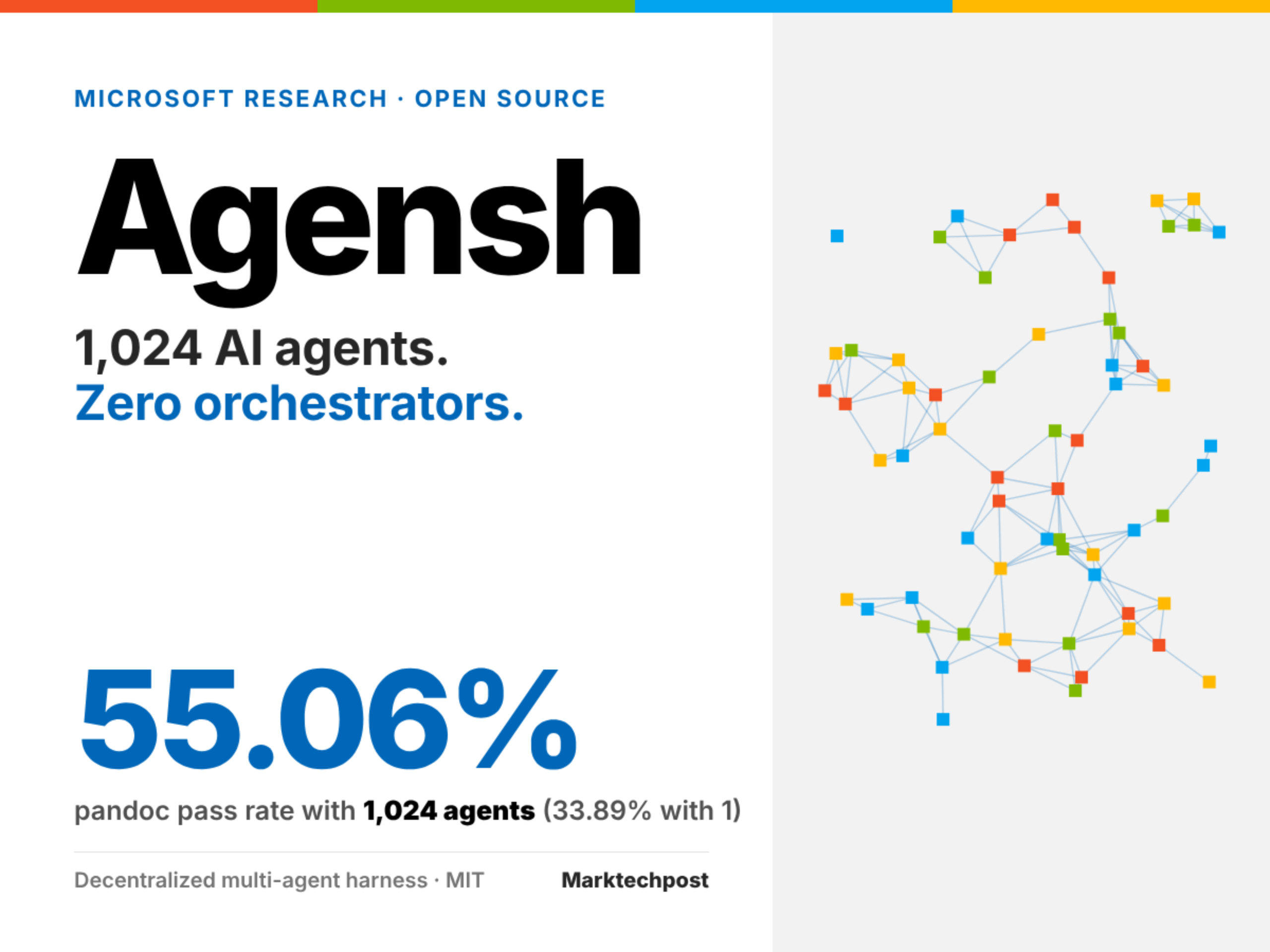
Microsoft Open-Sources Agensh: A Multi-Agent Harness for 1,024 Agents

Why it matters:This achievement represents a significant evolution in multi-agent system architectures—abandoning the traditional “master‑agent” paradigm and enabling large‑scale self‑organization through prompt engineering and lightweight service composition. Empirical results on ProgramBench (e.g., 128 agents achieving a 49% improvement in task load balancing across five tasks) establish a new benchmark for distributed AI engineering. Released under the MIT License and compatible with mainstream single‑agent tools such as Copilot CLI, it offers valuable guidance for practical development.

Timeline and related coverage

Letta platform releases a tutorial on building stateful engineering collaborators: supporting core memory, shared state, and portable workflows.

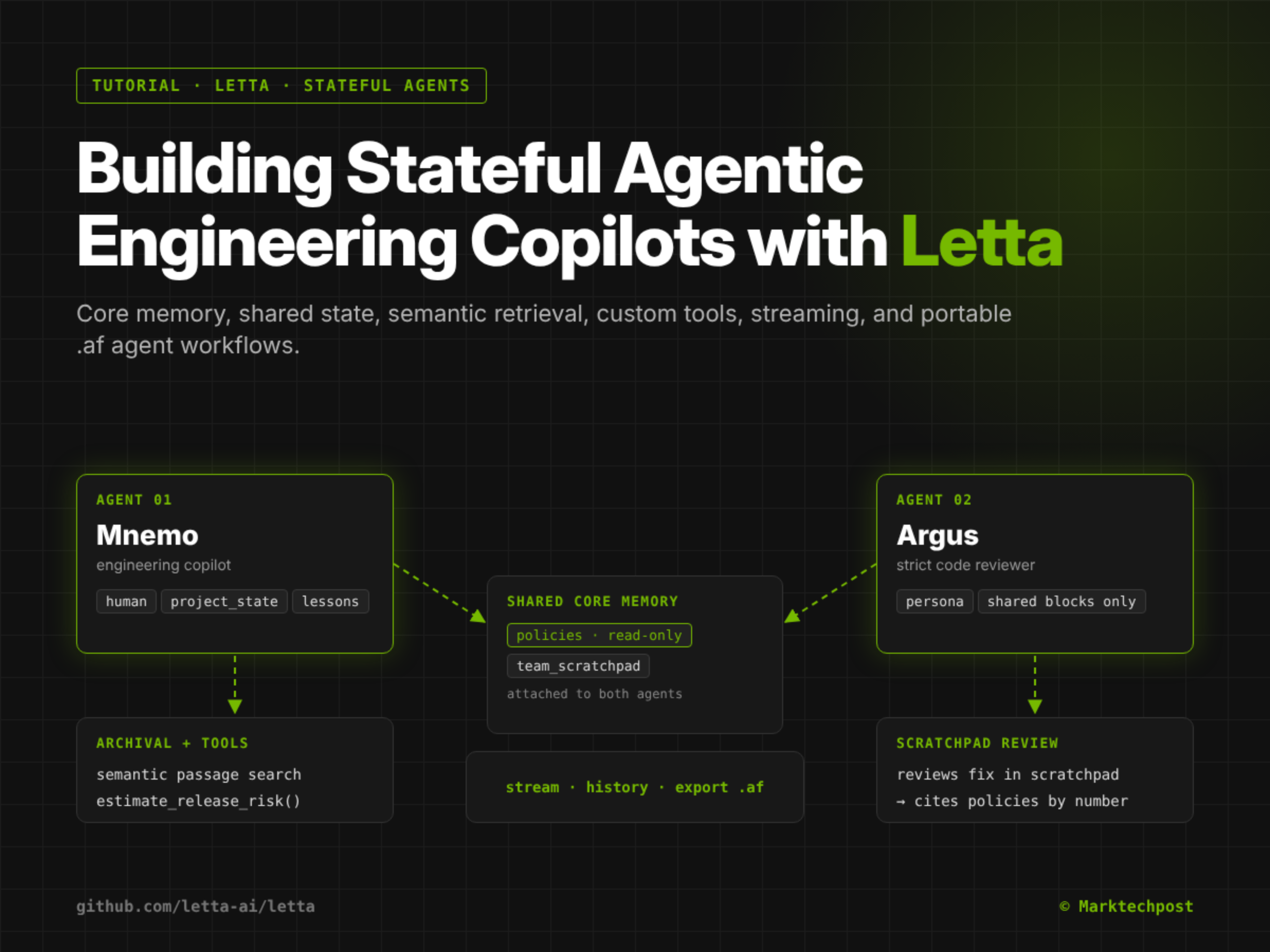
MarkTechPost published a tutorial on October 24, 2026, detailing how to build an agentic copilot with persistent state using the Letta framework. The guide covers capabilities such as verifiable core memory, multi-agent shared memory, semantic retrieval of archived knowledge, custom Python tool integration, streaming responses, and .agent format (.af) export. The content serves as a technical practice guide and does not provide performance metrics, security audits, or production‑environment validation.

Stateful Agentic Engineering Copilots with Letta: Core Memory, Shared State, Semantic Retrieval, Custom Tools, Streaming, and Portable Agent Workflows
Timeline and related coverage

Amazon SageMaker AI has launched GPU-free managed model training sessions, now generally available.

AWS has announced that SageMaker AI’s serverless model customization feature now includes “Training Sessions,” which are fully available starting today. Users can independently define post-training logic—such as custom loss functions, reward signals, or multi‑round reinforcement learning—while the platform automatically handles GPU allocation, distributed execution, fault tolerance, and checkpoint storage.

Timeline and related coverage

Microsoft and Hugging Face have open-sourced the ThinkingBox framework: using the database’s final state as a deterministic reward signal to advance post-training reinforcement learning for agents.

Microsoft and Hugging Face have jointly launched the open-source framework ThinkingBox, which generates binary 0/1 rewards by comparing the LLM agent’s final database state after execution with the expected state, for reinforcement learning-based fine-tuning. The accompanying benchmark, ThinkingBox-Bench, includes 507 real-world backend tasks, none of which were used during training. After 50 steps of GRPO fine-tuning, Qwen3.8-27B achieved a 9.08-percentage-point improvement in pass@1 on the held-out test set, with Observed 20/20 nearly tripling; however, pass@20 declined in some domains, reflecting a trade-off between breadth and stability.

Timeline and related coverage

How Three Java Champions Leverage GitHub Copilot to Boost Development Efficiency: Focusing on Human-AI Collaboration and Shared Responsibility

Vlad Mihalcea, Patrick Baumgartner, and Frank Delporte, three seasoned Java Champions, shared their experiences using GitHub Copilot in production environments and open-source projects, emphasizing human-led problem definition, context anchoring, iterative validation, and ultimate accountability—rather than relying on AI to automatically generate code.

Timeline and related coverage

How to seamlessly resume a GitHub Copilot session in VS Code

GitHub’s official tutorial explains how to import an entire Copilot session—complete with generated code changes, conversation context, and the working tree—into Visual Studio Code with a single click, enabling an end-to-end collaboration workflow that requires no branch rebase, preserves all context, and allows you to review/edit/test directly before pushing to the associated pull request.

Timeline and related coverage

Code with CodeQwen1.5

GITHUB HUGGING FACE MODELSCOPE DEMO DISCORD Introduction The advent of advanced programming tools, which harnesses the power of large language models (LLMs), has significantly enhanced programmer productivity and accuracy. Notwithstanding these advancements, dominant coding assistants like Github Copilot, built upon proprietary LLMs, pose notable challenges in terms of cost, privacy, security, and potential copyright infringement. Recognizing the imperative for a more transparent and accessible alternative, the open-source community has embarked on a concerted endeavor to develop open codeLLMs.