Skip to content
AI NEWS JOURNAL
AI, IN PERSPECTIVE

Search AI news

Search headlines, summaries and articles to connect the dots.

Newest first

Do AI Scientists Know What's New?

arXiv:2610.36511v1 Announce Type: new Abstract: A major challenge facing AI scientific discovery pipelines is how to determine when a generated idea is meaningfully novel. Ideally, novelty checks in these pipelines must be able to reject non-novel ideas while not rejecting too many novel ideas, and they should also be able to distinguish which parts of a proposal are non-novel, as opposed to opaquely discarding entire proposals. We design an analytical framework for evaluation of novelty checks with temporal ground truth at both the proposal- and claim-level, using four datasets of 1,060 proposals built from published papers, reviewer disputes, and generated ideas matching ones the field went on to publish. Auditing existing novelty checks with this framework, we find that checks with high


Timeline and related coverage

CONCUR: Concordant Auxiliary Rewards for Multi-Task, Multi-Reward Reinforcement Learning

arXiv:2610.36437v1 Announce Type: new Abstract: When a Large Language Model (LLM) is trained with Reinforcement Learning (RL) on multiple tasks, a task's primary reward can gate auxiliary rewards such as a length reward: on a failing response, an auxiliary cannot exceed the primary. However, group-relative advantage estimators treat a gated auxiliary like any other component, so it can reverse the primary's order, and at the primary's ceiling only auxiliaries order responses. Keeping gated auxiliaries hurts some tasks, while dropping them hurts others. We propose CONCUR, an advantage estimator that replaces the standardized scores of each gated auxiliary with the closest scores that satisfy two conditions: responses with higher primary rewards cannot receive lower scores, and responses at

Timeline and related coverage

Beyond IceBERT: Open-Data ModernBERT Encoders for Icelandic from 12M to 1B Parameters

arXiv:2610.36230v1 Announce Type: new Abstract: IceBERT, the reference encoder for Icelandic, found that a cleaned web crawl is enough to train a strong model and that starting from a multilingual model can help on some tasks. We revisit both findings with the ModernBERT architecture. We train Icelandic encoders from 12M to 1B parameters on 9B tokens of open data, and rerun IceBERT's benchmarks and five newer tasks for 30 encoders under one protocol with confidence intervals. Our 1B model trained from scratch, to our knowledge the first monolingual Icelandic encoder of that size, is significantly better than IceBERT on all eleven tasks; warm-started from the English Ettin encoder of the same shape, it has the best score of all encoders on every task we rank. Because our model shapes match

Timeline and related coverage

A Quantitative Approach to Asch Conformity in Frontier Large Language Models

arXiv:2610.36668v1 Announce Type: new Abstract: The Asch conformity experiment has recently gained considerable attention as a way of measuring conformity in large language models (LLMs). While previous studies have focused on demonstrating conformity in LLMs, our work adds a further quantitative layer to this approach. Instead of sampling a frontier LLM on a suite of questions, our approach samples a single question repeatedly, leveraging the probabilistic nature of LLMs to produce a distribution of answers. In doing so, we can compare the distributions of answers before and after the model is presented with the manufactured consensus. Our experiments confirm that frontier LLMs do conform, reinforcing prior literature, and, through our distribution-to-distribution comparisons, provide add

Timeline and related coverage

Google introduces cutting-edge Genie 4 world model

Google LLC today previewed Genie 4, an artificial intelligence model that can generate realistic three-dimensional environments. The algorithm is the latest addition to a series of world models that the company launched in 2024. Compared to its predecessor, Genie 4 is better at rendering fluid movements and other complex details. Furthermore, it can generate accompanying […] The post Google introduces cutting-edge Genie 4 world model appeared first on SiliconANGLE.

Timeline and related coverage

b11938

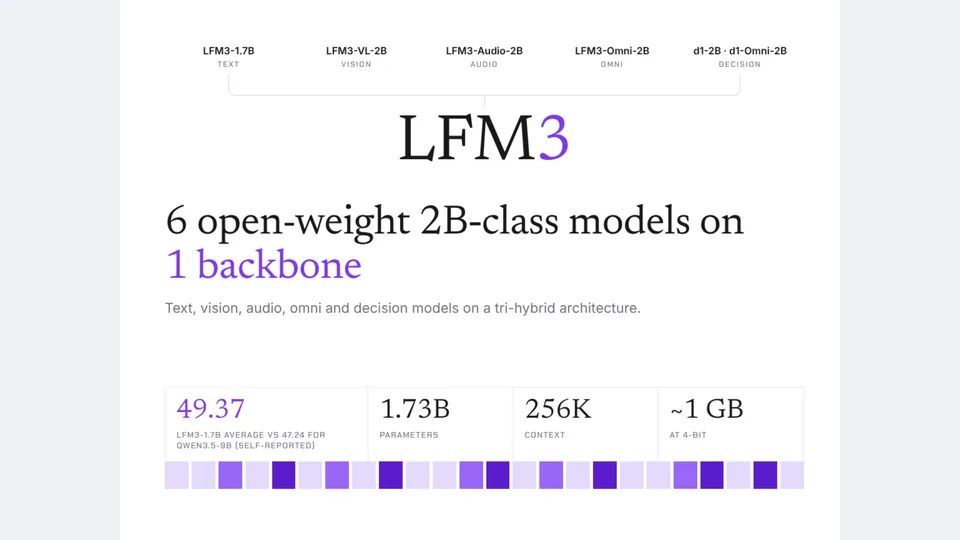
model : add LiquidAI/LFM3-1.7B and LiquidAI/LFM3-VL-2B (#31252) * model : add LiquidAI/LFM3-1.7B and LiquidAI/LFM3-VL-2B Co-authored-by: Sigbjørn Skjæret Co-authored-by: Xuan-Son Nguyen Assisted-by: Claude Opus 5.5 * tests : set the SWA rope base of the LFM3 test model Assisted-by: Claude Opus 5.5 * llama : enable recurrent state rollback for LFM3 Assisted-by: Claude Opus 5.5 * Apply batched suggestions from code review Co-authored-by: Sigbjørn Skjæret Co-authored-by: Tarek Dakhran * gguf-py : align the lfm3vl mapping comments Assisted-by: Claude Opus 5.5 * llama : fix CRLF line endings from the review suggestions Assisted-by: Claude Opus 5.5 * tests : add the LFM3 Metal fusion baseline Assisted-by: Claude Opus 5.5 * llama : keep the LFM3-VL depthwise conv kernels in F32 when quantizing As

Timeline and related coverage

Oracle brings Google’s TPUs to its cloud, adds ChatGPT integrations

Oracle Corp. today announced plans to make Google LLC’s TPU artificial intelligence accelerators available through its public cloud. The initiative marks the first time the search giant is supplying the chips to another hyperscaler. According to CNBC, Oracle will also add Cerebras Systems Inc.’s wafer-scale accelerators and OpenAI Group PBC’s Jalapeño inference processor. The latter […] The post Oracle brings Google’s TPUs to its cloud, adds ChatGPT integrations appeared first on SiliconANGLE.

Timeline and related coverage

GitHub Copilot supports server-to-server authentication

GitHub Copilot now supports server-to-server authentication for GitHub Apps installed on organizations, available in public preview. Services and agents built with the GitHub Copilot SDK can now make requests on… The post GitHub Copilot supports server-to-server authentication appeared first on The GitHub Blog.

新闻源配图 · GitHub Copilot changelog
Timeline and related coverage

b11936

llama : build the k-pool sparse selection independently of the kq_mask shape (#31243) * llama : build the k-pool sparse selection independently of the kq_mask shape qwen4exp (QSA) and glm5-next pick cache cells by index and no longer read the kq_mask values, but they still shaped the selection like the dense kq_mask. Build the selection as [n_kv, n_tokens] over the cache cells instead, and split it into the streams of the K view right before the attention. This lets the dense mask change its layout (e.g. per-sequence row lists) without touching the sparse layers. * improve comment Co-authored-by: Georgi Gerganov * llama : drop the unused build_fused_top_k_mask args, review nits --------- Co-authored-by: Georgi Gerganov **Website:** - **Attestations:** - **macOS/iOS:** - [macOS Apple Silico

Timeline and related coverage