Skip to content
AI NEWS JOURNAL
AI, IN PERSPECTIVE

Search AI news

Search headlines, summaries and articles to connect the dots.

Newest first

Can Test-Time Memory Evolution Outperform Test-Time Training for Scientific Discovery?

arXiv:2610.32046v1 Announce Type: new Abstract: Recent \emph{test-time training} (TTT) frameworks have enabled open-weight large language models (LLMs) to outperform inference-only frameworks powered by frontier models on scientific discovery tasks. However, TTT introduces additional computational cost for online weight updates during the discovery process, making computational efficiency an important consideration when scaling to larger models. This motivates us to explore an efficient \emph{test-time adaptation} method for scientific discovery. We introduce \emph{Test-Time Memory Evolution} (TTME), a plug-and-play test-time adaptation method, as an alternative to TTT. TTME continually updates the external memory by distilling the experience to guide subsequent discovery without updating

Can Test-Time Memory Evolution Outperform Test-Time Training for Scientific Discovery?
Timeline and related coverage

Speculative Diffusion is a Tale of Two Tradeoffs

arXiv:2610.31819v1 Announce Type: new Abstract: Speculative decoding is a technique that accelerates the inference speed of autoregressive large language models (LLMs) by sampling from a faster, lower quality draft model. Traditionally, a fundamental characteristic of speculative decoding is that it is lossless with respect to the verifier distribution, guaranteeing speed without sacrificing quality. This differs from recently developed diffusion LLMs (dLLMs), which are notably able to achieve substantial speedups by degrading the quality of their outputs with less diffusion effort. Because diffusion models are able to sample faster than autoregressive models by generating tokens in parallel, they are considered strong candidates for draft models in speculative diffusion. While it is widel

Timeline and related coverage

Does LeWorldModel Preserve Local Action Geometry?

arXiv:2610.31716v1 Announce Type: new Abstract: We examine how closely pretrained LeWorldModel (LeWM) reproduces the effects of small action changes. Using matched simulator and model responses, we measure action sensitivity with Gram matrices at three perturbation scales. Across nearly a thousand states from Reacher and OGBench Cube, the most sensitive action directions differ by median angles of about $36^\circ$ and $42^\circ$, respectively, at the smallest scale. Increasing the perturbation tenfold reduces median normalized Gram discrepancy by roughly 70\% on Reacher and 47\% on Cube. Geometry measured in pixels and embeddings varies more across scales than the chosen physical-state geometry. On held-out directions, environment Grams achieve median embedding response errors of 17\% and

Does LeWorldModel Preserve Local Action Geometry?
Timeline and related coverage

Latent Coherence: Do Frontier Language Models' Probability Judgments Obey the Law of Total Probability?

arXiv:2610.31833v1 Announce Type: new Abstract: LawZero's Scientist AI trains a Predictor toward the Bayesian posterior, with an objective that penalizes inconsistent probabilities among latent explanations. We ask whether current frontier language models, with no such training, are already consistent in this sense zero-shot: do their probability judgments satisfy the law of total probability, $P(X)=\sum_z P(z)P(X|z)$, when the latent $z$ must be inferred from records in the context? In separate single-turn calls, models are asked for $P(X)$, for $P(z)$ over the latent's states, and for $P(X|z)$; a causal family applies the same test to $P(y|do(x))$ and the back-door adjustment. Every query has an exact ground-truth probability, and a subset of items is asked in three wordings to separate

Timeline and related coverage

DriveMind: Mind-Evolving Belief Tracking for Closed-Loop Autonomous Driving

arXiv:2610.32069v1 Announce Type: new Abstract: Recent multimodal large language models (MLLMs) can perceive a traffic scene, reason about it, and propose a driving action within a single model. However, existing MLLM-based drivers reason from scratch at each frame and commit to a single explanation, discarding earlier hypotheses about the scene. When the scene is ambiguous, the agent locks in on the wrong interpretation and acts on it before evidence accumulates. In this paper, we propose DriveMind, an MLLM-based driving framework that keeps several hypotheses about the scene alive at the same time and updates their weights as new frames arrive. Inspired by particle filtering, DriveMind propagates each hypothesis through a VLM, scores it against the current observation, and resamples to m

Timeline and related coverage

Distributional Alignment of LLMs and Its Generalization Properties

arXiv:2610.31687v1 Announce Type: new Abstract: Large language models are increasingly used to simulate and probe human behavior, e.g., for surveys. For these applications, a key property is that outputs satisfy distributional alignment: to match its output distribution with some reference (in this case, human) distribution. An obstacle in achieving distributional alignment is generalizing from small training data. In this work, we study (1) how to distributionally align LLMs; and (2) how aligned LLMs might generalize to unseen samples and unrelated topics and tasks. Using two large-scale benchmarks, we find that LLMs can indeed achieve distributional alignment and generalize to unseen questions of the same domain. Cross-topic generalization depends on the relationship between topics (e.g.

Timeline and related coverage

Towards Adversarially Robust Multigraph Neural Networks for Financial Crime Analysis

arXiv:2610.31718v1 Announce Type: new Abstract: Financial transaction networks are naturally represented as multigraphs, where repeated transactions between the same pair of accounts are modeled as distinct edges. Recently proposed multigraph neural network architectures leverage this structure explicitly to achieve a strong performance on anti-money laundering (AML) tasks. However, their robustness to adversaries that manipulate transaction structures to evade detection remains largely unexplored. We present the first scalable framework for structural attacks and adversarial training of multigraph neural networks using node-edge incidence matrices, adapting projected gradient descent and projected randomized block coordinate descent methods to optimize structural perturbations over such m

Towards Adversarially Robust Multigraph Neural Networks for Financial Crime Analysis
Timeline and related coverage

LazyFlash: Forward-Dense, Backward-Sparse Attention for Accelerated Long-Context Fine-Tuning

arXiv:2610.31911v1 Announce Type: new Abstract: As large language models (LLMs) process increasingly long sequences, attention becomes a major computational bottleneck. Sparse attention mostly targets inference, yet many methods still train densely or cannot support sparse training, and their added complexity makes sparsity hard to turn into wall-clock speedups, leaving dense attention widely used in practice. This paper introduces LazyFlash, a forward-dense, backward-sparse attention method built on the observation that attention training is dominated by the backward pass. LazyFlash keeps the forward pass exactly dense, so the trained model remains a standard dense model that existing systems such as vLLM can serve without any change. For the backward pass, LazyFlash proposes a gradient-a

Timeline and related coverage

Democratizing LLM Training with the Edge: Challenges, Systems, and the Road Ahead

arXiv:2610.32215v1 Announce Type: new Abstract: The growing computational power of modern GPU data centers has let a few industrial giants train and deploy large language models (LLMs) on massive amounts of data. Yet the sheer scale of these models and their training data makes centralized development increasingly hard to sustain, and at the same time shuts out smaller institutions that hold relevant private data but lack comparable infrastructure. In this paper, we organize our positions on distributed LLM training around the pretraining and fine-tuning paradigms, covering federated learning, split learning, and decentralized approaches, and we assess their readiness for geo-distributed settings with heterogeneous hardware and unreliable connectivity. We then present a {\em unified} syste

Democratizing LLM Training with the Edge: Challenges, Systems, and the Road Ahead
Timeline and related coverage

b11888

common, grammar: add recursive depth limit, make it a requirement (#31153) * common, grammar: add recursive depth limit, make it a requirement * catch more recursive functions * common : tidy up peg parser changes * grammar : reject candidates in a loop, without a depth limit The depth limit in llama_grammar_reject_candidates_for_stack counted the code points of a vocab token, so any token of 256 chars or more was always rejected under a grammar, such as the 512-space token of GLM-4.7-Flash or the long space tokens of Laguna-S-2.1. The rejection now walks the code points with its own stack of levels instead of recursing: there is no limit and no stack risk, whatever the length of a token from the GGUF, and the masks match master. * grammar : track rejected candidates as indices into the in

Timeline and related coverage

Hugging Face Releases Carbon-X, a 14B Open DNA Language Model that Brings DNA and Natural Language Together for the First Time

Hugging Face released Carbon-X, an open 14.8B DNA language model built on Qwen3-14B. It reads raw DNA in chat, answers in English, and averages 66.7% across 5 DNA benchmarks under Apache 2.0. The post Hugging Face Releases Carbon-X, a 14B Open DNA Language Model that Brings DNA and Natural Language Together for the First Time appeared first on MarkTechPost.

Hugging Face Releases Carbon-X, a 14B Open DNA Language Model that Brings DNA and Natural Language Together for the First Time
Timeline and related coverage

b11879

CUDA: fuse FFN gate/up matmuls and GLU in MMQ with interleaved gate/up rows (#29948) * cuda: fuse FFN gate/up and GLU in MMQ with interleaved gate/up rows For prompt processing, run the gate and up matmuls of a dense FFN as one mul_mat_q launch and apply the GLU in the write-back. - The loaders take the gate weights as a second pointer and fill the weight tile with up and gate rows interleaved in chunks of 8, so each thread holds an up value and the matching gate value (rows r and r + 8 of an MMA tile). - The MMA loop is unchanged: same tile, warp layout, vec_dot and one sum[] per thread. The fused write-back computes the GLU from registers and writes half the rows. - The fused path uses the regular tiling (no stream-k) with the column tiles innermost so that neighbouring blocks share weig

Timeline and related coverage

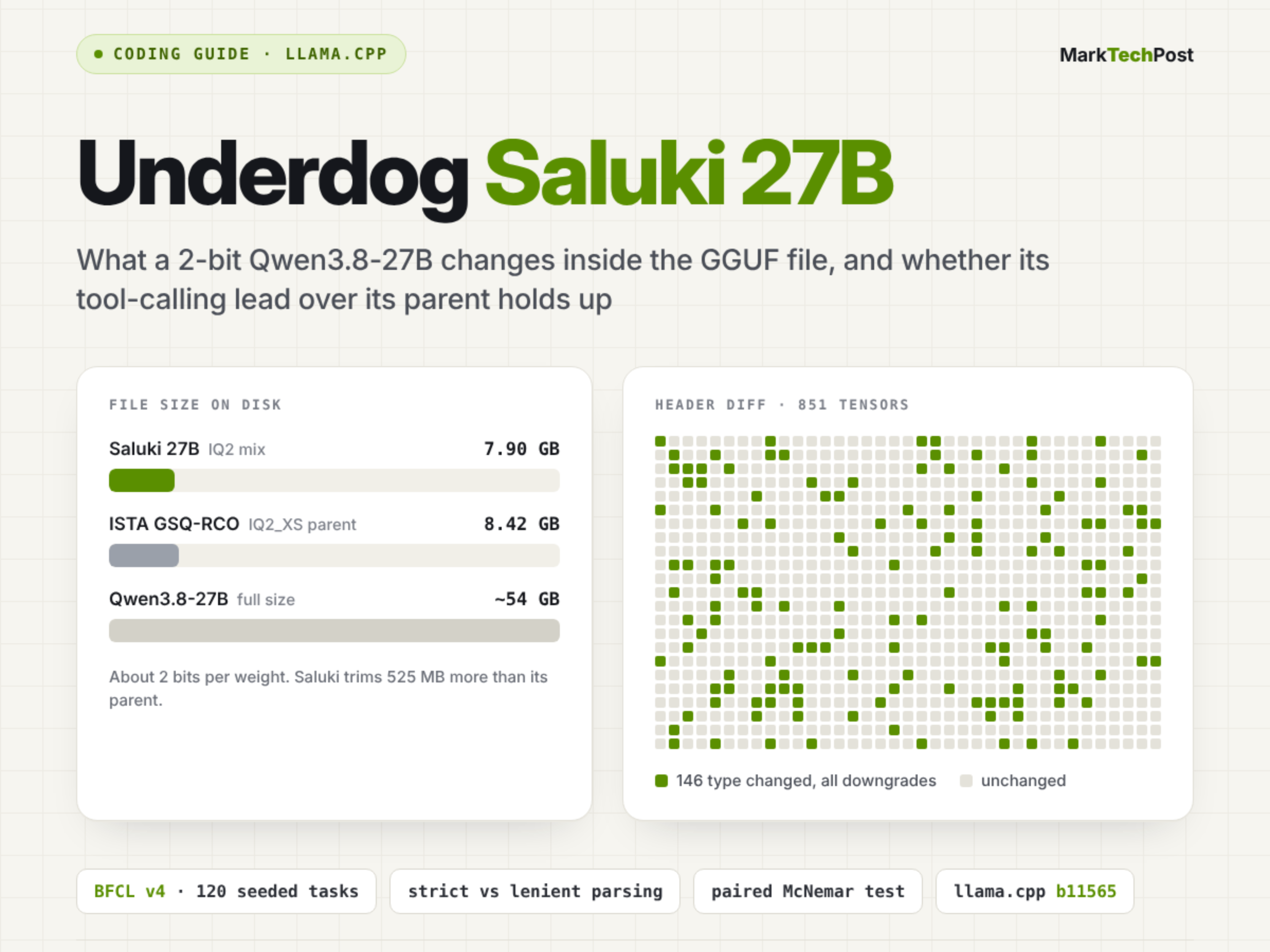
Underdog Saluki 27B: Technical Analysis of the 2-bit Qwen3.8-27B Tool-Calling Model Based on GSQ-RCO

This article introduces Saluki 27B, a model released by Underdog—a 7.9 GB, 2-bit quantized variant of Qwen3.8-27B—built using the GSQ-RCO method from ISTA-DASLab. It claims to outperform the original 54 GB full-precision model on the BFCL v4 benchmark across 120 tasks; however, all performance conclusions are based solely on the developers’ assertions and have not been independently verified.

How to Run Underdog Saluki 27B: 2-Bit Qwen3.8-27B Tool-Calling Guide
Timeline and related coverage

Sebastian Raschka has released an eight-video course titled “Building a Reasoning Model from Scratch.”

On October 24, 2026, Sebastian Raschka published an eight-part, over-11-hour hands-on video course on Python and PyTorch in Ahead of AI magazine (magazine.sebastianraschka.com), systematically covering the evaluation of inference models, scaling during inference, reinforcement learning (RLVR), and knowledge distillation, with all methods implemented using the pre-trained Qwen3-0.6B model.

Why it matters:This course is the author’s advanced technical educational offering, following “Building Large Language Models from Scratch.” It focuses on the core evolutionary direction of today’s mainstream LLMs—enhancing inference capabilities—covering the entire technical pipeline from setting up the foundational environment to GRPO reinforcement learning and self‑distillation. The author explicitly states that all implementations are “hand‑crafted from scratch,” fully reproducible, and highly instructive with significant engineering reference value.

Timeline and related coverage

CiteAnchor: Source-Aware Grounding for Hallucinated Citation Detection and Resolution

arXiv:2610.30355v1 Announce Type: new Abstract: Hallucinated citations make it harder to trace sources and verify the evidence behind scientific claims. Detecting them is difficult because bibliographic records can be incomplete or differ across source types and publication versions. A plausible match alone neither validates the citation nor establishes its underlying source. We introduce CiteResolve, a benchmark of 423 real-world hallucinated citations annotated for source recoverability. We further propose CiteAnchor, a source-aware grounding framework that adapts retrieval and field-level verification to each source type and separately determines citation validity and whether a unique source can be recovered. On an existing detection benchmark, CiteAnchor achieves 0.841 F1 with GPT-5.6

CiteAnchor: Source-Aware Grounding for Hallucinated Citation Detection and Resolution
Timeline and related coverage

The study proposes a new metric, RCG, to assess the coverage of synthetic survey respondents generated by LLMs.

The paper, published on October 24, 2026, on arXiv (ID 2610.30900v1), introduces a new evaluation metric called “Respondent Coverage Gap” (RCG) to assess the extent to which synthetic survey respondents generated by large language models (LLMs) cover the full response-profile space of real human respondents.

Silicon Samples Match the Answers but Not the Respondents

Why it matters:Existing evaluation methods focus solely on the distribution of individual item responses or inter-item correlations, failing to detect whether LLM-generated responses replicate answer combinations that actually exist in the real population. RCG is the first to quantify coverage gaps by analyzing the full response profile, and empirical evidence from two U.S. social survey datasets reveals that all tested LLMs exhibit significant undercoverage of certain population groups, performing worse than both a simple marginal sampling baseline and a Gaussian copula model.

Timeline and related coverage

New research introduces the ReflectPO framework, enhancing the autonomous error-correction capabilities of large language model agents in long-term tasks.

On October 24, 2026, arXiv published a research paper titled “ReflectPO: Reflection-Guided Policy Optimization for Long-Horizon LLM Agents” (ID 2610.30933v1), introducing a reinforcement learning framework called ReflectPO, designed to enhance the autonomous error-recovery capabilities of tool-augmented large language model agents in complex, multi-step, state-dependent tasks.

ReflectPO: Reflection-Guided Policy Optimization for Long-Horizon LLM Agents

Why it matters:This paper is a cutting-edge AI study recently published, focusing on a key bottleneck in the real-world deployment of LLM-based agents: the cumulative effect of early errors in long‑term tasks. Its proposed dual-component design—Reflection‑Guided Sampling and Tree‑Structured Credit Assignment—features methodological innovation and empirically outperforms multiple baselines across two benchmarking scenarios, making it a valuable technical reference.

Timeline and related coverage

Learning What to Ask for Tomorrow: Active Preference Acquisition for Long-Term Personalized Web Agents

arXiv:2610.31107v1 Announce Type: new Abstract: Web agents increasingly serve the same user across repeated online tasks such as booking travel, shopping, and scheduling, so their long-term usefulness depends on how well they know the user's preferences. Passive memory and personalization methods cannot obtain preferences the user never reveals, and clarification methods that value a question by its benefit to the current task overlook the benefit of reusing the answer in later tasks. We study Active Preference Acquisition (APA): which missing preferences are worth the cost of asking? We define the Prospective Personalization Value (PPV) of a missing preference as its expected cumulative utility gain over future tasks minus the effort and disclosure-risk cost of asking, and select question

Learning What to Ask for Tomorrow: Active Preference Acquisition for Long-Term Personalized Web Agents
Timeline and related coverage

Introducing Kimi K3.1 Pro

Introducing Kimi K3.1 Pro Kimi K3.1 Pro landed on the Kimi API today - it's not yet open weights, but Moonshot promise "Full model weights will be released by Nov 4, 2026". They're also offering a "Highspeed" version that's 2-3x faster, at twice the price (except for input token cache hits, which are priced the same). The US dollar pricing is $2.00/million tokens for input and $10/million for output - the same as GPT-6.1 Sol and half the price of Claude Opus 5.5. Moonshot's own benchmarks show Kimi as approximately level with Opus 5.5 and GPT-6 Astra - beating them on a few benchmarks, coming close on others. Artificial Analysis scored Kimi at 55 - ahead of Claude Fable 5.1, GPT-6 Astra, and Gemini 4 Argon (all at 53) and behind only Claude Opus 5.5 (58). This is the first time a (soon-to-

Timeline and related coverage