Skip to content
AI NEWS JOURNAL
AI, IN PERSPECTIVE

Search AI news

Search headlines, summaries and articles to connect the dots.

Newest first

Async-RBench: Benchmarking Asynchronous Task Execution in LLM Agents

arXiv:2610.32429v1 Announce Type: new Abstract: Large language model (LLM) agents increasingly execute tasks asynchronously: a main agent continues working while its subagents run, and the task state may change before their results arrive. The main agent must decide which work to update or preserve and which checks to repeat, while avoiding prohibited changes. Final task success alone does not reveal whether these results were handled correctly, and natural asynchronous arrivals are hard to reproduce. We introduce Async-RBench, a benchmark for asynchronous task execution in LLM agents, with 200 executable tasks covering eight scenarios. A scenario controller regulates result delivery using predefined task-state conditions, while an Event Response Contract (ERC) specifies what each response

Timeline and related coverage

Adaptive Transfer of Representational Signatures for LLM Reliability Detection

arXiv:2610.33442v1 Announce Type: new Abstract: Large language models (LLMs) are reported to be susceptible to reliability issues including hallucinations and reasoning errors. Existing quality detectors can predict unreliable outputs based on internal representations with decent accuracies. However, training these detectors often requires substantial domain-specific labeled data, which limits their applicability to new domains. We propose to address this challenge by transferring representational signatures across related domains. More specifically, we build a statistical framework that first extracts low-dimensional signatures for each domain, then uses cross-fitting to learn composition weights of domain-specific predictors. The weights adapt to each source domain's predictive relevance

Timeline and related coverage

Release: v5.21.0

# Release v5.21.0 ## New Model additions ### MiniCPM-OCR MiniCPM-OCR is a document-understanding model from OpenBMB's MiniCPM-V family. It keeps the MiniCPM-V 4.6 architecture, which pairs a SigLIP vision encoder and a window-attention merger with a Qwen3.5 language model. It is specialized for reading text-dense images such as scanned pages, screenshots, receipts and tables. **Links:** [Documentation](https://huggingface.co/docs/transformers/main/en/model_doc/minicpm_ocr) | [Paper](https://huggingface.co/papers/2509.18154) * Feat test (#49920) by @guarin in [#49920](https://github.com/huggingface/transformers/pull/49920) ### Flint Flint is Recursive's mixture-of-experts language model. Compared to a standard SwiGLU MoE transformer such as Qwen3-MoE, it uses hybrid attention (sliding-windo

Timeline and related coverage

Fleet-wide computer vision lifecycle at the edge with SageMaker SDK v3

Fleet-wide computer vision needs a model per camera, not one model for the whole fleet. This post presents a working Amazon SageMaker SDK v3 reference architecture that trains, quality-gates, compiles per-camera models with SageMaker Neo, and versions thousands of them, with an AWS Step Functions layer pacing fleet-scale retraining within account quotas.

Timeline and related coverage

Semantically Rich, Metrically Affect-Blind: A Geometric Blind Spot in Modern Text Embedders

arXiv:2610.32122v1 Announce Type: new Abstract: We report a systematic dissociation in modern text embedders: sentiment is almost perfectly decodable from their embeddings, yet almost entirely absent from their metric. Across eleven frozen encoders spanning 2021 to 2026, including 2026-generation models and the 4B-parameter LLM embedder Qwen3-Embedding-4B, a linear probe recovers sentence polarity at up to 91.3% accuracy while cosine similarity separates polarity by a margin of only 0.003-0.064. Qwen3-Embedding-4B, the strongest probe in the panel, reaches 91.3% probe accuracy but only 64.3 retrieval MAP. Because retrieval, clustering, deduplication, and retrieval-augmented generation operate on the metric rather than on a trained probe, these systems are effectively blind to information t

Timeline and related coverage

Can Test-Time Memory Evolution Outperform Test-Time Training for Scientific Discovery?

arXiv:2610.32046v1 Announce Type: new Abstract: Recent \emph{test-time training} (TTT) frameworks have enabled open-weight large language models (LLMs) to outperform inference-only frameworks powered by frontier models on scientific discovery tasks. However, TTT introduces additional computational cost for online weight updates during the discovery process, making computational efficiency an important consideration when scaling to larger models. This motivates us to explore an efficient \emph{test-time adaptation} method for scientific discovery. We introduce \emph{Test-Time Memory Evolution} (TTME), a plug-and-play test-time adaptation method, as an alternative to TTT. TTME continually updates the external memory by distilling the experience to guide subsequent discovery without updating

Can Test-Time Memory Evolution Outperform Test-Time Training for Scientific Discovery?
Timeline and related coverage

Don't Forget What You Just Learned: Self-Directed Repair Turns Agent Mistakes Into Lasting Lessons

arXiv:2610.31846v1 Announce Type: new Abstract: Intelligent agents should learn from their mistakes so that experience leads to continuous improvement. Yet today's agents recover from a mistake only temporarily: in-context reflections are easily forgotten across sessions and compete for limited context, while full-parameter fine-tuning is expensive and can interfere with existing capabilities. We introduce Self-Direction, a mechanism for agents to learn from mistakes that combines the benefits of temporary in-context retries and policy updates. When an agent fails a task, it reflects on its own trajectory in order to extract a lesson and immediately distills it into a lightweight low-rank adapter. By keeping the original weights frozen, Self-Direction prevents adapter training from overwri

Don't Forget What You Just Learned: Self-Directed Repair Turns Agent Mistakes Into Lasting Lessons
Timeline and related coverage

DriveMind: Mind-Evolving Belief Tracking for Closed-Loop Autonomous Driving

arXiv:2610.32069v1 Announce Type: new Abstract: Recent multimodal large language models (MLLMs) can perceive a traffic scene, reason about it, and propose a driving action within a single model. However, existing MLLM-based drivers reason from scratch at each frame and commit to a single explanation, discarding earlier hypotheses about the scene. When the scene is ambiguous, the agent locks in on the wrong interpretation and acts on it before evidence accumulates. In this paper, we propose DriveMind, an MLLM-based driving framework that keeps several hypotheses about the scene alive at the same time and updates their weights as new frames arrive. Inspired by particle filtering, DriveMind propagates each hypothesis through a VLM, scores it against the current observation, and resamples to m

Timeline and related coverage

Kolibri: A Sovereign European Model on the Pareto Frontier

arXiv:2610.31945v1 Announce Type: new Abstract: This report introduces Kolibri, an English-German mixture-of-experts transformer with 78.1B total parameters and 3.46B active parameters per token, released as open weights under the Apache 2.0 licence. We built Kolibri for sovereign and specialised deployment, with a particular focus on German and on regulated domains such as public administration, industry, and aerospace. To support these settings, we control the full model-development process, including data, architecture, training infrastructure, post-training, and evaluation. We train Kolibri on 24T tokens across pre-training, mid-training, and long-context extension, with German accounting for more than 20% of the data mix by bytes. To reach this share, we complement German datasets wit

Timeline and related coverage

Hugging Face Releases Carbon-X, a 14B Open DNA Language Model that Brings DNA and Natural Language Together for the First Time

Hugging Face released Carbon-X, an open 14.8B DNA language model built on Qwen3-14B. It reads raw DNA in chat, answers in English, and averages 66.7% across 5 DNA benchmarks under Apache 2.0. The post Hugging Face Releases Carbon-X, a 14B Open DNA Language Model that Brings DNA and Natural Language Together for the First Time appeared first on MarkTechPost.

Hugging Face Releases Carbon-X, a 14B Open DNA Language Model that Brings DNA and Natural Language Together for the First Time
Timeline and related coverage

b11879

CUDA: fuse FFN gate/up matmuls and GLU in MMQ with interleaved gate/up rows (#29948) * cuda: fuse FFN gate/up and GLU in MMQ with interleaved gate/up rows For prompt processing, run the gate and up matmuls of a dense FFN as one mul_mat_q launch and apply the GLU in the write-back. - The loaders take the gate weights as a second pointer and fill the weight tile with up and gate rows interleaved in chunks of 8, so each thread holds an up value and the matching gate value (rows r and r + 8 of an MMA tile). - The MMA loop is unchanged: same tile, warp layout, vec_dot and one sum[] per thread. The fused write-back computes the GLU from registers and writes half the rows. - The fused path uses the regular tiling (no stream-k) with the column tiles innermost so that neighbouring blocks share weig

Timeline and related coverage

Introducing Kimi K3.1 Pro

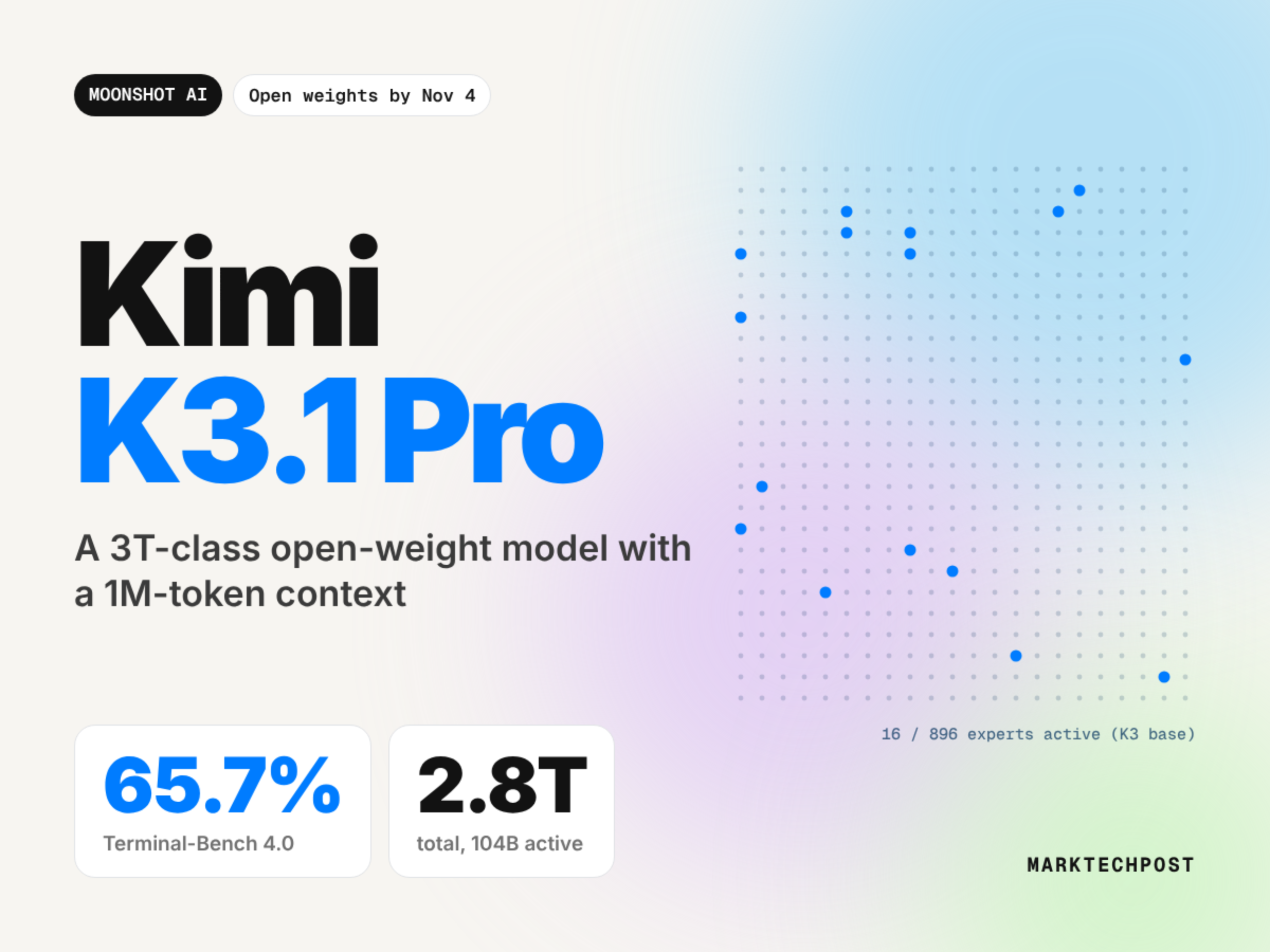
Introducing Kimi K3.1 Pro Kimi K3.1 Pro landed on the Kimi API today - it's not yet open weights, but Moonshot promise "Full model weights will be released by Nov 4, 2026". They're also offering a "Highspeed" version that's 2-3x faster, at twice the price (except for input token cache hits, which are priced the same). The US dollar pricing is $2.00/million tokens for input and $10/million for output - the same as GPT-6.1 Sol and half the price of Claude Opus 5.5. Moonshot's own benchmarks show Kimi as approximately level with Opus 5.5 and GPT-6 Astra - beating them on a few benchmarks, coming close on others. Artificial Analysis scored Kimi at 55 - ahead of Claude Fable 5.1, GPT-6 Astra, and Gemini 4 Argon (all at 53) and behind only Claude Opus 5.5 (58). This is the first time a (soon-to-

Timeline and related coverage

Black October: A Comprehensive Overview of the AI-Driven Cybersecurity Crisis—From Its Peak to Defensive Response

Around October 21–22, 2026, over a span of approximately 48 hours, more than a dozen high‑severity AI‑related vulnerabilities and intrusion incidents were reported worldwide, including PHP2Shell, GitLab RCE (CVSS 10), NGINX/HTTP/3 DoS, LiteLLM password theft, eMudhra CA key leakage, and Quest Diagnostics medical data exposure. State actors such as Storm‑0940 leveraged open‑source intelligent penetration‑testing frameworks like ARTEX to launch large‑scale attacks. Concurrently, AI security defense systems were rapidly being developed, encompassing formal verification, open‑source patching agents, standardization of agent capabilities, and hardware‑level optimizations.

Timeline and related coverage