
[AINews] Anthropic ends Coding Interviews: "Hunger beats tenure"
Since coding is solved, why code for the job?

Search headlines, summaries and articles to connect the dots.
Since coding is solved, why code for the job?
Human beings struggle with emergency communication. Chatbots can help—if people take them seriously.
One of England’s top judges, Geoffrey Vos, believes that AI could adjudicate plenty of civil cases. The question, he says, is where the line should be drawn.
arXiv:2610.36523v1 Announce Type: new Abstract: As agents collaborate on longer tasks, responsibility may pass between models before the work is complete. The receiving model must build on prior decisions, observations, and actions while addressing the remaining requirements. Evaluating this transition requires connecting the information preserved at handoff to how the receiver continues the work, a relationship that task-success and memory-retention scores alone do not capture. We introduce the Handoff State Continuity Benchmark (HSC-Bench), comprising 1,039 tasks that evaluate two complementary aspects of task takeover: recovering relevant repository evidence and continuing from established conversational, tool, and file-work state. Comparisons across six receiving models show that struc
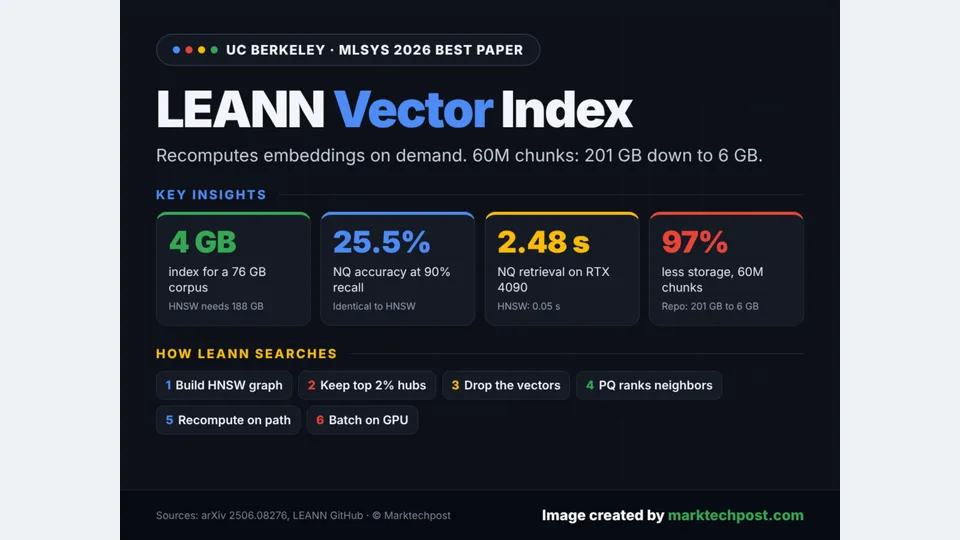
UC Berkeley’s LEANN vector index stores a pruned graph and recomputes embeddings at query time. It matches HNSW accuracy at 90% recall using 4 GB instead of 188 GB, at the cost of seconds-level search. The post Meet LEANN: An Open-Source Vector Index that Shrinks a 60M-Chunk RAG Index from 201 GB to 6 GB appeared first on MarkTechPost.
Checkr gave its AI agent a structured dbt context layer, cutting a support-metric investigation from hours to minutes.
AWS has been named a Leader in the 2026 Gartner Magic Quadrant for Contact Center as a Service (CCaaS) for AWS Connect Customer. This recognition marks an important milestone for our team, and it reflects years of work pushing on what's possible in customer experience.
Why conversational analytics stalls and the data fundamentals that make it reliable.
Education Innovation
Why AI agents can make semantic layers stick, if teams can solve the trust problem.
How LangChain built Content Studio, an open-source design agent in Slack that makes on-brand videos, graphics and decks, and the harness that powers it.
Every manufacturer has its own industrial intelligence. Some is documented, and some resides in the knowledge of experienced workers. Consider an experienced operator preparing to restart a line after a changeover. The machine settings matter, but so does knowing how a particular material behaves, what happened during the previous shift, and when an apparently minor…
As agents go mainstream, some publishers are hoping that people will pay for content tailor-made for AI—not humans.
The S-1, the numbers, and the reactions.
arXiv:2610.33008v1 Announce Type: new Abstract: Diffusion large language models (dLLMs) enable flexible generation through iterative masked denoising, but incur substantial inference cost because token representations are repeatedly recomputed across denoising steps. Existing cache-based methods reduce this cost by reusing intermediate results across denoising steps and recomputing only a subset of positions at each step, chosen either on a fixed schedule or by heuristic signals of change. Our trajectory experiments instead point to decoding trajectory as the more relevant quantity. Cached generation remains accurate when it stays close to the full-denoising trajectory, with errors concentrated around unmask-order deviations and reduced as longer reference prefixes are recovered. This sugg

arXiv:2610.32189v1 Announce Type: new Abstract: Unsupervised multivariate time series anomaly prediction (AP) aims to estimate future anomaly risks from current observations, providing early-warning signals for proactive intervention and maintenance in complex systems. Existing unsupervised AP methods follow a perturbation-based paradigm, where predefined or random perturbations are injected into historical windows to simulate abnormal future evolution. However, these methods share perturbations across different variables and contexts, and learn deterministic history-to-future evolution. In reality, anomaly evolution is variable- and context-dependent: the same perturbation may be amplified into abnormal future dynamics in one variable or context, while being absorbed as normal fluctuation
arXiv:2610.33062v1 Announce Type: new Abstract: Unified large multimodal models (ULMMs) are able to perform visual reasoning through interleaved text-image generation, but generating explicit intermediate images incurs significant computational overhead. While visual latent reasoning addresses this, most existing methods rely on vision-language models (VLMs) incapable of visual generation. We propose Oddin, a novel framework enabling latent visual reasoning in ULMMs. Oddin replaces intermediate images with compact latent tokens processed entirely by the understanding branch, reserving the generation branch for the final output image. We train the model via offline self-distillation with three objectives, final image generation losses, text distillation losses, and cross-entropy losses for
arXiv:2610.32104v1 Announce Type: new Abstract: Several formal theories have been developed to characterize the capabilities and limitations of the transformer architecture, each employing different abstractions that capture different features of the architecture. Due to the differences in their underlying assumptions and conceptual frameworks, these theories can disagree in their predictions about what tasks transformers find easy or hard. We map out seven theories of transformer capability (Star-free, $\mathsf{AC}^0$, $\mathsf{TC}^0$, C-RASP, MPC, BAPO, and Sensitivity) and translate their results into a common matrix of predictions across a suite of tasks covering different computational structures. We provide new theoretical results to complete this matrix. We then evaluate theoretical
arXiv:2610.33047v1 Announce Type: new Abstract: Long-running assistants often interpret follow-up requests whose referents, constraints, and active goals were established many turns earlier. The central challenge is therefore not only context length, but retrieval intent: a current query such as ``use the previous configuration'' may omit the project, entity, and version terms needed to locate relevant evidence. Long-context models can recover those terms by replaying the interaction, but repeatedly pay the cost of processing history. Conventional retrieval-augmented generation (RAG) is cheaper, yet assumes an information-sufficient query; conversational rewriting either rereads the history or depends on an explicitly maintained textual memory. We introduce \emph{Parametric Session State}
arXiv:2610.33274v1 Announce Type: new Abstract: Large language model (LLM) agents work in scenarios with very different memory needs. A question about past conversations needs the exact facts it names, while a multi-step task needs a trace of the steps already taken together with details that the next step cannot name. Existing memories are each designed and tested for one kind of scenario. Retrieval memories such as A-Mem miss steps that the current query does not express, summaries drop exact strings, and pairing the two fixes the split of the budget in advance. We propose FlexA-Mem, a general memory that writes each unit of history once into an immutable store and renders a fresh memory for every call. The rendered memory is a compact timeline of records plus detail that a fixed rule fi