Skip to content
AI NEWS JOURNAL
AI, IN PERSPECTIVE

Search AI news

Search headlines, summaries and articles to connect the dots.

Newest first

AdaptTok-Indic: Script-Aware Adaptive Tokenization for Indic Languages

arXiv:2610.33017v1 Announce Type: new Abstract: Multilingual tokenizers trained on English-dominated corpora often over-segment Indic languages, resulting in longer token sequences and increased tokenization disparity across scripts. We present AdaptTok-Indic, an Indic-specialized extension of adaptive tokenization that combines Unicode-normalized preprocessing with explicit Indic conjunct handling, script-aware routing, and learned byte-level boundary prediction jointly trained with a small Transformer language model. Evaluated on Bengali and Hindi, with additional evaluation on Gujarati, Tamil, and Telugu, AdaptTok-Indic achieves lower token fertility than SentencePiece BPE, an Indic-oriented tokenizer baseline, and an independently implemented MAGNET-style baseline. Across five recorded

Timeline and related coverage

Nemotron 3.5 Bolt 74B-A9B 24GB: A Hybrid Vision-Language Model for Local AI

arXiv:2610.33039v1 Announce Type: new Abstract: We introduce Nemotron 3.5 Bolt 74B-A9B 24GB, a hybrid Mamba-Transformer vision-language model that optimizes speed and intelligence per GB of memory used for local agentic workloads. Derived from the Nemotron 3.5 Super VL 120B-A12B model family, Nemotron 3.5 Bolt 74B-A9B 24GB combines Star Elastic compression with 2-bit Quantization-Aware Distillation for memory-constrained deployment. The model is optimized for reasoning, agentic tool use, and web & terminal interactions. We also trained a LiLiCorr speculative drafter that is released alongside the model to reach our target inference speed. The resulting model achieves a higher accuracy than leading models with similar memory footprints and speed across many benchmarks for general agentic ca

新闻源配图 · arXiv cs.CV
Timeline and related coverage

Entity-Aware Evaluation of OCR Systems for Historical Document Transcription

arXiv:2610.33004v1 Announce Type: new Abstract: Optical Character Recognition (OCR) is essential for digitizing historical archives, yet standard evaluation metrics such as Character Error Rate (CER) do not necessarily reflect whether meaningful information, such as names, dates, and identifiers, is preserved. In this work, we investigate entitylevel analysis of OCR errors as a complementary perspective for evaluating OCR quality in historical documents. Using a publicly available benchmark of 175 documents from the Berrutti Archive, augmented with 5,209 manually annotated entity mentions that will be released upon acceptance, we compare sequence-recognition OCR systems, OCR-specialized vision-language models, and general-purpose vision-language models. Beyond global transcription accuracy

Timeline and related coverage

Merge-Based Vocabulary Extension Stalls at the Pre-Tokenizer: An English-Preserving Repair for Nepali, Tested in Continued Pretraining

arXiv:2610.33016v1 Announce Type: new Abstract: Llama-3, Qwen3 and many other open LLMs pre-tokenize text with a regular expression whose word class admits only Unicode letters. Devanagari vowel signs are combining marks, so this regex splits Nepali words at every vowel sign, and models that use it spend 2.6 to 5.8 times as many tokens on Nepali as on the same English text. Merge-based vocabulary extension cannot join the split pieces: for Llama-3 and Qwen3 no number of new merges brings this premium below about 2.2, and ten released extensions already end within 4% of this pre-token floor. We give a small edit to the deployed regex that provably keeps every token id of text without combining marks or Devanagari characters. With 32,000 new merges it brings Nepali to 1.01 times English, abo

Timeline and related coverage

PhaseBreak: Proactive Temporal Protection against Unauthorized Image-to-Video Animation

arXiv:2610.33070v1 Announce Type: new Abstract: Image-to-Video (I2V) diffusion models can animate a single portrait or photograph, enabling shared images to be repurposed for motion synthesis without the subject's authorization. We study proactive visual protection against such use: before an image is released, its owner applies a bounded perturbation that preserves the sharing workflow but disrupts downstream motion generation. Existing spectral disruption objectives globally attenuate temporal representations and therefore provide limited control over subtle or spatially localized motion. Our key idea is that generated dynamics depend not only on temporal feature strength, but also on the order in which feature events occur. We propose PhaseBreak, a white-box spectral retiming protection

Timeline and related coverage

Cutting both ways: AI sharpens systems protection while opening new exploits for malicious actors

The cybersecurity industry is discovering that powerful frontier AI models are a double-edged sword. Companies can use models to identify vulnerabilities in source code and system configurations faster than ever before. As it turns out, malicious actors can do this as well. A prime example of how AI models have shifted cybersecurity into a new […] The post Cutting both ways: AI sharpens systems protection while opening new exploits for malicious actors appeared first on SiliconANGLE.

Timeline and related coverage

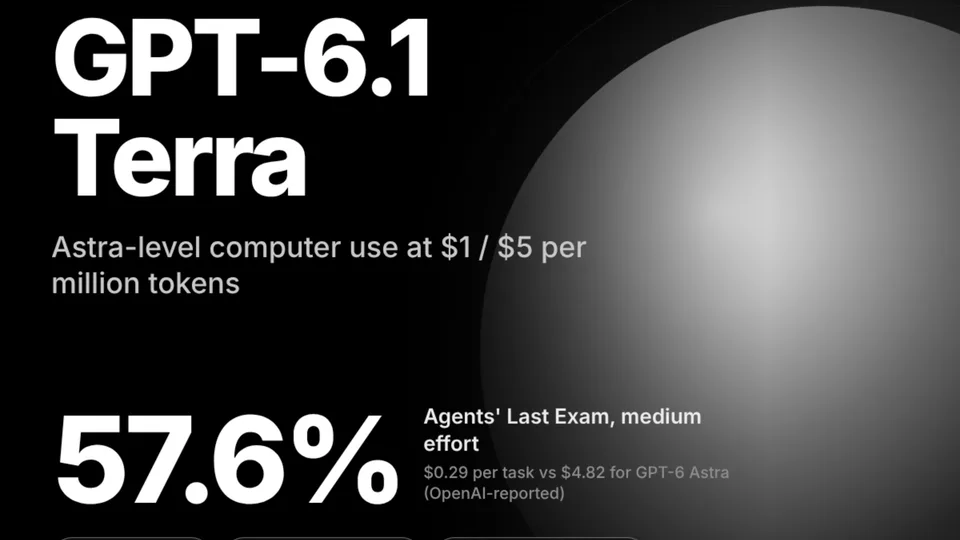
OpenAI launches GPT-6.1 Terra for faster, better-performing AI agents at half the price

OpenAI Group PBC today released GPT-6.1 Terra, an upgrade to the middle tier model in its lineup of frontier artificial intelligence systems. The new model, the successor to GTP-5.6 Terra, costs around 50% less while handling computer use tasks faster and with greater accuracy. Terra is positioned as the everyday model in OpenAI’s lineup, designed […] The post OpenAI launches GPT-6.1 Terra for faster, better-performing AI agents at half the price appeared first on SiliconANGLE.

Timeline and related coverage

Release: v5.21.0

# Release v5.21.0 ## New Model additions ### MiniCPM-OCR MiniCPM-OCR is a document-understanding model from OpenBMB's MiniCPM-V family. It keeps the MiniCPM-V 4.6 architecture, which pairs a SigLIP vision encoder and a window-attention merger with a Qwen3.5 language model. It is specialized for reading text-dense images such as scanned pages, screenshots, receipts and tables. **Links:** [Documentation](https://huggingface.co/docs/transformers/main/en/model_doc/minicpm_ocr) | [Paper](https://huggingface.co/papers/2509.18154) * Feat test (#49920) by @guarin in [#49920](https://github.com/huggingface/transformers/pull/49920) ### Flint Flint is Recursive's mixture-of-experts language model. Compared to a standard SwiGLU MoE transformer such as Qwen3-MoE, it uses hybrid attention (sliding-windo

Timeline and related coverage

Anthropic files S-1 paperwork for proposed IPO

Artificial intelligence giant Anthropic PBC filed papers today for an initial public offering with the United States Securities and Exchange Commission, putting it on track for what will likely be the biggest stock market debut of an AI developer to come, amid warnings about advanced AI. In its filing, Anthropic said it plans to list […] The post Anthropic files S-1 paperwork for proposed IPO appeared first on SiliconANGLE.

Timeline and related coverage

Anthropic files S-1 paperwork for blockbuster AI IPO

Artificial intelligence giant Anthropic PBC filed papers today for an initial public offering with the U.S. Securities and Exchange Commission, putting it on track for what will likely be the biggest stock market debut of an AI developer to come, amid warnings about advanced AI. In its filing, Anthropic said it plans to list on […] The post Anthropic files S-1 paperwork for blockbuster AI IPO appeared first on SiliconANGLE.

Timeline and related coverage

Which Answer Did the Seventeen-Year-Old Write? A Behavioral Case Study of Author-Age Misattribution, Miscalibrated Confidence, and Non-Corrective Self-Explanation in Six Frontier Language Models

arXiv:2610.31946v1 Announce Type: new Abstract: Three students answered the same exam prompt by hand: "What is happiness? Are you happy?" Their ages, recorded at collection, are 17, 28, and 45. The 17-year-old's answer is hedged and formally phrased. Asked to match each answer to an age and gender label, most frontier language models confidently assign it to an adult. This paper reports a structured case study of that failure across six models: Claude Fable 5, Gemini 3.1 Pro, GPT-5.6 Sol, Grok 4.5, GPT-4o (2024), and DeepSeek V4. We ran 1,081 API sessions and scored 3,225 responses across six experimental conditions that manipulate framing, disclosure format, and audience-awareness instruction. Three of six models perform at or near chance (1/3) on the matching task while reporting 73-88%

Timeline and related coverage

Semantically Rich, Metrically Affect-Blind: A Geometric Blind Spot in Modern Text Embedders

arXiv:2610.32122v1 Announce Type: new Abstract: We report a systematic dissociation in modern text embedders: sentiment is almost perfectly decodable from their embeddings, yet almost entirely absent from their metric. Across eleven frozen encoders spanning 2021 to 2026, including 2026-generation models and the 4B-parameter LLM embedder Qwen3-Embedding-4B, a linear probe recovers sentence polarity at up to 91.3% accuracy while cosine similarity separates polarity by a margin of only 0.003-0.064. Qwen3-Embedding-4B, the strongest probe in the panel, reaches 91.3% probe accuracy but only 64.3 retrieval MAP. Because retrieval, clustering, deduplication, and retrieval-augmented generation operate on the metric rather than on a trained probe, these systems are effectively blind to information t

Timeline and related coverage

Kolibri: A Sovereign European Model on the Pareto Frontier

arXiv:2610.31945v1 Announce Type: new Abstract: This report introduces Kolibri, an English-German mixture-of-experts transformer with 78.1B total parameters and 3.46B active parameters per token, released as open weights under the Apache 2.0 licence. We built Kolibri for sovereign and specialised deployment, with a particular focus on German and on regulated domains such as public administration, industry, and aerospace. To support these settings, we control the full model-development process, including data, architecture, training infrastructure, post-training, and evaluation. We train Kolibri on 24T tokens across pre-training, mid-training, and long-context extension, with German accounting for more than 20% of the data mix by bytes. To reach this share, we complement German datasets wit


Timeline and related coverage