
How OpenAI turned its coding tools into dots, an always-on personal assistant
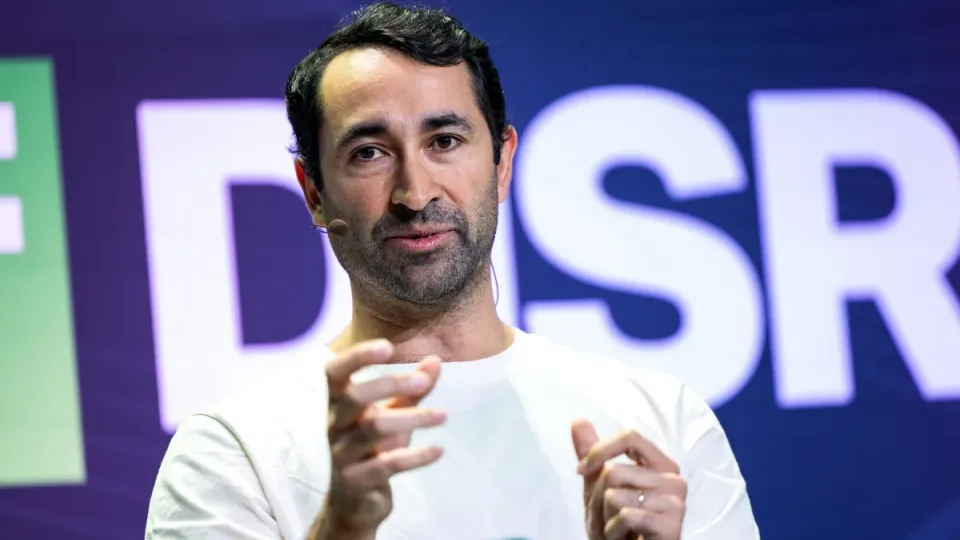
Alexander Embiricos, the OpenAI executive responsible for dots, never wants to have a meeting with someone else's AI agent.
Search headlines, summaries and articles to connect the dots.
Alexander Embiricos, the OpenAI executive responsible for dots, never wants to have a meeting with someone else's AI agent.
The biggest highlight is that the price has been cut in half.
OpenAI Group PBC today released GPT-6.1 Terra, an upgrade to the middle tier model in its lineup of frontier artificial intelligence systems. The new model, the successor to GTP-5.6 Terra, costs around 50% less while handling computer use tasks faster and with greater accuracy. Terra is positioned as the everyday model in OpenAI’s lineup, designed […] The post OpenAI launches GPT-6.1 Terra for faster, better-performing AI agents at half the price appeared first on SiliconANGLE.
Anthropic publicly filed its Nasdaq IPO application, targeting a listing during the week of November 16. Anthropic has officially embarked on its path to going public. The company, founded just five years ago and at the heart of the generative AI boom, could set a historic record with this IPO. In documents submitted to the U.S. Securities and Exchange Commission (SEC), Anthropic disclosed plans to list on the Nasdaq under the ticker symbol “ANT,” aiming for an IPO during the week of November 16. The company will issue Class T special shares held by Class T directors. In its prospectus, Anthropic reported first-half revenue of $16.29 billion, compared to $1.16 billion in the same period last year; a net loss of $80.75 billion versus $12.97 billion a year earlier; and an operating loss of $693 million, down from $2.14 billion in the prior-year period. As of September 30, no single customer accounted for more than 10% of the company’s revenue over the nine-month period, with 79% of revenue coming from customers outside the top five. On the partnership front, under an agreement with SpaceX AI, Anthropic has committed to cumulative spending of up to $120.5 billion through 2029. The company also revealed that capital expenditures are expected to rise significantly, potentially requiring additional financing sooner than currently anticipated; it will not pay any dividends in the foreseeable future and has not yet entered into any agreements for major acquisitions; furthermore, it may issue convertible notes totaling up to $42 billion. As of September 30, no single customer accounted for more than 10% of the company’s revenue over the nine-month period, with 79% of revenue coming from customers outside the top five. Regarding partnerships, under an agreement with SpaceX AI, Anthropic has agreed to incur cumulative expenditures of up to $120.5 billion through 2029. (Source: Sina Tech) Apple responds to iPhone Duo internal screen cracking issue: only a small number of devices affected, eligible for replacement. Shortly after the iPhone Duo’s launch, some users reported hinge malfunctions causing cracks in the internal display. Apple has now addressed these reports in a statement to MacRumors, stating that only a very limited number of devices are impacted. Apple did not specify the cause of the cracks nor disclose whether it plans to release a repair solution.
· OpenAI releases GPT-6.1 Terra, with API prices cut in half and faster computer performance · Apple officially rolls out iOS 27.2: Apple Music gets a new black-and-white design, and the iPhone Duo now supports the Apple Pencil · Huawei’s Enjoy series has cumulatively shipped over 160 million units #Follow iFanr’s official WeChat account: iFanr (WeChat ID: ifanr) for more exciting content delivered to you第一时间.
Nace AI has released Drex for Search, bringing its Drex decision models to document search for AI agents. Nace reports 92.05% on BrowseComp-Plus with 12.6 search calls, and fewer agent turns on OfficeQA Pro. The post Nace AI Releases Drex for Search for AI Agents: 92.05% on BrowseComp-Plus With 12.6 Search Calls appeared first on MarkTechPost.
Even ordinary people can use natural language to create their own custom AI hardware.
metal : stop overflow from happening in large matrix output offsets (#30072) * Metal : stop overflow from happening in large matrix output offsets Assisted-by: Codex * metal : widen batch offsets and MUL_MAT_ID token indices Assisted-by: Codex --------- Co-authored-by: feni6 <270037094+feni6@users.noreply.github.com> **Website:** - **Attestations:** - **macOS/iOS:** - [macOS Apple Silicon (arm64)](https://github.com/ggml-org/llama.cpp/releases/download/b11895/llama-b11895-bin-macos-arm64.tar.gz) - macOS Apple Silicon (arm64, KleidiAI enabled) [DISABLED](https://github.com/ggml-org/llama.cpp/pull/23780) - [macOS Intel (x64)](https://github.com/ggml-org/llama.cpp/releases/download/b11895/llama-b11895-bin-macos-x64.tar.gz) - [iOS XCFramework](https://github.com/ggml-org/llama.cpp/releases/dow
arXiv:2610.31810v1 Announce Type: new Abstract: Even a carefully proofread paper can leave small gaps in its proofs or its stated assumptions. We introduce PaperFormalizer, a Lean-based agentic pipeline that helps authors find and close such gaps in their own papers and turn each paper into a Lean-verified version. Starting from the LaTeX source, PaperFormalizer transcribes the paper into a dependency graph of statements, audits each statement in natural language for faithfulness, ambiguity and correctness, and then formalizes and proves the statements in Lean against Mathlib, optional domain libraries and the author's personal toolkit. Only the author knows what a statement is meant to say and how a formalization gap in a result is best fixed. The pipeline therefore stops and asks the aut

vulkan: Add a larger tile size for conv3d (coopmat2 only) (#29920) * vulkan: Add a larger tile size for conv3d (coopmat2 only) This adds a larger tile size, in practice it is only for coopmat2 where we don't need shared memory to store the output (would use more than 64KB). Add some additional representative backend tests. At least, this is what codex came up with from looking at sd.cpp Wan VAE. * only apply large tile size for newer driver versions **Website:** - **Attestations:** - **macOS/iOS:** - [macOS Apple Silicon (arm64)](https://github.com/ggml-org/llama.cpp/releases/download/b11877/llama-b11877-bin-macos-arm64.tar.gz) - macOS Apple Silicon (arm64, KleidiAI enabled) [DISABLED](https://github.com/ggml-org/llama.cpp/pull/23780) - [macOS Intel (x64)](https://github.com/ggml-org/llama
Anthropic launched OSS Scanner on October 8, 2026—a free, opt-in AI vulnerability-scanning tool powered by strong models such as Claude Mythos, designed specifically for critical open-source projects. As of October 19, it had onboarded 114 projects and, within 11 days, reported 77 high-severity and 803 medium-severity vulnerabilities (according to model ratings), with 88% of sampled audit results meeting its disclosure standards.
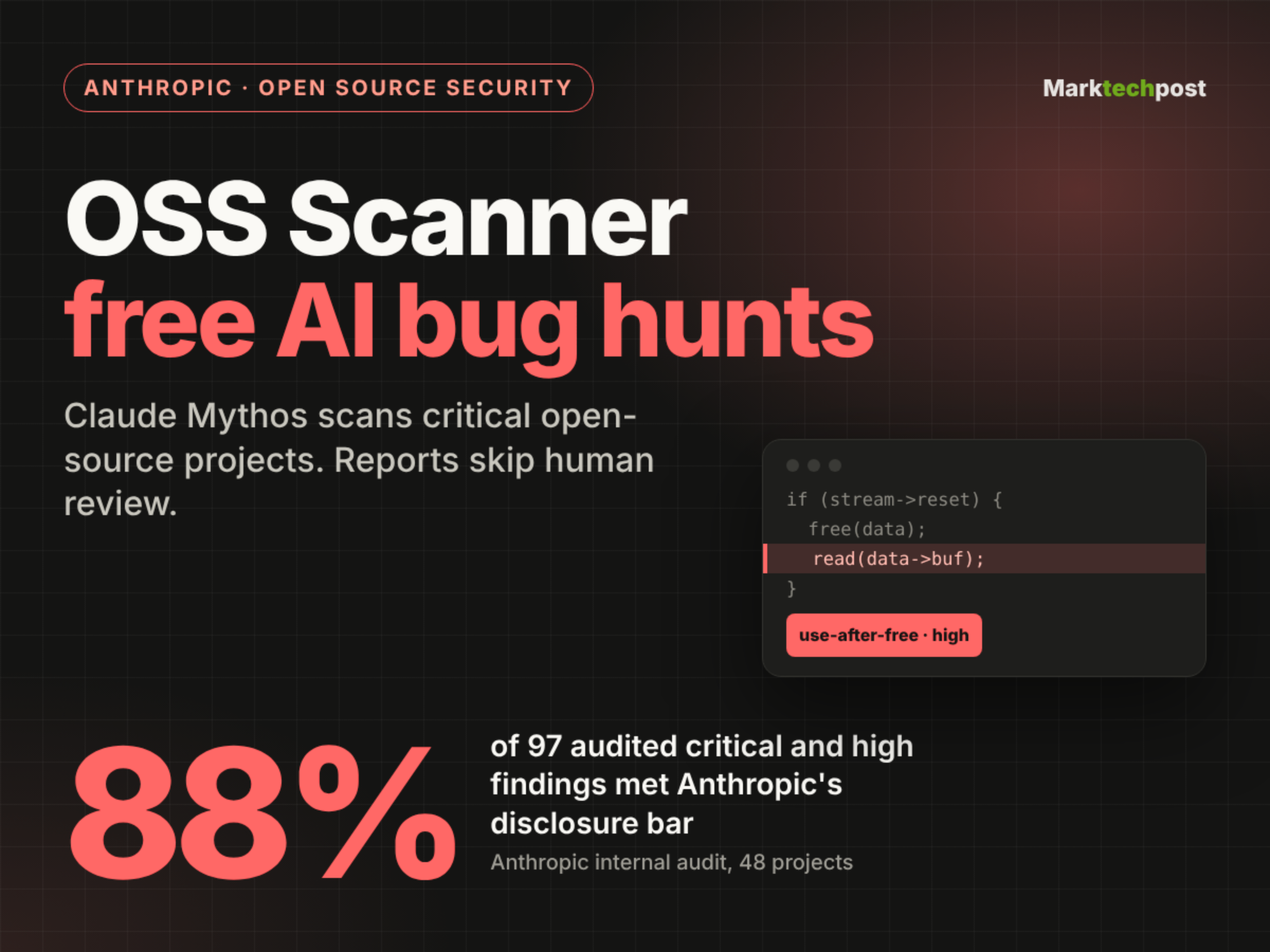
Why it matters:This tool represents a large-scale implementation of LLMs in the open-source security domain, characterized by zero cost, full automation, and offline auditing; however, bypassing the human review stage introduces risks of false positives and duplicate issues. Its accuracy metrics—88% detection rate and 1% false positive rate—and real-world project feedback (e.g., wolfSSL, curl) provide an empirical benchmark for the current state of AI‑driven vulnerability discovery.
Around October 21–22, 2026, over a span of approximately 48 hours, more than a dozen high‑severity AI‑related vulnerabilities and intrusion incidents were reported worldwide, including PHP2Shell, GitLab RCE (CVSS 10), NGINX/HTTP/3 DoS, LiteLLM password theft, eMudhra CA key leakage, and Quest Diagnostics medical data exposure. State actors such as Storm‑0940 leveraged open‑source intelligent penetration‑testing frameworks like ARTEX to launch large‑scale attacks. Concurrently, AI security defense systems were rapidly being developed, encompassing formal verification, open‑source patching agents, standardization of agent capabilities, and hardware‑level optimizations.
AWS has announced that SageMaker AI’s serverless model customization feature now includes “Training Sessions,” which are fully available starting today. Users can independently define post-training logic—such as custom loss functions, reward signals, or multi‑round reinforcement learning—while the platform automatically handles GPU allocation, distributed execution, fault tolerance, and checkpoint storage.
According to The Verge, well-known modder Sammy Hajhamid (online alias pepsipu) claims to have successfully jailbroken the Nintendo Switch 2. His tool, ‘ns2jb,’ was developed with assistance from OpenAI Codex and exploited a vulnerability triggered by an older game. A demonstration video shows “Mario Kart World” running a modified version that includes unofficial characters such as Cinnamoroll, the red Angry Birds, Peter Griffin, and Minecraft’s Steve.
AI startup Recursive has unveiled Flint, an open-source coding model that it claims was developed primarily using its in-house AI research system, Eureka Machine. With just 40 billion parameters and only 2.5 billion activations in practice, the model can run offline on a standard laptop—such as an M4 Pro MacBook—at an inference speed of 131 tokens per second, outperforming most models of comparable size on benchmarks like SWE-Bench.
Tenex, an AI-native software company founded 18 months ago, leverages output‑driven compensation, the MetaHarness framework, and Opus 5.5–powered AI agent workflows to serve roughly half of the Fortune 2000 companies. Its model focuses on process standardization, revaluing non‑coding capabilities, and addressing the last‑mile challenges of enterprise‑level AI deployment.
Tenex is an AI-native software delivery company established 18 months ago (as of 2026), with a team of 75 employees, serving roughly half of the Fortune 2000 companies and a comparable number of mid-sized enterprises. Its core practices include: a dynamic engineer compensation system anchored in story points; a quality‑assurance mechanism led by AI strategists; the MetaHarness framework, which embeds context directly within Git; and a capability realignment focused on “high‑value, non‑coding tasks.” Meanwhile, it has been observed that enterprise AI adoption remains concentrated on general‑purpose LLM deployments and engineering‑side agents, with backend office‑type production‑grade AI agents achieving only about 5% penetration.
Cloudflare uses OpenAI Daybreak to investigate vulnerabilities and propose fixes for review. Its developers use Codex to build faster and improve code quality.
OpenAI and Google Cloud are bringing frontier models and Codex workflows to Gemini’s Model Garden, available through Google Cloud Marketplace.
Two engineers shipped Stack Overflow for Agents in a few weeks with Codex, and its ChatGPT plugin helped drive up to 10× growth in agent creation.