Skip to content
AI NEWS JOURNAL
AI, IN PERSPECTIVE

Search AI news

Search headlines, summaries and articles to connect the dots.

Newest first

Artifact Distillation: Training-Free Transfer from Frontier to Small Language Models

arXiv:2610.37680v1 Announce Type: new Abstract: Closing the gap between frontier and smaller language models is usually approached by distillation: fine-tuning the small model (student) on a frontier model's (teacher) outputs, which binds transfer to training compute and leaves the transferred knowledge largely opaque. We propose Artifact Distillation: a teacher solves training instances and externalizes its problem-solving procedure into an artifact bank that a student queries at inference time, with no gradient updates. Across four LiveBench tasks, a bank written by Claude Opus 4.5 lets Claude Haiku 4.5 outperform unaided Claude Sonnet 4.5 on spatial reasoning (0.707 vs. 0.647) at 60% of its cost, and reach Sonnet 4.5's level on table joining at 89% of its cost. The same raw bank raises

Timeline and related coverage

Locating Sycophancy Across Training Stages in Open Language Models

arXiv:2610.37788v1 Announce Type: new Abstract: Language model assistants sometimes change a correct answer when the user suggests a wrong one. The behavior, called sycophancy, is usually attributed to preference-based post-training, yet early measurements found it in pretrained models. We ask where it comes from by measuring it at every available stage of training: 13 open checkpoints from 5 lineages, from base model through supervised fine-tuning and preference optimization to release. We separate how far an injected claim moves a model's answer from how firmly the answer was held, and vary who makes the claim, how reliable they are said to be, and how strongly they make it. Two sycophancy behaviors with different origins emerge, and both replicate across datasets. Deference to a claim i

Timeline and related coverage

DistOptimize: Automatic Optimization of Distributed Protocols

arXiv:2610.39017v1 Announce Type: new Abstract: Distributed consensus and consistency protocols are difficult to reason about yet foundational to the cloud; as such, they often undergo a rigorous proof and formal verification process before deployment. The same level of rigor is rarely applied to protocol modifications, which occur frequently in production and threaten to compromise safety. In this paper, we eliminate the risk of safety violations from manual modifications by presenting an automatic optimizer for distributed protocols: DistOptimize. DistOptimize adapts throughput optimizations from academic languages to frameworks used in production, verifying the correctness of the rewrites in Rocq and automating their application through a combination of calibration and ILP-based search

Timeline and related coverage

Scoring Explanations Without Reading Them: Structural Shortcuts in Automated-Interpretability Evaluation Data

arXiv:2610.37676v1 Announce Type: new Abstract: Automated interpretability scores an explanation of a sparse-autoencoder (SAE) feature by asking a model to predict, token by token, where the feature fires on evaluation examples or to judge whether marked tokens fit it. We find that the evaluation data standard pipelines build can be scored without reading the explanation. On Neuronpedia's stored fuzzing runs for 500 random GPT-2 small features, 91.3% of activating examples are cropped with the peak on the centre token, and a rule that says "yes" when the centre token is marked reaches balanced accuracy 0.979, against 0.838 for the stored LLM scorers (recomputed from the stored per-item verdicts, on marks rebuilt from the pipeline's code); a rule reading only the mark count reaches 0.969. T

Timeline and related coverage

Introducing Geist Serif

Vercel has launched Geist Serif, a high-contrast display serif typeface designed as part of the Geist family, which includes Geist Sans, Geist Mono, and Geist Pixel. Built on the same foundational principles as its predecessors, Geist Serif features fine serifs, sharp hairlines, and a variable axis called Element Shape (ELSH) offering four dot variants: Regular, Square, Triangle, and Heart. It maintains consistent x-height and cap height with Geist Sans for seamless integration across layouts. The font supports 352 Latin-script languages, includes 894 glyphs, and is available via npm and Vercel’s font platform. Future updates will include additional weights, an italic variant, Cyrillic support, and availability on Google Fonts. The release marks a shift toward editorial and fashion-inspired design, honoring print traditions while leveraging modern screen capabilities.

IP geolocation now covers more visitors at higher resolution

Vercel now provides city-level geolocation data for nearly all requests and postal-code data for 90% of traffic, with more frequent updates to reflect IP reassignments and routing changes. The improvement is automatic for all projects, requiring no code changes, and applies consistently across Vercel Functions and Routing Middleware. Users relying on geolocation for access controls, localization, or compliance may see shifts in location resolution—particularly for traffic from VPNs, hosting providers, and leased IP ranges—now reflecting the actual physical termination point rather than static registry allocations.

Simplifying runtime caching on Vercel

Vercel is merging its Data Cache service into Runtime Cache, unifying data caching across frameworks like Next.js, SvelteKit, and Nuxt. Developers using fetch caching or unstable_cache in Next.js won’t need to change their code. Pro and Enterprise projects receive increased storage allocations, with Pro getting 8x more space and Enterprise 10x. Runtime Cache now handles regional storage, authentication, and tag-based invalidation across Vercel’s global infrastructure. Improvements include faster reads during traffic bursts via circuit breakers, higher storage budgets reducing evictions, and enhanced observability with deployment markers, revalidation causes, and write utilization metrics. The migration simplifies billing and usage tools, with existing teams receiving advance notice and pricing details.

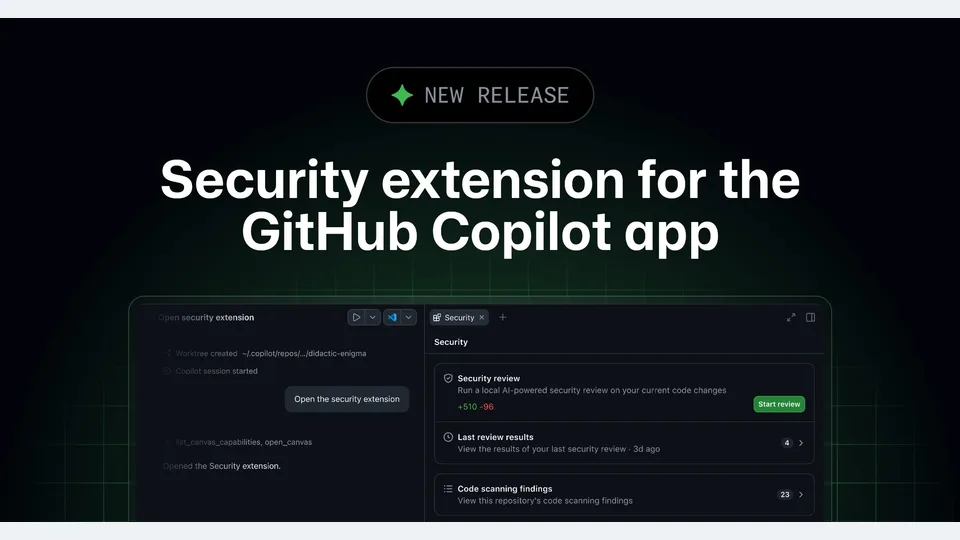
Security extension for the GitHub Copilot app

You can now work through your repository’s GitHub code scanning alerts without leaving the GitHub Copilot app. The new GitHub security extension, now in public preview, lets you find the… The post Security extension for the GitHub Copilot app appeared first on The GitHub Blog.

新闻源配图 · GitHub Copilot changelog
Timeline and related coverage

Nvidia releases all-in-one adaptable Nemotron 3.5 audio transcription and translation model

Nvidia Corp. today released a leaderboard-winning open artificial intelligence model for multilingual audio transcription and translation, along with an open data pipeline for fine-tuning Nemotron 3.5 Transcribe. Traditional transcription AI models follow a workflow that detects speech, transcribes it, identifies and labels different speakers, then answers questions about the transcription. Transcribe does all of this […] The post Nvidia releases all-in-one adaptable Nemotron 3.5 audio transcription and translation model appeared first on SiliconANGLE.

Timeline and related coverage

Virtana lets its AI agents pull in agents from other vendors to work IT incidents

Information technology observability company Virtana today added Agentic Observability Enterprise Management to its platform so its artificial intelligence agents can pull agents from other vendors into an IT incident. The release goes after a gap left by the way enterprises have adopted AI agents so far. Most enterprise agents have come built into a single […] The post Virtana lets its AI agents pull in agents from other vendors to work IT incidents appeared first on SiliconANGLE.

Timeline and related coverage