
Show HN: Telegram AI assistant with projects, images and background jobs
Article URL: https://github.com/watscho/chat-gpt-telegram-bot Comments URL: https://news.ycombinator.com/item?id=50377737 Points: 1 # Comments: 0
Search headlines, summaries and articles to connect the dots.
Article URL: https://github.com/watscho/chat-gpt-telegram-bot Comments URL: https://news.ycombinator.com/item?id=50377737 Points: 1 # Comments: 0
arXiv:2611.05590v1 Announce Type: new Abstract: What should ``verified'' mean when evaluating LLM-generated code? Many existing pipelines report a single verification number. We argue this collapses three distinct properties measured in a conditional audit sequence: verifier acceptance (Surface A), \emph{syntactic specification binding (Surface B: does the proof obligation bind to the spec?), and \emph{semantic specification fidelity} (Surface C: does the spec capture the informal requirement?). Two empirical demonstrations show the surfaces separate. \textbf{First ($A \neq B$), via Li@Opus (a same-model reproduction of \citet{li2025dafny}'s Dafny-as-intermediate-representation (IR) pipeline under Claude Opus 4.7) on three Python benchmarks}: it reaches \textbf{99.1\% verifier acceptance} on HumanEval while only \textbf{1.9\%} carry a certificate binding to a spec-defined predicate or function. \textbf{Second ($B \neq C$), via VCG on two Rust benchmarks}: we use VCG (which is our own in-house Dafny-as-intermediate pipeline) on Rust because the Rust target lets us enforce fully-verifiable output (every component ships as a Dafny certificate, ensures-binding gate passing by construction). Even inside that construction, \textbf{11.48\% (MBPP-Rust) and 14.82\% (VeriContest LC slice) of structurally-verified samples still fail hidden tests}. On the LC slice of VeriContest, \textbf{VCG's reported End2End rate is 7.79\% (535/6870).} The cited external rates are 5.51\% (GPT-5.5) and 1.88\% (single-shot Opus 4.7). These give descriptive differences of 2.3 percentage points and 4.14$\times$, respectively; task-budget, repair and harness differences prevent a matched-performance claim.
arXiv:2610.37680v1 Announce Type: new Abstract: Closing the gap between frontier and smaller language models is usually approached by distillation: fine-tuning the small model (student) on a frontier model's (teacher) outputs, which binds transfer to training compute and leaves the transferred knowledge largely opaque. We propose Artifact Distillation: a teacher solves training instances and externalizes its problem-solving procedure into an artifact bank that a student queries at inference time, with no gradient updates. Across four LiveBench tasks, a bank written by Claude Opus 4.5 lets Claude Haiku 4.5 outperform unaided Claude Sonnet 4.5 on spatial reasoning (0.707 vs. 0.647) at 60% of its cost, and reach Sonnet 4.5's level on table joining at 89% of its cost. The same raw bank raises
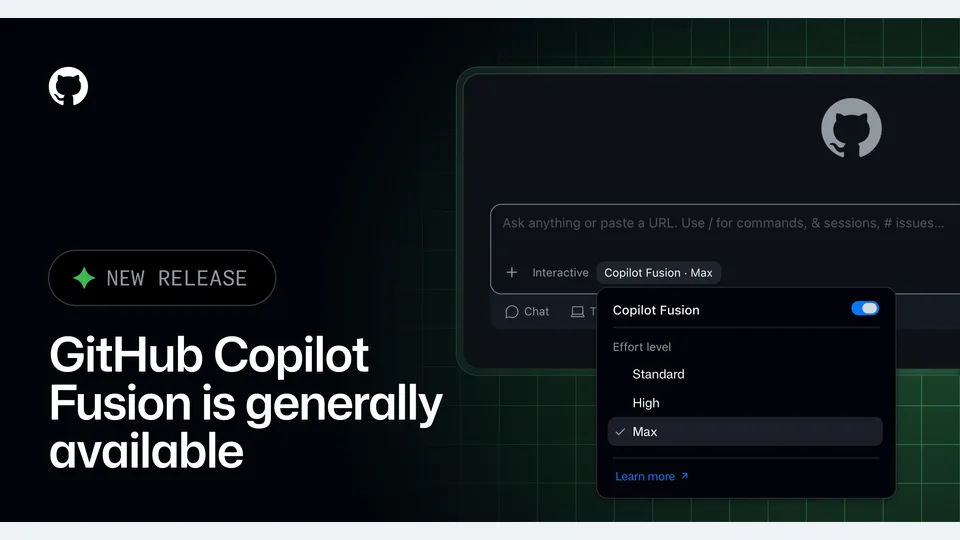
At Universe 2026, GitHub unveiled Copilot Fusion, an intelligent orchestration layer that automatically routes and combines models from OpenAI, Anthropic, Google, and others to complete coding tasks—eliminating the need for developers to manually select models. It integrates existing automatic model-selection technologies with Project HydraFusion, previewed in September. Once the model selector is enabled, the system automatically adopts execution modes such as single-model, cascading, or critique, based on task complexity.

GitHub Copilot Fusion is generally available. Instead of picking a model for each task, choose Copilot Fusion and let Copilot intelligently route and orchestrate which models it uses for you.… The post Route and orchestrate models with GitHub Copilot Fusion appeared first on The GitHub Blog.
Since coding is solved, why code for the job?

server : add realtime conversation and transcription on /v1/realtime (#31269) * server : add realtime conversation and transcription on /v1/realtime Co-authored-by: Xuan Son Nguyen Assisted-by: Claude Opus 5.5 * examples : default the realtime client to the server port 9931 Assisted-by: Claude Opus 5.5 * server : sample realtime responses right after their own decode Slots respond in turns on one context: sampling at the start of the next step read the logits of whichever slot decoded last, so concurrent sessions mixed their outputs. Assisted-by: Claude Opus 5.5 * move more stuff to server-realtime, making it self-contained * examples : fix the type check of the realtime client Assisted-by: Claude Opus 5.5 * examples : use the model card prompts in the realtime client Assisted-by: Claude O
model : add LiquidAI/d1-2B and LiquidAI/d1-omni-2B (#31275) * model : add LiquidAI/d1-2B and LiquidAI/d1-omni-2B Assisted-by: Claude Opus 5.5 * convert : keep the speech task templates out of the d1 GGUFs Assisted-by: Claude Opus 5.5 * small refactoring: no_batching --------- Co-authored-by: Xuan Son Nguyen **Website:** - **Attestations:** - **macOS/iOS:** - [macOS Apple Silicon (arm64)](https://github.com/ggml-org/llama.cpp/releases/download/b11945/llama-b11945-bin-macos-arm64.tar.gz) - macOS Apple Silicon (arm64, KleidiAI enabled) [DISABLED](https://github.com/ggml-org/llama.cpp/pull/23780) - [macOS Intel (x64)](https://github.com/ggml-org/llama.cpp/releases/download/b11945/llama-b11945-bin-macos-x64.tar.gz) - [iOS XCFramework](https://github.com/ggml-org/llama.cpp/releases/download/b119
model : add LiquidAI/LFM3-Audio-2B and LiquidAI/LFM3-Omni-2B (#31257) * model : add LiquidAI/LFM3-Audio-2B and LiquidAI/LFM3-Omni-2B Co-authored-by: Xuan Son Nguyen Assisted-by: Claude Opus 5.5 * convert : read the LFM3-Audio config.json as released A transformers that knows lfm3_audio rewrites the config into another layout (no lfm/encoder keys). Assisted-by: Claude Opus 5.5 * mtmd : disable flash attention for the LFM3-Audio depthformer Assisted-by: Claude Opus 5.5 * tts : add a voice option for LFM3-Audio and LFM3-Omni The model card offers a female and a male voice; --tts-voice for llama-tts, "voice" for the server /tts. Assisted-by: Claude Opus 5.5 * clean up template handling * convert : detect LFM3-Audio and LFM3-Omni by model_type Assisted-by: Claude Opus 5.5 * move banned tokens -
common : support deferred tools and tool_reference content parts (#31256) * common : support deferred tools and tool_reference content parts Assisted-by: Claude Opus 5.5 * common : credit the deferred tools co-author Co-authored-by: Aldehir Rojas <765227+aldehir@users.noreply.github.com> Assisted-by: Claude Opus 5.5 * tests : fix the type check of the deferred tools test Assisted-by: Claude Opus 5.5 **Website:** - **Attestations:** - **macOS/iOS:** - [macOS Apple Silicon (arm64)](https://github.com/ggml-org/llama.cpp/releases/download/b11940/llama-b11940-bin-macos-arm64.tar.gz) - macOS Apple Silicon (arm64, KleidiAI enabled) [DISABLED](https://github.com/ggml-org/llama.cpp/pull/23780) - [macOS Intel (x64)](https://github.com/ggml-org/llama.cpp/releases/download/b11940/llama-b11940-bin-maco
Jev ranks warehouse tables and labels agent failures in under a second, but adding retrieval hints leaves accuracy flat across 20 models on the Agentic Analytics Benchmark.
model : add LiquidAI/LFM3-1.7B and LiquidAI/LFM3-VL-2B (#31252) * model : add LiquidAI/LFM3-1.7B and LiquidAI/LFM3-VL-2B Co-authored-by: Sigbjørn Skjæret Co-authored-by: Xuan-Son Nguyen Assisted-by: Claude Opus 5.5 * tests : set the SWA rope base of the LFM3 test model Assisted-by: Claude Opus 5.5 * llama : enable recurrent state rollback for LFM3 Assisted-by: Claude Opus 5.5 * Apply batched suggestions from code review Co-authored-by: Sigbjørn Skjæret Co-authored-by: Tarek Dakhran * gguf-py : align the lfm3vl mapping comments Assisted-by: Claude Opus 5.5 * llama : fix CRLF line endings from the review suggestions Assisted-by: Claude Opus 5.5 * tests : add the LFM3 Metal fusion baseline Assisted-by: Claude Opus 5.5 * llama : keep the LFM3-VL depthwise conv kernels in F32 when quantizing As
Katelyn Lesse and Angela Jiang on Opus 5.5, the Claude Platform, and the engineering behind AI agents.

Katelyn Lesse and Angela Jiang join Latent Space to explain the engineering behind the Claude Platform: launching Opus 5.5, separating the model’s “brain” from the agent’s “hands,” scaling APIs, and building reliable managed agents. A new introduction ...
How LangChain built Content Studio, an open-source design agent in Slack that makes on-brand videos, graphics and decks, and the harness that powers it.
In this post, we show how Exowatt used Amazon SageMaker AI serverless model customization to build a repeatable AI pipeline that produces task-specific fine-tuned models for two deployment targets, edge and cloud, achieving higher accuracy than frontier models at up to 49x lower cost.
Lots of visuals to use and learn with.
After the release of K3.1 Pro, due to numerous users reporting that their quotas were being depleted too quickly, Moonshot AI urgently issued an announcement stating, “The issue lies with us, and we should have fixed it sooner.” Alongside compensating affected users, Moonshot AI also indicated that it would “reduce unnecessary sub-agent calls and output lengths.” Just two days before the model went live, Anthropic published an article titled “Building agents: When to fold subagents into your main agent loop,” which addressed precisely the topic of sub-agents. Anthropic concluded that, by comparing Claude deployments across multiple companies, they found that a single agent equipped with specific skills actually outperformed “a group of...”
Mirendil released Fern 0.1, its first model, pretrained from scratch with a 10M-token context window. It targets agentic AI R&D work, scores 100% on RULER single needle at 10M, but trails frontier models on agentic coding. The post Mirendil Launches Fern 0.1, Its First Model, With 10M-Token Context appeared first on MarkTechPost.
Old benchmarks approach perfect scores, yet new benchmarks consistently fall short in real-world performance. As large-model evaluation itself has become a business, companies are shifting their selection criteria from ranking-based assessments to cost‑benefit analyses.