Skip to content
AI NEWS JOURNAL
AI, IN PERSPECTIVE

Search AI news

Search headlines, summaries and articles to connect the dots.

Newest first

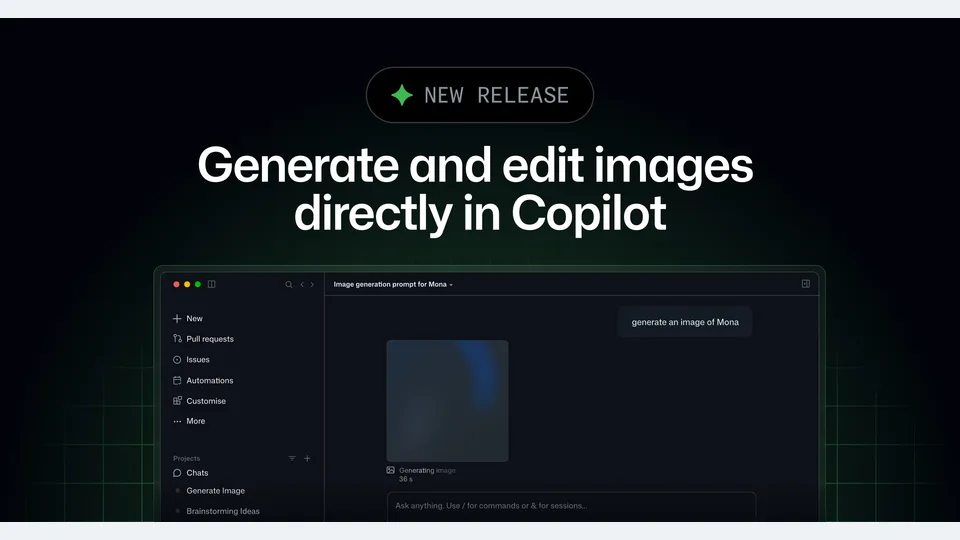
Generate and edit images directly in Copilot

You can now generate and edit images using natural language in GitHub Copilot. When you ask for an image, your selected reasoning model calls a dedicated image-generation tool powered by… The post Generate and edit images directly in Copilot appeared first on The GitHub Blog.

新闻源配图 · GitHub Copilot changelog
Timeline and related coverage

Virtana lets its AI agents pull in agents from other vendors to work IT incidents

Information technology observability company Virtana today added Agentic Observability Enterprise Management to its platform so its artificial intelligence agents can pull agents from other vendors into an IT incident. The release goes after a gap left by the way enterprises have adopted AI agents so far. Most enterprise agents have come built into a single […] The post Virtana lets its AI agents pull in agents from other vendors to work IT incidents appeared first on SiliconANGLE.

Timeline and related coverage

Jedify formally launches Data Agents for building AI analysts in plain language

Enterprise artificial intelligence context startup Jedify Inc. today formally launched Data Agents, a product that lets business teams set up autonomous AI analysts by describing the work they want done in plain language. Data Agents takes on a longstanding limit of business intelligence software, where analysts have to build dashboards ahead of time around the […] The post Jedify formally launches Data Agents for building AI analysts in plain language appeared first on SiliconANGLE.

Timeline and related coverage

Circuit Mind lands $25M and puts AI agents to work checking circuit board schematics

British circuit board design startup Circuit Mind Ltd. today announced it has raised $25 million in new funding to extend its artificial intelligence platform across more of the hardware design process. A verification tool that puts AI agents to work hunting for errors in schematics launched at the same time. Circuit Mind offers software that […] The post Circuit Mind lands $25M and puts AI agents to work checking circuit board schematics appeared first on SiliconANGLE.

Timeline and related coverage

GitHub Copilot supports server-to-server authentication

GitHub Copilot now supports server-to-server authentication for GitHub Apps installed on organizations, available in public preview. Services and agents built with the GitHub Copilot SDK can now make requests on… The post GitHub Copilot supports server-to-server authentication appeared first on The GitHub Blog.

新闻源配图 · GitHub Copilot changelog
Timeline and related coverage

Industrial Intelligence: The next growth opportunity for manufacturing

Every manufacturer has its own industrial intelligence. Some is documented, and some resides in the knowledge of experienced workers. Consider an experienced operator preparing to restart a line after a changeover. The machine settings matter, but so does knowing how a particular material behaves, what happened during the previous shift, and when an apparently minor…

Timeline and related coverage

After reading the prospectus, I finally understand why Anthropic no longer cares about its users.

The big one has finally arrived. On October 26, Anthropic publicly filed its S‑1 registration statement with the U.S. Securities and Exchange Commission, preparing to list on the Nasdaq Global Select Market under the ticker symbol ANT. Media reports suggest the company’s valuation is being discussed in a range of $1.5 trillion to $2 trillion, though the proposed offering price range remains undisclosed. Within 24 hours, this more than 300-page prospectus had already been scrutinized inside and outside the tech and finance communities, with everyone focusing on the most eye‑catching figures: revenue of $16.286 billion in the first half of 2026, compared to just $1.163 billion in the same period last year; operating profit of $974 million in the second quarter, marking the company’s first-ever quarterly operating profit; and a net loss of $80.7 billion, largely driven by $72.388 billion in changes to the fair value of convertible bonds, derivative liabilities, and SAFE notes—non‑cash accounting expenses. Yet beyond these Wall Street narratives, domestic developers and everyday users experience something quite different. In the eyes of mainland Chinese users, Claude is arguably the AI product currently facing the most account bans, the strictest risk controls, and the most frustrating user experience. Why does a company that has built a state‑of‑the‑art large model consistently appear so indifferent when dealing with ordinary individual users? After poring over the financial footnotes and risk disclosures in the prospectus, the answer is actually right there in the numbers. In Anthropic’s business landscape, personal users contribute only a very small share of its revenue. 01 Less Than 20% from Individual Users To understand who a company truly prioritizes, the simplest approach is to examine its revenue breakdown. In Note 2 of the financial statements attached to the prospectus, Anthropic splits its revenue into two main categories: usage‑based revenue and subscription revenue. The contrast is stark: for the full year 2025, usage‑based revenue totaled $3.796 billion, while subscription revenue was just $789 million—roughly an 83% to 17% split. By the first half of 2026, usage‑based revenue surged to $13.064 billion, with subscription revenue at $3.222 billion, still leaving usage‑based revenue accounting for about 80% and subscriptions making up roughly 20%. Even more telling details lie hidden within the composition of subscription revenue. Of that 20%, there are both individual users’ Cl

Timeline and related coverage

An agent that helps users snatch up iPhone foldable-screen models is reshaping e-commerce in the AI era.

Shopify AI saw transaction orders grow by a factor of 13. In the early morning of October 16, pre-orders began for Apple’s first foldable-screen phone, the iPhone Duo. Priced from $1,999, initial production capacity was tight, and delivery dates quickly slipped to January next year. This time, it wasn’t just people glued to their screens vying for the launch. This year, Agents have become the strictest “parents” to iPhone Duo scalpers. | Image source: Apple On the MacRumors forum, one user who missed out vented their frustration, while on Reddit others boasted about using Muse bots to snatch up multiple units in a single go—before even a human could click, the inventory had already been swept away by AI. Muse is Meta’s personal Agent, launched on September 8; shortly after its debut, it topped the free charts in the U.S. App Store, with downloads soon surpassing 2.5 million. According to Meta, shopping has become one of Muse’s primary use cases. Around the time the iPhone Duo went on sale, Muse even released a new version optimized for this device, with an update note that emphasized making in‑chat shopping more convenient. AI-driven shopping has moved from demo stages at product launches straight into real‑world stock‑picking scenarios. But not every retailer welcomes these new customers. In late September, Amazon began banning Muse. By October, users of Musk’s Grok Bot encountered the same warning when placing orders on Amazon: unauthorized AI agents continuing to access the platform violates Amazon’s terms of service. Meanwhile, another company, Shopify, took the exact opposite approach. On September 21, Shopify CEO Tobi Lütke announced a deep partnership with Muse, enabling Muse to process checkout through Shop Pay across all Shopify stores. And Shopify’s financial reports already show early returns from this strategy: in the first quarter of this year, orders generated via AI search grew nearly thirteenfold year over year, while store traffic driven by AI increased eightfold. Closing doors on one hand, opening them on the other—when more and more purchasing decisions are handed over to Agents, will the question of “whether or not to let Agents in” become…

Timeline and related coverage

GPT-6.1 Terra in GitHub Copilot

GPT-6.1 Terra, OpenAI’s newest model, is now generally available in GitHub Copilot. It is designed for everyday agentic coding and terminal work at a lower cost than GPT-6.1 Sol. In… The post GPT-6.1 Terra in GitHub Copilot appeared first on The GitHub Blog.

Timeline and related coverage

Microsoft offers buyouts to 60,000 employees

Microsoft is offering voluntary buyouts to up to 60,000 employees across the US, UK, Canada, and India. In a message to employees, Microsoft chief people officer Amy Coleman writes that this gives staff members "the opportunity to leave Microsoft with financial support and career planning resources" as the company looks to trim staff without another […]

Microsoft offers buyouts to 60,000 employees
Timeline and related coverage

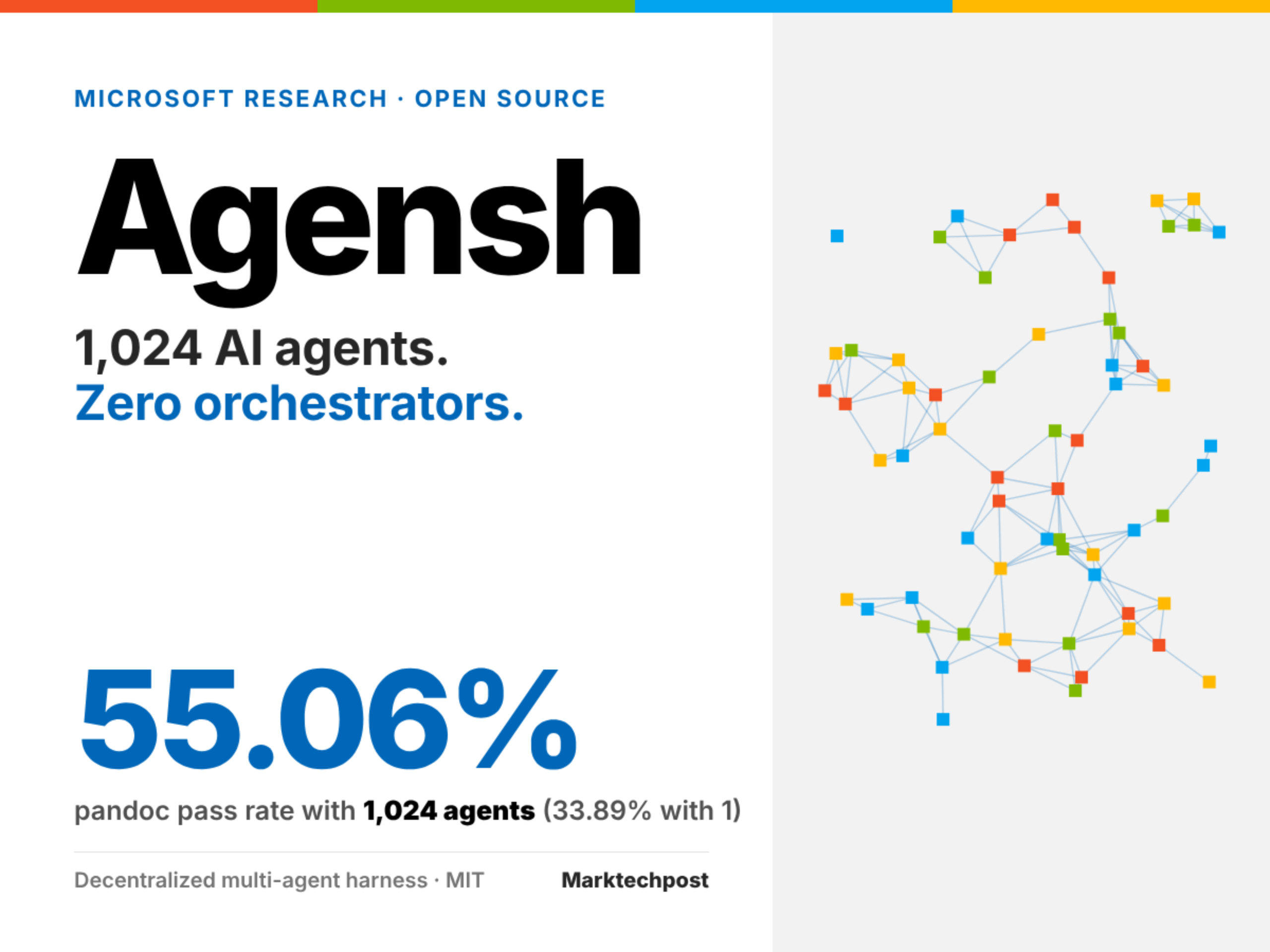
Microsoft open-sources Agensh: a decentralized framework that supports 1024 autonomous, collaboratively operating AI coding agents.

On October 25, 2026, Microsoft Research open-sourced Agensh, a multi-agent runtime framework that operates without a central coordinator, enabling 1 to 1,024 LLM-powered coding agents to self-organize and collaborate on ProgramBench. The system achieves decentralized coordination through shared dashboards inspired by Gitea, Mattermost, and DeLM, with all agents following the same prompt-driven five-step loop; its scalability has been validated in a Linux + Docker environment.

Microsoft Open-Sources Agensh: A Multi-Agent Harness for 1,024 Agents

Why it matters:This achievement represents a significant evolution in multi-agent system architectures—abandoning the traditional “master‑agent” paradigm and enabling large‑scale self‑organization through prompt engineering and lightweight service composition. Empirical results on ProgramBench (e.g., 128 agents achieving a 49% improvement in task load balancing across five tasks) establish a new benchmark for distributed AI engineering. Released under the MIT License and compatible with mainstream single‑agent tools such as Copilot CLI, it offers valuable guidance for practical development.

Timeline and related coverage

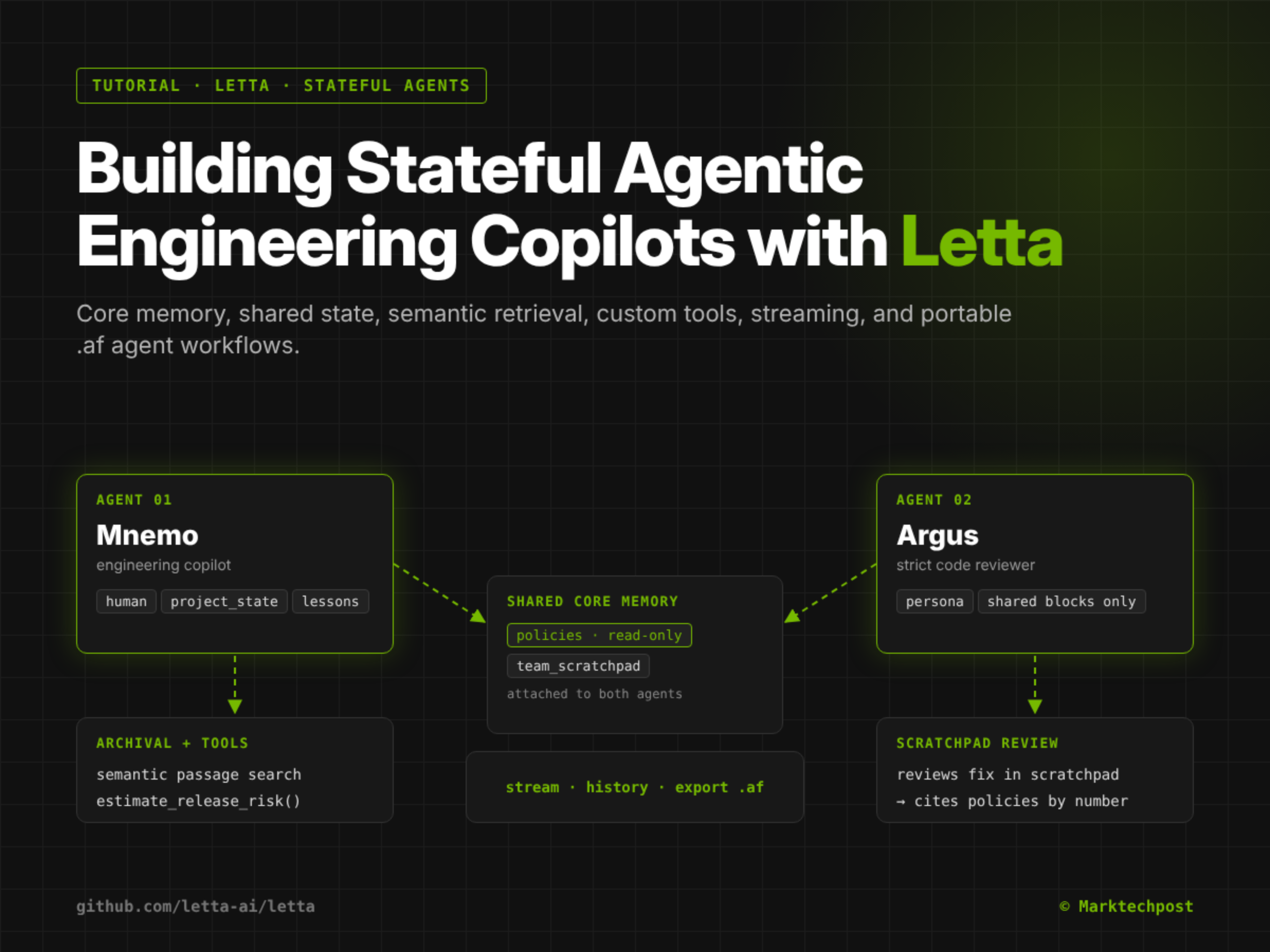
Letta platform releases a tutorial on building stateful engineering collaborators: supporting core memory, shared state, and portable workflows.

MarkTechPost published a tutorial on October 24, 2026, detailing how to build an agentic copilot with persistent state using the Letta framework. The guide covers capabilities such as verifiable core memory, multi-agent shared memory, semantic retrieval of archived knowledge, custom Python tool integration, streaming responses, and .agent format (.af) export. The content serves as a technical practice guide and does not provide performance metrics, security audits, or production‑environment validation.

Stateful Agentic Engineering Copilots with Letta: Core Memory, Shared State, Semantic Retrieval, Custom Tools, Streaming, and Portable Agent Workflows
Timeline and related coverage

Amazon SageMaker AI has launched GPU-free managed model training sessions, now generally available.

AWS has announced that SageMaker AI’s serverless model customization feature now includes “Training Sessions,” which are fully available starting today. Users can independently define post-training logic—such as custom loss functions, reward signals, or multi‑round reinforcement learning—while the platform automatically handles GPU allocation, distributed execution, fault tolerance, and checkpoint storage.

Timeline and related coverage

Microsoft and Hugging Face have open-sourced the ThinkingBox framework: using the database’s final state as a deterministic reward signal to advance post-training reinforcement learning for agents.

Microsoft and Hugging Face have jointly launched the open-source framework ThinkingBox, which generates binary 0/1 rewards by comparing the LLM agent’s final database state after execution with the expected state, for reinforcement learning-based fine-tuning. The accompanying benchmark, ThinkingBox-Bench, includes 507 real-world backend tasks, none of which were used during training. After 50 steps of GRPO fine-tuning, Qwen3.8-27B achieved a 9.08-percentage-point improvement in pass@1 on the held-out test set, with Observed 20/20 nearly tripling; however, pass@20 declined in some domains, reflecting a trade-off between breadth and stability.

Timeline and related coverage

How Three Java Champions Leverage GitHub Copilot to Boost Development Efficiency: Focusing on Human-AI Collaboration and Shared Responsibility

Vlad Mihalcea, Patrick Baumgartner, and Frank Delporte, three seasoned Java Champions, shared their experiences using GitHub Copilot in production environments and open-source projects, emphasizing human-led problem definition, context anchoring, iterative validation, and ultimate accountability—rather than relying on AI to automatically generate code.

Timeline and related coverage