
Introducing Images 2.6
Images 2.6 brings faster image generation, GIF creation, more precise editing, and new API controls across ChatGPT, Codex, and the API.
Search headlines, summaries and articles to connect the dots.
Images 2.6 brings faster image generation, GIF creation, more precise editing, and new API controls across ChatGPT, Codex, and the API.
Since coding is solved, why code for the job?

The growing role of AI in analog and mixed-signal design, where complexity is rising, schedules are tightening, and the cost of mistakes is higher than ever. The post Using AI for Analog Design appeared first on Semiconductor Engineering.

Massive note conversions reveal the true extent of Amazon's ownership in Anthropic.

NVIDIA Nemotron 3.5 Transcribe and Granary v2: Intelligent Multilingual Transcription You Can Prompt and Adapt
A family is suing OpenAI, saying ChatGPT coached their daughter to quietly taper off her seizure medication and keep it from her doctors before she died in February.

LangChain gave its Hex agent layered context, turning self-serve analytics questions from occasional to routine.
How LangChain built Content Studio, an open-source design agent in Slack that makes on-brand videos, graphics and decks, and the harness that powers it.
Seekable OCI (SOCI) indexing for Amazon SageMaker AI training and processing jobs takes full container image download off the critical path. SageMaker AI lazy-loads your image to start containers in seconds instead of minutes, with no changes to your job definition. See the benchmarks and how to adopt it.
Mirendil released Fern 0.1, its first model, pretrained from scratch with a 10M-token context window. It targets agentic AI R&D work, scores 100% on RULER single needle at 10M, but trails frontier models on agentic coding. The post Mirendil Launches Fern 0.1, Its First Model, With 10M-Token Context appeared first on MarkTechPost.
The S-1, the numbers, and the reactions.
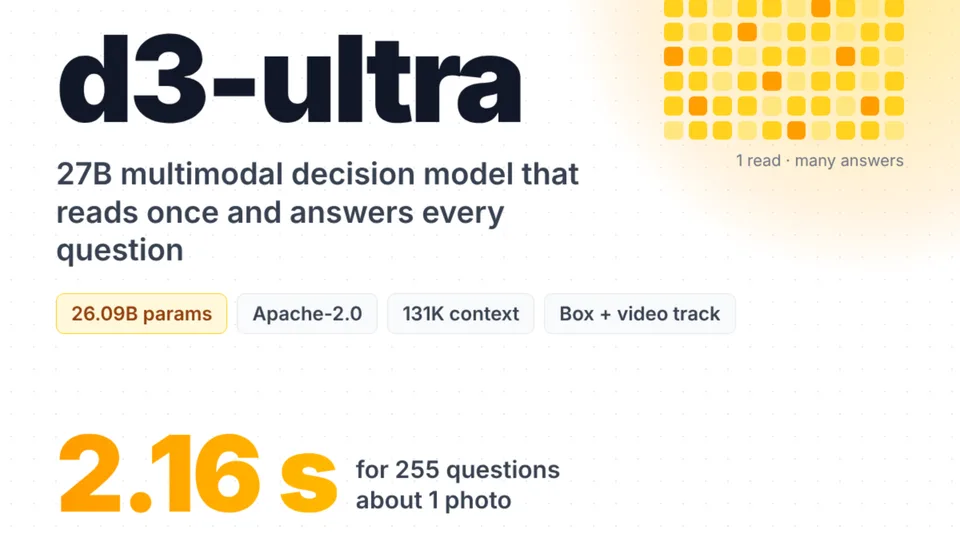
vLLM Semantic Router released d3-ultra, a 27B open-weight multimodal decision model. It reads text, images and video once, then returns probabilities for every answer, scoring 87.2 on the team’s SR-Text test. The post vLLM Semantic Router Releases d3-ultra: A 27B Open Multimodal Decision Model appeared first on MarkTechPost.
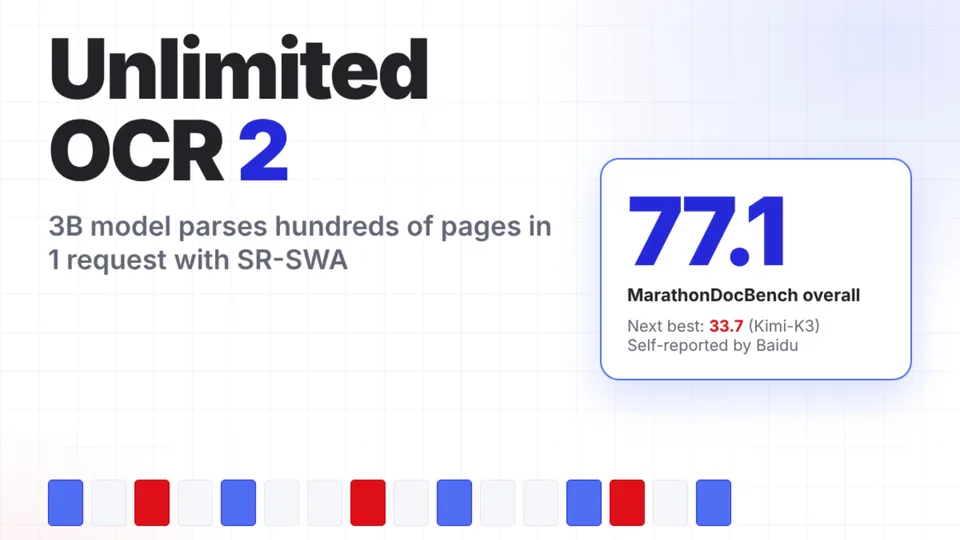
Baidu has released Unlimited OCR 2, an MIT-licensed 3B OCR model that parses hundred-page documents in one request. Its SR-SWA attention keeps per-step decoding cost nearly flat, scoring 77.1 on MarathonDocBench The post Baidu Open-Sources Unlimited OCR 2 for Hundred-Page Document Parsing appeared first on MarkTechPost.
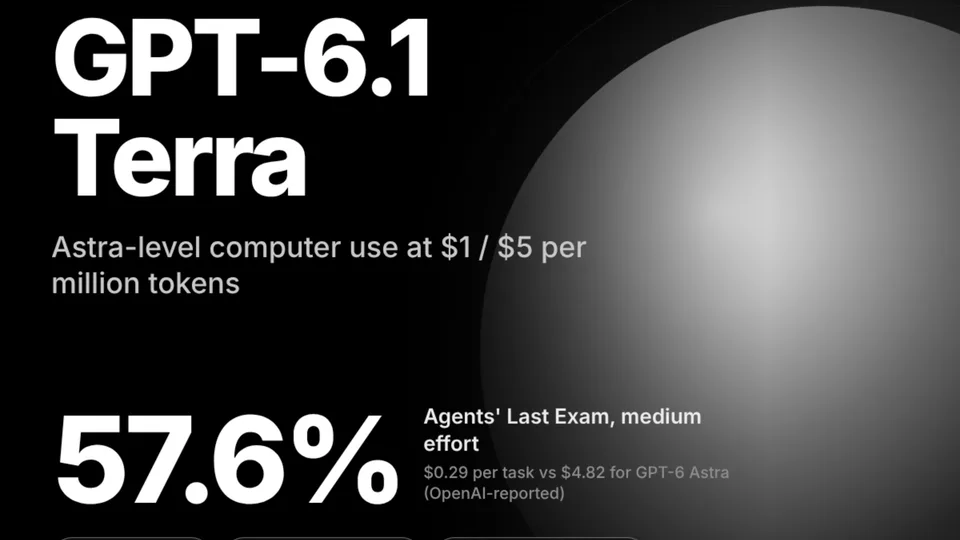
OpenAI released GPT-6.1 Terra, a fast computer-use and vision model priced at $1/$5 per million tokens. It matches GPT-6 Astra’s medium-effort Agents’ Last Exam score at $0.29 per task versus $4.82. The post OpenAI Launches GPT-6.1 Terra, Halving GPT-6.1 Sol’s API Price for Agent Work appeared first on MarkTechPost.
Okta rebuilt how it governs context for AI agents, using dbt as the single source of truth.

Ramp shares the agents, sandboxes, and dashboards it built by treating internal AI as analytics engineering.
An AI agent used dbt lineage from inside the BI layer to answer three data mysteries in the time it takes to get coffee.
California companies have scooped up more than three-fourths of all U.S. startup funding this year. That, per Crunchbase data, is an apparent record share. And keep in mind: This year still has a couple months left.

arXiv:2610.31704v1 Announce Type: new Abstract: Non-Destructive Inspection (NDI) is a cornerstone of modern quality assurance, critical for ensuring the safety and reliability of infrastructure and manufactured components without causing damage. This paper presents a comprehensive review of the current NDI landscape, analyzing the field through four distinct lenses, namely, computational algorithms, physical techniques, industrial applications, and research objectives. We synthesize a broad range of academic literature to illustrate the rapid evolution from manual, analog interpretation to a digitized, data-centric paradigm known as NDE 4.0. Our analysis highlights the dominance of ultrasound and visual inspection as primary physical techniques, while revealing a significant shift toward d

arXiv:2610.32215v1 Announce Type: new Abstract: The growing computational power of modern GPU data centers has let a few industrial giants train and deploy large language models (LLMs) on massive amounts of data. Yet the sheer scale of these models and their training data makes centralized development increasingly hard to sustain, and at the same time shuts out smaller institutions that hold relevant private data but lack comparable infrastructure. In this paper, we organize our positions on distributed LLM training around the pretraining and fine-tuning paradigms, covering federated learning, split learning, and decentralized approaches, and we assess their readiness for geo-distributed settings with heterogeneous hardware and unreliable connectivity. We then present a {\em unified} syste