New AI “copilot” helps engineers design better structures
The system asks humans for feedback to increase trust in machine-generated designs for buildings and bridges.
Search headlines, summaries and articles to connect the dots.
The system asks humans for feedback to increase trust in machine-generated designs for buildings and bridges.
The Microsoft C++ Language Server for GitHub Copilot CLI now bundles its MSBuild compile commands extractor and invokes it automatically. An agent no longer needs to discover and run a… The post C++ language server now auto-configures MSBuild builds appeared first on The GitHub Blog.
Enterprise GitHub Apps can now call the enterprise-level Copilot seat management APIs to control which users and enterprise teams are assigned Copilot seats. The Copilot seat management APIs are accessible… The post GitHub App support for Enterprise Copilot seat management appeared first on The GitHub Blog.
Article URL: https://stoppels.ch/2026/10/03/wake-me-up-when-ai-can.html Comments URL: https://news.ycombinator.com/item?id=50440657 Points: 26 # Comments: 7
Hi, Dmitri from Radioso here, an open-source platform to design AI agents for customers and visitors in any channel, in the style of Fin/Ada/Decagon. The repo is https://github.com/radioso-ai/radioso and our website is https://radioso.aiToday, your choices are:1. Buy a very expensive service for your vertical (usually starting with $$ five figures monthly) 2. Get a cheap off-the-shelf chatbot that mostly answers FAQs 3. Build your own, and then also build the inbox, human handoff, audit trail and integrations around itAt Radioso we wanted an open-source option that combines the best of all 3. You can integrate it with your own software via API/SDK or your CRM, or run it standalone, either self-hosted or in our cloud.The engine runs multi-step interactions and takes actions: calling your APIs, updating records, booking things. Maybe you’ve tried Parlant; Radioso is the alternative “with batteries included”: RAG, audit trail, customer service inbox, and integrations like Slack and email.Under the hood it’s plain TypeScript + PostgreSQL, works with OpenAI/Anthropic/other models, and is licensed under Apache 2.0 which includes all features (The only thing we keep under EE license is the multi-tenant layer we use to run our own cloud).We have existing customers running it for technical Q&A, course booking, online product recommendations and goods returns, among others, some reaching 92% of conversations automated. We’re currently working on voice support so we can offer a call center.Our ambition is to be “the WordPress of customer-facing AI” :), where people can contribute their favorite plugins and benefit from the ecosystem.Longer term, we think browsing the web will mostly mean talking to your own agent, and when you need a service or a purchase, your agent will talk to the vendor’s agent to get things done. For this, Radioso already publishes an A2A Agent Card and we’re working on the rest. Your Radioso services are also callable over MCP, for customers who already use it.Thanks for your attention. We’d especially love to hear which integrations you’d want, whether you’d self-host it, and what’s stopped you from deploying a customer-facing AI agent so far. Tell us what you think. Comments URL: https://news.ycombinator.com/item?id=50423820 Points: 1 # Comments: 0
Article URL: https://github.com/tryaida/aida Comments URL: https://news.ycombinator.com/item?id=50412923 Points: 2 # Comments: 1
Nino is a source-generated binary serializer for C#, and as far as we know the fastest one. In the same BenchmarkDotNet run on GitHub runners against MemoryPack 1.21.4, it serializes classes and polymorphic types 3.5–7.2x faster and deserializes them 1.7–2.1x faster (arrays of unmanaged structs are on par). Deserializing into existing objects allocates nothing. Reproduce: https://nino.xgamedev.net/en/docs/v4/benchmarksIt is built to read bytes you do not trust: lengths are checked before allocating, depth is bounded, hash flooding is limited, and the read paths are fuzzed in CI.The bytes are a spec, not a memory dump, so CoreCLR, Mono, IL2CPP and 32-bit hosts write the same bytes, and runtimes for TypeScript, Go and Rust pass the same conformance corpus.Trade-offs: positional by default (VersionTolerant or Keyed for stored data), a 4-byte type id on polymorphic values, no System.Type, needs C# 9 and Roslyn 4.3+.Docs: https://nino.xgamedev.net Comments URL: https://news.ycombinator.com/item?id=50413601 Points: 1 # Comments: 0
You can now manage GitHub Copilot code review settings through the REST and GraphQL APIs, from enterprise policy down to individual repositories. Copilot’s review overview comment is now more compact,… The post Copilot code review: API management and review overview updates appeared first on The GitHub Blog.
The Agent adoption chart in the Copilot impact dashboard now includes Copilot Chat and the VS Code Agents window, so you can see engagement across nine Copilot experiences. The adoption… The post Copilot impact dashboard adds chat and VS Code agent usage appeared first on The GitHub Blog.
Learn how to build a serverless Model Context Protocol (MCP) server on Amazon ECS with AWS Fargate that gives AI agents secure, metadata-driven access to an enterprise data lake. Exposing a new dataset requires only a JSON file, with no per-dataset integration code.
AI adoption moves fast. Readiness takes longer. Assess 6 dimensions to see where your data foundation limits AI.
The enterprise and organization repository-level Copilot usage metrics reports now show what happens to Copilot code review feedback. A new copilot_code_review object on each repos-1-day row reports how many Copilot-reviewed… The post Usage metrics API adds code review details and addressed rate appeared first on The GitHub Blog.
The Copilot usage metrics API now shows which users are missing client telemetry or are running IDE or extension versions below the usage metrics minimums. New per-user fields appear in… The post Usage metrics API flags telemetry and version gaps appeared first on The GitHub Blog.
Article URL: https://github.com/ag3ntsc4rn/autorun-audit Comments URL: https://news.ycombinator.com/item?id=50374018 Points: 1 # Comments: 0
Article URL: https://github.com/AlgoVesta/mcp Comments URL: https://news.ycombinator.com/item?id=50375559 Points: 1 # Comments: 0
Collective intelligence by shared context Comments URL: https://news.ycombinator.com/item?id=50372201 Points: 1 # Comments: 0
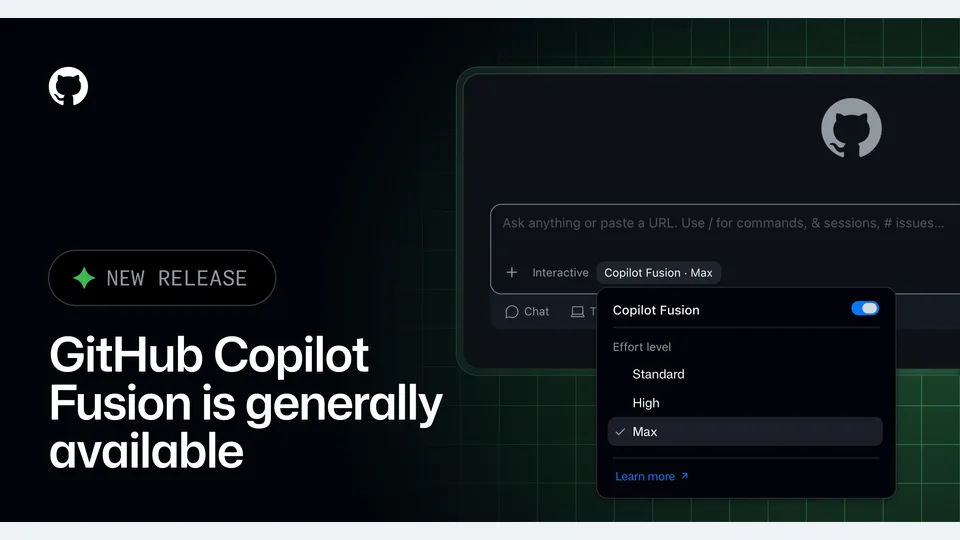
On October 28, 2026, GitHub released the official version of Copilot Fusion, simultaneously introducing an experimental local model routing feature. This capability enables automatic invocation of local models such as MAI Code 1.1 Flash on Windows devices and activates intelligent routing within VS Code, the CLI, and the Copilot App. The system automatically selects and combines cloud models—like those from OpenAI, Anthropic, and Google—based on three effort levels: Standard, High, and Max, achieving performance close to Claude Code while cutting costs in half during coding evaluations.
At Universe 2026, GitHub unveiled Copilot Fusion, an intelligent orchestration layer that automatically routes and combines models from OpenAI, Anthropic, Google, and others to complete coding tasks—eliminating the need for developers to manually select models. It integrates existing automatic model-selection technologies with Project HydraFusion, previewed in September. Once the model selector is enabled, the system automatically adopts execution modes such as single-model, cascading, or critique, based on task complexity.

GitHub Copilot Fusion is generally available. Instead of picking a model for each task, choose Copilot Fusion and let Copilot intelligently route and orchestrate which models it uses for you.… The post Route and orchestrate models with GitHub Copilot Fusion appeared first on The GitHub Blog.
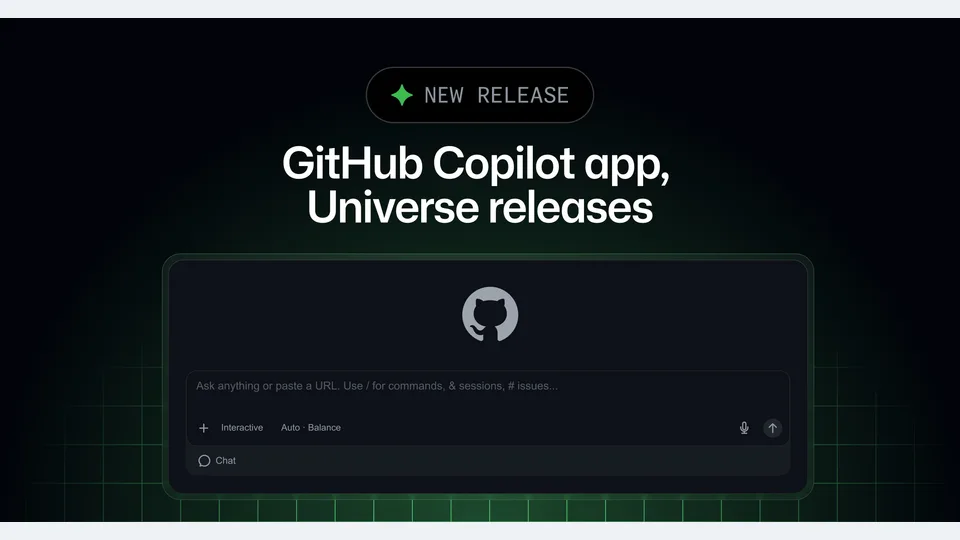
Work doesn’t always fit in a single repository or session. A feature can span several repositories. A launch plan can pull in specs, designs, and assets without touching a repository… The post GitHub Copilot app, Universe releases appeared first on The GitHub Blog.