Skip to content
AI NEWS JOURNAL
AI, IN PERSPECTIVE

Search AI news

Search headlines, summaries and articles to connect the dots.

Newest first

Dharma Field Extractor: Any Document In, Structured Fields in JSON Out

The Dharma Field Extractor, a 2-billion-parameter model, specializes in extracting specific fields from diverse document types—such as invoices, IDs, and medical forms—into structured JSON format. It outperforms general-purpose frontier LLMs in accuracy and reduces cost by up to 147 times when self-hosted, demonstrating that domain-specialized small models can surpass large general-purpose models on well-defined tasks. The model supports both open extraction (detecting fields without a schema) and schema-directed extraction (returning exact field names and types), with training data spanning English, Brazilian Portuguese, and multilingual documents. Benchmarks show superior F1 scores and valid JSON output across real-world datasets like SROIE and FUNSD, reinforcing the thesis that specialization beats scale for enterprise document processing.

Lesion Overlap Ranks PET Segmentation Models but Does Not Certify Patient-Level Tumor Burden

arXiv:2611.05564v1 Announce Type: new Abstract: Metabolic tumor volume (MTV) summarizes whole-body PET disease burden for prognostic stratification and treatment assessment. Automated MTV is useful only if its estimate is reliable for the individual patient, yet segmentation models are usually evaluated with overlap metrics such as Dice rather than burden error. We examined whether overlap metrics identify unreliable MTV estimates using 1,014 autoPET FDG PET/CT studies. We evaluated LesionTracer predictions held out from fine-tuning, compared five selected released models on 489 tumor-positive patients, and examined the findings in 597 PSMA studies. Across the five FDG models, ranking by higher mean Dice gave the same order as ranking by lower mean relative MTV error ($\rho=-1.00$, exact $p=0.017$). At the patient level, however, out-of-fold Dice tracked relative MTV error strongly ($\rho=-0.75$), yet 82 of 489 patients (16.8\%) fell on opposite sides of the Dice 0.80 and MTV-error 25\% thresholds. Within the training-exposed released models, correlations ranged from $-0.47$ to $-0.74$ over narrower, high-Dice ranges. Out of fold, opposing false-positive and false-negative volumes cancelled about one third of spatial error in net MTV. In 236 of 489 patients, each of the five models missed at least one lesion, though not necessarily the same lesion. Thus, agreement in average model rankings did not establish the reliability of individual MTV estimates or reveal shared lesion misses. PET segmentation benchmarks should report patient-level MTV error and missed-lesion counts alongside Dice and other overlap metrics.

Towards Efficient Whole Page Ranking with One-Pass Inference

arXiv:2611.05542v1 Announce Type: new Abstract: Whole-page ranking jointly optimizes advertisements and organic content to balance business outcomes and user engagement under complex layout and business constraints. Existing non-autoregressive (NAR) approaches enable efficient page generation but typically score candidate items independently of previously selected items, limiting their ability to capture order-dependent interactions. Autoregressive (AR) methods address this limitation through sequential conditioning, but incur substantial inference overhead that challenges large-scale deployment. Bridging this quality-efficiency gap remains a challenge in industrial whole-page ranking. We propose Multi-Item Scoring (MIS), a prefix-aware NAR-style framework that incorporates sequential context into efficient multi-item scoring. MIS integrates global candidate interactions, localized prefix conditioning, and position-aware scoring within a shared representation architecture. By computing reusable representations once per request and performing lightweight prefix-conditioned scoring during constrained beam search, MIS captures important sequential dependencies without repeated full-model inference. Experiments on KuaiRand-1K and RL4RS demonstrate that MIS approaches the generation quality of an autoregressive CGA baseline while achieving 4.07x and 3.54x faster CPU decoding, respectively. In a randomized evaluation on a large-scale social-video platform, MIS improves the realization metric by 0.104% and watch time by 0.058%, while reducing ranking-service CPU consumption by 9.73%. These results demonstrate that prefix-aware multi-item scoring can narrow the quality gap between NAR and AR generation while retaining the efficiency required for industrial scalability.

Use decision models with Amazon Bedrock AgentCore Evaluations

Some agent-evaluation questions are narrow and repeatable, and decision models answer exactly that kind of question. This post shows how to connect two decision models, Jev and Strands Decider, to Amazon Bedrock AgentCore Evaluations through code-based evaluators, and how to validate a decision-model check before you gate a release on it.

A thousand fewer paths to root

OpenAI built an autonomous pipeline that found, validated, and generated patches for 948 local privilege-escalation vulnerabilities in the Linux kernel.

CHROMA-MILL: Joint Low-Light Enhancement and White Balance under Colored Illumination

arXiv:2611.04092v1 Announce Type: new Abstract: Capturing an image in a low-light environment produces a weak, noisy sensor signal. Low-light image enhancement (LLIE) aims to restore it. Auto white balance (AWB) is also required for every image, and the same noisy signal degrades its ability to infer the scene illuminant. LLIE is typically performed first, followed by AWB, but this strategy remains largely unexamined because existing low-light datasets span a narrow range of illuminants and lack illuminant ground truth for evaluating AWB. We address this with CHROMA-MILL, a RAW dataset of 50 scenes captured with a DSLR and smartphone under four calibrated illuminants at eleven intensity levels. Because light is additive, we blend these captures in the linear RAW domain to synthesize physically valid illuminant mixtures with exact chromaticity ground truth. Benchmarking on this data, we find joint correction is best, and introduce CTI-Retinexformer, which supervises an illumination map, a chromaticity prediction, and an illumination-invariant scene embedding, outperforming the best cascade by 0.7 dB PSNR$_L$ and 1.1 $\Delta E_{00}$.

Do We Still Need Rotation-Invariant Architectures? A Statistical Robustness Benchmark for Point Cloud Classification

arXiv:2611.03952v1 Announce Type: new Abstract: A substantial line of work builds rotation invariance directly into point cloud architectures. We benchmark 10 architectures (PointNet, PointNet++, DGCNN, RIConv, RIConv++, RISurConv, PointMLP, PointTransformer, and the equivariant VN-PointNet and VN-DGCNN) across 5 domains under pose, noise, and occlusion, and analyze the results with confirmatory hypothesis tests rather than point estimates. The three rotation-invariant (RI) architectures achieve the best pose robustness but rank among the lowest on noise robustness in 4 of 5 domains. We ask whether this cost is intrinsic to invariance or specific to how invariance is obtained. We retrain all 10 architectures unchanged, with a simple invariance loss on the embedding and three training seeds each, and evaluate all models on the independently designed ModelNet40-C. Invariance training transfers narrowly but reliably. It improves exactly the corruption families its perturbations target wherever the baseline has headroom (mean occlusion +10.5, lidar +13.4 percentage points of accuracy). At matched training budget the best standard backbone and the best RI architecture end on par on unseen corruptions (within 2.5 percentage points in every seed), and invariance-trained RIConv++ is the most seed-stable top model. Once rotation augmentation is widened, standard backbones concede only a flat, angle-independent accuracy offset under full-sphere rotation. We release the benchmark along with a package for analyzing point cloud robustness and reproducing our results.

Introducing Images 2.6

Images 2.6 brings faster image generation, GIF creation, more precise editing, and new API controls across ChatGPT, Codex, and the API.

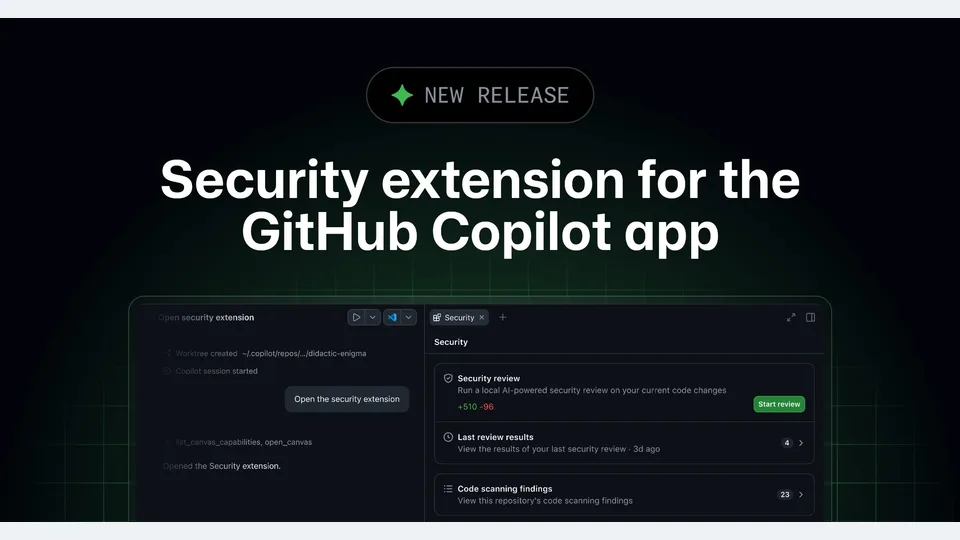
Security extension for the GitHub Copilot app

You can now work through your repository’s GitHub code scanning alerts without leaving the GitHub Copilot app. The new GitHub security extension, now in public preview, lets you find the… The post Security extension for the GitHub Copilot app appeared first on The GitHub Blog.

新闻源配图 · GitHub Copilot changelog
Timeline and related coverage