Skip to content
AI NEWS JOURNAL
AI, IN PERSPECTIVE

Search AI news

Search headlines, summaries and articles to connect the dots.

Newest first

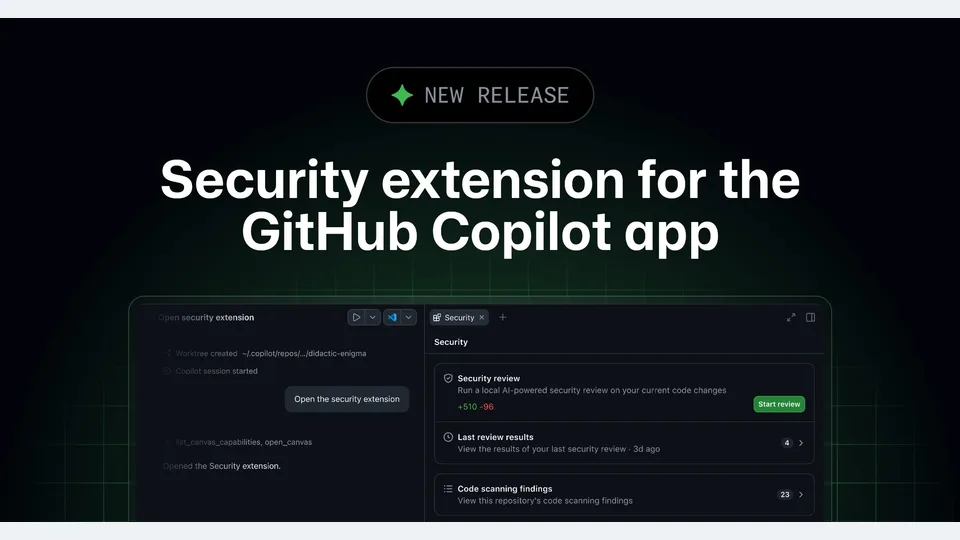
Security extension for the GitHub Copilot app

You can now work through your repository’s GitHub code scanning alerts without leaving the GitHub Copilot app. The new GitHub security extension, now in public preview, lets you find the… The post Security extension for the GitHub Copilot app appeared first on The GitHub Blog.

新闻源配图 · GitHub Copilot changelog
Timeline and related coverage

Nvidia releases all-in-one adaptable Nemotron 3.5 audio transcription and translation model

Nvidia Corp. today released a leaderboard-winning open artificial intelligence model for multilingual audio transcription and translation, along with an open data pipeline for fine-tuning Nemotron 3.5 Transcribe. Traditional transcription AI models follow a workflow that detects speech, transcribes it, identifies and labels different speakers, then answers questions about the transcription. Transcribe does all of this […] The post Nvidia releases all-in-one adaptable Nemotron 3.5 audio transcription and translation model appeared first on SiliconANGLE.

Timeline and related coverage

Virtana lets its AI agents pull in agents from other vendors to work IT incidents

Information technology observability company Virtana today added Agentic Observability Enterprise Management to its platform so its artificial intelligence agents can pull agents from other vendors into an IT incident. The release goes after a gap left by the way enterprises have adopted AI agents so far. Most enterprise agents have come built into a single […] The post Virtana lets its AI agents pull in agents from other vendors to work IT incidents appeared first on SiliconANGLE.

Timeline and related coverage

Jedify formally launches Data Agents for building AI analysts in plain language

Enterprise artificial intelligence context startup Jedify Inc. today formally launched Data Agents, a product that lets business teams set up autonomous AI analysts by describing the work they want done in plain language. Data Agents takes on a longstanding limit of business intelligence software, where analysts have to build dashboards ahead of time around the […] The post Jedify formally launches Data Agents for building AI analysts in plain language appeared first on SiliconANGLE.

Timeline and related coverage

Circuit Mind lands $25M and puts AI agents to work checking circuit board schematics

British circuit board design startup Circuit Mind Ltd. today announced it has raised $25 million in new funding to extend its artificial intelligence platform across more of the hardware design process. A verification tool that puts AI agents to work hunting for errors in schematics launched at the same time. Circuit Mind offers software that […] The post Circuit Mind lands $25M and puts AI agents to work checking circuit board schematics appeared first on SiliconANGLE.

Timeline and related coverage

Blog Review: Oct. 28

STCO for heterogeneous design; physical AI interactions; signing off AI-generated designs; workload profile analysis. The post Blog Review: Oct. 28 appeared first on Semiconductor Engineering.

新闻源配图 · SemiEngineering
Timeline and related coverage

3, 7, 14, 17, 42: Instruction Tuning Installs and Sharpens Number-Choice Heuristics in Language Models

arXiv:2610.36178v1 Announce Type: new Abstract: We measure, without sampling error, the probability a language model assigns to each integer from 1 to N when asked for a random number. For a fixed prompt the model defines one probability vector, which we compute by summing over each integer's scored spellings rather than estimate by sampling, removing the noise that limits earlier studies [1, 4]. We evaluate 18 open-weight model lines at five ranges up to N = 100, under 29 decoding configurations, on two inference stacks; 15 of them have matched base and instruction-tuned checkpoints that both give usable answers. Instruction tuning makes the distribution less uniform in all 15 pairs. It installs one heuristic, round-number avoidance, and sharpens another, endpoint avoidance. Base checkpoi

Timeline and related coverage

Detect Before You Disambiguate: Perturbation-Based Input Ambiguity Detection in LLMs

arXiv:2610.36353v1 Announce Type: new Abstract: Large language models (LLMs) often answer ambiguous inputs as if they had a single intended meaning. This is problematic because input ambiguity is an upstream source of uncertainty: when a prompt admits multiple valid interpretations, the key question is whether the model should answer directly at all. Existing input uncertainty methods often rely on LLM-generated statements or clarifications, but such transformations may already disambiguate the input before the ambiguity is measured. We propose a label-preserving perturbation framework for input ambiguity detection in which perturbations remain close to the original input while preserving its label. We instantiate this principle with two detectors: a black-box rule-based perturbation libra

Timeline and related coverage

ReCoPII: A Relation-Grounded Framework for Building Contextual PII Masking Datasets

arXiv:2610.35925v1 Announce Type: new Abstract: Training contextual masking systems for personally identifiable information (PII) requires examples distinguishing maskable from preservable mentions of one entity type, but privacy restrictions limit access to real data. Author-based augmentation (SPY) labels mentions unrelated to the author as non-PII, presuming a single data subject and overlooking others. We propose ReCoPII (Relation-grounded Contextual PII masking), a framework that builds such data without this premise: it plans ontology-constrained entity relations, writes insertion sentences with placeholders, reconstructs annotations with code, checks the result with a separate LLM, and derives MASK/KEEP labels from entity relations. On Korean documents from six domains, it yields Re

Timeline and related coverage

Frankly Speaking: The Company Election Integrity Keeps in Congressional Communication

arXiv:2610.36187v1 Announce Type: new Abstract: Election integrity is a shared commitment in American politics, but Democrats and Republicans in Congress increasingly mean different things by it. Analyzing 10,420 congressional e-newsletters sent from 2010 to 2025, we examine how the two parties invoke election terms such as ``integrity,'' ``security,'' and ``fraud.'' Using diachronic word embeddings, which track semantic change through how words are used in context, we measure how differently each party uses each term, how much each party shifts, and whether they share nearest semantic neighbors. We show that members of Congress do not need different words to tell different stories about elections. They need only place those same words in different company. Across nearly every term and yea

Timeline and related coverage