
Skip to content
AI NEWS JOURNAL
AI, IN PERSPECTIVE

Search AI news

Search headlines, summaries and articles to connect the dots.

Newest first

b11880

tools : reject truncated GGUF tensor data in merge (#31044) Co-authored-by: Shreya Agrawal **Website:** - **Attestations:** - **macOS/iOS:** - [macOS Apple Silicon (arm64)](https://github.com/ggml-org/llama.cpp/releases/download/b11880/llama-b11880-bin-macos-arm64.tar.gz) - macOS Apple Silicon (arm64, KleidiAI enabled) [DISABLED](https://github.com/ggml-org/llama.cpp/pull/23780) - [macOS Intel (x64)](https://github.com/ggml-org/llama.cpp/releases/download/b11880/llama-b11880-bin-macos-x64.tar.gz) - [iOS XCFramework](https://github.com/ggml-org/llama.cpp/releases/download/b11880/llama-b11880-xcframework.zip) **Linux:** - [Ubuntu x64 (CPU)](https://github.com/ggml-org/llama.cpp/releases/download/b11880/llama-b11880-bin-ubuntu-x64.tar.gz) - [Ubuntu arm64 (CPU)](https://github.com/ggml-org/lla
Timeline and related coverage

b11879

CUDA: fuse FFN gate/up matmuls and GLU in MMQ with interleaved gate/up rows (#29948) * cuda: fuse FFN gate/up and GLU in MMQ with interleaved gate/up rows For prompt processing, run the gate and up matmuls of a dense FFN as one mul_mat_q launch and apply the GLU in the write-back. - The loaders take the gate weights as a second pointer and fill the weight tile with up and gate rows interleaved in chunks of 8, so each thread holds an up value and the matching gate value (rows r and r + 8 of an MMA tile). - The MMA loop is unchanged: same tile, warp layout, vec_dot and one sum[] per thread. The fused write-back computes the GLU from registers and writes half the rows. - The fused path uses the regular tiling (no stream-k) with the column tiles innermost so that neighbouring blocks share weig

Timeline and related coverage

b11878

ggml-cuda: fuse qwen MRoPE + set-rows (#31025) **Website:** - **Attestations:** - **macOS/iOS:** - [macOS Apple Silicon (arm64)](https://github.com/ggml-org/llama.cpp/releases/download/b11878/llama-b11878-bin-macos-arm64.tar.gz) - macOS Apple Silicon (arm64, KleidiAI enabled) [DISABLED](https://github.com/ggml-org/llama.cpp/pull/23780) - [macOS Intel (x64)](https://github.com/ggml-org/llama.cpp/releases/download/b11878/llama-b11878-bin-macos-x64.tar.gz) - [iOS XCFramework](https://github.com/ggml-org/llama.cpp/releases/download/b11878/llama-b11878-xcframework.zip) **Linux:** - [Ubuntu x64 (CPU)](https://github.com/ggml-org/llama.cpp/releases/download/b11878/llama-b11878-bin-ubuntu-x64.tar.gz) - [Ubuntu arm64 (CPU)](https://github.com/ggml-org/llama.cpp/releases/download/b11878/llama-b11878

Timeline and related coverage

b11877

vulkan: Add a larger tile size for conv3d (coopmat2 only) (#29920) * vulkan: Add a larger tile size for conv3d (coopmat2 only) This adds a larger tile size, in practice it is only for coopmat2 where we don't need shared memory to store the output (would use more than 64KB). Add some additional representative backend tests. At least, this is what codex came up with from looking at sd.cpp Wan VAE. * only apply large tile size for newer driver versions **Website:** - **Attestations:** - **macOS/iOS:** - [macOS Apple Silicon (arm64)](https://github.com/ggml-org/llama.cpp/releases/download/b11877/llama-b11877-bin-macos-arm64.tar.gz) - macOS Apple Silicon (arm64, KleidiAI enabled) [DISABLED](https://github.com/ggml-org/llama.cpp/pull/23780) - [macOS Intel (x64)](https://github.com/ggml-org/llama

Timeline and related coverage

Taking on NVIDIA head-on to challenge Apple—Microsoft’s high-end AI PC gamble

Microsoft is courting local AI developers and high-end creators with the Surface Laptop Ultra, which features NVIDIA RTX Spark. The hardware brings large-capacity unified memory, CUDA, and RTX graphics capabilities to a portable device, but whether it can sustain competition against Macs will still depend on app optimization, agent-based experiences, and real-world workflows.

Why it matters:Ultimately, this competition comes down to whether on-device AI can genuinely boost creativity and development efficiency, and whether the associated costs—hardware, software, and migration—are justified. Hardware opens up new possibilities, but the ecosystem and real-world user experience determine how many users those possibilities can reach.

Timeline and related coverage

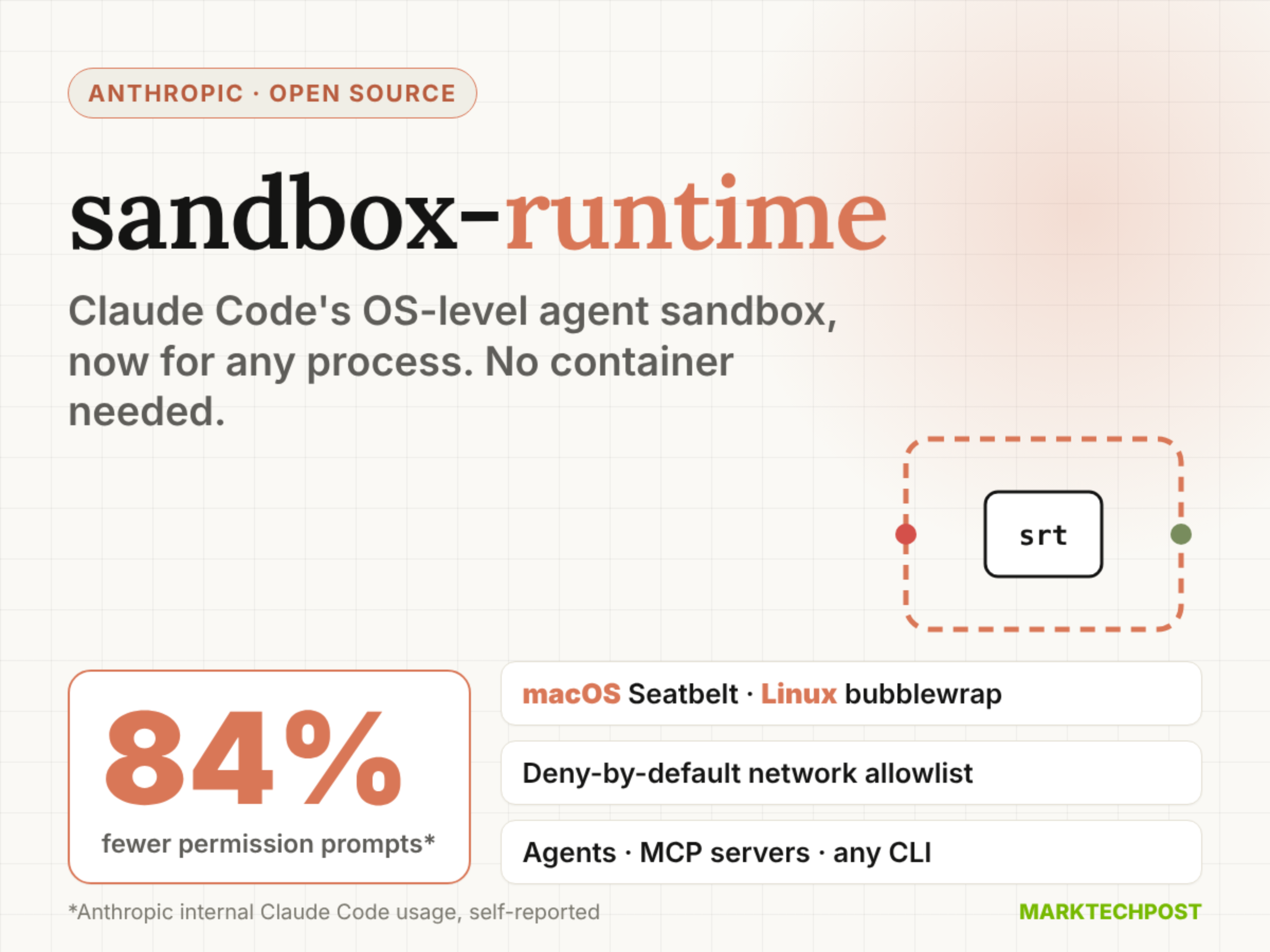
Anthropic open-sources the OS-level sandbox sandbox-runtime: providing container-free file and network isolation for AI agents.

On October 24, 2026, Anthropic open-sourced sandbox-runtime (srt), an OS-level sandboxing tool that operates without containers, designed to restrict file read/write and network access permissions for AI agents, MCP servers, and CLI tools. It supports macOS (Seatbelt), Linux (bubblewrap), and Windows (alpha), with npm package version 0.0.81 under the Apache-2.0 license.

Meet Anthropic’s sandbox-runtime: OS-Level Sandboxing for AI Agents, No Containers

Why it matters:This tool represents a significant advancement in AI security infrastructure—achieving fine-grained, full-process-tree coverage through the operating system’s native isolation mechanisms, directly addressing the risks of prompt injection and privilege escalation, and has already been deployed for internal validation within Claude Code.

Timeline and related coverage

NVIDIA unveiled its full lineup of on-premises AI hardware at GTC Berlin: RTX Spark, DGX Spark, and DGX Station have now launched in Europe.

At the GTC conference held in Berlin in October 2026, NVIDIA officially unveiled three on-premises AI hardware platforms for individual users, developers, and enterprise customers: RTX Spark (a personal agent for Windows PCs), DGX Spark (a Linux development cluster), and DGX Station (a cutting-edge AI workstation), while simultaneously announcing numerous software updates, model support, and ecosystem integrations.

Timeline and related coverage

How Three Java Champions Leverage GitHub Copilot to Boost Development Efficiency: Focusing on Human-AI Collaboration and Shared Responsibility

Vlad Mihalcea, Patrick Baumgartner, and Frank Delporte, three seasoned Java Champions, shared their experiences using GitHub Copilot in production environments and open-source projects, emphasizing human-led problem definition, context anchoring, iterative validation, and ultimate accountability—rather than relying on AI to automatically generate code.

Timeline and related coverage

Scaling ClickStack alerting with built-in anomaly detection

Managed ClickStack now flags unusual values on the charts you already use with built-in z-score anomaly detection, and a faster, sharded scheduler lets teams bring tens of thousands of alerts over from tools like Grafana.

Chasing that 32 ms tail latency in ClickHouse

A customer saw an extra ~32 ms on simple SELECT queries after idle periods. We traced it to unbatched Native protocol metadata packets overflowing a reset TCP congestion window, reproduced it with network namespaces, and fixed it by batching them.

chDB Durable Layer for agent memory

The chDB Durable Layer keeps agent memory fast to query locally while making its analytical state recoverable across laptops, CI jobs, and short-lived sandboxes.

ClickHouse release 26.9

ClickHouse 26.9 introduces conditional LIMIT boundaries, incremental refreshes for append-only materialized views, disk spilling for DISTINCT, time-limited tokens, and faster min/max/count queries.

Extending the Context Length to 1M Tokens!

API Documentation (Chinese) HuggingFace Demo ModelScope Demo Introduction After the release of Qwen2.5, we heard the community’s demand for processing longer contexts. In recent months, we have made many optimizations for the model capabilities and inference performance of extremely long context. Today, we are proud to introduce the new Qwen2.5-Turbo version, which features: Longer Context Support: We have extended the model’s context length from 128k to 1M, which is approximately 1 million English words or 1.