
Langfuse launches AI Gateway
One open source entry point for all AI usage in your company. See every model call, who made it and what it cost, natively traced in Langfuse.
Search headlines, summaries and articles to connect the dots.
One open source entry point for all AI usage in your company. See every model call, who made it and what it cost, natively traced in Langfuse.
Our most capable models for daunting technical work, Claude Fable 5.2 and Claude Mythos 5.2 set a new bar in coding, finance, and the sciences.
arXiv:2611.08730v1 Announce Type: new Abstract: LLM-based digital twins aim to predict how individuals would respond in new settings from representations of their prior responses. Existing evidence that compression of survey histories need not reduce predictive accuracy suggests that representation structure, rather than information volume alone, may be an important design choice. We study BDE, a fixed representation that organizes each respondent's survey history into Background, Decision procedure, and Evaluation. We evaluate it on Twin-2K-500 (Toubia et al., 2025) by predicting each respondent's held-out answers on 17 tasks. In a paired evaluation with 100 respondents, a fully inferred BDE profile improves overall accuracy over the raw survey transcript by 1.27 percentage points (pp) on gpt-5.4-nano (p < 0.01) and 1.19 pp on gpt-5.4-mini (p < 0.001). Three analyses then examine the schema, extraction depth, and component composition. Against a length-matched free-form profile written from the same transcript by the same extractor, BDE improves pricing accuracy on both simulators (2.15 pp on nano, p < 0.01; 1.38 pp on mini, p < 0.05), while its overall advantage is significant only on nano (1.05 pp, p < 0.05). Allowing deeper inference during extraction yields no statistically significant gain on either simulator. By contrast, adding Evaluation to a Background--Decision procedure profile improves overall accuracy by 1.44 pp on nano (p < 0.001) and 1.22 pp on mini (p < 0.001). These results indicate that the advantage over raw transcripts is not explained by compression or length alone, and attribute it primarily to profile composition rather than deeper extraction.
HOPE, a second-order expert pruning method for Mixture-of-Experts (MoE) language models, accounts for pairwise expert interactions by optimizing a quadratic program based on an interaction matrix derived from calibration data. Unlike first-order methods that prune experts independently, HOPE preserves cooperative expert groups, leading to better performance—especially at high pruning rates like 50%. On benchmarks such as SWE-Bench Pro, HOPE outperforms state-of-the-art first-order methods like REAP by up to +6.1%, maintaining model quality while significantly reducing memory footprint. The method requires only a single calibration pass and efficient quadratic programming, with negligible overhead. It has been validated on Qwen3.5 and GLM-4.5 models, showing consistent improvements across diverse tasks and calibration sets.
I've been beavering away at this since July, and its finally getting to a point where its stabilising.It started Windows only, but I recently converted over to Linux, so I've been ironing out the kinks in the last week. You can install it via apt or rpm, or .exe or .msi on Windows.Many more features to come, including native agent support and more preview features (images, PDF, document formats). Claude works pretty well in it, but I've not tried many other agents yet.I rarely leave throng now - 99% of my work happens inside it. I stopped using Visual Studio around 10 months ago (in favour of VSCode), and now I don't even use VSCode. Comments URL: https://news.ycombinator.com/item?id=50412226 Points: 1 # Comments: 0
Greenlight Financial resolves more than 90% of up to 4,000 monthly security and risk cases without human intervention using Luna, a tiered multi-agent system on Amazon Bedrock AgentCore. This post covers the architecture, episodic memory for continuous learning, and the expansion from SOC operations into financial risk triage.
A laser scientist reviews the laser light cannon from the Steven Universe cartoon, including its highly unusual beam shape.
Around 7PM each weeknight, I find myself standing in front of the fridge, trying to decide on something for dinner that won't make my husband complain, "Chicken again?" Yes, I should meal plan more, but I don't, so this is where I'm at. A nightly battle in which the chicken usually wins. Recently, my best […]
Article URL: https://github.com/vighnesh-bheed/eski Comments URL: https://news.ycombinator.com/item?id=50389748 Points: 1 # Comments: 0
Article URL: https://github.com/zoghlamimostafa/BrowserForge-MCP Comments URL: https://news.ycombinator.com/item?id=50373055 Points: 1 # Comments: 0
Hello everyone, I'm BIOcanse.Windows Task Manager has inaccurate readings and limited monitoring items. Various hardware adjustments are also very separated—CPU, GPU, and fans all require their own individual software. Their interfaces and interactions are primitive, and they often overwrite each other's configurations. Moreover, driver management of the CPU and GPU is too clumsy, and the memory usage issue on Windows is also very serious. So I made Resource Manager to view and manage all these resources in one place, making monitoring and scheduling work seamlessly together.Monitoring:This software integrates almost every possible monitoring item, letting you look at your computer from a God's-eye view!Scheduling:One of the core features. It uses algorithms I wrote to optimize memory usage and reasonably schedule processes across multiple CPU cores. It also supports GPU scheduling, which means it can switch the GPU a program uses while it is running. For example, after launching a game, if GPU usage is high or VRAM is about to overflow, it will move the remaining software to another GPU (for most personal computers, this is usually the integrated GPU).Reporting:Many times, computer performance problems are actually just caused by a single program or driver—the benefits of 100 programs optimizing themselves cannot make up for a memory leak in just one program. The reporting page reports abnormal resource usage (CPU, GPU, memory, VRAM, disk read/write, network traffic, and causing system interruptions).Hardware Adjustment:All the parameters you can think of for hardware like the CPU and GPU can be adjusted here. However, my own setup is an AMD CPU + NVIDIA GPU, so other setups still need to be verified. I do have several computers with Intel CPUs to verify Intel CPU support, but I really do not have a single AMD GPU. Although most of it uses mature open-source dependencies, there may still be risks, so please use it with caution. Comments URL: https://news.ycombinator.com/item?id=50380521 Points: 1 # Comments: 0
Hey HN, if you want to be new prime gap hero here is the code that runs and gets you biggest merits (everyone knows what that is in prime world). I spent months to tune it, and in the last few days got couple of top 10 records just by testing. So get you precious GPU time, run the code and become world no 1 in prime merits because it will make you cool, just not to your friends, girlfriend or family. Help the geek cause! Comments URL: https://news.ycombinator.com/item?id=50372526 Points: 1 # Comments: 1
Some agent-evaluation questions are narrow and repeatable, and decision models answer exactly that kind of question. This post shows how to connect two decision models, Jev and Strands Decider, to Amazon Bedrock AgentCore Evaluations through code-based evaluators, and how to validate a decision-model check before you gate a release on it.
arXiv:2610.38069v1 Announce Type: new Abstract: The short-time Fourier transform (STFT) computes the Fourier transform of a short-duration window of a longer signal, which characterizes how a frequency changes over time. While the Fourier transform algorithms, particularly the Fast Fourier Transform (FFT) algorithm, has been well developed to take advantage of parallel computing, there is limited work on understanding the performance of parallel short-time Fourier transform algorithms. In this study, two parallel short-time Fourier transform algorithms, one is FFT-based and the other a quasi-parallel feedforward algorithm, are implemented and analyzed in comparison with each other. It is found that while the quasi-parallel algorithm outperforms in runtime under low concurrency settings, th
GitHub Copilot Fusion is generally available. Instead of picking a model for each task, choose Copilot Fusion and let Copilot intelligently route and orchestrate which models it uses for you.… The post Route and orchestrate models with GitHub Copilot Fusion appeared first on The GitHub Blog.
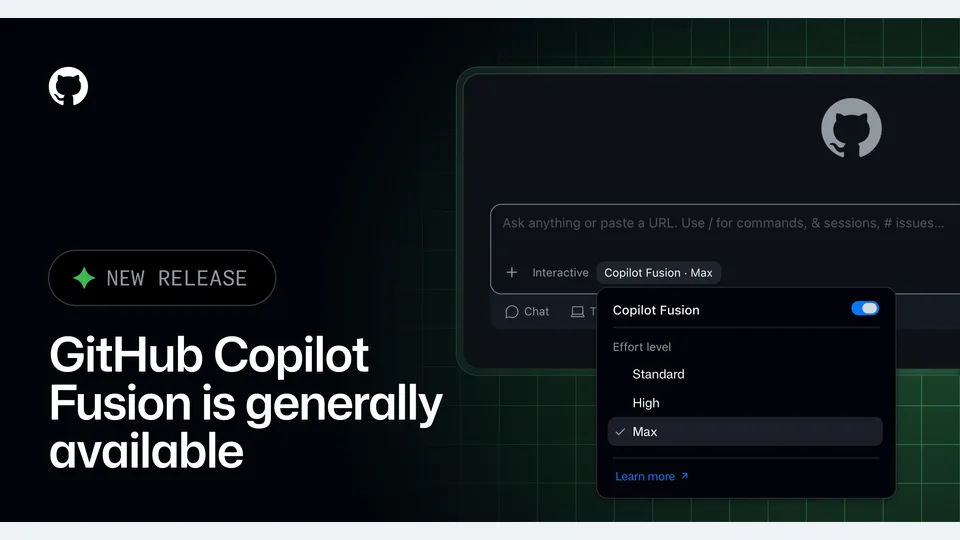
Today we are shipping intelligent routing for local models into experimental preview. GitHub Copilot Fusion can now choose between supported on-device models and cloud models, enabling intelligent local model routing… The post GitHub Copilot Fusion now supports selection of local models appeared first on The GitHub Blog.

Professor Paris Smaragdis develops computers with superhuman hearing for applications like speech recognition, music understanding, and environmental monitoring.

Katelyn Lesse and Angela Jiang on Opus 5.5, the Claude Platform, and the engineering behind AI agents.

Seekable OCI (SOCI) indexing for Amazon SageMaker AI training and processing jobs takes full container image download off the critical path. SageMaker AI lazy-loads your image to start containers in seconds instead of minutes, with no changes to your job definition. See the benchmarks and how to adopt it.
As agents go mainstream, some publishers are hoping that people will pay for content tailor-made for AI—not humans.