Skip to content
AI NEWS JOURNAL
AI, IN PERSPECTIVE

Search AI news

Search headlines, summaries and articles to connect the dots.

Newest first

Show HN: Open-source customer-facing agents

Hi, Dmitri from Radioso here, an open-source platform to design AI agents for customers and visitors in any channel, in the style of Fin/Ada/Decagon. The repo is https://github.com/radioso-ai/radioso and our website is https://radioso.aiToday, your choices are:1. Buy a very expensive service for your vertical (usually starting with $$ five figures monthly) 2. Get a cheap off-the-shelf chatbot that mostly answers FAQs 3. Build your own, and then also build the inbox, human handoff, audit trail and integrations around itAt Radioso we wanted an open-source option that combines the best of all 3. You can integrate it with your own software via API/SDK or your CRM, or run it standalone, either self-hosted or in our cloud.The engine runs multi-step interactions and takes actions: calling your APIs, updating records, booking things. Maybe you’ve tried Parlant; Radioso is the alternative “with batteries included”: RAG, audit trail, customer service inbox, and integrations like Slack and email.Under the hood it’s plain TypeScript + PostgreSQL, works with OpenAI/Anthropic/other models, and is licensed under Apache 2.0 which includes all features (The only thing we keep under EE license is the multi-tenant layer we use to run our own cloud).We have existing customers running it for technical Q&A, course booking, online product recommendations and goods returns, among others, some reaching 92% of conversations automated. We’re currently working on voice support so we can offer a call center.Our ambition is to be “the WordPress of customer-facing AI” :), where people can contribute their favorite plugins and benefit from the ecosystem.Longer term, we think browsing the web will mostly mean talking to your own agent, and when you need a service or a purchase, your agent will talk to the vendor’s agent to get things done. For this, Radioso already publishes an A2A Agent Card and we’re working on the rest. Your Radioso services are also callable over MCP, for customers who already use it.Thanks for your attention. We’d especially love to hear which integrations you’d want, whether you’d self-host it, and what’s stopped you from deploying a customer-facing AI agent so far. Tell us what you think. Comments URL: https://news.ycombinator.com/item?id=50423820 Points: 1 # Comments: 0

Show HN: Nino – Fastest C# serializer, safe on untrusted input, also TS/Go/Rust

Nino is a source-generated binary serializer for C#, and as far as we know the fastest one. In the same BenchmarkDotNet run on GitHub runners against MemoryPack 1.21.4, it serializes classes and polymorphic types 3.5–7.2x faster and deserializes them 1.7–2.1x faster (arrays of unmanaged structs are on par). Deserializing into existing objects allocates nothing. Reproduce: https://nino.xgamedev.net/en/docs/v4/benchmarksIt is built to read bytes you do not trust: lengths are checked before allocating, depth is bounded, hash flooding is limited, and the read paths are fuzzed in CI.The bytes are a spec, not a memory dump, so CoreCLR, Mono, IL2CPP and 32-bit hosts write the same bytes, and runtimes for TypeScript, Go and Rust pass the same conformance corpus.Trade-offs: positional by default (VersionTolerant or Keyed for stored data), a 4-byte type id on polymorphic values, no System.Type, needs C# 9 and Roslyn 4.3+.Docs: https://nino.xgamedev.net Comments URL: https://news.ycombinator.com/item?id=50413601 Points: 1 # Comments: 0

Copilot code review: API management and review overview updates

You can now manage GitHub Copilot code review settings through the REST and GraphQL APIs, from enterprise policy down to individual repositories. Copilot’s review overview comment is now more compact,… The post Copilot code review: API management and review overview updates appeared first on The GitHub Blog.

Copilot impact dashboard adds chat and VS Code agent usage

The Agent adoption chart in the Copilot impact dashboard now includes Copilot Chat and the VS Code Agents window, so you can see engagement across nine Copilot experiences. The adoption… The post Copilot impact dashboard adds chat and VS Code agent usage appeared first on The GitHub Blog.

Serverless MCP server for AI agent data lake access on Amazon ECS Fargate

Learn how to build a serverless Model Context Protocol (MCP) server on Amazon ECS with AWS Fargate that gives AI agents secure, metadata-driven access to an enterprise data lake. Exposing a new dataset requires only a JSON file, with no per-dataset integration code.

Usage metrics API adds code review details and addressed rate

The enterprise and organization repository-level Copilot usage metrics reports now show what happens to Copilot code review feedback. A new copilot_code_review object on each repos-1-day row reports how many Copilot-reviewed… The post Usage metrics API adds code review details and addressed rate appeared first on The GitHub Blog.

Usage metrics API flags telemetry and version gaps

The Copilot usage metrics API now shows which users are missing client telemetry or are running IDE or extension versions below the usage metrics minimums. New per-user fields appear in… The post Usage metrics API flags telemetry and version gaps appeared first on The GitHub Blog.

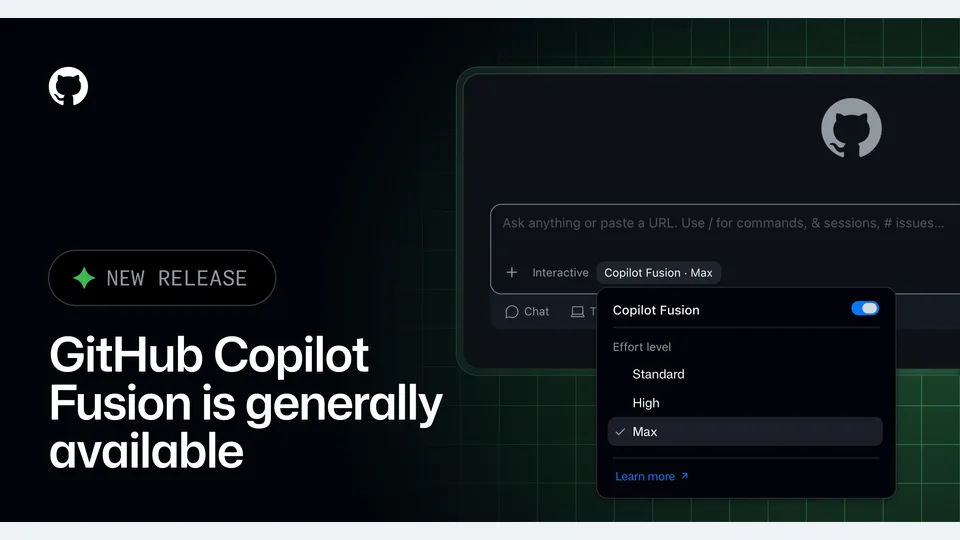
GitHub Copilot Fusion Launches with Dual Capabilities: Intelligent Model Orchestration and Local Model Routing

On October 28, 2026, GitHub released the official version of Copilot Fusion, simultaneously introducing an experimental local model routing feature. This capability enables automatic invocation of local models such as MAI Code 1.1 Flash on Windows devices and activates intelligent routing within VS Code, the CLI, and the Copilot App. The system automatically selects and combines cloud models—like those from OpenAI, Anthropic, and Google—based on three effort levels: Standard, High, and Max, achieving performance close to Claude Code while cutting costs in half during coding evaluations.

Timeline and related coverage

GitHub releases Copilot Fusion, an automated multi-model orchestration tool that boosts coding efficiency and cost-effectiveness.

At Universe 2026, GitHub unveiled Copilot Fusion, an intelligent orchestration layer that automatically routes and combines models from OpenAI, Anthropic, Google, and others to complete coding tasks—eliminating the need for developers to manually select models. It integrates existing automatic model-selection technologies with Project HydraFusion, previewed in September. Once the model selector is enabled, the system automatically adopts execution modes such as single-model, cascading, or critique, based on task complexity.

QQ20261029-155714.jpg
Timeline and related coverage

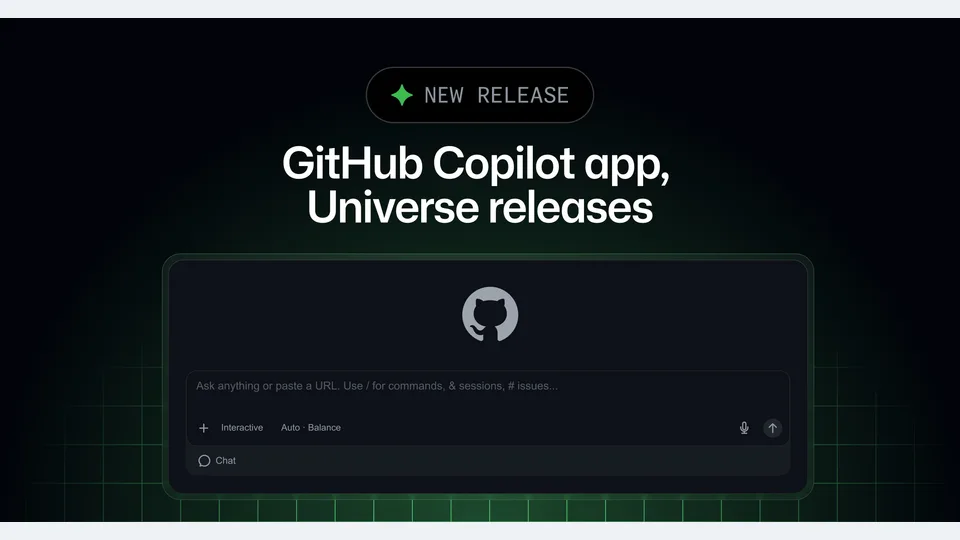
GitHub Copilot app, Universe releases

Work doesn’t always fit in a single repository or session. A feature can span several repositories. A launch plan can pull in specs, designs, and assets without touching a repository… The post GitHub Copilot app, Universe releases appeared first on The GitHub Blog.

新闻源配图 · GitHub Copilot changelog
Timeline and related coverage

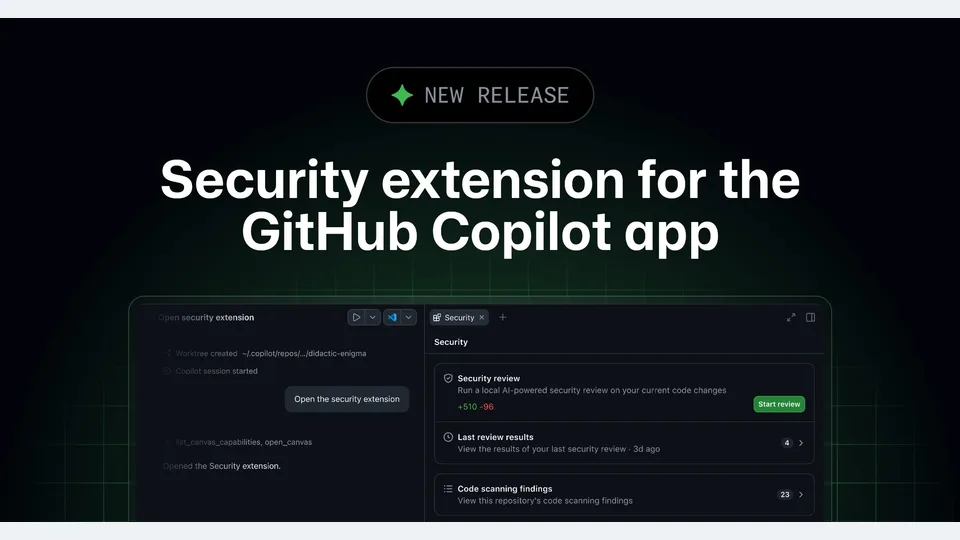
Security extension for the GitHub Copilot app

You can now work through your repository’s GitHub code scanning alerts without leaving the GitHub Copilot app. The new GitHub security extension, now in public preview, lets you find the… The post Security extension for the GitHub Copilot app appeared first on The GitHub Blog.

新闻源配图 · GitHub Copilot changelog
Timeline and related coverage